Part 51: A New Heaven and Earth
Click the icon below to download a 4-page PDF version of this page.

A renewed and perfect world
The great and final judgment of the world is over. Now John sees “a new heaven and a new earth, for the first heaven and the first earth had passed away, and the sea was no more” (Revelation 21:1). A new and perfect world comes into being. We’ve been longing for this ever since Genesis 3.
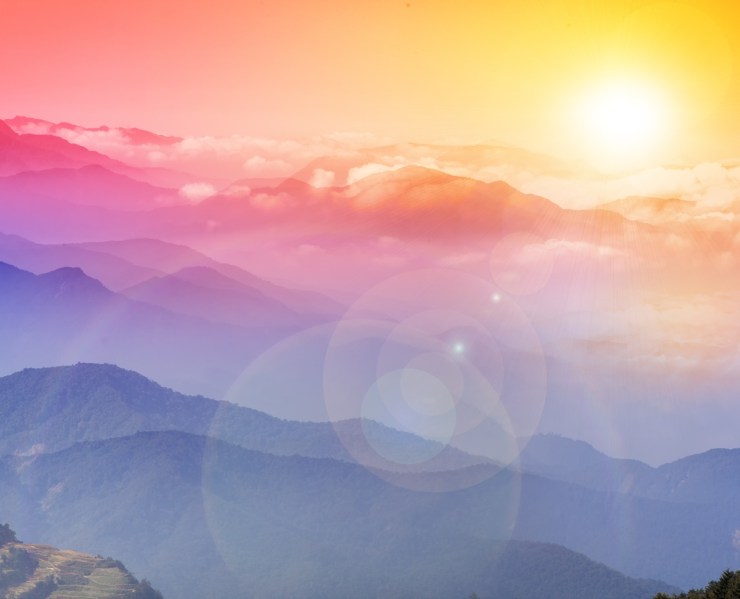
John writes, “I saw a new heaven and a new earth, for the first heaven and the first earth had passed away, and the sea was no more.” (Revelation 21:1).
In Part 1 we said that the Bible story is a drama in four acts―the Good, the Bad, the New, and the Perfect. Now, at last, we begin Act 4, the Perfect. God transforms Heaven and Earth; His people now live with Him on the renewed Earth. Creation will never be troubled by Satan or sin again.
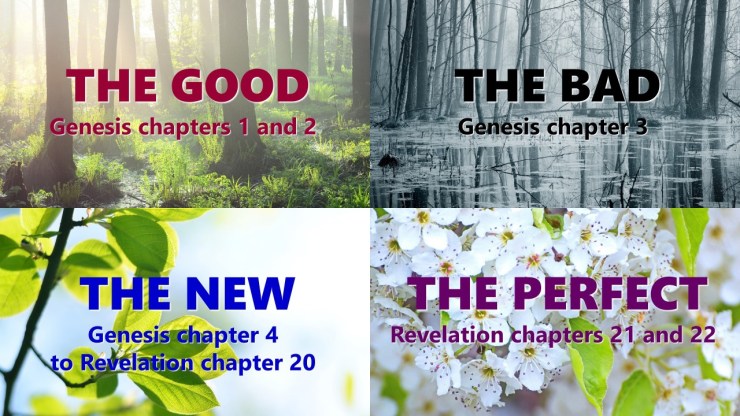
Through the Bible runs a single story. It’s a drama in four acts.
Our present Heaven and Earth will ‘pass away’. Will God destroy them and create a new Heaven and Earth from nothing? The answer seems to be ‘No’. Paul writes, “the creation . . . will be liberated from its bondage to decay and brought into the freedom and glory of the children of God” (Romans 8:21 NIV). Creation will be “liberated”―set free. This strongly suggests it will be transformed, rather than destroyed and replaced. In the beginning, God pronounced creation to be “very good” (Genesis 1:31). It’s been impacted by evil, but it hasn’t become evil. So it doesn’t need to be completely destroyed. What it does need is to be cleansed and restored, and “set free from its bondage to decay”.
God will cleanse and restore Heaven and Earth; creation will be “set free from its bondage to decay”.
How will God do that? Peter tells us that, “by the word of God . . . the heavens and earth that now exist are stored up for fire, . . . . But the day of the Lord will come like a thief, and then the heavens will pass away with a roar, and the heavenly bodies will be burned up and dissolved, and the earth and the works that are done on it will be exposed. . . . . the heavens will be set on fire and dissolved, and the heavenly bodies will melt as they burn! But according to his promise we are waiting for new heavens and a new earth in which righteousness dwells.” (2 Peter 3:5,7,10,12-13). All this suggests that the cosmos will undergo a ‘meltdown’, [1] to be reformed into the new Heaven and Earth. A picture that comes to mind is of a goldsmith melting down gold in a furnace, not to destroy it, but to shape it into something new.
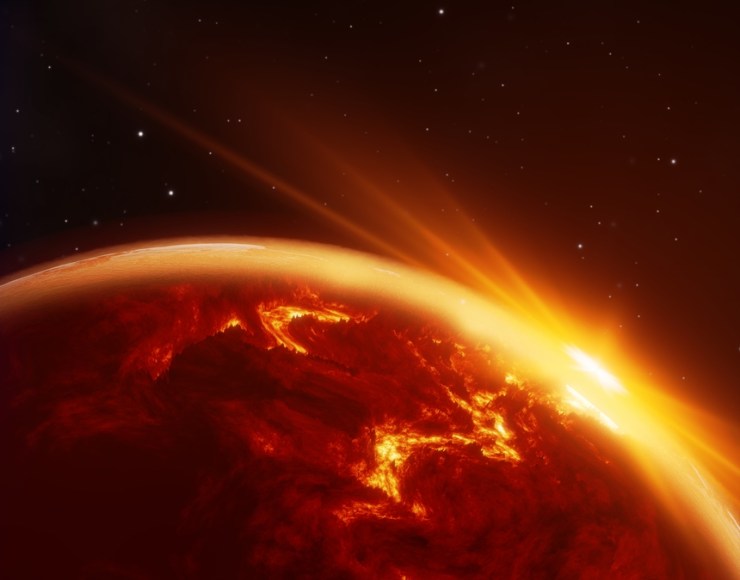
Peter tells us, “. . . the heavens will be set on fire and dissolved, and the heavenly bodies will melt as they burn!” (2 Peter 3:12) This suggests that the cosmos will undergo a ‘meltdown’, [1] to be reformed into the new Heaven and Earth.
Here’s another picture. When it’s time for a caterpillar to change into a butterfly, it pupates and becomes a chrysalis. Inside the chrysalis, the caterpillar’s body is broken down and then reconstituted into the butterfly. There’s total transformation. The caterpillar has passed away; the butterfly has come into being. You’d hardly think that they’re the same individual. And yet they are. That’s a great picture of how our present Heaven and Earth will “pass away” and the new Heaven and Earth will come into being. [2]
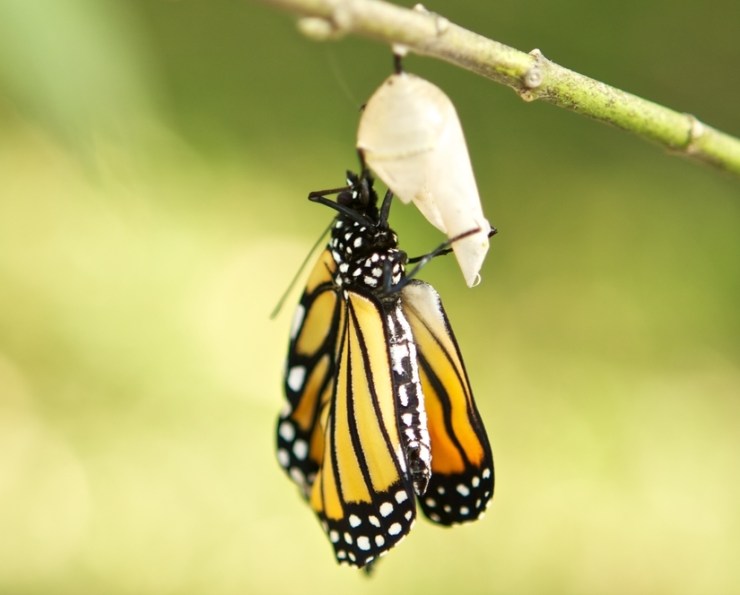
A caterpillar pupates and becomes a chrysalis, in which the caterpillar’s body is broken down and then reconstituted into the butterfly. This monarch butterfly is emerging from its chrysalis case.
What will be destroyed is Satan’s evil kingdom, as we saw in Part 50. Peter tells us: “the heavens and earth that now exist are stored up for fire, being kept until the day of judgment and destruction of the ungodly”. Scripture often pictures God’s anger and judgment as fire (for example Isaiah 66:15-16). God will thoroughly purge His creation from all evil: Babylon (Revelation 18:1-19:5); the sea beast and the false prophet and their armies (19:20-21); Antichrist (2 Thessalonians 2:8); Satan himself and the nations he’s deceived (Revelation 20:9-10), Death and Hades and anyone not named in the book of life (20:14-15). Finally, the physical creation has been polluted and spoiled by sin; it will be perfectly cleansed and healed. Satan and sin will never trouble Heaven and Earth again! Our renewed and perfect bodies So there’s continuity between the present Heaven and Earth and the new Heaven and Earth. And there’ll also be continuity between our present bodies and our resurrection bodies. As we saw in Part 38, Jesus’s risen body is the very same body He had during His earthly life. Our resurrection bodies will be our old bodies transformed, too―otherwise they wouldn’t be resurrection bodies! Paul illustrates this by a seed and the plant that grows from it. He writes, “So is it with the resurrection of the dead. What is sown is perishable; what is raised is imperishable. It is sown in dishonour; it is raised in glory. It is sown in weakness; it is raised in power. It is sown a natural body; it is raised a spiritual body.” (1 Corinthians 15:42-44). But after death, our bodies decay and turn to dust. How will God re-assemble them into our new resurrection bodies? Paul’s picture of the seed helps us here. Very few atoms in the seed may end up in the plant that grows from it. But there’s true continuity between them, nonetheless. There’ll be true continuity between our present and renewed bodies, too. There’s true continuity between this little seedling and the seed it’s emerging from. In the same kind of way there’s true continuity between our present bodies and the resurrection bodies we’ll have when Jesus comes again. The new creation has already begun! Jesus Himself is already part of the new creation. He has His resurrection body. He’s the “firstborn from the dead” (Colossians 1:18), the first to rise from death. The new creation began when He rose from death, two thousand years ago! And even though we don’t yet have our new bodies, there’s a sense in which we believers, too, are in the new creation now. Paul writes, “if anyone is in Christ, he is a new creation. The old has passed away; behold, the new has come” (2 Corinthians 5:17). The entrance of the bride At a typical wedding here in England, the congregation―and especially the bridegroom!―wait eagerly for the bride’s arrival. Suddenly, voices hush and heads turn to see her make her entrance, radiant with joy and beautifully dressed. And that’s what we see in Revelation 21. The “holy city, new Jerusalem” comes down “out of heaven from God, as a bride adorned for her husband” (21:2). This city is the heavenly bride, the bride of Christ. At its heart, the Bible story is a romance. Jesus gave Himself up for His beloved Church “that he might present the church to himself in splendour, . . . that she might be holy and without blemish” (Ephesians 5:25-27). Now we see His bride in her final splendour, pure and holy. Who is she? She’s all God’s people from all ages, from both the Old and New Testament periods. At a typical wedding here in England, the congregation―and especially the bridegroom!―wait eagerly for the bride’s arrival. Now, here in Revelation 21:2, the beautiful, pure bride of Christ makes her entrance. Two chapters before, an angel tells John to write: “Blessed are those who are invited to the marriage supper of the Lamb” (19:9). Who are these guests? They’re individual believers. And invitations to this end-time wedding feast are still being sent out! Weddings in Jesus’s time were―as they are today―celebrated by a feast (see John 2:1-11). This wedding between Jesus and His bride will be celebrated by a supper. Meals symbolise fellowship. The marriage supper of the Lamb pictures our fellowship with Jesus. We look ahead to this marriage supper every time we eat the Lord’s Supper together. We look ahead to the marriage supper of the Lamb every time we eat the Lord’s Supper together. Heaven on Earth When He returns, isn’t Jesus going to take us to live with Him in Heaven? Not exactly. Jesus is returning to Earth to live with us here on the new Earth. New Jerusalem comes down out of Heaven to Earth. Heaven will ‘invade’ Earth; there’ll be Heaven on Earth! We’ll live on Earth, and be in Heaven, too! “I will be their God, and they . . . My people” Then John hears “a loud voice from the throne” proclaiming “Look! God’s dwelling place is now among the people, and he will dwell with them. They will be his people, and God himself will be with them and be their God” (21:3 NIV). That’s the crowning promise of the new covenant that Jeremiah prophesied (Jeremiah 31:31-34). A covenant, as we’ve seen, brings two parties into a binding relationship. From the very beginning God has planned to live among His people. He began in the Garden of Eden before Adam and Eve sinned. He promised it throughout the Old Testament (for example, Exodus 6:7, Jeremiah 31:33, Zechariah 8:8). Jesus sealed the new covenant with His blood (Luke 22:19-20). Through the Cross, He’s made it possible for us to be God’s people. Now on the New Earth, God has come to live among His people for ever. God with us The holy God, creator and sustainer of all that exists, wants to live with us. This is one of the most amazing truths in the whole Bible! It’s a joy and delight to God to be with us! He wants to lavish on us all the countless and wonderful blessings of life in His presence. “The former things have passed away” 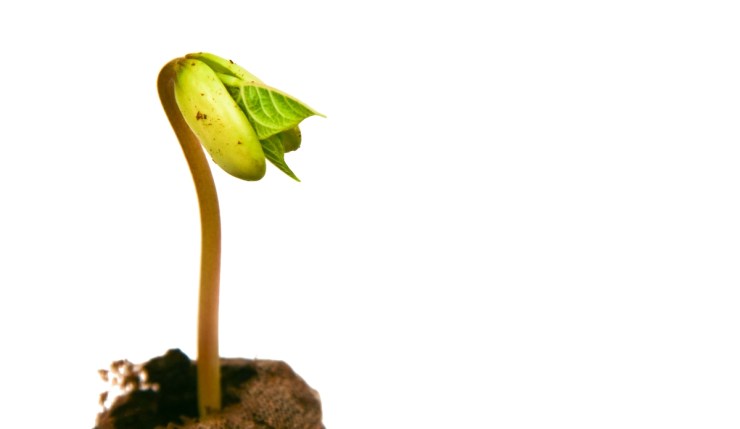

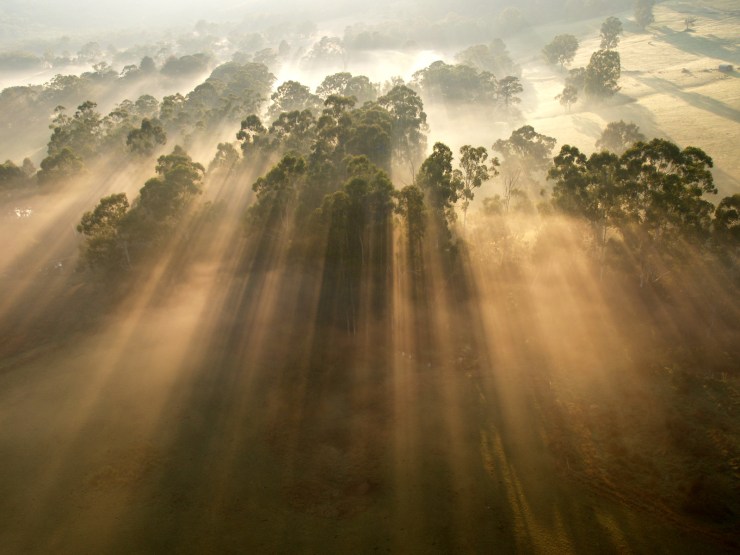
Morning mist © Steve Lacy at Flickr.com
(CC BY-NC-ND 2.0)
He “who was seated on the throne said, ‘Behold, I am making all things new'” (Revelation 21:5).
But outside the city are “the cowardly, the faithless, the detestable, . . . murderers, the sexually immoral, sorcerers, idolaters, and all liars” (21:8, see also 22:15). Their destiny is to remain outside the city―outside God’s presence, outside His blessing, outside the warmth of human friendship, outside everything that gave meaning to life. This is indeed the “second death” (21:8).
“The bride, the wife of the Lamb”
An angel invites John to see the bride: “Come, I will show you the Bride, the wife of the Lamb” (21:9). He sees “the holy city Jerusalem coming down out of heaven from God” (21:10). The city has “the glory of God, its radiance like a most rare jewel, like a jasper, clear as crystal” (21:11); it is “pure gold, clear as glass” (21:18, see also 21:21). The city glows with the beauty and glory of God. It’s saturated with God’s presence. The vision of it is almost beyond imagination. This wonderful city is described in picture-language. We’re seeing God’s people living in God’s presence in God’s paradise. We’re seeing the Kingdom of God in its final glory.
The city has “a great, high wall” (21:12). Each of its twelve gates is “made of a single pearl” (21:21). On them are inscribed “the names of the twelve tribes of the sons of Israel” (21:12). These “twelve tribes” picture God’s faithful people “from every nation” (7:9). They’re citizens of New Jerusalem; they have the right to enter the city. The wall has “twelve foundations”, each “adorned” with a different jewel (21:19-20). On them are “the twelve names of the twelve apostles of the Lamb” (21:14). The gospel that the apostles preached and taught is foundational to God’s people. By believing it, people are brought to faith in Christ; by feeding on it, they grow to maturity.
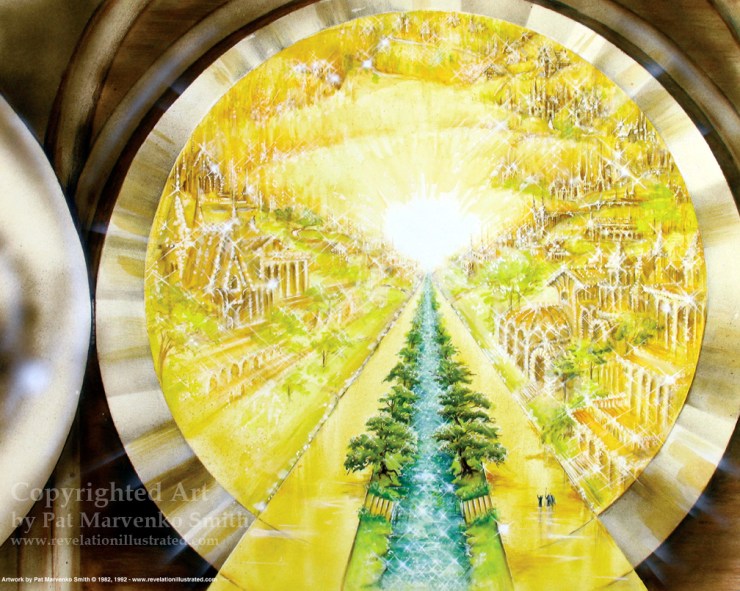
Artwork by Pat Marvenko Smith © 1982, 1992 Revelation Productions All rights reserved.
Each of the gates of New Jerusalem is made from a single pearl (Revelation 21:21), and its gates are always open (21:25). In this painting by Pat Marvenko Smith, we’re looking through one of these open gates. We see the river of living water flowing from the throne of God and the Lamb, through the middle of the street of the city; the tree of life flourishes on either bank (Revelation 22:1-2).
The city’s length, width and height are equal (21:16)―in other words, it’s a cube. There’s only one other cube in the Bible―the Most Holy Place in the Tabernacle (calculated from Exodus 26:1-37) and in the Temple (1 Kings 6:20). The Most Holy Place was the special room where God lived on Earth. But now there’s “no temple in the city, for its temple is the Lord God the Almighty and the Lamb” (21:22). The whole city is a Most Holy Place; the whole city is filled with the presence of God. In the Tabernacle and the Temple, only the high priest could enter the Most Holy Place, and only under the strictest conditions. Now God’s people―every one of them―live there! They live in the very presence of God.
The whole city is a Most Holy Place; the whole city is filled with the presence of God. God’s people live in the very presence of God!
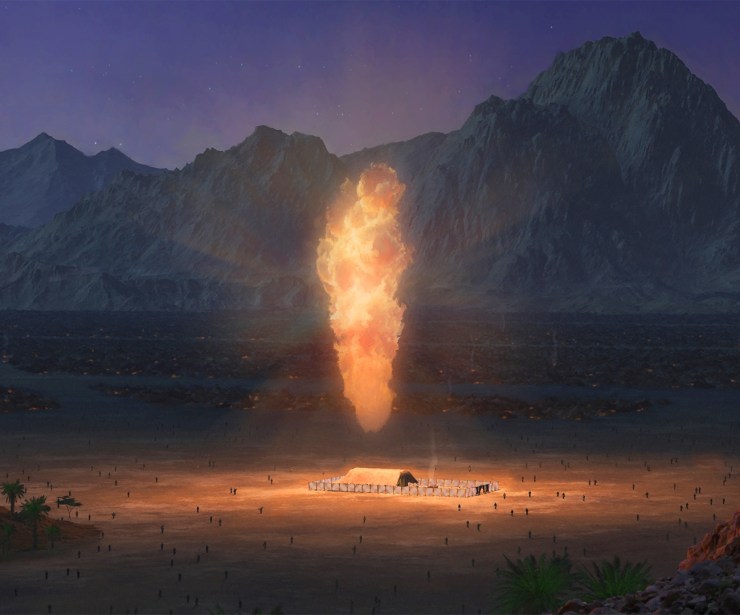
Image © Steve Creitz at ProphecyArt.com
An artist’s impression of the Tabernacle in the wilderness at night. The pillar of fire, a visible manifestation of God’s presence, rests above it. Only the high priest could enter the Most Holy Place in the Tabernacle―and later in the Temple―and only under the strictest conditions. But in the new creation, all God’s people live there! They all live in the presence of God.
And the city is huge―“12,000 stadia” (around 1,450 miles) square (21:16). These measurements seem to be telling us that New Jerusalem fills the new Earth. In the beginning, God lived in the Garden of Eden with Adam and Eve. But as the human family grew ever larger, they were to extend the garden―and therefore God’s presence with it―out to the whole Earth. Now that’s happened! So Habakkuk’s prophecy is fulfilled: “the earth will be filled with the knowledge of the glory of the LORD as the waters cover the sea” (Habakkuk 2:14 and see Isaiah 11:9).
Salvation for the nations and their kings
The nations will walk by the city’s “light”―the light of God’s glory (21:24). And the “kings of the earth will bring their glory” into the city; into it will be brought “the glory and the honour of the nations” (21:24,26). This is an act of worship; the kings and nations are laying down their glory and honour before God. Earlier in Revelation, we read that “all nations have drunk the wine of the passion of” Babylon’s “sexual immorality” (18:3), and “the kings of the earth” had committed “sexual immorality” with Babylon (17:1-2, see also 18:3,9). So how did any of “the nations” and “the kings of the earth” get into New Jerusalem? In the only way anyone can get in―by repenting of sin and receiving Jesus Christ as their Lord. By His blood, the Lamb “ransomed people for God from every tribe and language and people and nation” (Revelation 5:9). And so God has fulfilled His promise to Abraham, that through him “all peoples on earth will be blessed” (Genesis 12:3 NIV).
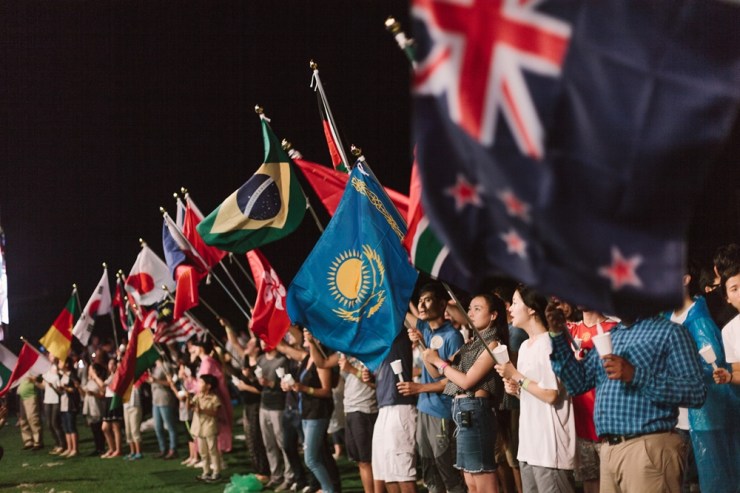
By His blood, the Lamb “ransomed people for God from every tribe and language and people and nation” (Revelation 5:9).
A new Eden
In this city is a throne―“the throne of God and of the Lamb” (22:1,3). Flowing from this throne is “the river of the water of life, bright as crystal”. It flows “through the middle of the street of the city” (22:1). This river of life, “flows . . . through the length of Scripture”.[3] A river “flowed out of Eden to water the garden” (Genesis 2:10-12), we see its life-giving stream, for example, in Psalm 1:1-3 and Ezekiel 47:1-12. Now we see it here in the new Earth. It pictures eternal life―life in fellowship with God, life in His presence, abundant life (see John 10:10). It is the life that the Holy Spirit gives us (see John 7:37-39). God promises, “To the thirsty I will give from the spring of the water of life without payment” (21:6, see also 7:17, 22:17). God invites everyone to drink of His living water.

Kuang Si Falls and its emerald water pools in Luang Prabang province, Laos © Basile Morin at Wikimedia Commons (CC BY-SA 4.0)
Through “the middle of the street of the city” was “the river of the water of life, bright as crystal, flowing from the throne of God and of the Lamb” (Revelation 22:1-2).
On either side of the river is “the tree of life” with “twelve kinds of fruit” (22:2). Like the river, the tree of life first appears in the Garden of Eden (Genesis 2:9). If Adam and Eve had eaten from it before they sinned, God would have given them eternal life―a never-ending life of perfect relationship with Him. But after they’d sinned, God had to “guard the way to the tree of life” (Genesis 3:24) to prevent them eating from it. But now access to that tree has been restored. All God’s people may eat from the tree! It yields fruit every month. And it bears leaves “for the healing of the nations” (22:2).
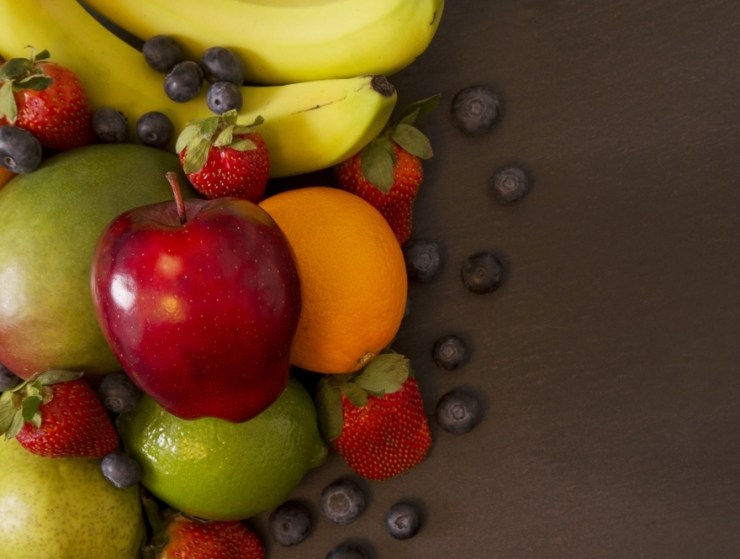
The “the tree of life” bore “twelve kinds of fruit, yielding its fruit each month” (Revelation 22:2).
Two contrasting worlds[4]
We’ve seen that the Bible is, among other things, ‘a tale of two cities’―humanity’s city Babylon and God’s city Jerusalem. What a contrast they are! ● New Jerusalem is a chaste bride, the wife of the Lamb (21:2,9); Babylon was a filthy prostitute, “with whom the kings of the earth have committed sexual immorality” (Revelation 17:2). ● New Jerusalem has “the glory of God” (21:11); Babylon was “clothed in fine linen, in purple and scarlet, adorned with gold, with jewels, and with pearls” (18:16), riches gained through exploitation and corruption. ● In New Jerusalem flows “the river of the water of life” (22:1); Babylon is the scene of slaughter; she’s drunk with “the blood of the martyrs of Jesus” (17:6)[5]
A new garden
New Jerusalem reminds us of the Garden of Eden. But it’s far more than a restored Garden. It now covers the whole Earth. And it’s transformed into a garden-city. The Garden of Eden was, in fact, a kind of ‘building site’. God planned that a garden-city should be built there―and that it should extend across the whole Earth. Now we see that city!
Next time . . .
What will life be like on the New Earth? And what will we do? We’ll explore these two questions in our final part. And we’ll end by recapping on some key themes we’ve traced in our series.
Bible Reading and Question
You may like to read Revelation 21:1-7. Here’s a question to think about:
? In Old Testament times God lived among His people in the Most Holy Place, the innermost room of the Tabernacle and Temple. But now the whole of New Jerusalem―in fact, the whole of the new Earth―is His dwelling place. What impact does this have on your hope of life in eternity?
Video
Here’s a short video, entitled All Things New: The Story of Eternity with Jesus (Revelation 21-22). It’s designed for children ages 6 to 12. But it’s so good, youth and adults may well enjoy it, too. This video is in a series published by Crossway. It’s based on the book called The Biggest Story Bible Storybook. All the videos can be viewed at The Biggest Story videos website. You can also create a free account to enable you to download them.
REFERENCES [1] See Worldview and Textual Criticism in 2 Peter 3:10 by Al Wolters. Published in the Westminster Theological Journal in 1987, volume 49, pages 405-413. [2] See What Happens When You Die? Glorified and Free on the New Earth by John Piper. Available online at https://www.desiringgod.org/messages/what-happens-when-you-die-glorified-and-free-on-the-new-earth, accessed on 20 June 2025. [3] Quoted from The Message of Revelation (The Bible Speaks Today) by Michael Wilcock, page 211. Published by Inter-Varsity Press, Leicester, United Kingdom, in 1975. [4] Adapted from the quotation “Babylon and the New Jerusalem represent contrasting worlds” in From Eden to the New Jerusalem: Exploring God’s Plan for Life on Earth by T. Desmond Alexander, page 175. Published by Kregel Publications, Grand Rapids, Michigan, in 2009, by permission of Inter-Varsity Press, Leicester, England. [5] See The Theology of the Book of Revelation by Richard Bauckham, pages 131-132. Published by Cambridge University Press, Cambridge, United Kingdom, 1993.
CREDITS ► Text copyright © 2025 Robert Gordon Betts ► Unless otherwise indicated, all Scripture is taken from the ESV® Bible (The Holy Bible, English Standard Version®), copyright © 2001 by Crossway, a publishing ministry of Good News Publishers. Anglicized English Standard Version copyright © 2002 by Crossway. Used by permission. All rights reserved. The ESV text may not be quoted in any publication made available to the public by a Creative Commons license. The ESV may not be translated in whole or in part into any other language. ► Scripture quotations marked ‘NIV’ are taken from The Holy Bible, New International Version (Anglicised edition). Copyright © 1979, 1984, 2011 by Biblica (formerly International Bible Society). Used by permission of Hodder & Stoughton Publishers, an Hachette UK company. All rights reserved. ‘NIV’ is a registered trademark of Biblica (formerly International Bible Society). UK trademark number 1448790.
 52 Steps
