
Part 3 ► “It Was Very Good”
Click the icon below to download a 4-page PDF version of this page.

So God finished all His creative work. On the seventh day, He rested. Everything was now exactly as God wanted it to be.
Creation declares God’s glory
The psalmist sang that “the heavens declare the glory of God, and the sky above proclaims his handiwork” (Psalm 19:1). The apostle Paul tells us that God’s “eternal power and divine nature, have been clearly perceived, ever since the creation of the world, in the things that have been made” (Romans 1:20).
When we look at the world around us―from breathtaking mountain panoramas right down to microscopic creatures―we discover exquisite beauty and design that can only have come from God, the great Designer and Creator.

This world is shot through with God’s glory. Mount Huangshan, China.
“When we look at the world around us we discover exquisite beauty and design that can only have come from God, the great Designer and Creator.”
So what does the creation tell us about God?
► God is all-powerful. God made everything. He created it through His Son: “All things were made through him” (John 1:3). And now, moment by moment, the Son of God, Jesus Christ, “upholds the universe by the word of his power” (Hebrews 1:3). So there’s nothing outside of His control or authority―nothing at all!
► God is a speaking God. God spoke the universe into existence. And, as we’ve just seen, the Son of God upholds the universe by His all-powerful word.
► God is inexhaustibly creative. In sea and sky and on land, the natural world is filled with life and beauty. The sheer abundant, extravagant variety of life is simply mind-boggling.
► God is good. God declared His creation to be “very good” (Genesis 1:31). Only a good God could create a good world.
► God is relational. He made beings “in his own image” (Genesis 1:27)―humans with whom He could enjoy a warmly personal relationship.
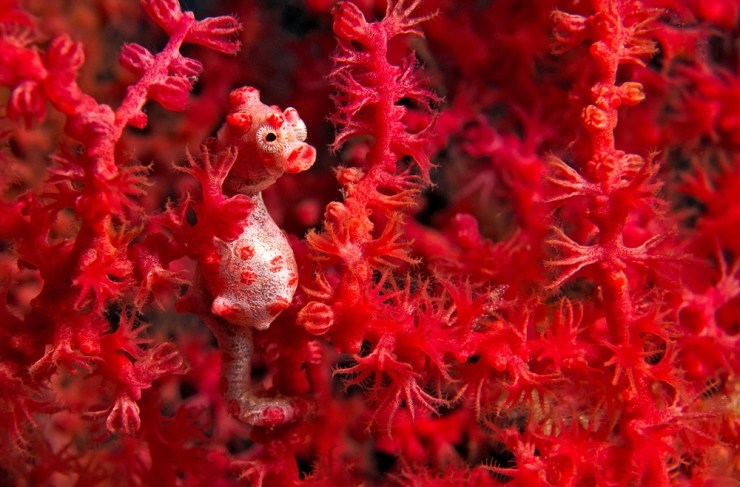
This little creature, towards the left-hand side of this photograph is actually a fish – a pygmy seahorse. It’s less than an inch long, a little miracle of the sea, brilliantly camouflaged in this fan coral.
Creation is separate from God
Creation is separate and distinct from God. It declares His glory and power and divine nature. But it isn’t part of God Himself. That’s why we mustn’t worship creation or any created thing. Only God Himself is divine. Only He is worthy of worship.
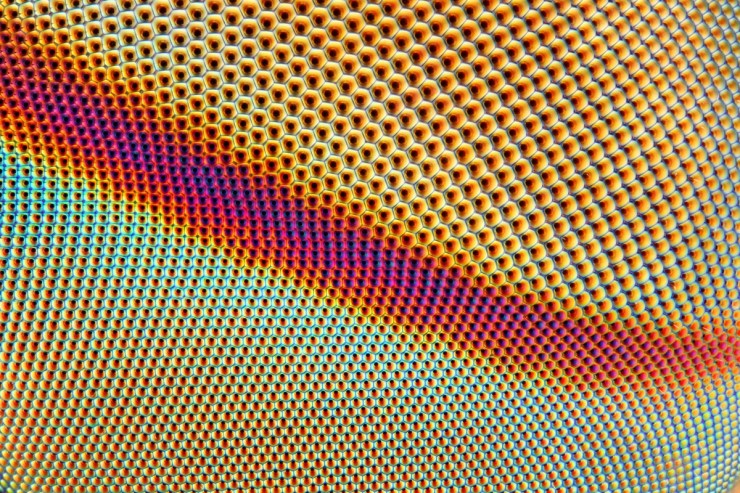
Here’s another of God’s masterpieces. You can only really see this one in all its glory with a microscope. It’s the eye of an ordinary horsefly. It consists of thousands of individual eyes all arranged in this wonderful geometric pattern.
Creation depends on God

Horses in the Camargue, Southern France.
Moment by moment, all creation depends on God. The Son of God sustains the universe by His all-powerful word; in the Son ”all things hold together” (Colossians 1:17). The lower orders of life―animals and plants―depend on their Creator unconsciously. But it’s our privilege to live in conscious daily awareness and acknowledgement of our reliance on God. In Him “we live and move and have our being” (Acts 17:28). He gives us “life and breath and everything” (Acts 17:25).
“It’s our privilege to live in conscious daily awareness and acknowledgement of our reliance on God.”
Created things are good
God declared the universe to be “very good”. But ever since Adam and Eve sinned in the Garden of Eden, our world has been spoiled by evil. Physical, material things are so often used to do evil things. And material things can come to dominate our lives―that’s something we call ‘materialism’. But physical things aren’t intrinsically evil. On the contrary, they’re intrinsically good. And God gives us physical, material things for our use and enjoyment.
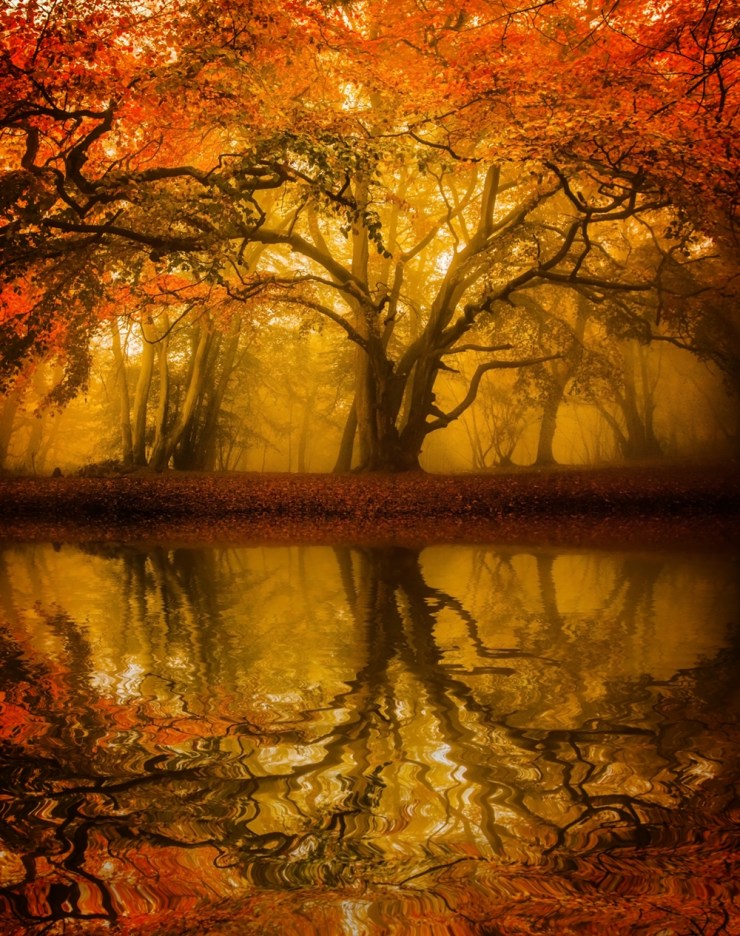
Autumn gold, echoed in still waters.
“Your body is a temple of the Holy Spirit”
And this means our own physical bodies are good, too. Sadly, of course, we can use our bodies to commit sin. But our bodies are not sinful of themselves. They’re good. And believers are to keep their bodies pure, because they’re temples of the Holy Spirit (1 Corinthians 6:19).
The Son of God Himself became a Man with a physical body! That demonstrates goodness of the human body beyond all doubt. And the Son of God still has a physical body. Our Lord Jesus Christ was raised bodily from death. His body is now a glorious body (Philippians 3:21). But it’s still a physical body.
And our Lord will transform our own mortal bodies “to be like his glorious body” (Philippians 3:20–21). We’ll have resurrection bodies! They’ll undoubtedly possess new and amazing properties unknown to us now. But they’ll still be physical bodies.
How then should we live?
The creation is good, because it was created by our good God. And so intellectual and ‘spiritual’ callings (for example, being in full-time Christian service) aren’t, in themselves, better than manual jobs―occupations that deal with physical, material things. Jesus Himself spent most of His adult life as a skilled manual worker―a carpenter (the Greek word can also mean ‘builder’).
And some people think that, since this world is headed ultimately for disaster and destruction, it would be a waste of time to care for the environment. On the contrary, God has appointed us as stewards of His creation. We’re to look after it, and not spoil, mismanage or neglect it.
The ‘Pale Blue Dot’
Compared with the vastness of the universe, Earth is a fragile, insignificant speck. This was so clearly portrayed by the famous image of planet Earth captured by the spacecraft Voyager 1 in 1990. That image, now named Pale Blue Dot, was taken from a distance of about 6 billion kilometres from the Earth. Our planet appears as a tiny dot against the vastness of space.
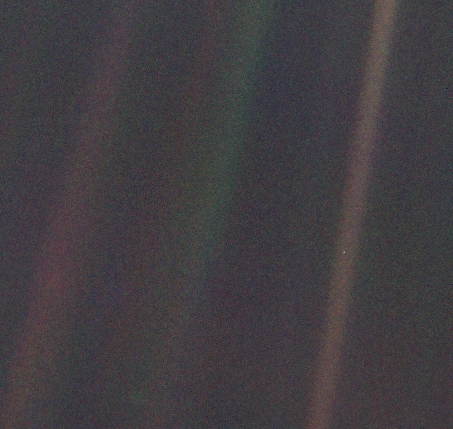
Pale Blue Dot courtesy of NASA
The ‘Pale Blue Dot’ image of Earth―one of the most remarkable photos ever taken. You can just see the Earth as a tiny dot caught in the ray of sunlight to the right (the ray is due to taking the image so close to the sun).
“The most astonishing and wonderful thing about Earth is this: God made this Earth to live here Himself.”
But it was on this tiny dot that God created beings made in His image. It was here that God Himself became Man, and lived and suffered and died and rose again. Here on our fragile and seemingly insignificant planet the Son of God altered for ever the destiny of the whole creation.
And the most astonishing and wonderful thing about Earth is this: God made this Earth to live here Himself. Of course, God lives in Heaven, too. But He also makes His home here on Earth with His people. In the beginning, God walked in the Garden of Eden. Thousands of years later He took up residence in the Tabernacle and, later, the Temple. Then He came to live on Earth among us in the Person of His Son, Jesus Christ (John 1:14). Now He lives in His redeemed people, the Church. The Church is a temple (1 Corinthians 3:16-17, 2 Corinthians 6:16) that’s being built up and joined together to be God’s home (Ephesians 2:19-22). And one day God will transform this Earth, fill it with His presence, and live with His people here for ever.
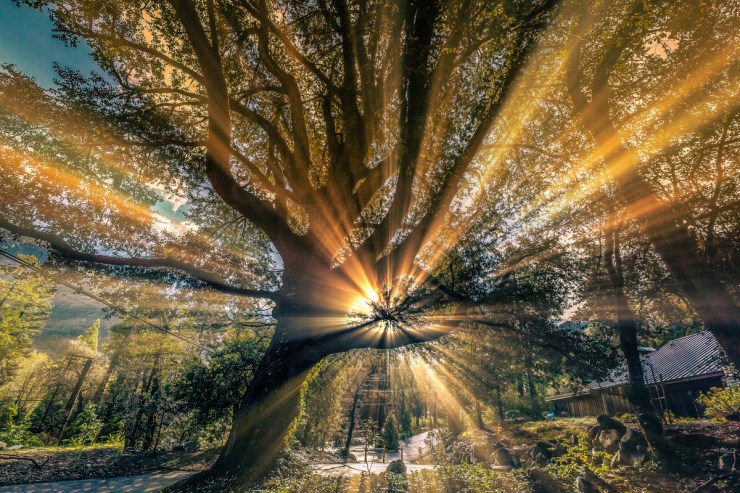
One day God will transform this Earth, fill it with His presence, and live with His people here for ever.
Why did God create?
God created because it was in His nature to create. He is self-giving, outgoing, life-giving, generous. That’s His nature. And so creating is a deeply natural thing for our God to do.
“God created us humans so He might love us and lavish on us all the blessings of life in His presence.”
And God is love (1 John 4:8,16). Love is at the very root of His divine nature. He created us humans so He might love us and lavish on us all the blessings of life in His presence.
In God’s image
Creation displays exquisite beauty and design wherever you look. But what’s the most wonderful thing in all of creation? It’s us humans. We’re “fearfully and wonderfully made” (Psalm 139:14). And the most amazing thing about us is this: God made us “in his own image” (Genesis 1:27). We aren’t actually divine, of course. But we are as like God as it is possible for any created being to be.
In the next part . . .
God created mankind “in His own image” (Genesis 1:27). What does this mean? And what did God put us on Earth to do? We’ll explore these questions in the next part of our series.
Bible Reading and Question
You may like to read Psalm 104, a Psalm that focuses on God’s wonderful creation. And here’s a question to think about:
?We saw that, as humans, it’s our privilege to be in conscious daily awareness and acknowledgement of our reliance on God. How should this impact how we live our lives?
Resources
Firstly, here’s a video of Psalm 8. This psalm is a wonderful hymn of praise to God. It celebrates God’s glory and humanity’s dominion over His creation. The Psalm reflects the creation narratives of Genesis 1 and 2. But there are also echoes of Genesis chapter 3, too―the chapter that tells us how sin and evil entered this world. Mention of “foes”, “enemy”, and “avenger” in verse 2 recall the opposition to God and His people that we experience in this fallen world. But, finally, this Psalm points to Christ Jesus―Psalm 8:6 is quoted in 1 Corinthians 15:27 and Ephesians 1:22, and Psalm 8:4-6 is quoted in Hebrews 2:6-8. Jesus is the perfect Man, the second Adam. All things have been put under His feet. And when He comes again, He will make everything new (Revelation 21:5). God’s people will then rule this world on His behalf, just as God planned from the beginning.
Secondly, here’s an article entitled Nature is Anything but Natural: Enjoying Creation Through the Psalms. The writer comments (quoting from another author) “One of the central teachings of Scripture is that the natural world is not at all natural. It is the creation of a supernatural God.” He asks, “Has the natural world lost some of its wonder in your eyes? Have you started to take for granted things God himself literally breathed into existence and sustains with his whispers? Does anything God made still quiet you?” Read the whole article HERE.
REFERENCES [1] See The Good God: Enjoying Father, Son and Spirit by Michael Reeves, pages 23-24. Published by Paternoster, Milton Keynes, United Kingdom, in 2012.
CREDITS ► Text copyright © 2024 Robert Gordon Betts ► All Scripture is taken from the ESV® Bible (The Holy Bible, English Standard Version®), copyright © 2001 by Crossway, a publishing ministry of Good News Publishers. Anglicized English Standard Version copyright © 2002 by Crossway. Used by permission. All rights reserved. The ESV text may not be quoted in any publication made available to the public by a Creative Commons license. The ESV may not be translated in whole or in part into any other language. ► Image of Earth entitled Pale Blue Dot on page 12 is in the public domain because it was solely created by NASA. Its description is as follows. ‘This narrow-angle color image of the Earth, dubbed ‘Pale Blue Dot’, is a part of the first ever ‘portrait’ of the solar system taken by Voyager 1. It is published at http://en.wikipedia.org/wiki/File:Pale_Blue_Dot.png Image cropped.
 52 Steps

