
Part 24: “A House For My Name”
Click the icon below to download a 4-page PDF version of this page.

The Temple―”of fame and glory throughout all lands”
Solomon succeeds his father David as king of Israel around 970BC. Israel enters a period of peace and prosperity unequalled before or since.
Israel enters a period of peace and prosperity unequalled before or since.
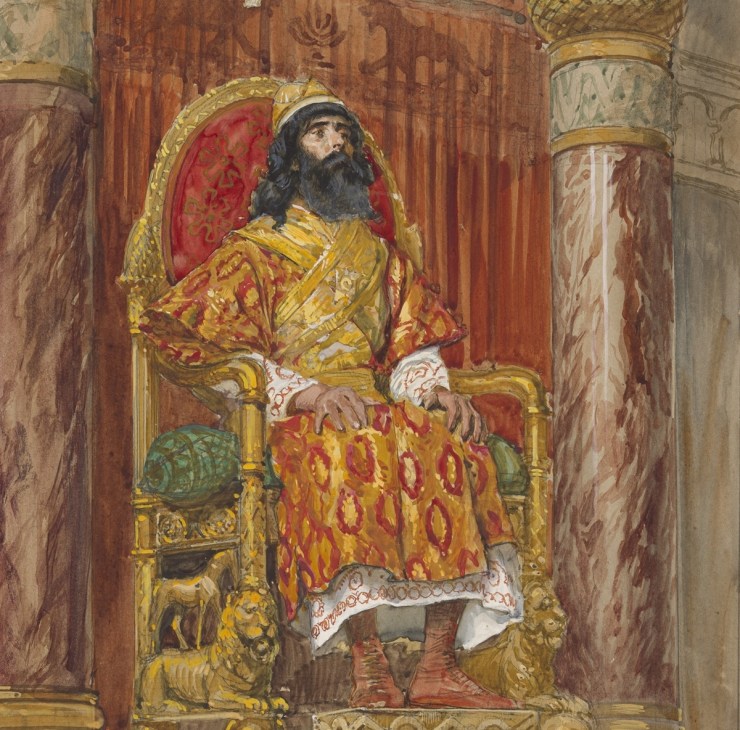
Image courtesy of The Jewish Museum, New York
Solomon Is Made King painted by James Jacques Joseph Tissot.
God appears to Solomon in a dream and says, “Ask what I shall give you” (1 Kings 3:5). Solomon asks for wisdom so he can “discern between good and evil” (3:9). God is pleased with his request, and says, “I give you a wise and discerning mind, so that none like you has been before you and none like you shall arise after you. I give you also what you have not asked, both riches and honour, so that no other king shall compare with you, all your days.” (3:12-13).
Last time we saw God making a covenant with Solomon’s father David. One of God’s promises was that David’s son would build “a house” for God’s “name” (2 Samuel 7:13). God gave David the design for it (1 Chronicles 28:11-19). And so Solomon builds a magnificent Temple. He sites it on Mount Moriah, just outside the city of Jerusalem, to the north. This is almost certainly the mountain where Abraham sacrificed Isaac (see Genesis 22:2). No expense is spared. It’s to be “exceedingly magnificent, of fame and glory throughout all lands” (1 Chronicles 22:5). It’s detailed in 1 Kings 6:2-10,15-36, 7:13-51, and 2 Chronicles 3:3-5:1.
Click this video to enjoy a brief tour of the interior of a model of the Temple of Solomon. This model was made after a design by Thomas Newberry, and was displayed as the centrepiece of the Anglo-Jewish Historical Exhibition in London in 1887. You can read about the model, now held by The Met (The Metropolitan Museum of Art) in New York, HERE.
The Temple’s basic plan is like the Tabernacle’s. In the outer courtyard is a great altar, and a huge bronze basin, plus ten smaller water basins on wheeled stands. The Temple building itself comprises the Holy Place and the Most Holy Place, plus additional rooms around them. But not only is the Temple a permanent building (rather than a tent), it’s also much bigger than the Tabernacle. The Holy Place is 45 feet high, 60 feet long, and 30 feet wide. The Most Holy Place is a perfect cube, 30 feet in each direction. At the entrance of the Temple is a great porch, flanked by two great bronze pillars.
The inner surfaces―the walls, floors, beams and presumably the ceilings―of the Holy Place and the Most Holy Place are overlaid with gold. Enter these rooms, and all you can see is gold! What an amazing experience to serve as a priest there, the light from the lampstands reflecting off the gold, and flooding the room with a glorious golden glow. In the Holy Place are ten golden lampstands, a golden table for the bread, and a golden altar for incense. Within the Most Holy Place is the Ark of the Covenant with the mercy seat on top, guarded by two massive cherubim of olivewood overlaid with gold.
Video from Bible Scenes (CC BY 4.0 International)
Click the video to see an artist’s impression of what Solomon’s Temple looked like.
A new Garden of Eden
As we saw in session 7, there were links between the Tabernacle and the Garden of Eden. The Tabernacle was, in effect, a new ‘Garden of Eden’―the garden where humans lived in God’s presence.[1]
The Temple, too, has links with the Garden. Its inner walls are decorated with gourds, flowers and palm trees. They’re also adorned with cherubim, which, together with the two massive cherubim in the Most Holy Place and the two on the mercy seat, remind us of the cherubim of Genesis 3:24. The tops of the two pillars flanking the porch are in the form of lilies and decorated with pomegranates. The rim of the huge water basin in the courtyard is like a lily-blossom; under its rim it’s decorated with gourds. The decoration on the stands for the smaller water basins includes cherubim and palm trees. To enter the Temple is, symbolically, like entering a new Garden of Eden!
To enter the Temple is, symbolically, like entering a new Garden of Eden!
Filled with God’s glory
When all is complete, Solomon assembles the elders and leaders of Israel and dedicates the Temple. The Ark of the Covenant is brought into the Most Holy Place. God’s glory-cloud fills the Temple; “a cloud filled the house of the LORD, so that the priests could not stand to minister . . . , for the glory of the LORD filled the house . . . .” (1 Kings 8:10-11). God takes up residence there, just as He did in the Tabernacle. From above the mercy seat, God reigns over Israel and over the whole Earth. The mountain the Temple stands on becomes known as Mount Zion. It’s God’s “holy mountain” (Joel 3:17), where heaven touches Earth.
The Temple is like a new ‘Garden of Eden’; so is the whole of the Promised Land. It’s a fertile, fruitful paradise. God is rolling back the curse on the land (Genesis 3:17-19). God’s new humanity, Israel, lives in God’s new paradise. God’s people are living in God’s presence in God’s paradise. That’s nothing less than the Kingdom of God. It surely seems to Israel that God’s Kingdom has fully come![2]
This is the high point of Israel’s whole history. When he dedicates the Temple, Solomon says: “Blessed be the LORD who has given rest to his people Israel, according to all that he promised. Not one word has failed of all his good promise, which he spoke by Moses his servant.” (1 Kings 8:56).
God’s people are living in God’s presence in God’s paradise. It surely seems to Israel that God’s Kingdom has fully come!
God’s missional people
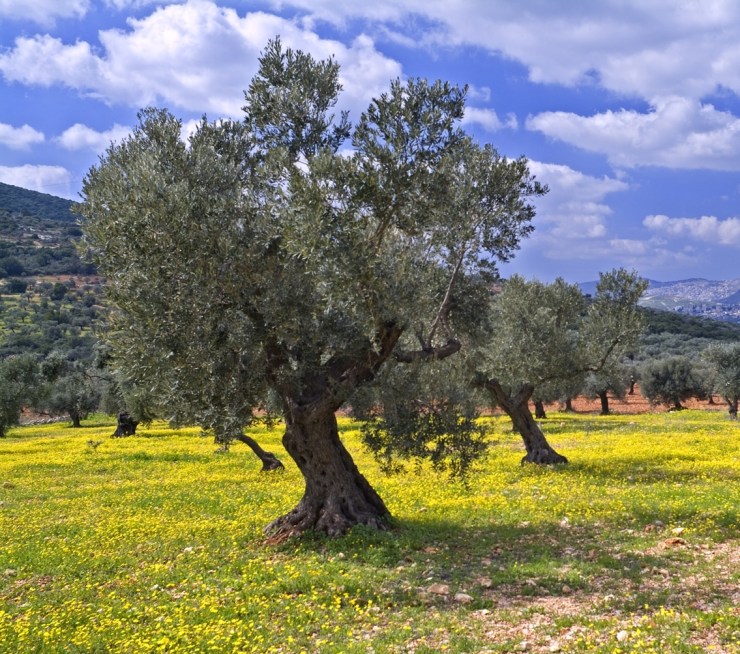
An olive grove in Galilee, Israel. Moses said, ”For the Lord your God is bringing you into a good land, a land of brooks of water, of fountains and springs, . . . a land of wheat and barley, of vines and fig trees and pomegranates, a land of olive trees and honey, a land in which you will eat bread without scarcity, . . . .”(Deuteronomy 8:7-9).
The Promised Land was God’s bridgehead into a world under Satan’s oppression. That bridgehead was now secured. Now God’s people were to bring God’s blessing to the nations around. They were then, as we are now, a missional people.
► Firstly, Israel was to reveal God’s nature, His kingship, His grace and His plan of salvation to the nations. One writer tells us, “Rather than send his evangelists and witnesses out to the far-flung corners of the earth, as he does in New Testament times, God set a mission station in the midst of the nations for all to see.”[3] Through God’s Law, through the sacrifices and festivals, through the peace and wellbeing of the nation, and through the fruitfulness of their land, Israel was to teach the nations around about God. They were to demonstrate to them what God is really like―not capricious, vindictive and cruel like their own gods, but holy, righteous, trustworthy and kind. Pagans couldn’t have personal relationships with their gods; Israel was to demonstrate that the true God loves to be in personal relationship with His people.
►Secondly, God’s people―His new humanity―were to demonstrate to the pagan nations around what human life was meant to be like. Israel was to be a showcase to the world of what a blessing it was for people to be in covenant relationship with God.[4]
►Finally, Israel was to become a major trading nation. It would become wealthy enough to lend to many nations (Deuteronomy 15:6).[5]
God’s people were to bring God’s blessing to the nations around. They were then, as we are now, a missional people.
At the crossroads of the world
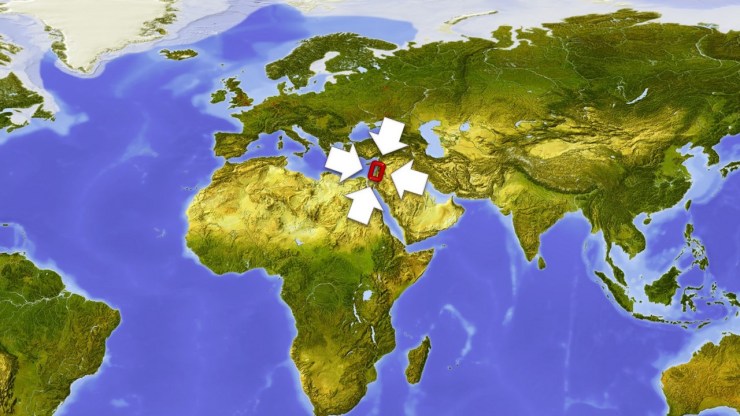
The Promised Land was God’s bridgehead into a world under Satan’s oppression. That bridgehead was now secured. Now God’s people were to bring God’s blessing to the nations around.
Israel was at the crossroads of the world―strategically positioned on trade routes linking Europe, Asia and Africa. So people from many surrounding nations would pass through the land. Others might make a special journey there. As one writer explains, God “intended Israel to function like a spiritual magnet, attracting other nations to him through its witness to God.”[6] We see this principle in action during Solomon’s reign: “. . . people of all nations came to hear the wisdom of Solomon . . . .” (1 Kings 4:34). At the Temple’s dedication, Solomon prays “. . . when a foreigner . . . comes from a far country for your name’s sake (for they shall hear of your great name and your mighty hand, and of your outstretched arm), when he comes and prays toward this house, hear . . . and do according to all for which the foreigner calls to you, in order that all the peoples of the earth may know your name and fear you, . . . .” (1 Kings 8:41-43). Some travellers might even find themselves settling in the Promised Land―perhaps even becoming members of God’s covenant people.
So the direction of mission was inwards―like a magnet, drawing people to Israel and to the true God. As we’ll see later in our journey, a thousand years later, that missional direction reversed. God was going to send His people out “to the end of the earth” (Acts 1:8).
A people, a land, a blessing
At this moment in His people’s history, God is fulfilling His promises to Abraham in a wonderful way.
●Firstly, God promised Abraham “I will make of you a great nation” (Genesis 12:2). Now Israel is a great nation, “as many as the sand by the sea” (1 Kings 4:20).
●Secondly, God promised Abraham “To your offspring I give this land, from the river of Egypt to . . . the river Euphrates” (Genesis 15:18). Now Abraham’s descendants are in that land! Its borders stretch from the upper Euphrates to Egypt’s border (see 1 Kings 4:21,24-25).
●Finally, God promised Abraham “in you all the families of the earth shall be blessed” (Genesis 12:3). In the various ways we’ve just seen, Israel was poised to begin being a blessing to the nations.
One day, of course, these promises to Abraham will be ultimately fulfilled in the new Creation pictured in the Bible’s closing chapters. But this period in Israel’s history is a glorious glimpse of what’s to come.
At this moment in His people’s history, God is fulfilling His promises to Abraham in a wonderful way.
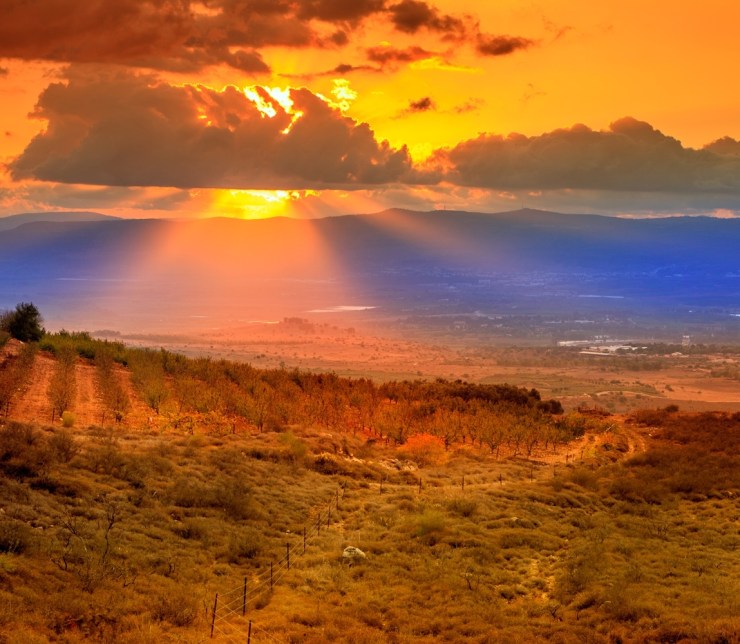
Sunset over Hula Valley, in the northern Golan Heights in Israel.
Next time . . .
But the battle with Satan isn’t over. That ancient enemy of God’s people isn’t going to give up without a fight. Once more, when Israel is doing so well, things go wrong. We see what happens next time.
Bible Reading and Questions
You may like to read 1 Kings 3:5-14. Here are questions to think about:
?As we saw above, Solomon asks God for wisdom so he can “discern between good and evil” (1 Kings 3:9). That phrase reminds us of “the tree of the knowledge of good and evil” in the Garden of Eden (Genesis 2:17). God forbad Adam and Eve from having the knowledge of good and evil. But God is pleased that Solomon wants to discern between good and evil, and so He grants his request. Why does God give Solomon something which He didn’t want Adam and Eve to have? Think about how Solomon got his knowledge, and how Adam and Eve got theirs. What’s the difference? And how does this apply to us today?
Book

In her book, Even Better than Eden: Nine Ways the Bible’s Story Changes Everything About Your Story, Nancy Guthrie traces nine themes through the Bible – the wilderness, the tree, God’s image, clothing, the Bridegroom, the Sabbath, the offspring, the dwelling place, and the city. Essentially, what she gives us is a series of nine mini-overviews of the Bible story, each one tracing the story from the point of view of one of these key themes. Her overall thrust is that God’s plan for His world is not simply to restore what was lost in Eden before the Fall, but will be far more glorious.
Read the publisher’s description HERE. Download an excerpt HERE. Nancy’s website page for this book is available HERE
Nancy Guthrie teaches the Bible at her home church, Cornerstone Presbyterian Church, in Franklin, Tennessee, as well as at conferences around the world, including through her Biblical Theology Workshop for Women. She is the author of numerous books and the host of the Help Me Teach the Bible podcast from The Gospel Coalition.
REFERENCES [1] From The Epic of Eden by Sandra L. Richter, page 181. Published by Intervarsity Press, Downers Grove, Illinois, in 2008. [2] See God’s Big Picture: Tracing the Storyline of the Bible by Vaughan Roberts, page 82. Published by Inter-Varsity Press, Leicester, United Kingdom, in 2003. [3] Michael D. Williams, Far as the Curse is Found, page 120. Published by P&R Publishing, Phillipsburg, New Jersey, in 2005. [4] See Exodus (Word Biblical Commentary, Volume 3) by John I. Durham, page 263. Published by Thomas Nelson Publishers, Nashville, Tennessee, in 1987. [5] Peter C. Craigie, The Book of Deuteronomy, page 237. Published by William B. Eerdmans Publishing Company, Grand Rapids, Michigan, in 1976. [6] Michael D. Williams, Far as the Curse is Found, page 255. Published by P&R Publishing, Phillipsburg, New Jersey, in 2005.
CREDITS ► Text copyright © 2024 Robert Gordon Betts ► Unless otherwise indicated, all Scripture is taken from the ESV® Bible (The Holy Bible, English Standard Version®), copyright © 2001 by Crossway, a publishing ministry of Good News Publishers. Anglicized English Standard Version copyright © 2002 by Crossway. Used by permission. All rights reserved. The ESV text may not be quoted in any publication made available to the public by a Creative Commons license. The ESV may not be translated in whole or in part into any other language.
 52 Steps