Part 9: Blessing to the Nations
Click the icon below to download a 4-page PDF version of this page.

Confusion at Babel
We ended part 8 with people building “a city and a tower” (Genesis 11:4). They wanted to settle down and be famous. And they wanted their tower to have ”its top in the heavens” (11:4), so a false god could stay among them. But they get nowhere near Heaven―how can they? God has to come down to inspect the city and the tower (11:5)!
At that time, “the whole world had one language and a common speech” (11:1 NIV). So God says “Come, let us go down and there confuse their language, so that they may not understand one another’s speech” (11:7). The city is called Babel, because God confuses the people’s language. God fragments humanity into different language groups, unable to communicate with each other. And He “dispersed them from there over the face of all the earth, and they left off building the city” (Genesis 11:8).
Once more, our merciful God steps in to save rebellious humanity from ruin. People can’t cooperate easily if they can’t understand each other and if they’re scattered across the globe. That slows down the pace of technical, economic and social change. So it hinders the rise of a global civilisation under Satan’s control. God again intervenes in human history, so He can continue to work out His plan of salvation for us. However bad things may get, this world is in God’s hands.
“God again intervenes in human history, so He can continue His plan of salvation for us.”
God’s promises to Abram
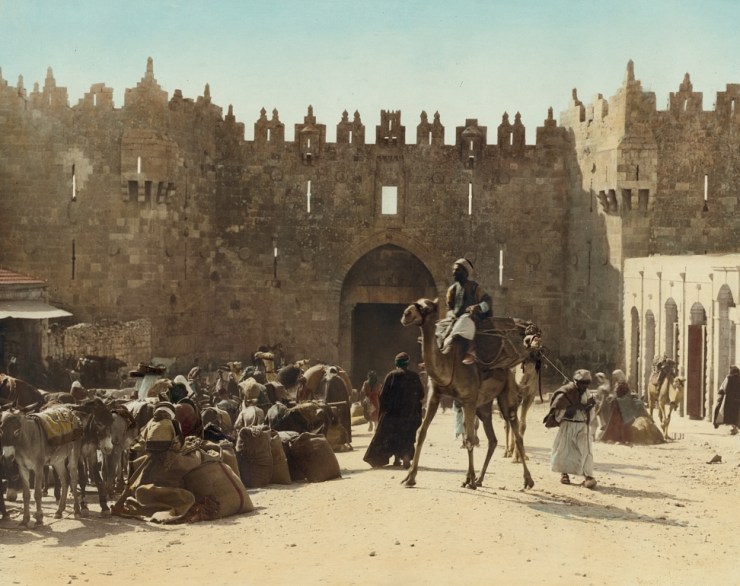
Image courtesy of Library of Congress
Pack train outside the Damascus gate, Jerusalem (hand-coloured photograph taken around 1919). A scene that may be very similar to that when Abram and his family departed from Ur.
God now calls a man named Abram, whom He later renames Abraham. We read “The Lord had said to Abram, ‘Go from your country, your people and your father’s household to the land I will show you. I will make you into a great nation, and I will bless you; I will make your name great, and you will be a blessing. I will bless those who bless you, and whoever curses you I will curse; and all peoples on earth will be blessed through you.’” (Genesis 12:1-3 NIV). Notice how many times God uses the word “bless” and “blessing”! Right from the beginning, He wanted our world to be blessed. Now, through Abram, He begins again to bring blessing to our world! God begins again to put right all the consequences of humanity’s rebellion against God in the garden of Eden![1]
Blessing
What is ‘blessing’? It’s being under God’s favour. It’s life in God’s presence, life in relationship with Him. The Psalmist says, “in your presence there is fullness of joy; at your right hand are pleasures forevermore” (Psalm 16:11). To live in relationship with God is to have what the Bible calls eternal life. In John’s Gospel, we read, “God so loved the world, that he gave his only Son, that whoever believes in him should not perish but have eternal life” (John 3:16). That’s the life that’s truly blessed!
The builders of Babel wanted a “name”―enduring fame. And they set out to build a city. Neither a name nor a city are, in themselves, bad things. Their sin lay in the fact they wanted to get these things their way and for their glory.
Now God promises Abram these same two things―a name and a city:
► God says to Abram: “I will . . . make your name great” (Genesis 12:2). Abram won’t make his own name great―God will make his name great.
►The proud rebels of Babel tried to build a city through their own human power. But Abram never builds a city―he lives in tents. His eyes aren’t fixed on a city built by human power for human glory. His eyes are fixed on God’s city, “the city that has foundations, whose designer and builder is God” (Hebrews 11:10).
The whole Bible is, among other things, ‘a tale of two cities’―humanity’s city and God’s city. Humanity’s city is called Babel, also known as Babylon. God’s city is called Jerusalem. These cities are symbols. A city is a centre of human community. Babylon symbolises godless humanity under Satan’s control. Jerusalem symbolises godly humanity under God’s rule. The contrast between these cities begins here in Genesis. It climaxes in the Book of Revelation, the final book of the Bible.
“The Bible is, among other things, ‘a tale of two cities’―humanity’s city and God’s city.”
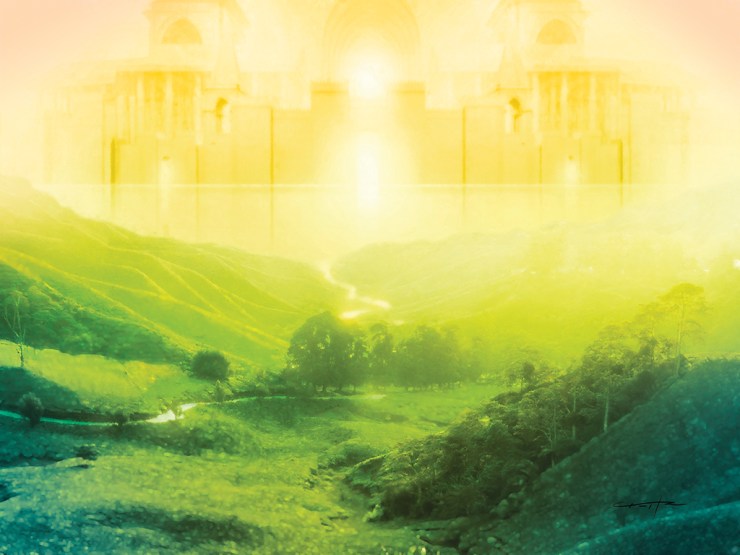
Image © Steve Creitz at Prophecy Art
“Abraham was looking forward to the city that has foundations, whose designer and builder is God” (Hebrews 11:10). In this painting, an artist imagines that city, the city that John describes in the Book of Revelation. We read, “Then I saw a new heaven and a new earth, for the first heaven and the first earth had passed away, and the sea was no more. And I saw the holy city, new Jerusalem, coming down out of heaven from God, prepared as a bride adorned for her husband.” (Revelation 21:1-2).
The shape of history
The Bible story is a bit like an hourglass―wide at the bottom and top, but narrow in the middle.
►The Bible begins with a wide view―in Genesis 1-11 we read about the creation of the universe and the history of the whole world.
► Now, from Genesis 12 onward through the Old Testament, the story narrows down to a single man, Abraham, and the nation, Israel, that he fathered. In the four Gospels, the story zooms in again on the life and work of one Man, Jesus Christ.
►From the Day of Pentecost, however, the story widens out again. The gospel goes out to the nations. Finally, at the end of the Book of Revelation, we end as we began, with a worldwide view―the New Heaven and Earth.
Last time we saw that God made a covenant with Noah and his sons, and every living creature. That covenant reflected what God said to Adam and Eve. After the flood, a new chapter in human history began. Noah was a new Adam.
“Abram is another new Adam. God is making another new start.”
Now God makes promises to Abram. These promises reflect what we read about Adam in Genesis 1 and 2. Abram is another new Adam. God is making another new start.
►A paradise God placed Adam in a garden―the garden of Eden. The land God was going to lead Abram to was like a new garden of Eden―”a good land, a land of brooks of water, of fountains and springs, . . . a land of wheat and barley, of vines and fig trees and pomegranates, . . . of olive trees and honey” (Deuteronomy 8:7–8).
►A people God commanded Adam and Eve to be fruitful and multiply (Genesis 1:28). God promised Abram that he’d be fruitful and multiply. He was going to father a great nation (Genesis 12:2).
►A blessing God blessed Adam and Eve (Genesis 1:28). God promised that He would bless Abram (Genesis 12:2).
And Abram himself would be a blessing (Genesis 12:2); through him “all peoples on earth will be blessed” (Genesis 12:3). The rest of the Bible tells how God fulfils these promises to Abram. God reinforces and expands on these promises a number of times, as we’ll see.
“By faith Abraham obeyed . . .”
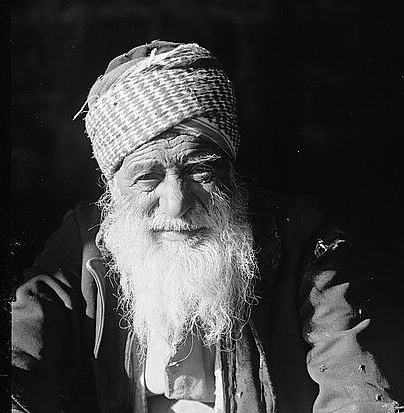
Image courtesy of Library of Congress
A photograph of an Arab Jew from the Yemen, taken between 1898 and 1914. A wonderful portrait that brings Abraham to mind.
God doesn’t tell Abram where He’s going to lead him. Abram simply trusts God, and steps out in faith. The writer to the Hebrews tells us, “By faith Abraham obeyed when he was called to go out to a place that he was to receive as an inheritance. And he went out, not knowing where he was going” (Hebrews 11:8). This man’s step of faith begins a whole new phase in God’s plan for this world!
In stepping out in obedience, Abram is saying, in effect: “I don’t know where you’re leading me. But You know best. I hand my life over to you. I will do what You say.” He’s a complete contrast to Adam and Eve. They gave in to the snake’s temptation; they failed to trust and obey God. So their relationship with God was broken. But Abram trusts and obeys God. And so he becomes God’s friend (2 Chronicles 20:7, Isaiah 41:8, James 2:23).
“Abram trusts and obeys God. And so he becomes God’s friend.”
So Abram sets out. He originally lived in Ur, a city in what is now southern Iraq. Abram’s father Terah and his nephew Lot accompany Abram and his wife Sarai on the first part of the journey. They travel along the ‘fertile crescent’ from Ur north-west to Haran in Syria, where they settle. From Acts 7:2, we learn that God called Abram when he was still living in Ur. It’s quite possible that God called Abram again when he was in Haran.
Finally, Abram, Sarai and Lot leave Haran and continue the journey to Canaan―roughly what is now Israel. This was the land that God was going to give to Abram’s descendants.
God blesses Abram; he becomes a wealthy man, “very rich in livestock, in silver, and in gold” (13:2). He makes his base near a town called Hebron (Genesis 13:18).
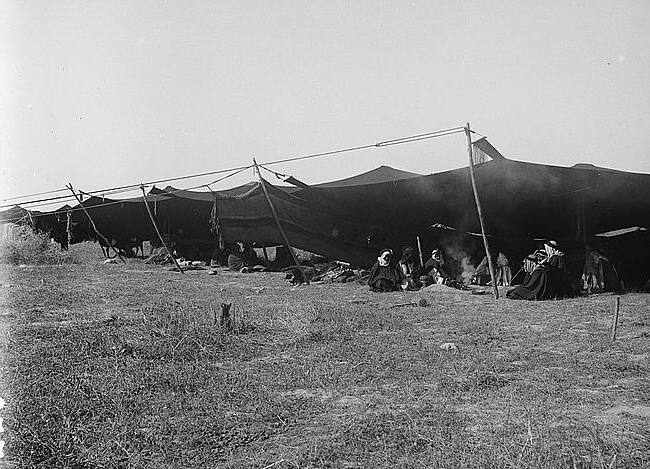
A Bedouin chieftain’s tent courtesy of Library of Congress
A Bedouin chieftain’s tent in the Holy Land (a photograph probably taken between about 1940-1946). Abraham, too, lived in tents: “By faith [Abraham] went to live in the land of promise, . . . living in tents with Isaac and Jacob, heirs with him of the same promise” (Hebrews 11:9).
One day, Abram’s nephew Lot gets captured during a battle between two groups of tribal kings. We read all about this in Genesis 14:1-24. Abram and his allies rally to Lot’s defence; they rescue Lot and all the other captives, together with the goods that were taken.
Then two kings―the king of Sodom, and Melchizedek, king of Salem―go to meet the victorious Abram. These kings are complete contrasts. The king of Sodom is a pagan ruler. Melchizedek is “priest of God Most High” (Genesis 14:18). We meet him again in Psalm 110 and in the Book of Hebrews. He’s king of Salem, very probably the city later called Jerusalem. He’s a priest and king, and he’s a significant figure. He foreshadows Jesus, our High Priest and King.
Melchizedek offers Abram bread and wine, and pronounces a blessing on him. Abraham gives Melchizedek a tenth of the goods. In giving this portion to God’s priest, Abraham affirms that it’s God who has given him the victory.
The king of Sodom says that Abram can keep the goods he’s recaptured. But Abram refuses his offer. God alone would be Abram’s benefactor. It’s an act of commitment to God.
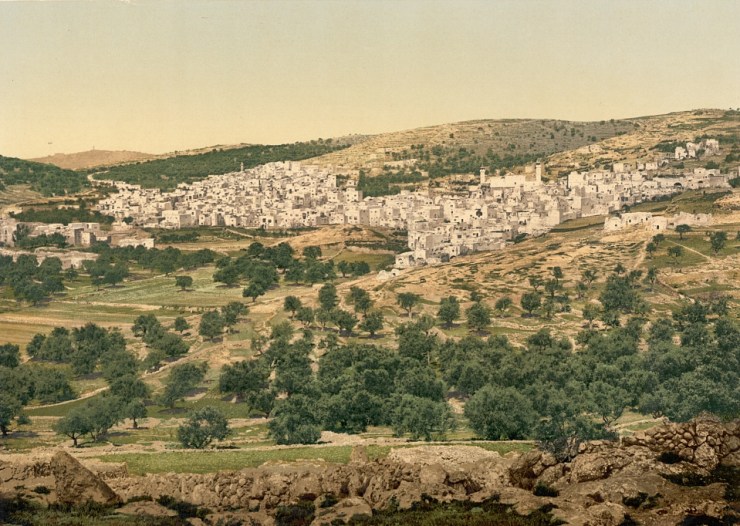
General view of Hebron courtesy of Library of Congress
An early photograph of Hebron, taken around 1890 to 1900. It was at Hebron that Abraham transacted the purchase of the cave of Machpelah and surrounding land as a burial place (Genesis 23:1-20). Abraham, Sarah, Isaac, Rebekah and Jacob were all buried there. And about two miles north of Hebron is Ramet el Khalil. This may be the location of Mamre, where Abraham seems to have settled for considerable periods of time (Genesis 13:18, 14:13, 18:1), and where Isaac lived (Genesis 35:27).
In the next part . . .
God had promised Abram “I will make you into a great nation” (12:3). Later, God said, “I will make your offspring as the dust of the earth” (13:15-16). Abram was 75 years old when he left Haran. Years have passed and he still has no offspring. He’s an elderly man. His wife Sarai is barren (11:30), and too old to have a baby anyway. However will God fulfil His promise? We’ll see next time.
Bible Reading and Questions
You may like to read Genesis 12:1-9. Here are two questions to think about:
?From this passage, what do we learn about Abram? What is God teaching us through him?
Videos
Here’s two short videos, entitled A Table and a Tower and The Father of Nations They’re designed for children ages 6 to 12. But they’re so good, I think everyone will find them helpful. These video are in a series published by Crossway. They’re based on the book called The Biggest Story Bible Storybook. All the videos can be viewed at The Biggest Story videos website. You can also create a free account to enable you to download them.
REFERENCES [1] See Galatians: Gospel-Rooted Living (Preaching the Word) by Todd Wilson, pages 99-101. Published by Crossway, Wheaton, Illinois, in 2013.
CREDITS ► Text copyright © 2024 Robert Gordon Betts ► Unless otherwise indicated, all Scripture is taken from the ESV® Bible (The Holy Bible, English Standard Version®), copyright © 2001 by Crossway, a publishing ministry of Good News Publishers. Anglicized English Standard Version copyright © 2002 by Crossway. Used by permission. All rights reserved. The ESV text may not be quoted in any publication made available to the public by a Creative Commons license. The ESV may not be translated in whole or in part into any other language. ► Scripture quotations marked ‘NIV’ are taken from The Holy Bible, New International Version (Anglicised edition). Copyright © 1979, 1984, 2011 by Biblica (formerly International Bible Society). Used by permission of Hodder & Stoughton Publishers, an Hachette UK company. All rights reserved. ‘NIV’ is a registered trademark of Biblica (formerly International Bible Society). UK trademark number 1448790.
 52 Steps