Part 8: Cleansing and Covenant
Click the icon below to download a 4-page PDF version of this page.

The Flood
In the previous part, we saw evil flooding this world. Humanity was heading for ruin.
Our holy God is heartbroken. He regrets that he’s made humanity―so much so that He vows to wipe them and all the animals “from the face of the earth” (Genesis 6:7 NIV). But there’s still a ray of hope! We read in 6:8-9, “Noah found favour in the eyes of the LORD. . . . . Noah was a righteous man, blameless in his generation. Noah walked with God.” In every age and generation, God has His people. Even in those desperate days, there is righteous Noah.
God plans to destroy mankind by a flood, and stem the tide of sin. But how can He save Noah? In a flood, the only safe place is a boat. So that’s what God asks Noah to build. And what a boat it was! It was called “an ark” (6:14). It was huge―around 450 feet (137 metres) long, 75 feet (23 metres) wide, and 45 feet (13½ metres) high.
God gives Noah the design. The ark had good seaworthy proportions, and was large enough to keep it steady in the floodwaters. Building it must have taken years. Faithful Noah must have endured years of mockery as he and his sons laboured on this huge boat, probably many miles from the sea.
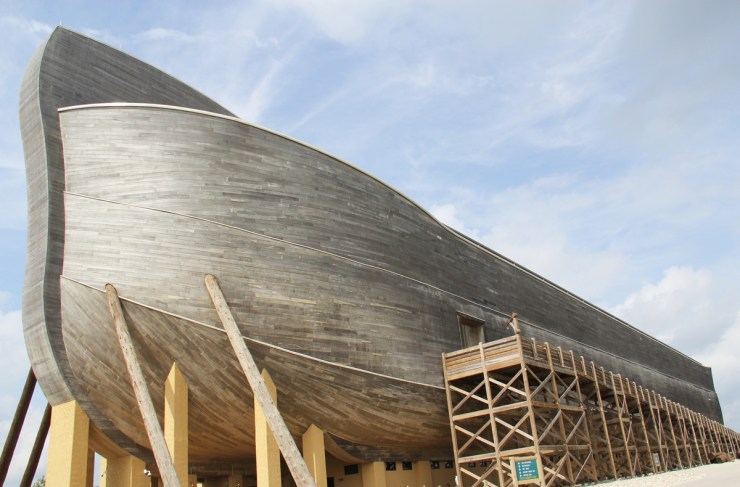
Full-size replica of the Ark, at the Ark Encounter theme park in Kentucky, United States. It’s built according to the dimensions given in the Bible.
The day comes when God tells Noah to board the ark, with his family, and all the different kinds of animal. God Himself shuts the door. Then “all the fountains of the great deep burst forth, and the windows of the heavens were opened. And rain fell upon the earth forty days and forty nights” (7:11-12). Through this flood, God “blotted out every living thing that was on the face of the ground, man and animals and creeping things and birds of the heavens. . . . . Only Noah was left, and those who were with him in the ark” (7:23, and compare Luke 17:26–27).
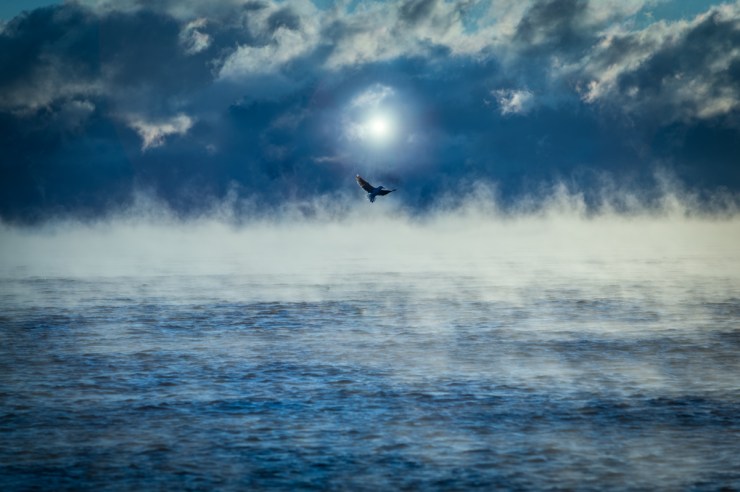
Noah “sent forth a dove from him, to see if the waters had subsided from the face of the ground. But the dove . . . returned to him to the ark, for the waters were still on the face of the whole earth.” (Genesis 8:8-9). Seven days later, Noah sent the dove out again; it returned with an olive leaf in its mouth. A week later, he sent it out a third time, and it never returned. The flood had subsided.
After the flood has done its work, God causes the waters to recede. The ark comes to rest. Noah, his family and the animals step out onto a freshly cleansed land.
The primeval Earth had been submerged by water (Genesis 1:2). The flood returns Earth to that original state. Then the waters recede and dry land appears, just as they did on the third creation day (Genesis 1:9-10). The flood is like a new creation.
“The waters recede and dry land appears, just as they did on the third creation day. The flood is like a new creation.”
But sin continues. The “intention of man’s heart” is still “evil from his youth” (8:21). So what did God achieve by sending the flood?
He sent the flood as a judgment. But it was, at the same time, an act of supreme mercy. God changed the course of history to save humanity from total ruin―to save it from Satan’s domination. He stepped in to ensure the promised “offspring” of Eve would be born, and would “crush” Satan’s “head” (Genesis 3:15), and save you and me and “a great multitude that no one could number, from every nation, from all tribes and peoples and languages” (Revelation 7:9).
A covenant confirmed
After the flood, Noah offers sacrifices to God―an act of thanksgiving and devotion to Him. Then God does something very significant. He confirms a covenant with Noah, his sons and descendants, and with every living creature. This is the first time that we meet the word ‘covenant’ in the Bible. A covenant is a binding agreement between two parties. It may bring them into relationship. Or it may confirm or add to a relationship they already had.
God made several covenants with His people. We can think of them as the backbone of the Bible story. Through these covenants―step by step―God accomplished His plan of salvation for us and for this world.
“The covenants God made with His people are the ‘backbone’ of the Bible story.”
God explains the terms of this covenant to Noah and his sons (9:1-7). What He says is remarkably similar to what He said to Adam and Eve, recorded in Genesis 1:27–29.
► God blessed Adam and Eve (Genesis 1:28); He blesses Noah and his sons (Genesis 9:1).
►God commanded Adam and Eve, and now commands Noah and his sons, “Be fruitful and multiply and fill the earth” (Genesis 1:28, 9:1).
►God gave Adam dominion over the animals (Genesis 1:26,28); God delivers every creature into the hands of Noah and his sons (Genesis 9:2).
►God appointed food for Adam (Genesis 1:29); He appoints food for Noah and his sons (Genesis 9:3-4). Adam’s diet was vegetarian; now God adds meat to people’s diet.
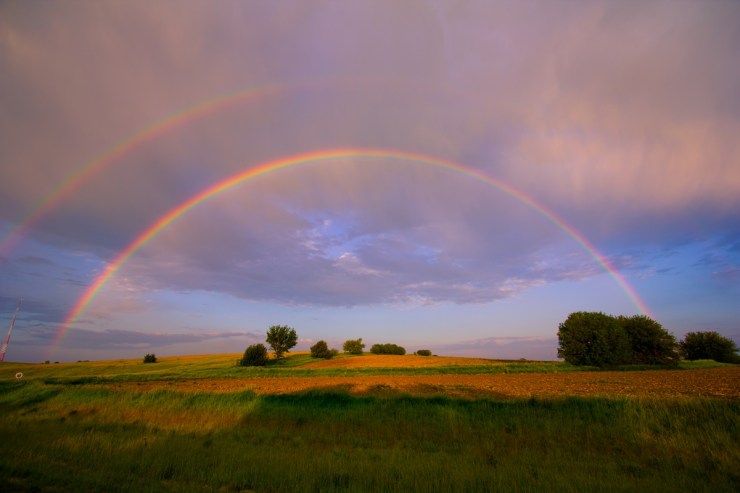
God said, “When I bring clouds over the earth and the bow is seen in the clouds, I will remember my covenant that is between me and you and every living creature of all flesh. And the waters shall never again become a flood to destroy all flesh.” (Genesis 9.14-15).
God ‘establishes’ this covenant with Noah and his offspring and all the living creatures. In other words, He confirms a covenant that already existed. That covenant was made at creation. Adam and Eve were to be in relationship with God; they were to be committed to love, trust and obey Him. And God was committed to looking after the Earth. He planned to do this through Adam and Eve―they were to fill the Earth, subdue it and rule over all its creatures. So right at the beginning of history, we see commitment between humanity and God, and between God and His creation. Though the word ‘covenant’ isn’t used, these commitments are clearly covenantal.
Noah is a new Adam. Adam lived in a newly created world. Noah and his family step out into a newly cleansed world. And so now God confirms those original creational commitments. That’s why what God says to Noah reflects what God said to Adam and Eve.
But there are differences. The world after the flood is still a fallen world. Violence is still an ugly fact of life. So God takes account of this. Animals now live in fear of people, and God places them under human authority. God now institutes the death penalty for a murderer (9:6). And although God adds meat to the human diet, he excludes “meat that has its lifeblood still in it” (9:4 NIV). Blood is the vehicle of life, and life is from God. So, to show respect for life, blood wasn’t to be eaten.
God also confirms His commitment to preserve the Earth, the human race, and all the creatures. He says to Noah: “I establish my covenant with you: Never again will all life be destroyed by the waters of a flood; never again will there be a flood to destroy the earth” (Genesis 9:11 NIV). The sign of this covenant was a rainbow (9:13). Every time we see a rainbow, God reminds us that “never again will there be a flood to destroy the earth”.
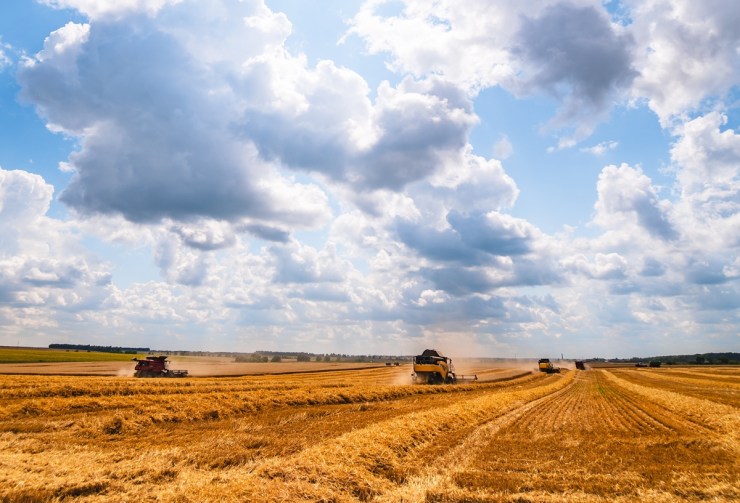
After the flood, God promised: “While the earth remains, seedtime and harvest, cold and heat, summer and winter, day and night, shall not cease” (Genesis 8:22).
God created mankind “in his own image” (Genesis 1:27). After Adam and Eve sinned, that image became distorted and dysfunctional. But it wasn’t erased. A £10 note may be crumpled and dirty. But it’s still worth £10. Sin has crumpled and spoiled people. But we still possess our original value―we still bear the image and likeness of God. After the flood, God reaffirms that we’re “in His image” (Genesis 9:6).
Another Fall
But sin continues. We read this: “Noah began to be a man of the soil, and he planted a vineyard. He drank of the wine and became drunk and lay uncovered in his tent.” (Genesis 9:20-21). Noah’s son Ham sees his father naked and tells his two brothers, Shem and Japheth. But, out of respect for their father, they lay a garment on their shoulders, walk backwards into Noah’s tent, and cover him without seeing him naked.
What Ham actually did wrong is something of a mystery. Perhaps it was simply that he gazed at his naked father and told his brothers about it. That alone would have been a disgusting act of disrespect in those days. Respect for parents and for the elderly was central to ancient society. Centuries later, God said to His people: “Cursed be anyone who dishonours his father or his mother” (Deuteronomy 27:16).
This is the first recorded sin after the flood. It reminds us of the very first sin. ◆ It involves fruit―that is, wine made from fruit. ◆ It involves nakedness and shame. ◆ And it results in a curse―Noah curses Ham’s son Canaan and his descendants, the Canaanites. We’ll meet the Canaanites later in our journey―they’ll follow in the footsteps of their ancestor Ham. But Noah blesses Shem and Japheth, who acted to protect his dignity.
It’s like Genesis 3 all over again. However can sin be erased from the human heart? Whatever can God do to save mankind? The rest of the Bible unfolds the answer to that question.
“However can sin be erased from the human heart? The rest of the Bible unfolds the answer to that question.”
The tower of Babel

Image from Wikimedia Commons
Model of an ancient ziggurat. This ziggurat is dated to around 1275-1240BC, and its remains still exist. The blue building on top is a temple.
After the flood, Noah’s descendants don’t disperse across the world, but remain in the Middle East. The people settle together in a plain in “the land of Shinar” (11:2), very roughly what’s now present-day Iraq. They say, “Come, let us build ourselves a city and a tower with its top in the heavens, and let us make a name for ourselves, lest we be dispersed over the face of the whole earth” (Genesis 11:4).
God had commanded the human race to multiply and disperse across the whole Earth and colonise it. But these people don’t want to be dispersed. And they want to make “a name” for themselves. They begin to build ”a tower with its top in the heavens”. It seems very likely this was what we call a ‘ziggurat’―a step-sided tower with a temple at the top. A ziggurat was dedicated to a pagan god. People believed that if they served that god properly, it would spend time in the temple.
God wanted this world to be a place where His people lived in His paradise in His presence. Now humanity takes it into their heads to try to bring this about themselves―but without God. They want to build a strong, secure civilisation where their god could live among them. But behind their god was Satan himself.
At that time, everyone spoke the same language (11:1). So there were no language barriers. That meant that all kinds of knowledge and skills could easily be shared. A powerful, global, godless civilisation would not be long in coming. Once more, Satan is threatening to bring humanity totally under his control.
In the next part . . .
Once more, the human race is destined for ruin. How will God respond? And what will be the next step in His plan of salvation for us? We’ll see next time.
Bible Reading and Questions
You may like to read Genesis 9:1-17. Here are a few questions to think about:
?What is a covenant? The covenant with Noah, as we’ve seen, is one of a number of covenants God made with people. Why do you think God makes covenants with people? What does this tell us about Him? What does it tell us about our relationship with Him?
Video
Here’s a short video, entitled Rain, Rain, Go Away. It’s designed for children ages 6 to 12. But it’s so good, I think everyone will find it helpful. This video is the fourth in a series published by Crossway. They’re based on the book called The Biggest Story Bible Storybook. All the videos can be viewed at The Biggest Story videos website. You can also create a free account to enable you to download them.
CREDITS ► Text copyright © 2024 Robert Gordon Betts ► Unless otherwise indicated, all Scripture is taken from the ESV® Bible (The Holy Bible, English Standard Version®), copyright © 2001 by Crossway, a publishing ministry of Good News Publishers. Anglicized English Standard Version copyright © 2002 by Crossway. Used by permission. All rights reserved. The ESV text may not be quoted in any publication made available to the public by a Creative Commons license. The ESV may not be translated in whole or in part into any other language. ► Scripture quotations marked ‘NIV’ are taken from The Holy Bible, New International Version (Anglicised edition). Copyright © 1979, 1984, 2011 by Biblica (formerly International Bible Society). Used by permission of Hodder & Stoughton Publishers, an Hachette UK company. All rights reserved. ‘NIV’ is a registered trademark of Biblica (formerly International Bible Society). UK trademark number 1448790.
 52 Steps
.jpg)