
Part 7: East of Eden
Click the icon below to download a 4-page PDF version of this page.

Act 3―the New
As we saw in part 1, the Bible story is a drama in four acts―the Good, the Bad, the New, and the Perfect. Last week, we began Act 3―the New. God is beginning something new. He’s set in motion His plan to put right all the consequences of humanity’s rebellion against Him. Step by step, over thousands of years, we’ll see God outworking His plan of salvation. One day, Eve’s promised “offspring” would “crush” Satan’s “head” (Genesis 3:15).
Exiled from the garden
Adam and Eve fell prey to the snake’s tempting words. They ate the fruit of the tree of the knowledge of good and evil. We and our world still suffer the consequences of their sin.
There was another special tree in the garden of Eden―“the tree of life” (Genesis 2:9, 3:22,24). Adam and Eve were free to eat from this tree. If they had eaten from it before they sinned, God would have given them eternal life―a never-ending life of perfect relationship with Him.
But now they were sinners. If they ate now from the tree of life, they’d exist for ever―but without a relationship with God. Their lives would be ruined for ever. They’d have no hope of salvation. But God doesn’t allow that. He sends them out of the garden so they can’t eat from the tree of life. This is an act of supreme mercy, as well as judgment. At “the east of the garden of Eden he placed the cherubim and a flaming sword that turned every way to guard the way to the tree of life” (Genesis 3:24). Adam and Eve are now shut out of the garden.
Humanity is now in exile. Deep down, we’ve never forgotten the garden of Eden. We’re homesick. We long to return to paradise.

Adam and Eve are now shut out of the garden. Deep down, we’ve never forgotten this garden. We long to return to paradise.
Satan’s plan for this world
Satan had wanted to be worshipped and served instead of God in Heaven: we learned this in part 5. He failed. Now, it seems, he wanted to be worshipped and served instead of God here on planet Earth. He wanted to be the ‘god’ of this world. He dreamed of a global civilisation with him as its lord, and united in rebellion against God.
Satan has power here on Earth only by God’s permission and within His limits. And through it all, God is bringing about His amazing plan of redemption for mankind.
He seemed to be succeeding. The first humans had fallen to his temptation. Now he had power over human society―as John wrote, the whole world “lies in the power of the evil one” (1 John 5:19). Through history, we see empires, dictators, tyrants and warlords all ultimately inspired by Satan in his quest to rule the world. The Bible tells us about some of these.
But we need to remember that Satan rules only by God’s permission and within His limits. And through it all, God is at work. He’s bringing about His amazing plan of redemption for mankind. God is always in control of history!
Cain and Abel
Satan and Eve are now at war. And so are their offspring―people who follow Satan are enemies of those who follow God. That war now erupts, with deadly results.
Eve gives birth to two boys―Cain and Abel. We read, “In the course of time Cain brought to the LORD an offering of the fruit of the ground, and Abel also brought of the firstborn of his flock and of their fat portions” (4:3-4). The Lord “looked with favour on Abel and his offering, but on Cain and his offering he did not look with favour” (4:4-5).
God doesn’t accept Cain’s sacrifice. Why? Was it because Cain didn’t sacrifice an animal? Not necessarily. The key reason is that Abel offered his sacrifice in faith (Hebrews 11:4). He offered God the “fat portions” from the firstborn of his flock. Firstborn animals were considered to be the best, and the fat was the choicest part of the animal. Abel offered God the very best he could bring. In contrast, Cain just brought “an offering of the fruit of the ground”. His offering was, it seems, nothing special. It was offered half-heartedly. So God doesn’t accept it.
Cain is angry. But see how graciously God deals with him. God says: “Why are you angry, and why has your face fallen? If you do well, will you not be accepted? And if you do not do well, sin is crouching at the door. Its desire is for you, but you must rule over it.” (Genesis 4:6-7). God wanted to turn Cain away from anger.
But Cain ignores God. His anger explodes into violence; he murders his brother. Cain was (as John writes) “of the evil one” (1 John 3:12). The devil is “a murderer from the beginning . . .” (John 8:44). Cain becomes a murderer like Satan.
There was no capital punishment in those days. Instead, God says to Cain, “now you are cursed from the ground, which has opened its mouth to receive your brother’s blood from your hand. When you work the ground, it shall no longer yield to you its strength” (Genesis 4:11–12). The ground wouldn’t yield much for him. And God tells him that he’ll be “a fugitive and a wanderer on the earth” (Genesis 4:12)―rootless and homeless.
But God shows Cain remarkable mercy. He places a mark on him to protect him. God even promises to take vengeance on anyone who murders Cain the murderer! Cain now goes “away from the presence of the Lord” (Genesis 4:16). He settles in the land of Nod, east of Eden.
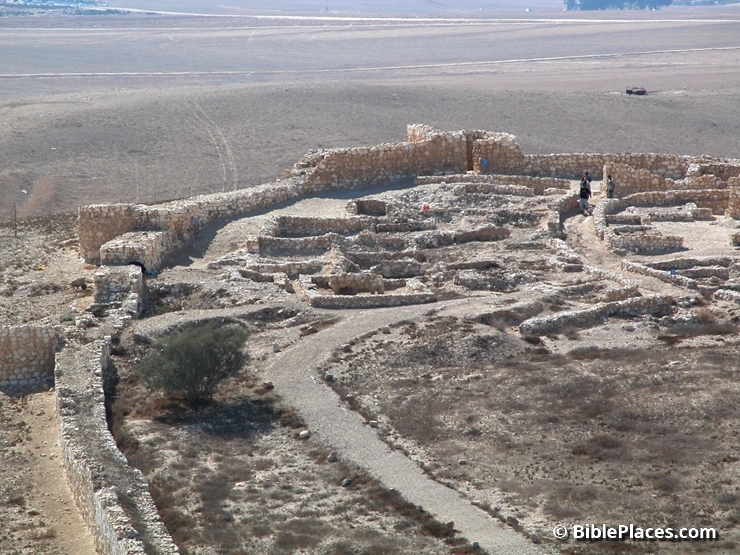
Image © BiblePlaces.com
Part of the ruins of the lower city of Arad in what is now Israel. Arad was founded before 3050 BC and was abandoned around 2650. With an estimated population of 2,500-3,000, the size of Arad in the Early Bronze Age was 25 acres. The city was a tightly packed mass of buildings surrounded by a wall. Though this is far later than Cain’s time, it is still very ancient and perhaps not dissimilar from the kind of city that Cain founded. It shows an ancient Middle Eastern city to be a tight-knit and fortified community.
Cain builds a city―the first city recorded in the Bible. Perhaps he builds it to defy God’s judgment on him―to settle down and stop being a fugitive, and to be secure within its walls.
Cain’s descendants master the skills of raising livestock, music and metal-working. Technology and the arts, foundations of civilisation, flourish. But alongside these cultural advances, there’s violence. Cain’s descendant Lamech threatens merciless revenge on any who dare oppose him.

Blacksmith at work. Among the skills that Cain’s descendants mastered was metal-working.
Another son, another family
Eve gives birth to another son. She calls him Seth, saying “God has appointed for me another offspring instead of Abel . . . .” (Genesis 4:25). Notice the word “offspring”. That word reminds us of God’s promise in Genesis 3:15. Seth is, in fact, an ancestor of the promised offspring who would crush Satan’s head.
In the days of Seth’s son Enosh, people begin “to call on the name of the Lord” (Genesis 4:26 NIV). Some people start to worship and pray to God. Enosh’s great-great-grandson Enoch walks “with God” (5:22). And he never dies―God simply takes him into His presence in heaven!
However bad things get, God always has his people. They may be few. But they are there!
Enoch’s grandson is another man called Lamech. But he’s a complete contrast to the Lamech descended from Cain. This Lamech names his son Noah, saying, “He will comfort us in the labour and painful toil of our hands caused by the ground the LORD has cursed” (Genesis 5:29 NIV). Lamech longs for relief from the painful toil caused by the curse (see Genesis 3:17-19). He hopes his son will bring this about. And so we’re introduced to Noah, who we meet in the next step of our journey.
Photograph courtesy of the Library of Congress Photochrom print collection.
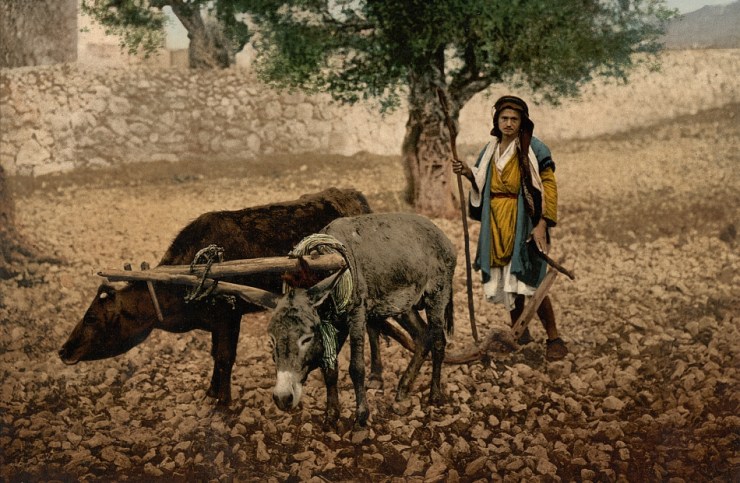
Lamech longs for relief from the painful toil caused by the curse (see Genesis 3:17-19). Photograph of a farmer in Palestine, taken around 1890-1900.
Evil grows worse and worse. Cain founds a godless society. And, as we’ll see next, evil floods the earth. But among this wickedness, there are godly people―Lamech, and Enoch and Noah and others who “call upon the name of the Lord”. However bad things get, God always has his people. They may be few. But they are there!
The flood of evil
As the human race increases in number, sin spirals out of control. Wickedness floods the Earth. Genesis 6:2 tells us: “the sons of God saw that the daughters of humans were beautiful, and they married any of them they chose” (NIV).
Who were these “sons of God”? The most likely scenario is that they were evil angels, under Satan’s control. It seems that these angels were interfering in human procreation, and thus ancestry, in some way. Two New Testament passages probably refer to this episode. Jude writes about “angels who did not stay within their own position of authority, but left their proper dwelling” (Jude 6). Peter also mentions angels who sinned (2 Peter 2:4). The offspring of these “sons of God” and “daughters of humans” are “the mighty men who were of old, the men of renown” (Genesis 6:4). They were famous warriors.
The Lord God sees “that the wickedness of man was great in the earth, and that every intention of the thoughts of his heart was only evil continually” (Genesis 6:5). Evil engulfs our own world today. But the evil in those days was far worse. Satan was well on the way towards bringing humanity totally under his domination―and so realising his ambition to be worshipped and served on Earth.
There may have been another threat, too. If evil angels were indeed interfering in human procreation and ancestry, then Eve’s own family line was threatened. If things carried on like this, her promised “offspring”―the descendant who would “crush” Satan’s “head” (Genesis 3:15), might never be born. God’s plan of salvation was in danger.
The human race was destined for ruin. God is heartbroken: He “regretted that he had made human beings on the earth, and his heart was deeply troubled” (6:6 NIV). So He acts to save our human race. In judgment―but also in mercy―God steps in to stem the hellish tide of sin. He says “I will wipe from the face of the earth the human race I have created—and with them the animals, the birds and the creatures that move along the ground—for I regret that I have made them” (Genesis 6:7 NIV).
The human race was destined for ruin. God is heartbroken. In judgment―but also in supreme mercy―He acts to save our human race.
In the next part . . .
What will become of the human race? Will they all perish? And however will the promised “offspring” be born and crush Satan’s head? We’ll see in the next step of our journey.
Bible passages and Question
You may like to read Genesis 4:1-10, Hebrews 11:4, 1 John 3:12. Here’s a question to think about:
? As we read through the Bible, we discover that many of the people we read about are examples to us. In what ways are Cain and Abel examples to us―an example to avoid, and an example to follow?
Resources
Here’s a short video, entitled From Bad to Worse. It’s designed for children ages 6 to 12. But it’s so good, I think everyone will find it helpful. This video is the third of a series published by Crossway. They’re based on the book called The Biggest Story Bible Storybook. All the videos can be viewed at The Biggest Story videos website. You can also create a free account to enable you to download them.
CREDITS ► Text copyright © 2024 Robert Gordon Betts ► Unless otherwise indicated, all Scripture is taken from the ESV® Bible (The Holy Bible, English Standard Version®), copyright © 2001 by Crossway, a publishing ministry of Good News Publishers. Anglicized English Standard Version copyright © 2002 by Crossway. Used by permission. All rights reserved. The ESV text may not be quoted in any publication made available to the public by a Creative Commons license. The ESV may not be translated in whole or in part into any other language. ► Scripture quotations marked ‘NIV’ are taken from The Holy Bible, New International Version (Anglicised edition). Copyright © 1979, 1984, 2011 by Biblica (formerly International Bible Society). Used by permission of Hodder & Stoughton Publishers, an Hachette UK company. All rights reserved. ‘NIV’ is a registered trademark of Biblica (formerly International Bible Society). UK trademark number 1448790. ► Image of ancient city of Arad © BiblePlaces.com. ► Image of farmer published HERE and courtesy of the Library of Congress Photochrom print collection.
 52 Steps