
Part 6: Mutiny
Click the icon below to download a 4-page PDF version of this page.

Last time, we left Eve gazing at a tree―”the tree of the knowledge of good and evil” (Genesis 2:9,17). Eve saw that it was “good for food”, “a delight to the eyes”, and―what’s more―“to be desired to make one wise” (3:6). Deceived by the crafty snake, Eve takes some of the fruit and eats it. She gives some to Adam. He eats it, too. Thus we enter the most tragic passage in the whole Bible.
God’s judgment and His promise
The snake promised Eve that, if she ate the fruit, her eyes would be opened and she’d “be like God, knowing good and evil” (3:5). After eating the forbidden fruit, Adam and Eve’s eyes are indeed “opened”. But they’re in for a very unpleasant surprise. They realise that they’re “naked” (3:7). They hadn’t bargained for that! That snake had deceived them!
Ashamed, they look around for something―anything―that might cover up their nakedness. They make loincloths from fig leaves. But that doesn’t help―how can it? When God walks in the garden in the cool of the day, in fear they hide from Him. Once, they would have eagerly looked forward to being with God. Now they hide from Him.

When God walks in the garden in the cool of the day, in fear they hide from Him. Once, they would have eagerly looked forward to being with God. Now they hide from Him.
The Lord God calls to Adam and asks “Where are you?” (3:9). Adam replies, “I heard the sound of you in the garden, and I was afraid, because I was naked, and I hid myself” (3:10). God continues, “Who told you that you were naked? Have you eaten of the tree of which I commanded you not to eat?” (3:11).
Adam answers “The woman whom you gave to be with me, she gave me fruit of the tree, and I ate” (3:12). The blame game begins. Adam shifts the blame to Eve. And, by adding “whom you gave to be with me” he even implies it was God’s fault for giving Eve to him in the first place! Satan, the accuser, has sown his own character into human hearts. Adam has become God’s accuser.
God questions Eve too. He asks “What is this that you have done?” She replies, “The serpent deceived me, and I ate” (3:13).
Of course, God knew exactly what the guilty pair had done. But He wanted them to own up. He wanted them to repent and to seek His forgiveness.
Eve was the first to eat. So why did God question Adam first? Adam was the leader in his marriage relationship. The buck stopped with him. He should have stepped in to warn Eve and shield her from the snake’s temptation. But he didn’t. Instead, he followed his wife into sin.
Our holy, righteous God then passes judgment. First, He curses the snake. He condemns it to eat dust. That symbolises humiliation and defeat. No matter how hard Satan tries to thwart God’s purposes, he can never ultimately succeed.
From now on, through the entire Bible story, we see God’s grace “outrunning the avalanche of sin”!
And God says to the snake: “I will put enmity between you and the woman, and between your offspring and hers; he will crush your head, and you will strike his heel” (Genesis 3:15 NIV). A war begins. Satan and Eve would be at war. And there’d be war between their ‘offspring’―people who follow Satan and those who follow God. But God promises that, one day, a single offspring of Eve will “crush” Satan’s “head”―in other words, defeat him. When will he arrive? And how will he defeat Satan? From here on, step by step, the Bible reveals the answers to these questions. From this promise onwards through the entire Bible story, we see God’s grace “outrunning the avalanche of sin”![1]
The fallout from the Fall
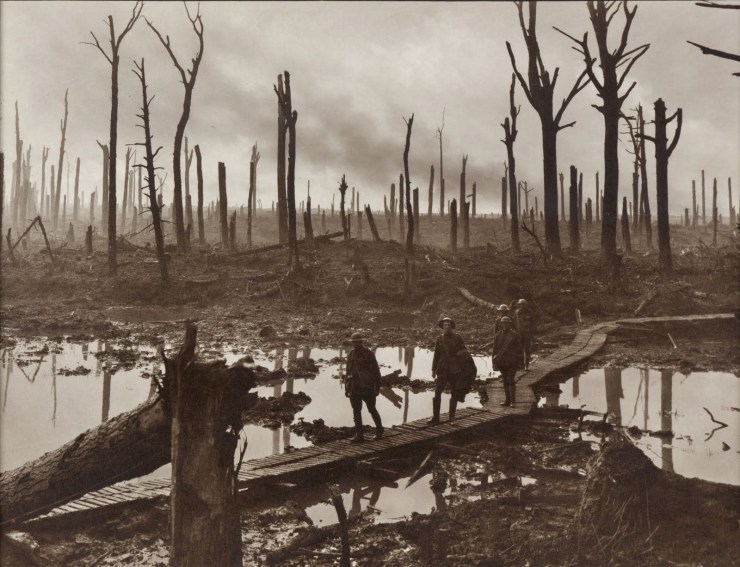
Image from Wikimedia. Image in the public domain.
A photograph from the First World War. Australian soldiers walk through a shattered woodland in Belgium. A graphic image of our suffering world.
We’ve seen that we’re all connected to the very first man, our ancestor Adam. He’s the head of our human race. So when Adam ate the forbidden fruit, all of us―in some mysterious way we can’t fully explain―were implicated in his sin. Perhaps an example will help. On 3rd September 1939, the United Kingdom declared war on Germany. On that day, all British citizens became involved in that war, simply because they were British. When the head of our human race rebelled against God, we all became involved in that rebellion.
Adam’s first act of rebellion did something else, too. Rebellion became part of our human character. Adam and Eve’s sin was different from any other human sin ever committed. Originally they had no urge to sin. They could be―and were―tempted, but they need not have sinned. But from the moment they did sin, they found themselves slaves to sin. And, because we’re all connected to Adam, we’re all born slaves to sin. We’re all born with a natural inclination to want our own way, to do our own thing, to live as if we’re masters of our lives. That self-willed character becomes obvious in our very earliest years!
Why did God make the human race like this? Why are we all connected back to one man, when it’s caused so much trouble and suffering? But this isn’t the end of the story! God designed our human race like this with our blessing in mind, as we’ll see later in our journey.
God had warned Adam that, if he ate the forbidden fruit, “in the day that you eat of it you shall surely die” (Genesis 2:17). But Adam lived for 930 years! Eve, too, lived many years. Of course, they did eventually die―God had said, ”for you are dust, and to dust you shall return” (Genesis 3:19). So what did God mean when He told Adam that he’d die “in the day that you eat of it”?
What happens when someone dies? Their earthly body begins to decay, of course. But the non-material part of them―their spirit―continues to exist. They enter a new, unseen world. They have no further contact with this world; all their relationships with people here on Earth are broken.
The human race was now alienated from God. That brings an emptiness that no-one and nothing else can fill.
And that’s what death really is. Fundamentally, death is broken relationship. When Adam and Eve sinned, all their relationships were spoiled. First and foremost, their relationship with God was broken. The human race was now alienated from God. That brings an emptiness that no-one and nothing else can fill.
Adam and Eve’s relationship with each other was also spoiled. God told Eve, “Your desire shall be contrary to your husband, but he shall rule over you” (Genesis 3:16 NIV). The battle of the sexes began. Husband and wife would now strive to control each other. God intended the marriage relationship to be blessed by perfect harmony and joy. Now it would involve conflict and sorrow. Every other human relationship has been spoiled, too.
Because of Adam and Eve’s sin, Satan gained power over human society. The apostle John wrote that the whole world “lies in the power of the evil one” (1 John 5:19). But we need to remember that Satan rules our world only by God’s permission and within His limits.
What else does sin do?
► Our sin incurs debt. God is our Creator, Sustainer, and Provider; we owe Him our love and obedience. But because we fail to love and obey God, we become indebted to Him―a debt that needs to be paid.
►Our sin spoils other people’s lives.
►Sin brings pain. God said to Eve, “I will surely multiply your pain in childbearing; in pain you shall bring forth children” (Genesis 3:16). The woman’s role as childbearer was now to be attended by pain. Is this just the physical pain of childbirth? Does it also include the emotional pain that so often accompanies raising children? Does it include the anguish of infant mortality, stillbirth, and miscarriage? Perhaps it does. The man’s special role as breadwinner was now accompanied by pain, too. God said to Adam, “. . . cursed is the ground because of you; in pain you shall eat of it all the days of your life; thorns and thistles it shall bring forth for you; . . . . By the sweat of your face you shall eat bread, till you return to the ground, . . . .” (3:17–19). The land would now more readily yield weeds than useful crops. Feeding himself and his family would demand relentless effort. And what if the crops failed and the livestock died?[2]
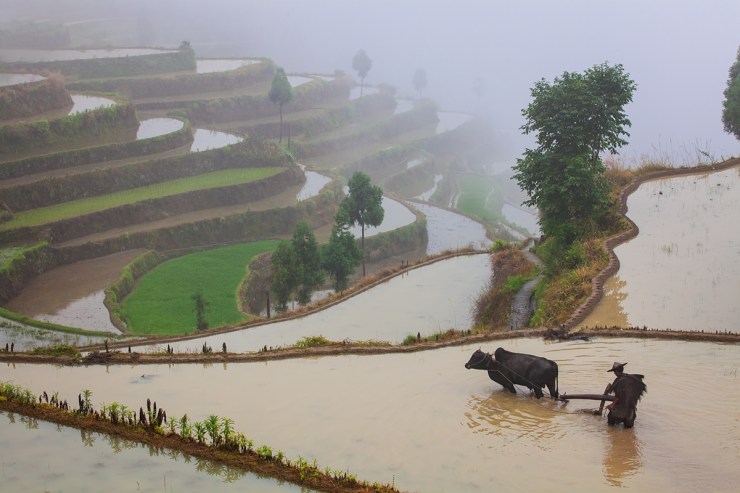
A farmer working on a terraced rice field in Asia. God said to Adam, “. . . cursed is the ground because of you; . . . . By the sweat of your face you shall eat bread, till you return to the ground, . . . .” (3:17–19).
►Sin brings inner turmoil―guilt, anxiety, loneliness, aimlessness and frustration.
►Sin impacts our bodies; we suffer physical disease and injury, and the inevitable ageing process that ends in death.
►Adam and Eve’s sin impacted God’s creation: God subjected it to ”bondage to decay” (Romans 8:21 NIV). And we spoil God’s creation through our own sin―we plunder and pollute the natural world.
►Finally, our human race can’t subdue this planet and have dominion over the natural world as God intended.
Why is there suffering in this world? All of us have asked that question. Our world was created by our good God. Deep down, we know there shouldn’t be suffering in God’s world. And yet there is. Things are not what they ought to be. Why? The basic answer to this age-long question is found here in Genesis 3.
A sacrifice
However could God sort all this out and put everything right? Whatever would it take to unravel such a mess? The rest of the Bible tells us.
But even here, right at the very beginning of the Bible story, God seems to hint at the answer. After pronouncing judgment on them, God clothes Adam and Eve with animal skins (Genesis 3:21). To obtain them, we may assume that animals had to die. It seems that God sacrifices animals to clothe Adam and Eve.
God seems to be telling us this: to deal with human sin and all its consequences, there needs to be death―sacrificial death. Why? And who would suffer this sacrificial death? And how does this death deal with sin and all that sin has done? We’ll see all this later in our journey.
However could God put everything right? The rest of the Bible tells us.
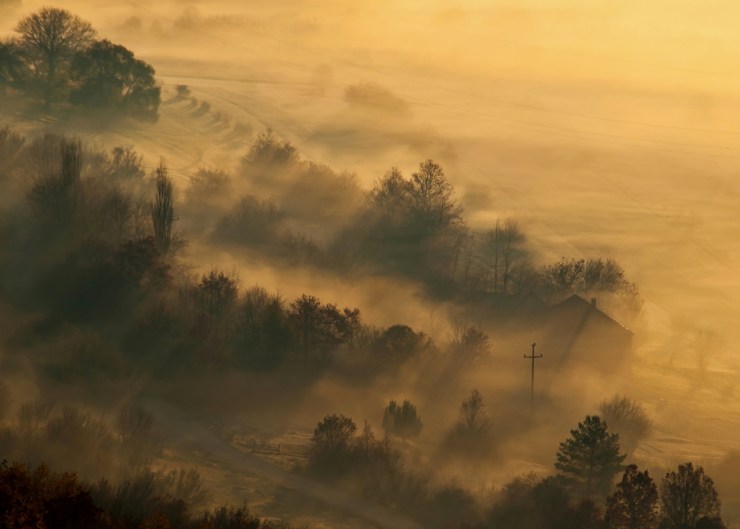
For now, creation is “subjected to frustration” (Romans 8:20 NIV). But when Jesus comes again, it “will be set free from its bondage to corruption and obtain the freedom of the glory of the children of God” (Romans 8:21).
In the next part . . .
Sin spirals out of control until all hope seems lost. But we also see God’s marvellous grace. And in the midst of a sin-soaked society, God has his people. They may be few; but they are there, lights in a darkening world.
Bible passage and Question
It would be helpful to read Genesis 3:1-24. Here’s a question you may like to explore:
?Nicky Gumbel writes, “The issue of suffering is the most frequently raised objection to the Christian faith”.[3] How does what you’ve read above help you to answer that question?
Resources
Here’s a short video, entitled A Very Bad Day. It’s designed for children ages 6 to 12. But it’s so good, I think everyone will find it helpful. This video is the second of a series published by Crossway. They’re based on the book called The Biggest Story Bible Storybook. All the videos can be viewed at The Biggest Story videos website. You can also create a free account to enable you to download them.
REFERENCES [1] This phrase is quoted from The Story of All Stories: Genesis 1-11 by Darrell Johnson, pages 75, 83 and 85. Published by Regent College Publishing, Vancouver, Canada, in 2019. The phrase “avalanche of sin” was used by Gerhard von Rad (see note 5 on page 74 of The Story of All Stories). [2] Adapted from The Epic of Eden: A Christian Entry into the Old Testamentby Sandra L. Richter, page 111. Published by InterVarsity Press, Downers Grove, Illinois, in 2008. [3] Quoted from Why Does God Allow Suffering? By Nicky Gumbel, page 7. New edition published by Alpha International, London, U.K., in 2016.
CREDITS ► Text copyright © 2024 Robert Gordon Betts ► Unless otherwise indicated, all Scripture is taken from the ESV® Bible (The Holy Bible, English Standard Version®), copyright © 2001 by Crossway, a publishing ministry of Good News Publishers. Anglicized English Standard Version copyright © 2002 by Crossway. Used by permission. All rights reserved. The ESV text may not be quoted in any publication made available to the public by a Creative Commons license. The ESV may not be translated in whole or in part into any other language. ► Scripture quotations marked ‘NIV’ are taken from The Holy Bible, New International Version (Anglicised edition). Copyright © 1979, 1984, 2011 by Biblica (formerly International Bible Society). Used by permission of Hodder & Stoughton Publishers, an Hachette UK company. All rights reserved. ‘NIV’ is a registered trademark of Biblica (formerly International Bible Society). UK trademark number 1448790. ► Image from World War I battlefield on page 2 published HERE This image is Crown Copyright because it is owned by the Australian Government or that of the states or territories, and is in the public domain because it was created or published prior to 1970 and the copyright has therefore expired. The government of Australia has declared that the expiration of Crown Copyrights applies worldwide. Image cropped.
 52 Steps

