
Part 50: Coming with the Clouds of Heaven
Click the icon below to download a 4-page PDF version of this page.

The signs of Jesus’s coming
Forty days after His resurrection, the eleven disciples watch as Jesus “was lifted up, and a cloud took him out of their sight” (Acts 1:9). As they gaze upwards, two angels tell them, “This Jesus, . . . will come in the same way as you saw him go into heaven” (Acts 1:11). At the end of this age, Jesus will return to Earth. The “appearing of the glory of our great God and Saviour Jesus Christ” is our “blessed hope” (Titus 2:13). Three times at the end of the Bible Jesus declares, “I am coming soon” (Revelation 22:7,12,20). The apostle John responds, ”Amen. Come, Lord Jesus!” (22:20). That’s the cry of all God’s faithful people through the ages. Come, Lord Jesus!
Three times at the end of the Bible Jesus declares, “I am coming soon”. The apostle John responds, “Amen. Come, Lord Jesus!”
Two days before Jesus’s crucifixion, one of His disciples points out to Him how magnificent the Temple is. But Jesus responds, “There will not be left here one stone upon another that will not be thrown down” (Mark 13:1). Later, His disciples come to him privately, and ask, “Tell us, when will these things be, and what will be the sign of your coming and of the close of the age?” (Matthew 24:3). That’s the question we’d all like to ask!
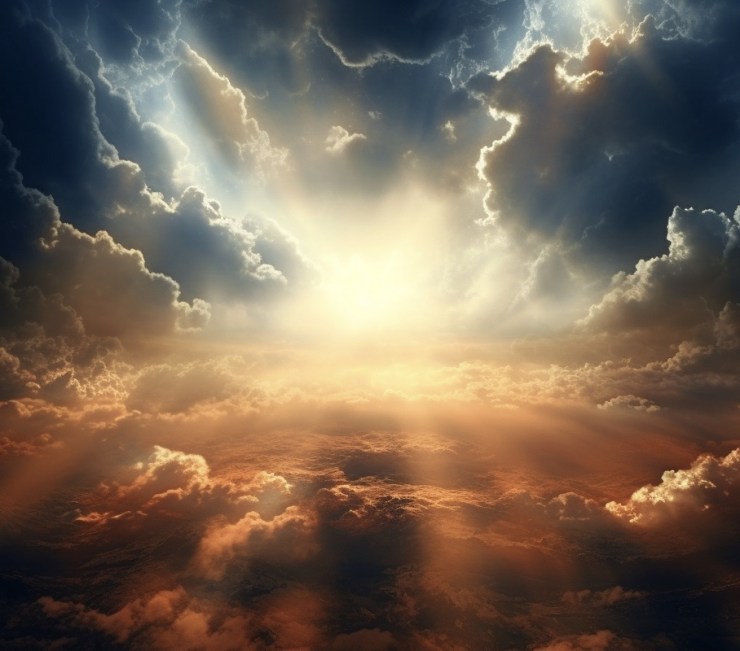
When Jesus returns “. . . the powers in the heavens will be shaken. And then they will see the Son of Man coming in clouds with great power and glory” (Mark 13:25-26).
The Bible makes it clear that certain things must happen before Jesus comes. He tells them, “. . . you will hear of wars and rumours of wars. . . . but the end is not yet. . . . nation will rise against nation, . . . and there will be famines and earthquakes in various places. All these are but the beginning of the birth pains.” (Matthew 24:6-8). Wars and disasters have continued throughout human history. But it seems likely that they will increase to a climax shortly before Jesus returns―just as the pain of childbirth comes to a climax just before the baby is born. And in Part 49, we learned that Jesus’s Second Coming won’t happen before “the rebellion”―a great revolt against God led by “the man of lawlessness”, the Antichrist (2 Thessalonians 2:1-3).
Jesus also speaks about the persecution that believers will face. He says, “Then you will be handed over to be persecuted and put to death, and you will be hated by all nations because of me” (Matthew 24:9 NIV). He warns them of spiritual decline and deception in the Church: “At that time many will turn away from the faith and will betray and hate each other, and many false prophets will appear and deceive many people. Because of the increase of wickedness, the love of most will grow cold, but the one who stands firm to the end will be saved.” (Matthew 24:10-13 NIV).
But Jesus continues: “this gospel of the kingdom will be proclaimed throughout the whole world . . . , and then the end will come” (Matthew 24:14). And God has promised the salvation of “all Israel”; Paul tells us that “a partial hardening has come upon Israel, until the fullness of the Gentiles has come in. And in this way all Israel will be saved, . . . .” (Romans 11:25-26). This probably doesn’t mean every individual Jew will be saved. But it does mean many Jews―in fact, most of the nation―will accept Jesus as their Messiah, as His Second Coming draws closer.[1]
The day of His coming
How will Jesus return to Earth?
● He’s coming in person, in His resurrection body. He ascended bodily into Heaven, and (as we saw earlier) He’ll come back “in the same way” (Acts 1:11).
●He’s coming with power and glory. Jesus came once as a helpless infant; He’ll return “with power and great glory” (Matthew 24:30) with “all the angels” (Matthew 25:31), “with a cry of command, with the voice of an archangel, and with the sound of the trumpet of God” (1 Thessalonians 4:16). His people will rejoice at His coming. But unbelievers will call “to the mountains and rocks, ‘Fall on us and hide us from the face of him who is seated on the throne, and from the wrath of the Lamb, for the great day of their wrath has come, and who can stand?’” (Revelation 6:16-17).
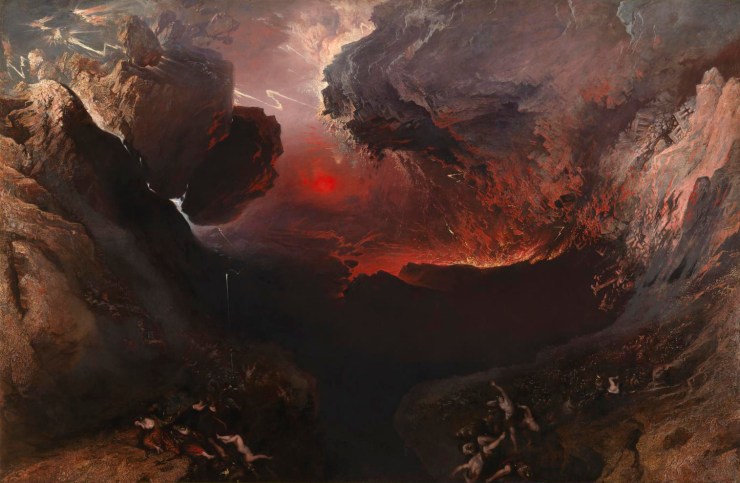
Image from Wikimedia Commons
The Great Day of His Wrath painted by John Martin. The artist was inspired by the description of the Last Judgment in Revelation. We read, “When he opened the sixth seal, . . . the sun became black as sackcloth, . . . . The sky vanished like a scroll that is being rolled up, and every mountain and island was removed from its place. Then . . . everyone, . . . hid themselves in the caves and among the rocks of the mountains, calling to the mountains and rocks, ‘Fall on us and hide us from the face of him who is seated on the throne, and from the wrath of the Lamb, for the great day of their wrath has come, and who can stand?’” (Revelation 6:12-17).
●He’s coming openly. Jesus’s first coming was in obscurity―born in an ordinary town in a troubled corner of the Roman Empire. But when He comes again, “every eye will see him” (Revelation 1:7). Jesus tells us, “. . . the sun will be darkened, and the moon will not give its light; the stars will fall from the sky, . . . . then all the peoples of the earth will mourn when they see the Son of Man coming on the clouds of heaven, with power and great glory.” (Matthew 24:29-30 NIV). At His coming, it seems that Heaven and Earth will suddenly be transparent to each other. And so everyone―wherever they are―will see Him.

Jesus said, “as the lightning flashes and lights up the sky from one side to the other, so will the Son of Man be in his day” (Luke 17:24).
●He’s coming unexpectedly. The day of the Lord “will come like a thief in the night” (1 Thessalonians 5:2); it will catch this world unawares. Jesus says, “But about that day or hour no one knows, . . . only the Father. Be on guard! Be alert!” (Mark 13:32-33 NIV). We believers must be ready for Him (see Matthew 24:42-25:13). We’re to live obedient, faithful lives, watchful for the day of His coming. Those who walk closely with Him may well become increasingly aware of the approach of that day.[2]
There’s much debate about the sequence of events when Jesus returns. Some events―or even all of them―may happen at the same time. Here’s an outline: ►Jesus will conquer all the powers of evil. ► Every believer, from every period of history, will receive a glorious resurrection body, and will meet Jesus. ►The great final judgment will take place. ► Satan and his evil angels, together with every human who has rejected God, will be thrown into Hell. ►Finally, a “new heaven and a new earth” will come into being. Believers will live there in God’s presence for ever.
Destruction and death to the devil’s domain
At His coming, Jesus will conquer all the powers of evil that we met in Part 49: Babylon (17:1-6), which seems to be godless civilisation; the sea beast (13:1-10, 17:1-18), which seems to be godless political and military regimes; the land beast (13:11-18), also called “the false prophet” (16:13), which seems to be false religion and godless ideology and the dragon (12:3-4,7-17), Satan himself.
► Babylon will fall―an event dramatically portrayed in 18:1-19:5. ”Fallen! Fallen is Babylon the Great!”; “In one hour she has been brought to ruin!” (Revelation 18:2,19 NIV). Evil always bears the seeds of its own destruction. The “ten horns” on the beast, and the beast itself, ”will hate the prostitute” and “make her desolate and naked, and devour her flesh and burn her up with fire” (17:16). It seems that godless regimes end up destroying the very civilisations that they’ve birthed and nurtured. Godless civilisation is ripe for God’s judgment. But it’s Satan’s forces which execute God’s justice upon it. Evil is serving the purposes of God.

Image from Wikimedia Commons
The Course of Empire: Destruction painted by Thomas Cole. This is the fourth of a series of five paintings illustrating the rise and fall of a great city. It depicts its fall. Compare this scene with the second image in Part 49 depicting the city at its height of glory. A storm rages in the distance, and it seems that a fleet of enemy warriors has overthrown the city’s defences, sailed up the river, and is torching the city and ravaging and killing its inhabitants. The bridge across the river is broken; a makeshift crossing strains under the weight of soldiers and refugees. In his advertisements for the series, the artist quoted these lines from Lord Byron’s poem ‘Childe Harold’s Pilgrimage’: “There is the moral of all human tales; / ‘Tis but the same rehearsal of the past, / First Freedom and then Glory―when that fails, / Wealth, vice, corruption,―barbarism at last. / And History, with all her volumes vast, / Hath but one page, . . . .”[3]
► Jesus will destroy the Antichrist. Paul writes, “. . . then the lawless one will be revealed, whom the Lord Jesus will overthrow with the breath of his mouth and destroy by the splendour of his coming” (2 Thessalonians 2:8 NIV).
► Jesus will defeat the two beasts. In Revelation 19:11-21 John sees Christ―“King of kings and Lord of lords”, crowned with many crowns―riding a white warhorse. He’s “The Word of God”; from His mouth comes “a sharp sword with which to strike down the nations”. Following Him on white horses are ”the armies of heaven”, clad ”in fine linen, white and pure”―these seem certain to be God’s people. This is the last battle, fought at Armageddon “on the great day of God the Almighty” (16:14), the day when Jesus returns. This battle is fought and won, not with weapons of steel, but with the truth. The beast and the false prophet are deceivers. So it’s truth that defeats them―proclaimed by the One who is “The Word of God”, and “the truth” (John 14:6). The beast and false prophet are captured and “thrown alive into the lake of fire that burns with sulphur”. And so Jesus destroys the worldly regimes, and the belief systems that supported them. And with His sword―His word of judgment―Christ slays “the kings of the earth with their armies”, people who were captivated by the false prophet’s lies, and worshipped the beast (13:12-15).
The great final battle is fought and won, not with weapons of steel, but with the truth.
This is the final battle in the war that began in the Garden of Eden. At its heart, this war has always been about truth. As we saw in Part 5, Satan deceived Adam and Eve into thinking wrongly and believing his lies (Genesis 3:1-7). He’s “the father of lies” (John 8:44). Here in Revelation 19:11-21, the word of the One who is the “the truth” executes judgment on the beast and the false prophet, the great deceiver’s deceiving henchmen.
► Satan will be thrown into Hell. In Revelation 20:1-6 we see an angel chaining and imprisoning Satan for “a thousand years”, a period called ‘the Millennium’. During that time, God’s people reign with Christ. Then after the “thousand years” Satan is released; he deceives the nations and gathers them to attack God’s people. But “fire came down from heaven and devoured them”; Satan is “thrown into the lake of burning sulphur, . . . .”, where, together with the beast and the false prophet, he’ll be “tormented day and night for ever and ever” (Revelation 20:9-10 NIV).
The Millennium
Christians have interpreted Revelation 20:1-10 in different ways. We haven’t space to cover them all here. One clue is this: Jesus has chained Satan, “the strong man” (Matthew 12:29).[4] And shortly before His death, Jesus said, “now will the ruler of this world be cast out” (John 12:31). He has defeated Satan by the Cross. Now Jesus is seated at His Father’s right hand, treading down all His enemies (Psalm 110:1). He has complete authority over all the evil powers (Ephesians 1:20-21).[5][6]
Satan can’t “deceive the nations” (Revelation 20:3) any more. In the past, God “allowed all the nations to walk in their own ways” (Acts 14:16), but “now he commands all people everywhere to repent” (Act 17:30). Daily, God is delivering people “from the domain of darkness” and transferring them “to the kingdom of his beloved Son” (Colossians 1:13). Threaten though he may, Satan can’t stop people coming to Christ (John 12:32).
So it’s not unreasonable to understand the “thousand years” to be the whole period from Christ’s resurrection to His Second Coming.[7][8] We can then interpret the rest of Revelation 20:1-10 in this light―and see the battle of 20:8-10 as another ‘camera angle’ on the end-time battle of Armageddon.

This bronze sculpture of St Michael’s victory over the devil is displayed outside Coventry Cathedral. It depicts the scene in Revelation 12:7-9: “Now war arose in heaven, Michael and his angels fighting against the dragon. . . . . And the great dragon was thrown down, that ancient serpent, who is called the devil and Satan, . . . and his angels were thrown down with him.” Satan is shown with chains around his feet and loins, which recalls Revelation 20:1-3. Revelation 12:7-9 and 20:1-3 both seem to describe the same event―Jesus’s defeat of Satan at the Cross.
Our resurrection
Paul explains: “. . . the Lord himself will come down from heaven, with a loud command, . . . and the dead in Christ will rise first”; then believers still alive when Jesus returns “will be caught up together with them . . . to meet the Lord in the air” (1 Thessalonians 4:16-17 NIV). This act of being “caught up” is often called ‘the rapture’.
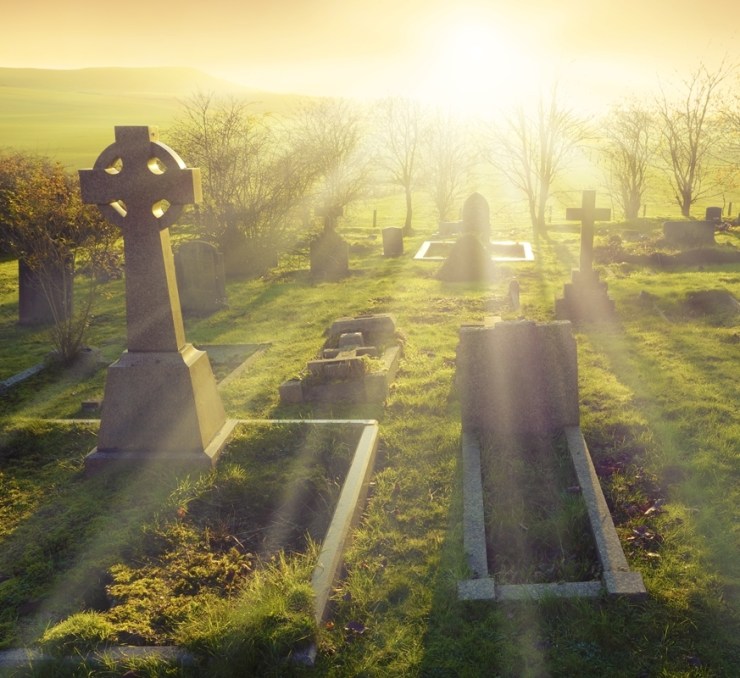
Paul writes, “. . . the Lord himself will come down from heaven, with a loud command, with the voice of the archangel and with the trumpet call of God, and the dead in Christ will rise first.” (1 Thessalonians 4:16 NIV).
All believers who’ve died will be raised with new resurrection bodies. The bodies of believers still alive at Jesus’s coming will be transformed without going through death. Jesus “will transform our lowly bodies so that they will be like his glorious body” (Philippians 3:20-21 NIV). Unbelievers will also receive resurrection bodies, though we don’t know what they’ll be like.
The last judgment
Then everyone will be judged. John writes: “. . . I saw a great white throne and him who was seated on it. . . . . And I saw the dead, . . . standing before the throne, and books were opened. Then another book was opened, which is the book of life. And the dead were judged by what was written in the books, according to what they had done.” (Revelation 20:11-12). John doesn’t say whether the Father or the Son is seated on this throne. But we know that the Father has handed over all judgment to the Son (John 5:22,27, Acts 17:31). Jesus Himself said He’ll “come in his Father’s glory with his angels, and then he will reward each person according to what they have done” (Matthew 16:27 NIV). So it seems clear that Jesus will be our Judge. One reason is surely this: Jesus is not only God, but also a human being like us, and was tempted just as we are, yet without sin (Hebrews 4:15). And for us believers, that is a great comfort. The very same person who suffered and died to forgive our sins, and rose again to give us new resurrection life, is the One who will be our Judge.[9]
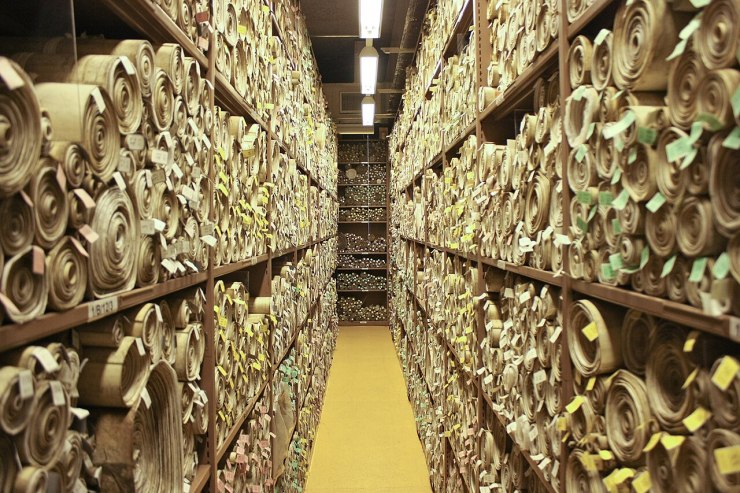
Acts of Parliament housed in the Victoria Tower, Palace of Westminster © Jeroen at Wikimedia Commons (CC BY 2.0)
John writes, “I saw the dead, . . . standing before the throne, and books were opened. Then another book was opened, which is the book of life. And the dead were judged by what was written in the books, according to what they had done.” The books that John saw were scrolls. The scrolls in this image are records of Acts of Parliament of the government of the United Kingdom. The whole archive contains records going back hundreds of years.
Believers will be judged, as well as unbelievers. God has justified believers; our names are written in “the book of life”. Nonetheless “we will all stand before God’s judgment seat . . . . each of us will give an account of ourselves to God” (Romans 14:10,12 NIV). God will assess every person’s life―even their most secret thoughts. In the end, nobody can blame their heredity or upbringing or circumstances for the kind of person they’ve become. It’s our responses to life’s circumstances that makes us what we are at the moment of death.
Our lives on Earth now are our ‘formative years’―a foundational period of training and maturing that’s preparing us for life in the world to come. So how are we living? Are we yielding ourselves fully to God? Are we being moulded by the Spirit into the image of His Son (see 2 Corinthians 3:18)? Are we presenting our bodies “as a living sacrifice” and allowing the Holy Spirit to transform us by renewing how we think (Romans 12:1-2)?[10] Are we walking in the Spirit, rather than in our own strength? Are we trusting and obeying God, come what may?
Our lives on Earth are our ‘formative years’―a foundational period of training and maturing that’s preparing us for life in the world to come.
Hell
At the last judgment, God will assign each person their eternal destiny―either to live with Him in His new creation, or to live without Him in Hell. We’ll explore the new creation in the final two parts of our series. For now, we must consider the other destination―Hell. Paul tells us that “the Lord Jesus” will be “revealed from heaven with his mighty angels in flaming fire, inflicting vengeance on those who do not know God and on those who do not obey the gospel of our Lord Jesus. They will suffer the punishment of eternal destruction, away from”―or “that comes from” (ESV footnote)―“the presence of the Lord . . . .” (2 Thessalonians 1:7-9).
The Greek word most often used for “hell” in the New Testament is gehenna. This name is derived from the name of a valley outside Jerusalem called “the Valley of the Son of Hinnom” (Jeremiah 32:35). This was once a place where children were sacrificed by fire to a pagan god, which called down God’s judgment. The combination of fire, God’s judgment, and slaughter, made the Valley of Hinnom a vivid image of Hell. The most graphic descriptions of Hell come from Jesus Himself. He tells us it’s “where ‘the worms that eat them do not die, and the fire is not quenched’” (Mark 9:48 NIV); it’s “the outer darkness”, where there’ll be “weeping and gnashing of teeth” (Matthew 8:12). In Revelation 21:8, it’s “the lake that burns with fire and sulphur, which is the second death”. This is picture language, but it reflects a terrible reality―the agonising sense of God’s anger, and of guilt and shame, loneliness, self-loathing and regret, and the emptiness of an existence without purpose and meaning.[11]
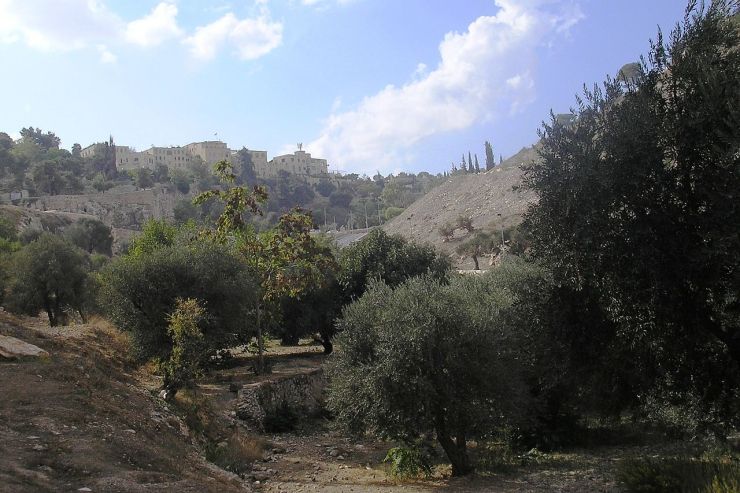
Valley of Hinom © Deror avi at Wikimedia Commons (CC BY-SA 3.0)
The valley of Hinnom, referrd to in the Old Testament as “the Valley of the Son of Hinnom” (Jeremiah 32:35). This was once a place where children were sacrificed by fire to a pagan god, which called down God’s judgment. The combination of fire, God’s judgment, and slaughter, made the Valley of Hinnom a vivid image of Hell.
The underlying torment of hell is relational. We humans were made to love. But in Hell there is no love, no meaningful relationships of any kind. First and foremost, those in Hell are estranged from God, and experience His righteous anger. God made us for Himself.[12] To be estranged from Him is to lose everything that makes life worth living.

We humans were made to love. But in Hell there is no love, no meaningful relationships of any kind.
God loves each one of us with an unimaginably vast and steadfast love―a love supremely demonstrated on the Cross. He doesn’t want anyone to “perish, but that all should reach repentance” (2 Peter 3:9). God makes it as difficult as He can for people to reject Him. But He does not make it impossible. Some people choose to reject God, and to live without Him. And that choice becomes their destiny.
Next time . . .
In Revelation 21:1-22:5, our vision is filled with the glorious sight of God’s city, New Jerusalem, who is none other than the beautiful Bride of Christ!
Bible Readings and Question
You may like to read Revelation 1:1-3, 1:9, 3:14, 6:9, 19:11-21, and 20:4. Here’s a question to think about:
?In the Book of Revelation, the words and phrases “word of God”/“Word of God”, “witness”, and “testimony” occur a number of times. Given that one of Revelation’s key themes is spiritual warfare, why do you think this is? See also Ephesians 6:17.
Video
Here’s a short video, entitled The Snake Crusher Wins: The Story of the Final Battle (Revelation 20). It’s designed for children ages 6 to 12. But it’s so good, youth and adults may well enjoy it, too. This video is in a series published by Crossway. It’s based on the book called The Biggest Story Bible Storybook. All the videos can be viewed at The Biggest Story videos website. You can also create a free account to enable you to download them.
REFERENCES [1] See Romans: a Concise Guide to the Greatest Letter Ever Written by Andrew David Naselli, pages 143-145. Published by Crossway, Wheaton, Illinois, in 2022. [2] See His Waiting Bride: an Outline of Church History in the Light of The Book of Revelation, from the Lectures of Edgar E. Parkyns, page 55. Published by Wheatcorn Publications, West Ewell, United Kingdom, in 1996. [3] See The Course of Empire (paintings) in Wikipedia, last edited 30 March 2025 at 19:09 UTC. Available online at https://en.wikipedia.org/wiki/The_Course_of_Empire_(paintings), accessed on 16 June 2025. [4] See The Expositor’s Bible Commentary, Revised Edition, Volume 9: Matthew and Mark, Tremper Longman III and David E. Garland, general editors, page 335. Published by Zondervan, Grand Rapids, Michigan, in 2010. [5] See The Letter to the Ephesians (Pillar New Testament Commentary) by Peter T. O’Brien, page 141-144. Published by William B. Eerdmans Publishing Company, Grand Rapids, Michigan, and Cambridge, United Kingdom, and Apollos, Leicester, United Kingdom, in 1999. [6] See Ephesians (Word Biblical Commentary, Volume 42) by Andrew T. Lincoln, pages 62-65. Published by Word Books, Dallas, Texas. [7] See The Revelation of John: a Commentary on the Greek Text of the Apocalypse by Stephen S. Smalley, pages 504-505. Published by SPCK, London, United Kingdom, in 2005. [8] See Triumph of the Lamb: a Commentary on Revelation by Dennis E. Johnson, pages 287-288. Published by P&R Publishing, Phillipsburg, New Jersey, in 2001. [9] See Come, You Weary: Enjoy Christ’s Comfort by Michael Reeves. Published by Union Publishing, Bridgend, United Kingdom, in 2025. [10] See The Epistle to the Romans (The New International Commentary on the New Testament) by Douglas Moo, pages 754-758. Published by William B. Eerdmans Publishing Company, Grand Rapids, Michigan, and Cambridge, United Kingdom, in 1996. [11] See Knowing God by J.I. Packer, pages 172-173. Published by Hodder and Stoughton, London, United Kingdom, in 1975. [12] See Confessions by Augustine of Hippo, book 1, chapter 1. Newly translated and edited by Albert C. Outler, Perkins School of Theology, Southern Methodist University, Dallas, Texas. Published by the Christian Classics Ethereal Library, Grand Rapids, Michigan, in 1955. Available online at https://www.ccel.org/ccel/augustine/confessions, accessed on 4 May 2024. In this book, the exact quotation is, “thou hast made us for thyself and restless is our heart until it comes to rest in thee”.
CREDITS ► Text copyright © 2025 Robert Gordon Betts ► Unless otherwise indicated, all Scripture is taken from the ESV® Bible (The Holy Bible, English Standard Version®), copyright © 2001 by Crossway, a publishing ministry of Good News Publishers. Anglicized English Standard Version copyright © 2002 by Crossway. Used by permission. All rights reserved. The ESV text may not be quoted in any publication made available to the public by a Creative Commons license. The ESV may not be translated in whole or in part into any other language. ► Scripture quotations marked ‘NIV’ are taken from The Holy Bible, New International Version (Anglicised edition). Copyright © 1979, 1984, 2011 by Biblica (formerly International Bible Society). Used by permission of Hodder & Stoughton Publishers, an Hachette UK company. All rights reserved. ‘NIV’ is a registered trademark of Biblica (formerly International Bible Society). UK trademark number 1448790.
 52 Steps


