
Part 47: Soldiers of Christ
Click the icon below to download a 4-page PDF version of this page.

The last days
Jesus has defeated, disarmed, and bound Satan. He has crushed the serpent’s head (Genesis 3:15). ● He’s proved Satan to be “a liar and the father of lies” (John 8:44). Satan’s great lie is: God is not good. [1] But in His life, and supremely on the Cross, Jesus demonstrated that God is good; He loves, and loves without limit. “For God so loved the world, that he gave his only Son, . . . .” (John 3:16). ● And Jesus has released us from Satan’s condemnation by forgiving our sin. God has declared us not guilty, and credited us with Christ’s perfect righteousness. Once Satan could legitimately demand that God punish us. But now he can’t!
But though Satan is defeated, God hasn’t yet removed him from creation and thrown him into hell. That will happen when Jesus returns. Till then, Christ “must reign until he has put all his enemies under his feet. The last enemy to be destroyed is death.” (1 Corinthians 15:25-26). Our current period of history―from the Day of Pentecost until Jesus’s Second Coming―is what the Bible calls the “last days” (for example, Acts 2:17). During these “last days” war is raging in heavenly places and here on Earth. Satan and his powers of evil are fighting a fierce rearguard action against God and His people (see Revelation 12:9-10,13-17). And God has enlisted us in His army; we’re on the final push to total triumph. Satan’s kingdom is being plundered. Daily, throughout the world, people are being born again and enrolled as citizens in God’s Kingdom. Jesus’s great commission is being fulfilled―God’s people are making “disciples of all nations” (Matthew 28:18-20).
On 6th June 1944―D-Day―Allied forces landed on the Normandy beaches and began their final advance towards Germany and victory over the Nazis. The Allies had overwhelming superiority in men and weapons. Victory was assured. But the war wasn’t over―many battles lay ahead; many lives would be lost. In our spiritual conflict, ‘D-Day’ took place on the Cross. But the war against Satan is not yet over. Many battles lie ahead. The conflict will surely grow fiercer as our Lord’s return draws near. But the outcome is never in doubt.
‘D-Day’ took place on the Cross. But the war against Satan is not yet over. Many battles lie ahead. But the outcome is never in doubt.
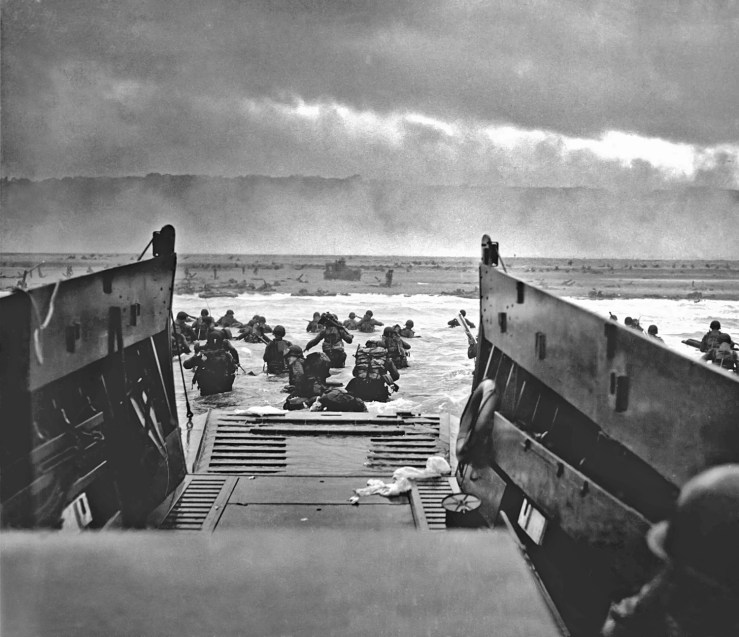
Image from Wikimedia Commons
A historic photograph of D-Day. Landing craft disembark troops of the U.S. Army’s First Division at Omaha Beach, Normandy. In our spiritual conflict, ‘D-Day’ took place on the Cross; we’re on the final push to total triumph.
Know your enemy
One of the vital keys to success in any war is to know your enemy―his personality, his aims, and his strategies. So Paul tells us about our enemy: “For we do not wrestle against flesh and blood, but against the rulers, against the authorities, against the cosmic powers over this present darkness, against the spiritual forces of evil in the heavenly places” (Ephesians 6:12). Notice the detailed way Paul describes the forces of evil―we face a powerful array of foes. And we need to remember that our battlefield is in “the heavenly places”―an unseen spiritual realm that’s every bit as real as this world, and closer to us than we may think. What happens here on Earth is only part of the picture. We can’t judge things just by what we see around us. We need God’s Spirit to show us what’s really going on.
We have a crafty, scheming enemy―we’re up against “the schemes of the devil” (Ephesians 6:11). Satan’s key weapon is deception. He’s “the deceiver of the whole world” (Revelation 12:9). And that means our primary battlefield is our minds, our thinking. Right at the beginning, Satan deceived Adam and Eve into believing lies about God―we saw this in Part 5. Satan does the same to us. He tempts us to believe lies. He’s a master of cunning trickery. We face guerilla tactics―sabotage, ambushes and booby-traps. He tries to take our eyes off the truth. He tries to blur the lines between truth and error. He tries to lead us down false trails to drain our spiritual strength. He “prowls around like a roaring lion looking for someone to devour” (1 Peter 5:8 NIV).
And notice the word Paul uses to describe our combat―we “wrestle”. Our battle is like a wrestling-match. It’s fought at close quarters, and involves our whole person. [2]
“The whole armour of God”
How do we fight? Not in our own strength. We’re no match for Satan and his forces. Unaided, we’d go down like skittles. We’re to be “strong in the Lord and in the strength of his might” (Ephesians 6:10). We fight in the Lord’s strength, not ours.
God equips us for battle with His armour. [3] Paul writes, “Put on the whole armour of God, that you may be able to stand against the schemes of the devil. . . . . Therefore take up the whole armour of God, that you may be able to withstand in the evil day, and having done all, to stand firm. Stand therefore, . . . .” (Ephesians 6:11,13-14). Notice how Paul emphasises the word “stand”. He doesn’t urge us to win the victory. It’s already been won. Jesus Christ has already defeated Satan (see, for example Colossians 2:15). We believers are seated with Christ in heavenly places; we share His victory over evil powers. Our part is to stand firm in that victory. We’re to withstand the enemy’s onslaught, refuse to give him a single foothold in our own personal lives, or in the life of our church.
Jesus Christ has already defeated Satan. We share His victory. Our part is to stand firm in that victory.
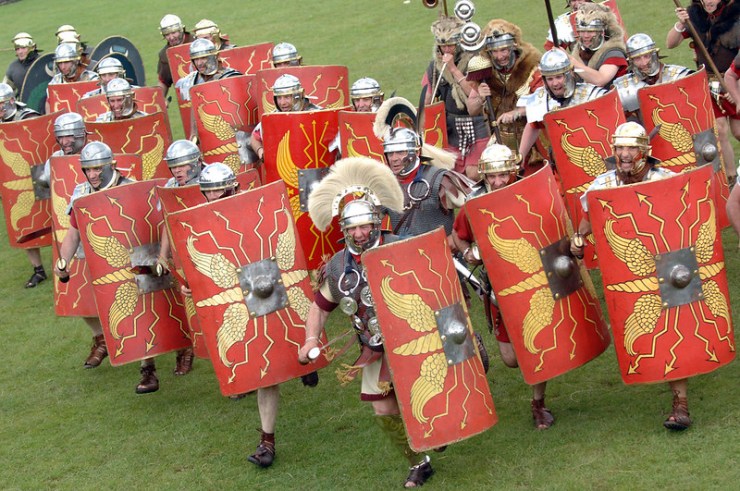
Then in Ephesians 6:14-17, Paul lists the different pieces of equipment; the Roman soldier’s battle kit may well have been in his mind as he wrote.
The charge © Amgueddfa Cymru / National Museum of Wales on Flickr.com
(CC BY-NC 2.0)
The Ermine Street Guard at Caerleon, South Wales, re-enacting Roman soldiers charging the enemy.
Jesus the Messiah is our great Warrior. He’s worn the armour of God and wielded the sword of His word to gain the victory for us (Isaiah 11:4-5, 52:7, 59:17). Now He’s enlisted us in the final stage of the battle against Satan and his forces. [4]
What do all these pieces of kit symbolise? And how exactly do we equip ourselves with them? The clue is this: Satan’s key weapon is deception. He wants us to think wrongly. He wants us to believe lies.
► We’re to stand “having fastened on the belt of truth”. To prepare for battle, you need to put your belt on and tighten it so your clothes don’t flap about and hinder you. The belt also provides a place to fix your sword. The “truth” is God’s gospel truth (Ephesians 1:13, and see 4:21)―truth that Satan tries so hard to make us lose sight of. We’re to stand firm in the truth of Scripture: the truth about who God is, what Christ has done for us, and who we are in Christ. And we’re to walk―in other words, live every day―“in the truth” (2 John 4, 3 John 3-4).
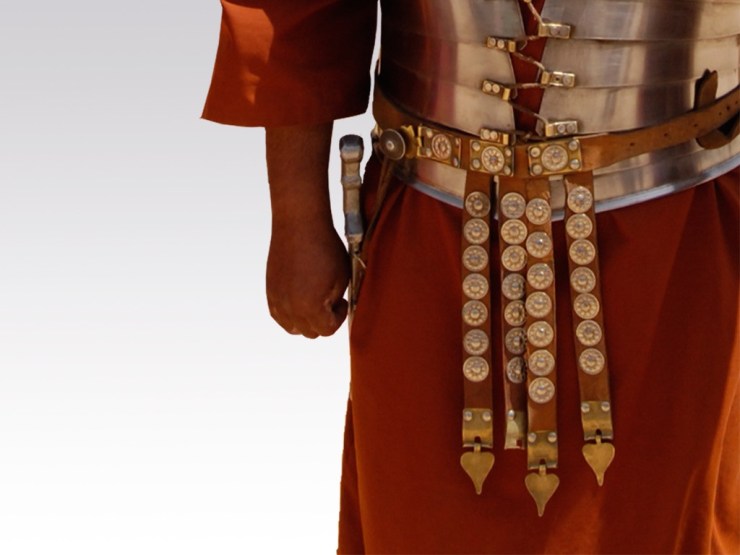
Image © David Padfield and courtesy of FreeBible Images (CC BY-NC 4.0)
A replica of a Roman soldier’s belt, holding the inner tunic and the breastplate in place.
►We must put on “the breastplate of righteousness”. A breastplate protects our vital organs in battle. On the Cross, the Father made Christ “to be sin who knew no sin, so that in him we might become the righteousness of God” (2 Corinthians 5:21). God has given us “the free gift of righteousness” (Romans 5:17). We’re “in Christ”, and so we’re clothed with Jesus’s own righteousness. We’re to “put on” this truth―in other words, choose to believe it―to protect us against all Satan’s accusations. And we’re to build on that foundational truth by living rightly. We must “put on the new self, created to be like God in true righteousness and holiness” (Ephesians 4:24 NIV). Righteous, godly living is a powerful defence against our enemy.

Caliga, Roman soldier’s sandal from the 1st century AD, Landesmuseum, Mainz © Carole Raddato from Frankfurt, Germany at Wikimedia Commons (CC BY-SA 2.0)
A Roman soldier’s hobnailed sandal dating from the 1st century AD―and thus during the period of the early Church.
►Our feet must be shod with “the readiness given by the gospel of peace”. Paul may well be thinking here of the Roman hobnailed sandal. This gave good grip, preventing slipping and sliding―essential when fighting at close quarters. The “gospel of peace” gives us “peace with God” (Romans 5:1); that, in turn, gives us “the peace of God” which surpasses our understanding and guards our “hearts and . . . minds in Christ Jesus” (Philippians 4:7). That peace is firm and strong, enabling us to hold our ground and resist Satan, whatever he throws at us. Peter writes, “Your adversary the devil prowls around . . . . Resist him, firm in your faith, . . . .” (1 Peter 5:8-9); James tells us, “Submit . . . to God. Resist the devil, and he will flee from you” (James 4:7).

Satan “prowls around like a roaring lion looking for someone to devour. Resist him, standing firm in the faith, . . . .” (1 Peter 5:8-9 NIV).
►We must grasp “the shield of faith”. Paul has in mind the large Roman wooden shield about four feet high and 2½ feet wide, covered in canvas and leather, that protected the whole body. [5] When soaked in water, this shield could quench the enemy’s flaming arrows. Unswerving, resolute trust in God’s love and care for us quenches “all the flaming darts of the evil one”―things like doubts, selfish ambitions, fleshly desires, desire for revenge, jealousy, and despondency.
►We must put on “the helmet of salvation”―the firm assurance that God has rescued us from Satan’s dominion and made us His beloved children, and the confidence we’ll enjoy perfect salvation when Jesus returns―what Paul also calls the “helmet” that is “the hope of salvation” (1 Thessalonians 5:8, see Hebrews 9:28, 1 Peter 1:5).
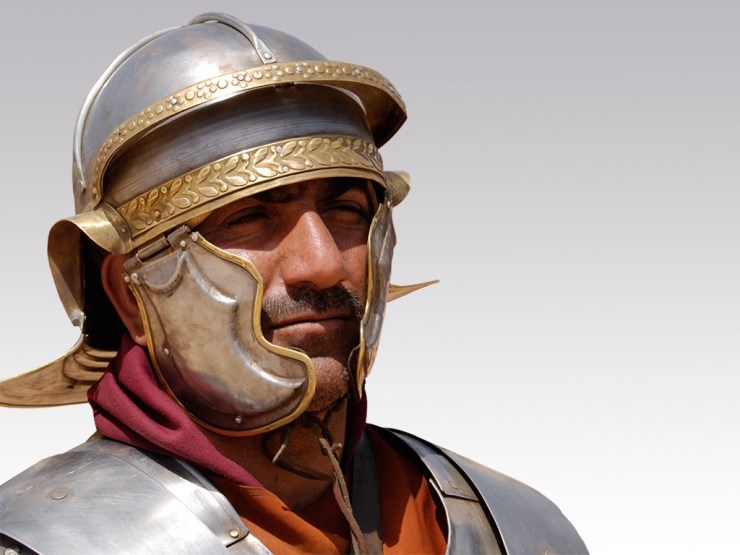
Image © David Padfield and courtesy of FreeBible Images (CC BY-NC 4.0)
A replica of a Roman soldier’s helmet.
►We have just one weapon―“the sword of the Spirit, which is the word of God”. The word for “sword” means a short sword used for cutting and stabbing, [6] vital for close combat. The sword is God’s truth proclaimed with the Holy Spirit’s penetrating power. It’s the only weapon we need. We must take hold of God’s word―the Scriptures “breathed out by God” (2 Timothy 3:16)―and wield it in the power of God’s Spirit against the enemy’s assaults. Jesus Himself countered Satan’s tempting words in the desert by quoting Scripture (Matthew 4:1-11). The Psalmist wrote, “I have stored up your word in my heart, that I might not sin against you” (Psalm 119:11). We must follow his example.
►Paul concludes: “pray in the Spirit on all occasions with all kinds of prayers and requests. With this in mind, be alert and always keep on praying for all the Lord’s people.” (Ephesians 6:18 NIV). Prayer is central to our warfare.
Our daily battleground
Our key battleground is the daily routine of ordinary life. Day by day we must learn to trust and obey God fully―in the small and unseen things, as well as in the big things, just as Jesus did (see, for example, John 8:29). That’s where our victory must first be won. Our daily lives may seem routine and insignificant but our “day-to-day struggle to live without compromise is part of a battle that touches heaven itself”.[7]
Sin gives Satan a foothold in our lives. It isn’t only the obvious sins―like immorality―that we must overcome. Sinful attitudes can also get the better of us―such as sleepiness and carelessness about the things of God, envy, bitterness, unforgiveness, self-pity, and hopelessness. These attitudes can creep in almost unawares; we need to be alert and quick to recognise them, and―clad in God’s armour―defeat them.
Jesus taught us to pray: “. . . lead us not into temptation, but deliver us from evil” (Matthew 6:13). We’re to ask our Father to deliver us from trials we couldn’t bear without falling into sin. [8] God will answer our prayer; He “will not let you be tempted beyond your ability, but . . . he will also provide the way of escape, that you may be able to endure it” (1 Corinthians 10:13). And our High Priest Jesus is able to sympathise with our weaknesses; because “in every respect” He’s “been tempted as we are, yet without sin” (Hebrews 4:15).
Two basic rules for soldiers, and for our own Christian lives, are these: ● Soldiers are under orders. Well-trained soldiers obey without question. We, too, need to learn how to obey God implicitly―just as Jesus Himself did. We can fight effectively only when we’re under God’s authority. ● Soldiers never operate independently. Teamwork, communication, ‘looking out’ for one another―all these are essential to the success of any military operation. They’re essential to our spiritual warfare, too. We do battle, not just as individuals, but as a church. The lone Christian, like the lone soldier, is at great risk.
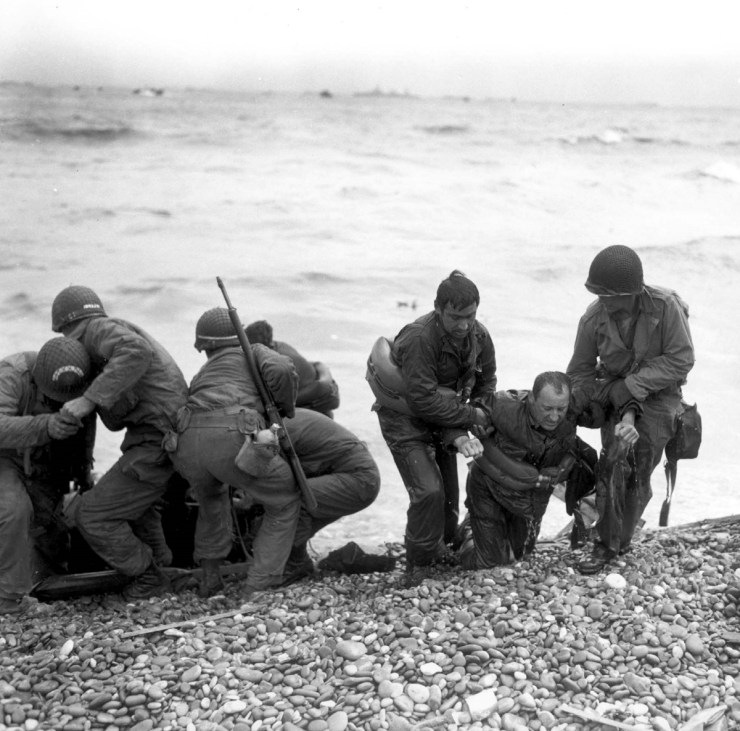
Image from Wikimedia Commons
Members of a landing party help injured soldiers to safety on Utah Beach during the Allied Invasion of Europe on D-Day. Teamwork, communication, ‘looking out’ for one another―all these are essential to the success of any military operation. They’re essential to our spiritual warfare, too. We do battle, not just as individuals, but as a church.
Growing in holiness
We believers have been reborn with a new character that naturally hates sin and loves God. We’ve “been set free from sin” and “have become slaves of righteousness” (Romans 6:18). But we still, all too often, give way to temptation. So how do we gain the victory over sin?
It’s vital to remember that we have a new identity in Christ. So we need to bring our lives into line with that new identity. We have to “put off” our “old self”―our old sinful attitudes and way of life―and “put on the new self created after the likeness of God in true righteousness and holiness” (Ephesians 4:22-24). We have to cultivate new attitudes and a new way of life. That’s where our will comes in. We can allow ourselves to give in to temptation, or we can choose to resist. That’s a choice we have to make; God won’t make it for us. We must choose to obey God. How can I do this? Before I was born again I was powerless. But now the Holy Spirit lives in me; He gives me the power to make the right choices.

It’s vital to remember that we have a new identity in Christ. So we need to bring our lives into line with that new identity. We have to “put off” our “old self”―our old sinful attitudes and way of life―and “put on the new self created after the likeness of God in true righteousness and holiness.” (Ephesians 4:22-24).
Only God, through His Holy Spirit, can transform us. Our part is to call on Him, co-operate with Him, and obey Him. I’m to put to death the sinful practices of the body (see Romans 8:13, Colossians 3:5). And I’m not to be conformed to this world. I’m to allow God’s Spirit to renew my mind[9] so I think the same way God does, and do what pleases Him (see Romans 12:2). And as I continue to obey God, then the Spirit purifies me, so that all I think and say and do reflects more and more the character of the holy God Who lives within me. That’s what the Bible calls “sanctification”, which means ‘being made holy’ (for example, Romans 6:19).
What practical steps can we take to help us live holy lives?
●It’s vital that we read the Bible regularly. The Holy Spirit helps us to understand it, and speaks to us as we read it. It shows us about God, about ourselves and our world, and about God’s wonderful plan of salvation. Through reading the Bible, we come to understand everything in a completely new way. We come to see things in the way God Himself sees them.

Through reading His Scriptures, God changes the way we see everything. We come to understand God, ourselves, and our world in a completely new way.
●We need to pray, both alone and with others. We have the wonderful privilege of speaking to God as our Father in prayer. Jesus gave us a model prayer, which we call ‘the Lord’s Prayer’ (Matthew 6:9-13), in which He shows us the kinds of things to pray. Prayer includes praising and thanking God, confessing our sins, and requests for ourselves, for other people, for God’s Church, and for everything that promotes God’s glory. [10]
We’re to pray “in the Spirit” (6:18)―in other words, prompted, guided, and empowered by the Spirit. [11] And we can be assured that “the Spirit helps us in our weakness”, because “we do not know what to pray for as we ought, but the Spirit himself intercedes for us with groanings too deep for words” (Romans 8:26).
When we declare the truth about God in worship and praise, Satan can’t stand it. “Worship is . . . a central act of holy war. When Christ is enthroned on our praises, He becomes a terror to our enemies . . . .” [12] God’s enemies fall when His people praise Him (compare 2 Chronicles 20:22).
●We need to meet regularly and often with other believers, in the gatherings of the whole church, in smaller groups, and informally.
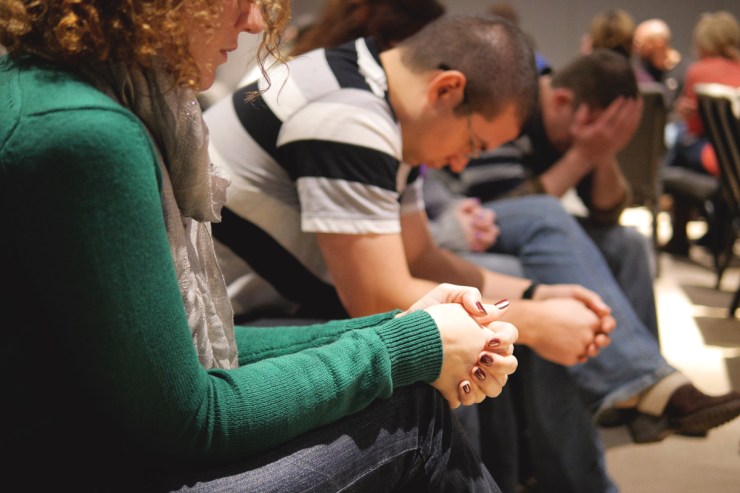
We need to meet regularly and often with other believers, in the gatherings of the whole church, in smaller groups, and informally.
●We must learn to avoid things that are likely to tempt us―the kinds of books and magazines, websites, TV programmes and films, and situations that could stir us into sin. Temptation so often begins in our minds. There’s an often-quoted saying that goes, “We sow a thought and reap an act; we sow an act and reap a habit; we sow a habit and reap a character; we sow a character and reap a destiny.” We must nip temptation in the bud; act at once, and resist it!
Next time . . .
What became of the churches planted by Paul and others? Jesus Himself gives us an insight in His letters to seven churches in Asia Minor, written toward the end of the first century AD. We’ll look at these next time.
Bible Readings and Question
You may like to read 1 Corinthians 15:24-26, Ephesians 6:12, Revelation 12:7-12. Here’s something to think about:
?Jesus defeated Satan by His death and resurrection. Yet “the whole world” still “lies in the power of the evil one” (1 John 5:19). Can you think of reasons why God hasn’t yet finally expelled Satan and his evil forces from creation?
Video
Here is a short video entitled Taming the Tongue: The Story of Using Words to Bless Not Curse (James 3). It’s designed for children ages 6 to 12. But youth and adults may well enjoy it, too. It’s from a series published by Crossway, and is based on the book called The Biggest Story Bible Storybook. All the videos can be viewed at The Biggest Story videos website. You can also create a free account to enable you to download them.
REFERENCES [1] See The Deceiver’s Great Lie by Sinclair Ferguson. Available online at https://learn.ligonier.org/podcasts/things-unseen-with-sinclair-ferguson/the-deceivers-great-lie (accessed 22 May 2025). [2] See War in Heaven: God’s Epic Battle with Evil by Derek Prince, page 23. Published by Chosen Books, a division of Baker Book House Co., Grand Rapids, Michigan, in 2003. [3] Two helpful resources on the armour of God are: [a] Ephesians: the Mystery of the Body of Christ (Preaching the Word) by R. Kent Hughes, pages 211-255. Published by Crossway, Wheaton, Illinois, in 1990, and [b] Spiritual Warfare and the Church’s Mission According to Ephesians 6:10-17 by Mark D. Owens. Available online at https://www.tyndalebulletin.org/article/29411 (accessed 22 May 2025). [4] See The Whole Armour of God: How Christ’s Victory Strengthens Us for Spiritual Warfare by Iain M. Duguid, pages 16-17, and Commentary on the New Testament Use of the Old Testament edited by G.K. Beale and D.A. Carson, pages 830-833. Published by Baker Academic, a division of Baker Publishing Group, Grand Rapids, Michigan, and Apollos, an imprint of Inter-Varsity Press, Nottingham, United Kingdom, in 2007. [5] See ESV Expository Commentary, volume XI: Ephesians-Philemon, edited by Iain M. Duguid, James M. Hamilton, and Jay Sklar, page 114. Published by Crossway, Wheaton, Illinois, in 2018. [6] See The Letter to the Ephesians (Pillar New Testament Commentary) by Peter T. O’Brien, page 481. Published by William B. Eerdmans Publishing Company, Grand Rapids, Michigan, and Cambridge, United Kingdom, and Apollos, Leicester, United Kingdom, in 1999. [7] Quoted from Revelation for You by Tim Chester, page 99. Published by The Good Book Company, Epsom, United Kingdom, in 2019. [8] See ESV Expository Commentary, volume VIII: Matthew-Luke, edited by Iain M. Duguid, James M. Hamilton, and Jay Sklar, page 109. Published by Crossway, Wheaton, Illinois, in 2021. [9] See Romans: Righteousness from Heaven (Preaching the Word) by R. Kent Hughes, pages 209. Published by Crossway, Wheaton, Illinois, in 1991. [10] See The Irreplaceable Value of Prayer in Your Spiritual Formation, by Matthew C. Bingham. Available online at https://www.crossway.org/articles/the-irreplaceable-value-of-prayer-in-your-spiritual-formation/ (accessed 22 May 2025). [11] See The Letter to the Ephesians (Pillar New Testament Commentary)) by Peter T. O’Brien, page 485. Published by William B. Eerdmans Publishing Company, Grand Rapids, Michigan, and Cambridge, United Kingdom, and Apollos, Leicester, United Kingdom, in 1999. [12] Quoted from The Kingdom and the Power: Rediscovering the Centrality of the Church by Peter J. Leithart, page 98. Published by P&R Publishing, Phillipsburg, New Jersey, in 1993.
CREDITS ► Text copyright © 2025 Robert Gordon Betts ► Unless otherwise indicated, all Scripture is taken from the ESV® Bible (The Holy Bible, English Standard Version®), copyright © 2001 by Crossway, a publishing ministry of Good News Publishers. Anglicized English Standard Version copyright © 2002 by Crossway. Used by permission. All rights reserved. The ESV text may not be quoted in any publication made available to the public by a Creative Commons license. The ESV may not be translated in whole or in part into any other language. ► Scripture quotations marked ‘NIV’ are taken from The Holy Bible, New International Version (Anglicised edition). Copyright © 1979, 1984, 2011 by Biblica (formerly International Bible Society). Used by permission of Hodder & Stoughton Publishers, an Hachette UK company. All rights reserved. ‘NIV’ is a registered trademark of Biblica (formerly International Bible Society). UK trademark number 1448790.
 52 Steps

.jpg)
