
Part 46: Gifted for Service
Click the icon below to download a 4-page PDF version of this page.

Gifts of the Triune God
As we saw in Part 44, the Church is a body. Paul tells us “. . . you are the body of Christ and individually members of it” (1 Corinthians 12:27). Our own bodies have many parts, each with its own special function. And that’s how it is in the Church. God gifts each one of us, so we can make our own special contribution to the Church’s health, growth to maturity, and mission (see Romans 12:3-5).

Every believer is gifted. Each of us has at least one of these gifts. All of us have an essential role in the body (see 1 Corinthians 12:21-25). We all need to play our part; the body’s health and growth depends on it.
Paul gives four lists of spiritual gifts, in Romans 12:6-8, 1 Corinthians 12:8-10,28-30, and Ephesians 4:11. They’re often called the gifts of the Spirit, but in fact they’re the spiritual gifts of the Triune God. Paul writes, “there are varieties of gifts, but the same Spirit; and there are varieties of service, but the same Lord; and there are varieties of activities, but it is the same God who empowers them all in everyone” (1 Corinthians 12:4-6―“Lord” here is the Son; “God” here refers to the Father). The Father, the Son, and the Holy Spirit are all involved in giving gifts to the body.[1][2]
The four lists of spiritual gifts include gifts themselves (for example, prophecy), or people gifted in specific ways (for example, prophets). They seem to fall into three broad categories: gifts of insight, inspired speech and teaching; gifts of leadership and service; and gifts of special power.
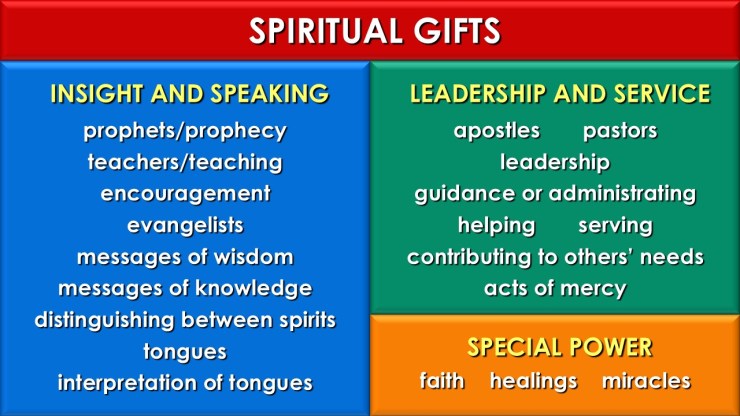
Gifts of insight, inspired speech and teaching
► Prophecy, or prophets, is the only gift included in all four lists. This suggests it’s specially important. It’s also mentioned in other passages (for example, 1 Corinthians 14:1-5, 1 Timothy 4:14). Prophecy is a Spirit-inspired, revelatory message, through which God may encourage, instruct, or give direction, understanding, or wisdom. An example is when the Spirit directed the church in Antioch to send Barnabas and Saul out for their first missionary journey (Acts 13:1-3). God may also sometimes give prophecy to challenge, warn, or correct―but always in order to safeguard and build up His people. And prophecy may not always be given in ways we might label as ‘prophecy’. For example, when praying, we may find ourselves praying prophetically into a situation. Teaching and preaching may include prophecy, too.
►The gift of teaching or teachers occurs in three of the four lists. It’s also mentioned in other passages, for example, Colossians 1:28, 2 Timothy 2:2. Teaching is another key gift, used to explain and apply the Scriptures.
►The gift of “encouragement” (Romans 12:8 NIV) is probably mainly a spoken gift―speaking to encourage believers. Barnabas, nicknamed “son of encouragement” (Acts 4:36), is our shining example (see Acts 11:22-24).
►Evangelists proclaim the good news of the gospel. This includes both preaching the gospel to the unsaved and proclaiming the whole gospel to challenge and build up believers.[3]
►In 1 Corinthians 12:8 (NIV) Paul includes “a message of wisdom” and “a message of knowledge”. These are difficult to define exactly, and they doubtless overlap. They seem most likely to be specific insights, based on the Scriptures, that are specially relevant to a church or to individuals at the time they’re given. As such, they seem to overlap with prophecy.
►The gift of distinguishing between spirits is identifying whether something is from the Holy Spirit, or a demonic spirit, or has a merely human origin. Its main use appears to be for assessing prophecies (see 1 Corinthians 14:29).
►“Various kinds of tongues” (1 Corinthians 12:10) are Spirit-inspired messages in a language not known to the speaker or usually to the hearers―but God can sometimes give people tongues that are known to one or more of their hearers, as happened on the Day of Pentecost. Today, tongues are usually thought of as messages from God to His people. But it seems clear that Paul considers tongues to be basically directed to God―to praise and worship Him, and pray to Him (see 1 Corinthians 14:14-15). When messages in tongues are spoken aloud in gatherings of believers, they need to be interpreted, so everyone can understand them―for which God gives the gift of interpretation of tongues (1 Corinthians 12:10).
Gifts of leadership and service
►The word ‘apostle’ means ‘someone who is sent’, for example, as a messenger or representative. Jesus’s disciples were a special group of apostles (with Matthias replacing Judas, Acts 1:15-26). Three others called apostles in the New Testament are Paul (for example, Romans 1:1), Barnabas (Acts 14:4,14), and James the Lord’s brother (Galatians 1:19). Others, such as Apollos (see 1 Corinthians 1:12, 4:6, 16:12) seem to have been considered apostles, too. This indicates that the gift of apostleship continues to this day. Apostolic ministry is wider than an individual local church. Those with apostolic gifting may open up new territory for the gospel, or plant churches. They may also advise, support, and guide established churches.

Apostolic ministry is wider than an individual local church. Those with apostolic gifting may open up new territory for the gospel, or plant churches. They may also advise, support, and guide established churches.
►The term ‘pastor’ means ‘shepherd’. Elders are to “shepherd the flock of God” (1 Peter 5:2)―caring for their church as shepherds care for their sheep. But there may well be others in a local church besides the elders who have pastoral gifting. Teaching is an important part of pastoral ministry―that’s surely why “the pastors and teachers” are closely linked in Ephesians 4:11.

Image from The Library of Congress Prints & Photographs Online Catalog
The term ‘pastor’ means ‘shepherd’. Elders are to “shepherd the flock of God” (1 Peter 5:2)―caring for their church as shepherds care for their sheep. But there may well be others in a local church besides the elders who have pastoral gifting.
►The “one who leads” (Romans 12:8) most likely means someone who takes a lead in the church.
►The Greek word for “guidance” or “administrating” (1 Corinthians 12:28 NIV, ESV) is from the same root as a word meaning ‘ship’s pilot’ or ‘steersman’. It carries the idea of ‘giving guidance’ or ‘wise counsel’, rather than organising or administrating as we’d normally think of it. It means setting the right trajectory or strategy for a church (or group of churches), and steering it in the right direction.[4]

A navigation officer steering a ship. The gift of “guidance” or “administrating” (1 Corinthians 12:28 NIV, ESV) means setting the right trajectory or strategy for a church (or group of churches), and steering it in the right direction.
►There are four other serving gifts. Helping may include all kinds of assistance and support, perhaps especially to the needy. Serving is practical service―perhaps especially organising and providing for believers’ practical needs. Contributing or giving most likely involves sharing what we have with others, especially the poor. Acts of mercy means caring for those in need, such as the poor, the ill, disabled or elderly.[5]
Gifts of special power
►Faith is listed as a spiritual gift. We’re all to live a life of faith. But the specific gift of faith seems to be a Spirit-given assurance that God will exercise His power in a specific situation or a specific way.
►In the phrase “gifts of healing” (1 Corinthians 12:9), the words for both “gifts” and “healing” are plural in the Greek. This may suggest a variety of healing gifts. It may also suggest that each instance of healing is a gift in its own right, rather than someone having a ‘healing ministry’.
►The Greek word for “miracles” covers any occasion where God’s power is exercised in supernatural ways. In the phrase “the working of miracles” (1 Corinthians 12:10), both “working” and “miracles” are plural in the Greek. This may suggest a variety of manifestations of God’s power; it may also suggest that each miracle is a gift in its own right, rather than someone having a ‘miracle ministry’.
Key gifts for building up the body of Christ
Paul ranks three gifts in 1 Corinthians 12:28―“God has appointed in the church first apostles, second prophets, third teachers . . . .” In Ephesians 4, Paul lists these gifts along with “evangelists” and “pastors”. God gives these five key gifts “to equip the saints for the work of ministry, for building up the body of Christ . . . .” (Ephesians 4:12).Gifted to love and to serve
In conclusion, here are some important points about the spiritual gifts:
● We can’t be too cut and dried about defining the gifts. There’s clearly overlap between many of them. And some gifts, such as serving and helping, can be used in a variety of ways.
●Spiritual gifts are not essentially the same as natural talents or abilities, though there may well be a strong connection.
●Some gifts (like helping and contributing to the needs of others) are activities we should all engage in as part of normal Christian life. But those who have a specific spiritual gift are given special ability in that area. For example, those with the gift of helping are specially enabled by God’s Spirit to help effectively.
●Gifts that appear to be ordinary activities (like helping and serving) are as much spiritual gifts―and as dependent on the Holy Spirit for their use―as what we might consider more ‘supernatural’ gifts (like prophecy and the working of miracles).
● Every believer is gifted. Each of us has at least one of these gifts. All of us have an essential role in the body (see 1 Corinthians 12:21-25). We all need to play our part; the body’s health and growth depends on it. We’re to “eagerly desire the greater gifts” (1 Corinthians 12:31 NIV). And we need to walk closely with our Lord so that our gifts flourish and develop.

Serving at a church welcome desk. Gifts, like serving, that appear to be ordinary activities are as much spiritual gifts―and as dependent on the Holy Spirit for their use―as what we might consider more ‘supernatural’ gifts (like prophecy).
Last time, we saw that we’re God’s priesthood. We’re to offer sacrifices (1 Peter 2:5). Our key sacrifice is to offer God our bodies, meaning our whole selves (Romans 12:1-2). We’re to dedicate ourselves to the Lord. And that involves loving and serving others. That’s why Paul immediately goes on in 12:3-8 to list some of the spiritual gifts.[6] God gives us His spiritual gifts so we can serve others. The gifts are to be used as expressions of love. Even if someone is the most gifted member of the church, without love they’re “nothing” (1 Corinthians 13:1-3).
Spiritual gifts are to be used as expressions of love. Even if someone is the most gifted member of the church, without love they’re “nothing” (1 Corinthians 13:1-3).
Next time . . .
By His death and resurrection, Jesus defeated Satan and his forces. But this world still “lies in the power of the evil one” (1 John 5:19); Satan still prowls around, “seeking someone to devour” (1 Peter 5:8). We’re at war; a spiritual battle is raging. We’ll look at all this next time.
Bible Readings and Questions
You may like to read Romans 12:6-8, 1 Corinthians 12:8-10, 28-30, and Ephesians 4:11. Here’s a couple of questions to think about:
?Of the 20 gifts, a high proportion (eight) involve speech. Why do you think this is?
?We’ve grouped together gifts of leadership and service. Do you think this is appropriate, and why?
Book Recommendation

In Christ Our Life Michael Reeves looks at the person and work of Christ, beginning from His eternal Sonship, through His incarnation, life, death, resurrection, and ascension, to His return. The author shows us the significance of all this, looking especially at how all our salvation is found in Christ. Andrew Wilson writes, “Mike Reeves has done it again. This is another rich, deep, simple, joyful, thrilling book: theology that does what theology should, in pointing us to Jesus, marvelling, and celebrating.” You can get it from 10 of Those, or any Christian bookseller.
REFERENCES [1] See ESV Expository Commentary, volume X: Romans-Galatians, edited by Iain M. Duguid, James M. Hamilton, and Jay Sklar, page 337. Published by Crossway, Wheaton, Illinois, in 2020. [2] See The First Epistle to the Corinthians: a Commentary on the Greek Text (The New International Greek Testament Commentary), by Anthony C. Thiselton, pages 934-935. Published by William B. Eerdmans Publishing Company, Grand Rapids, Michigan, and Cambridge, United Kingdom, in 2000. [3] See The Letters to Timothy and Titus (Pillar New Testament Commentary) by Robert W. Yarbrough, pages 441-442. Published by William B. Eerdmans Publishing Company, Grand Rapids, Michigan, and Cambridge, United Kingdom, in 2018. [4] See 1 Corinthians (Baker Exegetical Commentary on the New Testament) by David E. Garland, pages 599-600. Published by Baker Academic, Grand Rapids, Michigan, in 2003. [5] The Epistle to the Romans (The New International Commentary on the New Testament) by Douglas Moo, page 769. Published by William B. Eerdmans Publishing Company, Grand Rapids, Michigan, and Cambridge, United Kingdom, in 1996. [6] See Romans (Baker Exegetical Commentary on the New Testament) by Thomas R. Schreiner, pages 649-650. Published by Baker Academic, Grand Rapids, Michigan, in 1998.
CREDITS ► Text copyright © 2025 Robert Gordon Betts ► Unless otherwise indicated, all Scripture is taken from the ESV® Bible (The Holy Bible, English Standard Version®), copyright © 2001 by Crossway, a publishing ministry of Good News Publishers. Anglicized English Standard Version copyright © 2002 by Crossway. Used by permission. All rights reserved. The ESV text may not be quoted in any publication made available to the public by a Creative Commons license. The ESV may not be translated in whole or in part into any other language. ► Scripture quotations marked ‘NIV’ are taken from The Holy Bible, New International Version (Anglicised edition). Copyright © 1979, 1984, 2011 by Biblica (formerly International Bible Society). Used by permission of Hodder & Stoughton Publishers, an Hachette UK company. All rights reserved. ‘NIV’ is a registered trademark of Biblica (formerly International Bible Society). UK trademark number 1448790.
 52 Steps