
Part 41: From Antioch to Rome
Click the icon below to download a 4-page PDF version of this page.

Into Asia Minor
The church in Antioch in Syria thrives. For a whole year, Barnabas and Saul teach “a great many people” there (Acts 11:26). It’s here that believers are first called Christians (12:26). And the church shows love, contributing to the needs of God’s people; a prophet foretells “a great famine”; so they send Barnabas and Saul to Jerusalem with money for the believers in Judea to buy food (11:27-30,12:25). Galatians 2:1-10 probably refers to the same occasion. If so, Saul takes opportunity to explain his understanding of the gospel to the church leaders there. James, Peter and John agree that they’ll take the gospel to Jews, while Barnabas and Saul go to the Gentiles.

Facial Composite of Saint Paul Courtesy of LKA NRW (CC CC BY-SA 2.0 DE)
A reconstruction of what Paul may have looked like, created by experts using historical sources.
Saul and Barnabas return to Antioch. Some time later, we find the church leaders there worshipping God and fasting. The Holy Spirit tells them, “Set apart for me Barnabas and Saul for the work to which I have called them” (13:2). And so begins the first missionary journey―to Cyprus, then through parts of Asia Minor (now Turkey). John Mark accompanies them. But as they arrive in Asia Minor, John quits and returns home (13:13).
Although Paul’s primary mission field is the Gentiles, he still goes to synagogues, where he can preach to Jews as well as to God-fearing Gentiles. God blesses his and Barnabas’s gospel ministry, and many are converted. Paul’s wonderful sermon in the synagogue in Antioch in Pisidia is recorded in 13:16-41. In Iconium, God grants “signs and wonders to be done by their hands” (14:3). But whenever God’s work is flourishing, Satan attacks. Not content with opposing them in Antioch and Iconium, unbelieving Jews travel 100 miles to Lystra, stone Paul, and drag him out of the city unconscious (14:19-20). The disciples gather round him; Paul gets up and simply carries on the work! They go on to Derbe, preach and make many disciples; then retrace their steps, strengthening and encouraging the new disciples, and saying “through many tribulations we must enter the kingdom of God” (14:22). They appoint elders in every church.
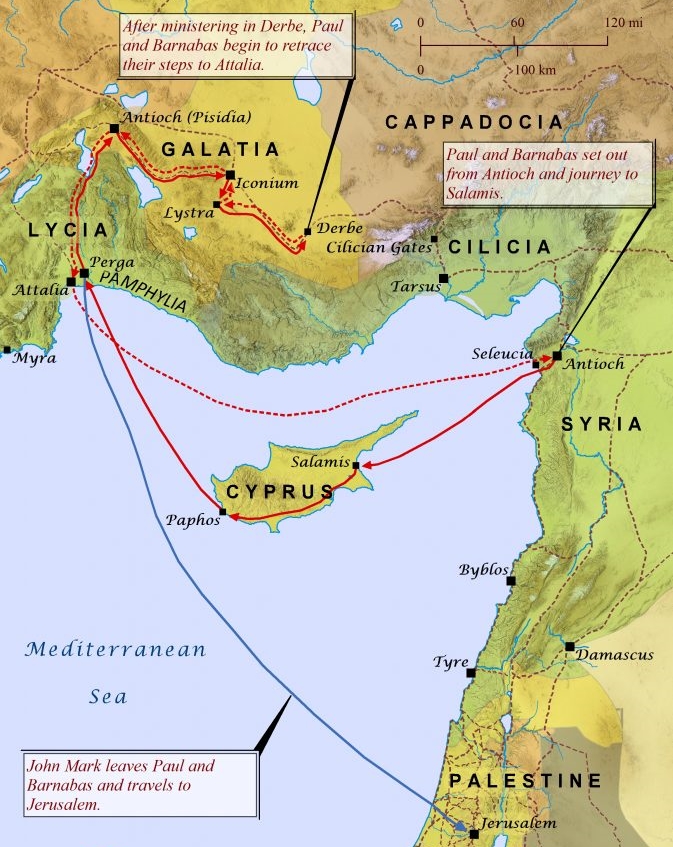
Image © David P. Barrett at BibleMapper.com. All rights reserved.
Map showing Paul’s first missionary journey.
And so Paul and Barnabas return home. They tell the church in Syrian Antioch “all that God had done with them, and how he had opened a door of faith to the Gentiles” (14:27). Notice how the hub of gospel outreach has shifted from Jerusalem to Antioch. Here in this multiracial city, the church is ready to move at the Spirit’s bidding to take the gospel out to Jew and Gentile alike.
Notice how the hub of gospel outreach has shifted from Jerusalem to Antioch. Here in this multiracial city, the church is ready to move at the Spirit’s bidding to take the gospel out to Jew and Gentile alike.
Persecution against the Jerusalem church breaks out again, too. King Herod lays “violent hands” on some believers, kills the apostle James, and imprisons Peter. But the church prays earnestly, and God sends an angel to release him (Acts 12:1-19)!
Model of a Roman merchant ship Courtesy of the Sceince Museum Group (CC BY 4.0)
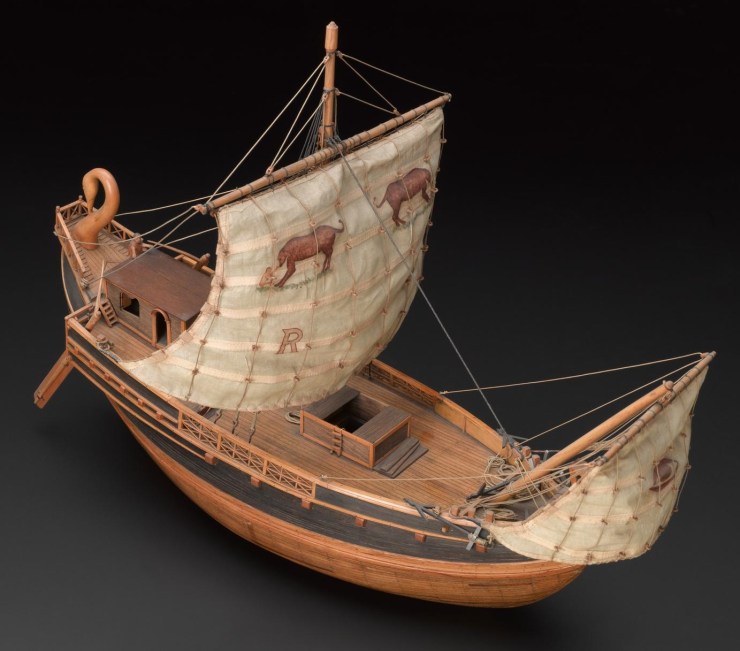
A scale model of a Roman merchant ship, around 100 feet long, and based on a drawing of a Roman sailing ship of between 151AD and 250AD. Paul made many sea journeys, and he would have travelled on ships similar to this.
The gospel message in danger
Not content with causing trouble from unbelievers, Satan causes trouble inside the Church too. Last time we saw how he incited Ananias and Sapphira to be dishonest. Now he tries another tactic―wrong teaching. In fact, in the history of the Church, trouble within it is has done far more damage than persecution from outside.
In the history of the Church, trouble within it is has done far more damage than persecution from outside.
And so trouble arrives in Antioch (Galatians 2:11-16). Some Jewish believers come from Jerusalem. They persuade the Jewish believers in Antioch―including Peter (who’s in Antioch at the time) and even open-hearted Barnabas―to stop eating with Gentiles. This is despite the clear guidance God gave Peter on this very issue in Joppa. This endangers the gospel message; it also threatens to tear the Church apart. Paul acts decisively; he criticises and corrects Peter “before them all”.
Then more strict Jewish believers (called ‘Judaisers’) arrive from Jerusalem. They say: “Unless you are circumcised according to the custom of Moses, you cannot be saved” (Acts 15:1). ‘Judaisers’ even infiltrate the newly-fledged Galatian churches planted during Paul and Barnabas’s mission there. The issue boils down to this: to be a Christian, do you first have to become a convert to Judaism? The answer is no! From the Day of Pentecost onwards, Jew and Gentile alike can be saved simply by faith in Jesus Christ.
The Old Testament laws about such things as circumcision and diet symbolise spiritual truth. Circumcision symbolised death to self. But our “old self” is now ”crucified with” Christ (Romans 6:6). The dietary laws taught people about holiness. But now we believers are holy because God lives in us, and the Holy Spirit helps us to live holy lives. But it can be hard for some people to leave the past behind. The Judaisers fervently believe the old laws are still necessary. So what should the Church teach? To settle this, Paul and Barnabas go to Jerusalem and have a summit meeting with the church leaders to hammer out a solution. After much debate, James, the Lord’s half-brother, sums up. He declares that Gentile believers don’t have to keep the laws about such things as circumcision and diet. But it’s agreed that they should “abstain from what has been sacrificed to idols, and from blood, and from what has been strangled, and from sexual immorality” (15:2-29). But the decision relates only to Gentiles. What should Jewish believers do? The conference doesn’t address that. For years afterwards many Jewish believers remain “zealous for the law” (21:20). They hang on to a Jewish form of Christianity, which will have severely hindered, if not virtually prevented, open fellowship with Gentile believers.
On the move again
After a period back in Antioch, Paul sets out on his second missionary journey (15:41-18:22). But this is launched after a blazing row! Paul and Barnabas argue over whether to take John Mark (15:37-40), who gave up part-way through their first journey. Unable to agree, they separate. Barnabas takes John Mark, and goes to Cyprus. Paul takes Silas; they journey through northern Syria, Asia Minor, and on to what’s now Greece. In Lystra, Timothy joins them―a man of whom Paul later writes, “as a son with a father he has served with me in the gospel” (Philippians 2:22).
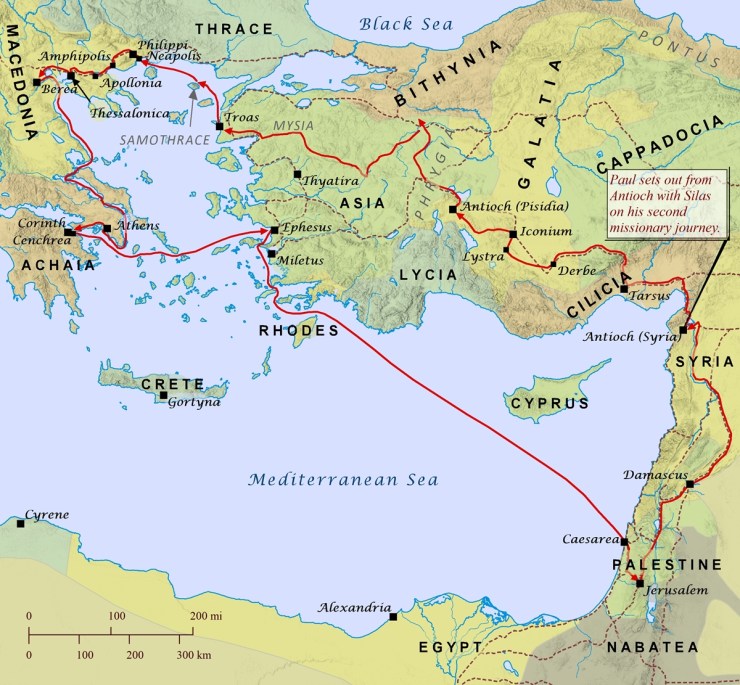
Image © David P. Barrett at BibleMapper.com. All rights reserved.
Map showing Paul’s second missionary journey.
Paul’s ministry again results in many converts and much opposition. In Philippi, he and Silas are beaten and imprisoned; in Thessalonica, unbelieving Jews start a riot, then arrive in Berea to stir up unrest there, too. In Athens, a city “full of idols”, Paul preaches to some of the intellectual elite (17:18-34). He also spends 18 months in Corinth―a wealthy and worldly trading centre, with high strategic value for gospel advance (18:1-17). Again, unbelieving Jews stir up trouble. Here in Corinth Paul meets Aquila and Priscilla. This godly couple accompany him when he leaves Corinth, and stay in Ephesus; there they take eloquent preacher Apollos under their wing and explain “to him the way of God more accurately” (18:24-28). Apollos becomes another of Paul’s valued fellow-workers.
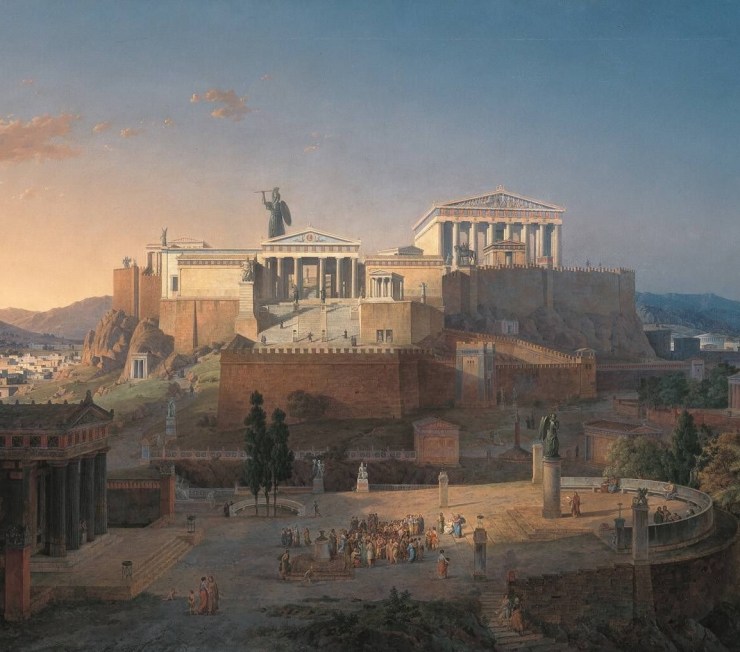
Image from Wikimedia Commons
Idealized View of the Acropolis and the Areopagus in Athens painted by Leo von Klenze. This view envisages the city’s ‘golden age’ in the 5th century BC. The building to the right on the summit is the Parthenon. In the foreground is the Areopagus, where Paul preached to the men of Athens (Acts 17:18-33). Though not entirely accurate, and depicting the city around 500 years earlier than Paul’s day, this view does convey the kind of architectural grandeur (and paganism) that Paul encountered there.
After some time back in Antioch, Paul sets out on his third missionary journey (18:23-21:17). He travels through Asia Minor and stays in Ephesus for over two years (19:1-20:1). This city is a large commercial centre, again with high strategic value for gospel outreach. For three months, Paul preaches in the synagogue. But some unbelieving Jews stir up trouble. So Paul takes the disciples and holds daily discussions “in the hall of Tyrannus” for two years, so that “all the residents” of Asia Minor hear “the word of the Lord, both Jews and Greeks”. And God does “extraordinary miracles by the hands of Paul”. Many believers confess their magic spells; a number of them who’ve practised sorcery bring their books to be burned―books worth 50,000 “pieces of silver” go up in smoke! All this angers the tradesmen who profit from the city’s paganism. Uproar ensues, endangering two of Paul’s companions. When it’s quietened down, Paul takes his leave, travelling through what’s now Greece and on to Jerusalem.

Image © David P. Barrett at BibleMapper.com. All rights reserved.
Map showing Paul’s third missionary journey.
On his journeys, Paul suffers many hardships―just read 2 Corinthians 11:24-28! But, for Paul, all his suffering is eclipsed by the privilege of serving his Lord. At the end of his life, he writes: “I have fought the good fight, I have finished the race, I have kept the faith” (2 Timothy 4:7).
At the end of his life, Paul is able to write, “I have fought the good fight, I have finished the race, I have kept the faith” (2 Timothy 4:7).
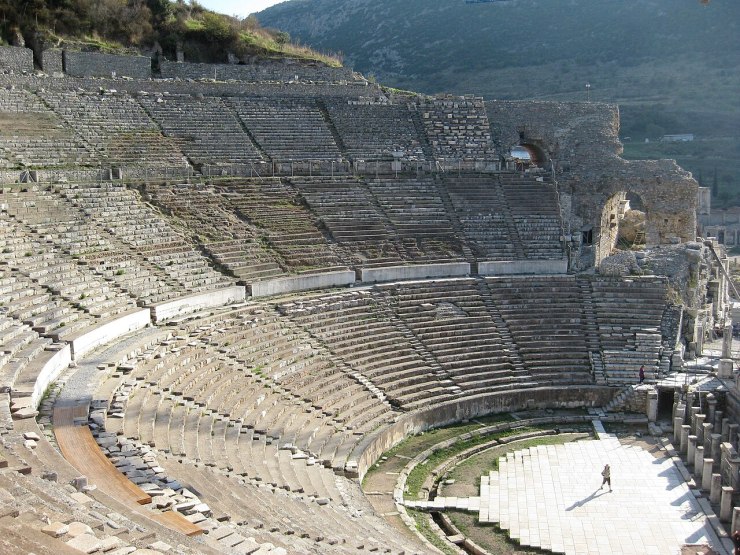
Photograph of the Theatre at Ephesus Image from Wikimedia Commons
The Roman theatre at Ephesus, where the crowd assembled during the uproar started by Demetrius the silversmith during Paul’s third missionary journey (Acts 19:23-41). The original theatre is believed to have been constructed around the beginning of the third century BC. It was improved in the reign of Emperor Claudius (41-54 AD), as well as in later years. Paul was in Ephesus around 52-54 AD, and so would probably have seen the theatre as improved by Claudius.
“You must testify also in Rome”
And so Paul arrives in Jerusalem. He knows, through the Holy Spirit, that “imprisonment and afflictions” await him. But he faces his future with resolute courage, saying “I do not account my life . . . as precious to myself, if only I may finish . . . the ministry that I received from the Lord Jesus, . . . .” (20:23-24).
These afflictions begin in the Temple. Jews from Asia Minor see him there, stir up the crowd and seize him, accusing him of attacking Judaism and defiling the Temple by bringing Gentiles into its inner court. A riot breaks out; the mob tries to kill Paul. Roman soldiers arrest him and allow him to speak to the crowd. The next day, Paul is brought before the Jewish leaders to defend himself. That night, the Lord appears to him, saying, “as you have testified . . . about me in Jerusalem, so you must testify also in Rome” (23:11). Some Jews vow to kill him. But their plot is discovered, and he’s taken to Felix, the Roman governor, in Caesarea. Paul defends himself before Felix, then―after two years’ custody―before Felix’s successor Festus, and King Herod Agrippa.
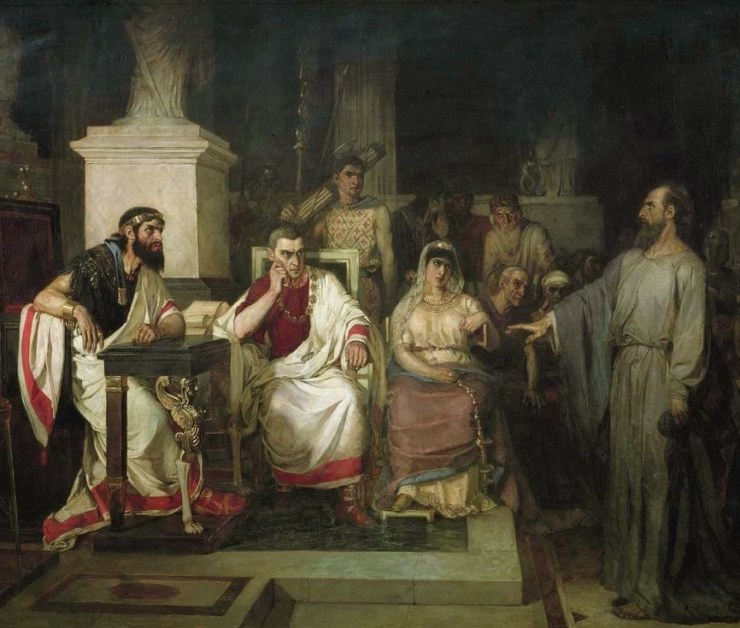
Image from Wikimedia Commons
The Apostle Paul Explains the Tenets of the Faith in the Presence of King Agrippa, his sister Bernice, and the Proconsul Festus painted by Vasily Surikov. The artist imagines the scene we read about in Acts 25:23-26:32.
He appeals to be judged by the Emperor Nero himself. So he’s taken to Rome, first by ship―during which he suffers shipwreck―then by road. He’s kept under house arrest in Rome. And so the Book of Acts, which begins in Jerusalem, ends in the capital of the Roman Empire. Peter calls Rome “Babylon” (1 Peter 5:13). ‘Babylon’ is another name for ‘Babel’: this great city is the ‘Babel’ of its age―“the worldcentre of organized godlessness” (see Parts 8 and 9). But within 30 years of the Day of Pentecost there’s a Christian community there. The gospel has a bridgehead in ‘Babylon’!
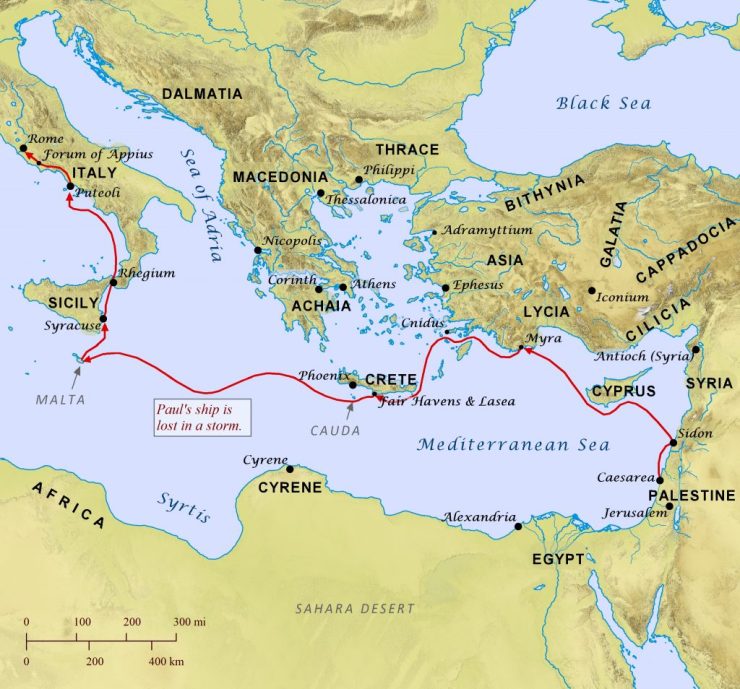
Image © David P. Barrett at BibleMapper.com. All rights reserved.
Map showing Paul’s journey to Rome.
Paul lives in Rome for “two whole years”, welcoming visitors, and “proclaiming the kingdom of God and teaching about the Lord Jesus Christ with all boldness and without hindrance” (Acts 28:30-31). So ends the Book of Acts. It seems unfinished. And that’s because it is! We’re in ‘Acts chapter 29’. God’s people continue to go and “make disciples of all nations” (Matthew 28:19) until Jesus comes again.
We’re in ‘Acts chapter 29’. God’s people continue to go and “make disciples of all nations” (Matthew 28:19) until Jesus comes again.
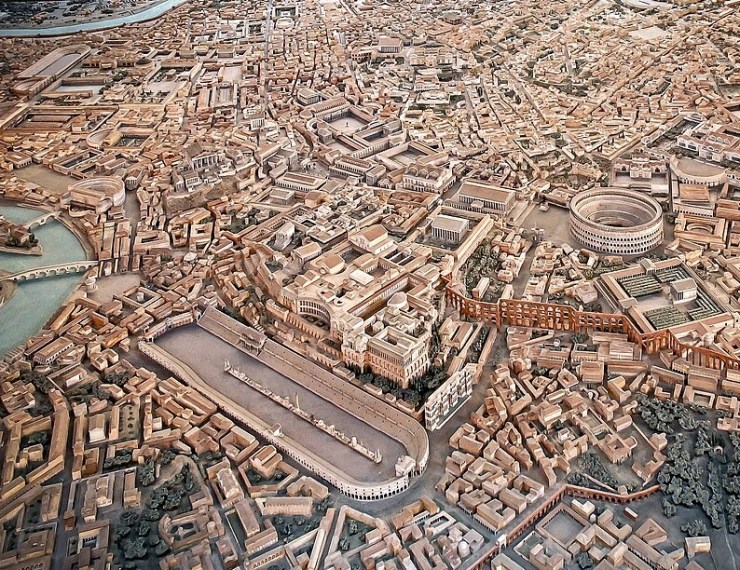
Maquette de Rome au temps de Constantin, par Italo Gismondi, Rome. © Jean-Pierre Dalbéra at Wikimedia Commons (CC BY-SA 2.5)
Detail of a photograph of a massive model of ancient Rome as it would have been in the days of Constantine the Great, 306-337AD. Although this is around 260 years later than Paul’s day, it does show the monumental size and grandeur of the city that Paul might have seen on his way to house arrest in Rome, and on his release.
Next time . . .
We’ll begin to look at the remaining books of the New Testament―from Romans to Revelation. And we’ll look at what Jesus achieved for us and for our world by His death and resurrection.
Bible Readings and Question
You may like to read Acts 11:19-26, 13:1-3, 21:17-21, Galatians 2:11-16. Here’s something to think about:
? Can you think of any reasons why the church in Antioch, rather than the church in Jerusalem, becomes the hub of gospel outreach to the nations?
Videos
Here are two short videos, entitled The God Who Can Be Known: The Story of Paul on Mars Hill (Acts 17), Ships and Snakes and Sermons, Oh My!: The Story of Paul on the Island of Malta (Acts 27-28). They’re designed for children ages 6 to 12. But youth and adults may well enjoy them, too. These videos are from a series published by Crossway. They’re based on the book called The Biggest Story Bible Storybook. All the videos can be viewed at The Biggest Story videos website. You can also create a free account to enable you to download them.
REFERENCES [1] Quoted from The First Epistle General of Peter: a Commentary by Alan M. Stibbs, page 176. Published by The Tyndale Press, London, U.K., in 1959.
CREDITS ► Text copyright © 2025 Robert Gordon Betts ► Unless otherwise indicated, all Scripture is taken from the ESV® Bible (The Holy Bible, English Standard Version®), copyright © 2001 by Crossway, a publishing ministry of Good News Publishers. Anglicized English Standard Version copyright © 2002 by Crossway. Used by permission. All rights reserved. The ESV text may not be quoted in any publication made available to the public by a Creative Commons license. The ESV may not be translated in whole or in part into any other language. ► Scripture quotations marked ‘NIV’ are taken from The Holy Bible, New International Version (Anglicised edition). Copyright © 1979, 1984, 2011 by Biblica (formerly International Bible Society). Used by permission of Hodder & Stoughton Publishers, an Hachette UK company. All rights reserved. ‘NIV’ is a registered trademark of Biblica (formerly International Bible Society). UK trademark number 1448790.
 52 Steps


