
Part 40: The Gospel Advances
Click the icon below to download a 4-page PDF version of this page.

The word goes out with power
The fledgling church is growing and flourishing, gathering together, united in love, generous to those in need. The apostles continue to proclaim Jesus’s resurrection “with great power” (Acts 4:33). God, who created the heavens and the Earth by His word, is now creating a new humanity through His proclaimed word.
God, who created the heavens and the Earth by His word, is now creating a new humanity through His proclaimed word.
God confirms the word with “many wonders and signs” done through the apostles (2:43, 5:12). Through Peter and John, God heals “a man lame from birth”; everyone sees him “walking and leaping and praising God”. A crowd gathers; Peter seizes the opportunity to preach to them, and thousands more respond and believe (3:1-26, 4:4).
Trouble―from outside and inside
Then trouble comes. The war between Satan’s followers and God’s followers (see Genesis 3:15) continues. The Jewish leaders are “greatly annoyed” because the apostles are “teaching the people and proclaiming in Jesus the resurrection from the dead” (4:1-2). They arrest Peter and John and order them “not to speak or teach at all in the name of Jesus” (4:18). After further threats, they let them go. In response, the believers pray, “Lord, . . . grant to your servants to continue to speak your word with all boldness, while . . . signs and wonders are performed through the name of your holy servant Jesus”. The place where they’re praying “was shaken, and they were all filled with the Holy Spirit and continued to speak the word of God with boldness” (4:29-31). Next, the leaders put “the apostles” (5:18)―perhaps all of them now―in prison. But an angel releases them and they continue teaching the people. Again the authorities arrest the apostles and command them to stop; this time they beat them before releasing them.
Trouble comes from within the Church, too. Ananias and Sapphira try to deceive the apostles (Act 5:1-11). Their deception threatens to bring mistrust and disunity into the Church in its earliest days. Peter discerns immediately what’s going on. Ananias and Sapphira fall down dead; God is cleansing and guarding His Church.
Eventually the religious leaders’ unyielding resistance to God vents itself in murder. A believer called Stephen is preaching and doing miracles. He’s one of seven deacons chosen to serve the church in giving provisions to the needy widows (Acts 6:1-6). The Jewish leaders arrest him and charge him with blasphemy; they bring in false witnesses to accuse him. But Stephen responds boldly. He takes his accusers back through their national history, and declares that God’s presence can’t be confined to a man-made temple (7:1-53). He concludes: “You stiff-necked people . . . you always resist the Holy Spirit. As your fathers did, so do you.” (7:51). The Jewish leaders explode with rage. They drag Stephen off and stone him to death―laying their coats at the feet of a young Pharisee called Saul (7:58). Stephen is the first name in the long and ever-growing list of those slaughtered for their faith in Christ.
The first two or three years of the Church’s history have been a breathing space. God has gathered in many Jews in Jerusalem, including “a great many” priests (5:14, 6:7). But Stephen’s bold sermon is like an earthquake. It triggers “a great persecution against the church in Jerusalem, and they were all scattered throughout the regions of Judea and Samaria, except the apostles” (8:1). The young Pharisee, Saul “was ravaging the church, and entering house after house, he dragged off men and women and committed them to prison” (8:3).
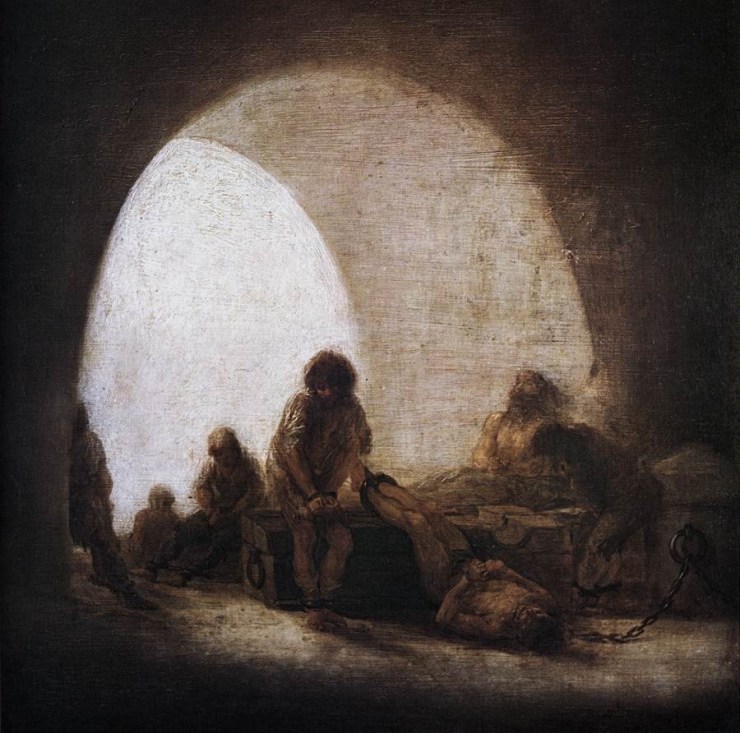
Image from Wikimedia Commons
Detail from A Prison Scene by Francisco Goya. The young Pharisee, Saul “was ravaging the church, and entering house after house, he dragged off men and women and committed them to prison” (8:3).
Scattered for the gospel
But persecution doesn’t suppress the gospel. On the contrary; the believers are scattered and, as they go, they preach the gospel! So they fulfil the second phase of outreach Jesus foretold―“you will be my witnesses in Jerusalem and in all Judea and Samaria . . . ” (Acts 1:8).
A man called Philip (another of the seven deacons, not the apostle by that name) goes and preaches in the city of Samaria. The crowds pay close attention. Philip heals many people and drives out many unclean spirits. News gets back to Jerusalem, and Peter and John come to see what’s happening. They can see the Holy Spirit is powerfully at work. The apostles pray for people, and the Samaritans―so despised by the Jews―receive the Holy Spirit. It’s their ‘Day of Pentecost’ (8:4-8,14-17)!
Three key conversions
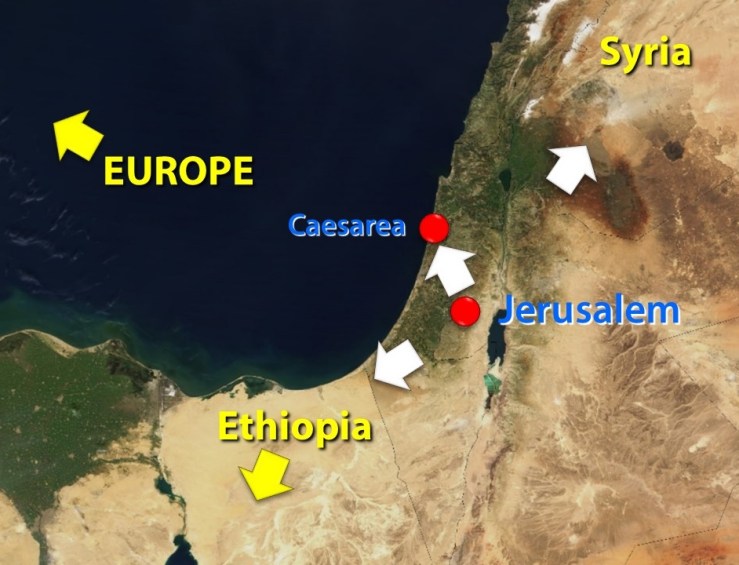
Then in Acts 8:26-10:48 we read about three conversions―an Ethiopian court official, Saul the persecutor (whom we’ve already met), and a Roman centurion named Cornelius. These conversions are significant. Judea was at the crossroads of the world―strategically positioned on routes linking Africa, Asia and Europe.
● The Ethiopian court official is converted on a road to Gaza, and thus to Africa.
●Saul, out to arrest believers, is himself ‘arrested’ by Jesus, who appears in blinding light to him on a road to Damascus, and thus to Asia.
●Cornelius is a centurion of what’s known as “the Italian Cohort”, and is converted in a major port for travel to other parts of the Roman Empire, including Europe.
Background satellite map courtesy of NASA Visible Earth
Acts 8:26-10:48 records conversions on routes to the world―Africa, Asia, and Europe.
So each man is converted on a key route out of Jerusalem to the rest of the world.[1] God is speeding the good news about Jesus Christ out to every nation. In Old Testament times, the direction of mission was inwards―drawing people to Israel and to the true God. Now the missional direction has reversed. God is sending His messengers out “to the end of the earth” (Acts 1:8).
In Old Testament times, the missional direction was inwards to Israel. Now the direction has reversed. God is sending His messengers out “to the end of the earth” (Acts 1:8).

Image from Wikimedia Commons
The Baptism of the Eunuch by Rembrandt. The artist imagines Philip baptising the Ethiopian court official on the road from Jerusalem to Gaza (Acts 8:26-39).
We’re told about Cornelius’s conversion in some detail (10:1-48). Peter is staying in a house in Joppa on the Mediterranean coast. In a vision, God shows him a huge sheet containing various animals. They include ‘unclean’ animals that the Law forbade Jews to eat. Three times, Peter hears a voice saying, “kill and eat” (10:13). God is now repealing the old dietary laws. He’s showing Peter that he shouldn’t think of anyone as “impure or unclean” (10:28 NIV). Now Jewish believers can visit Gentile believers in their homes and share meals with them without a problem. Then God leads Peter to a Gentile’s house―the house of Cornelius. Peter is warmly welcomed, and he begins to preach to them. But while he’s still speaking, the Holy Spirit falls on Cornelius and everyone listening to Peter. It’s the Gentiles’ ‘Day of Pentecost’! Peter stays with Cornelius for a few days, which must have included sharing meals. Here we see Jew and Gentile together, brothers united in Christ. [2]
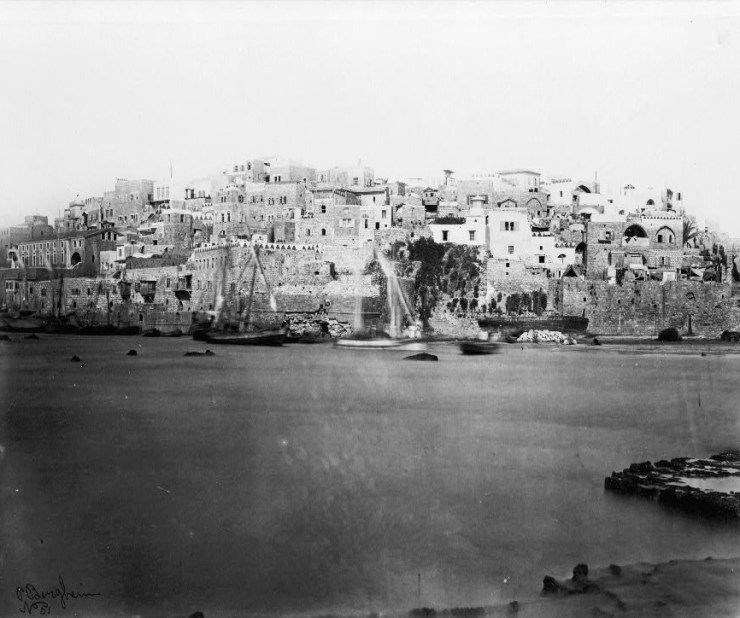
Image from The Library of Congress Prints & Photographs Online Catalog
An early photograph of the port of Joppa, taken between 1860 and 1890. It’s in a house in this city where God shows Peter the vision of a huge sheet containing various animals. (Acts 10:9-23).
But back in Jerusalem, Peter has to justify what he’s done. Some Jewish believers say, “You went to uncircumcised men and ate with them” (11:3). Peter explains everything. Then the Jewish believers glorify God, saying: “Then to the Gentiles also God has granted repentance that leads to life” (11:18). They realise Gentile believers don’t have to become Law-abiding, circumcised Jewish proselytes before they can join the Church. This is groundbreaking. But this point is still to be fiercely contested, as we’ll see in the next part.
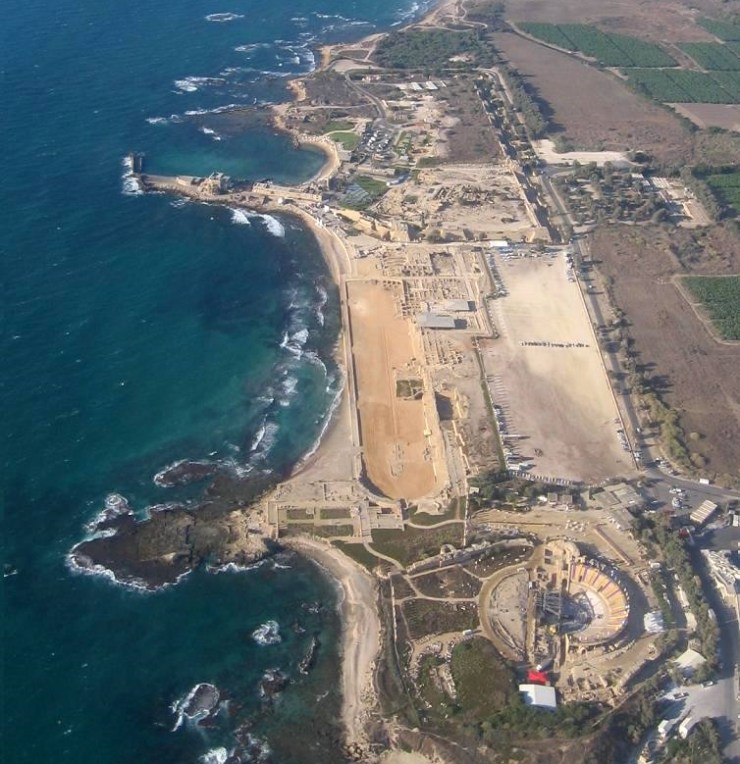
Image from Wikimedia Commons
Aerial view of the ancient port of Caesarea. Cornelius and those with him were baptised with the Holy Spirit here (Acts 10:24-48). You can see the restored Roman theatre to the lower right, and long stadium in the centre.
Preparing the world for the gospel
We saw in Part 31 how God had prepared the world around Judea for gospel outreach.
►Many Jews are now living in Gentile lands. We saw in Acts 2:8-11 how widely Jews had dispersed. Jewish synagogues―where Jews and God-fearing Gentiles meet to pray and study the Scriptures―can now be found in many places where they’d settled. These serve as ‘entry-points’ for the gospel; Paul and others preach Jesus in them, and many believe, especially God-fearing Gentiles.
►Greek is now the ‘international’ language of the eastern Roman Empire. Having a common language was a huge help in evangelism.
►The Scriptures had been gathered into the Old Testament as we know it today. It was now available in Greek as well as Hebrew. Having the whole Old Testament available, and in this widely-known language, was a huge help in preaching the gospel and in teaching believers. The New Testament would soon be written in Greek, too.
►Political unity under the Roman Empire, coupled with good communications by sea and road, helped to speed believers on their way to preach and plant churches.
Breaking new gospel ground
Believers fleeing Jerusalem after Stephen’s death travel as far as Phoenicia, Cyprus and Antioch, preaching only to Jews. Then, in Antioch, some of the more adventurous among them take a momentous step forward. [3] They preach the gospel to Gentiles. And “a great number who believed turned to the Lord” (11:21).
In Antioch, some of the more adventurous believers take a momentous step forward. They preach the gospel to Gentiles. And “a great number who believed turned to the Lord” (Acts 11:21).
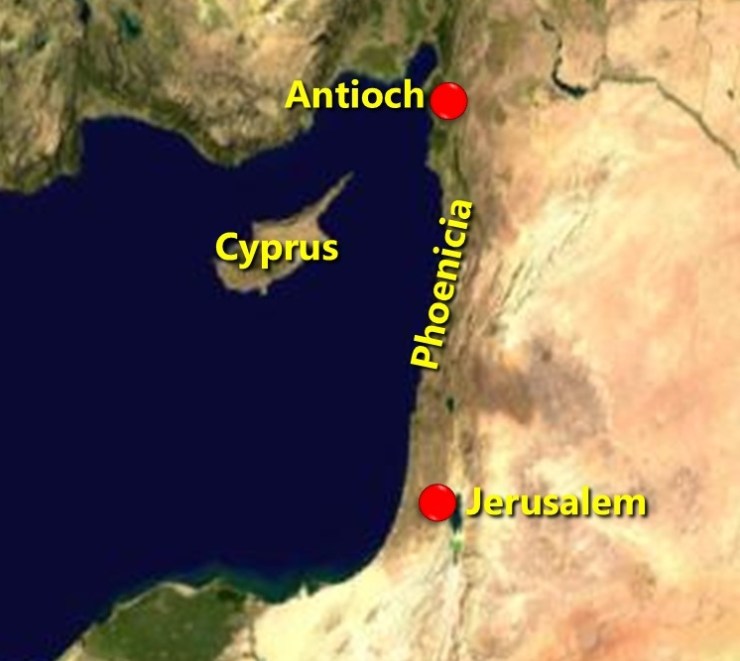
Image from Wikimedia Commons “>(Archive imageused)
Map showing the places mentioned in Acts 11:19. “Now those who were scattered because of the persecution that arose over Stephen travelled as far as Phoenicia and Cyprus and Antioch, speaking the word to no one except Jews. But there were some of them, men of Cyprus and Cyrene, who on coming to Antioch spoke to the Hellenists also, preaching the Lord Jesus.” (Acts 11:19-20).
Antioch, 300 miles north of Jerusalem, was a huge city by ancient standards―it became the third largest in the Roman Empire. The apostles in Jerusalem send Barnabas to Antioch to see what’s happening. This big-hearted man, full of the Holy Spirit, encourages the believers at Antioch to stay firmly faithful to God (11:22-24).
The church in Antioch grows rapidly. So Barnabas recruits Saul, later called Paul (11:25-26). As we’ve seen, Jesus met with this fanatical persecutor on the road to Damascus. Blinded, he’s led into Damascus, where a man called Ananias prays for him. God tells Ananias “This man is my chosen instrument to proclaim my name to the Gentiles . . . and to the people of Israel” (Acts 9:15 NIV). Ananias says to Saul, “Brother Saul, the Lord Jesus who appeared to you . . . has sent me so that you may regain your sight and be filled with the Holy Spirit.” Saul is a Jewish rabbi, trained by the highly respected Gamaliel (Acts 22:3, 5:34). He immediately preaches powerfully in the Damascus synagogues. He then goes away “into Arabia” and returns to Damascus (Galatians 1:17). Evading a Jewish plot to kill him, he goes to Jerusalem and preaches there, too. Again, he finds his life in danger―the persecutor now becomes the persecuted. [4] So he spends some years in Syria and Cilicia. He’s God’s “chosen instrument”; God takes time to prepare him for His service. Barnabas then brings him to Antioch.
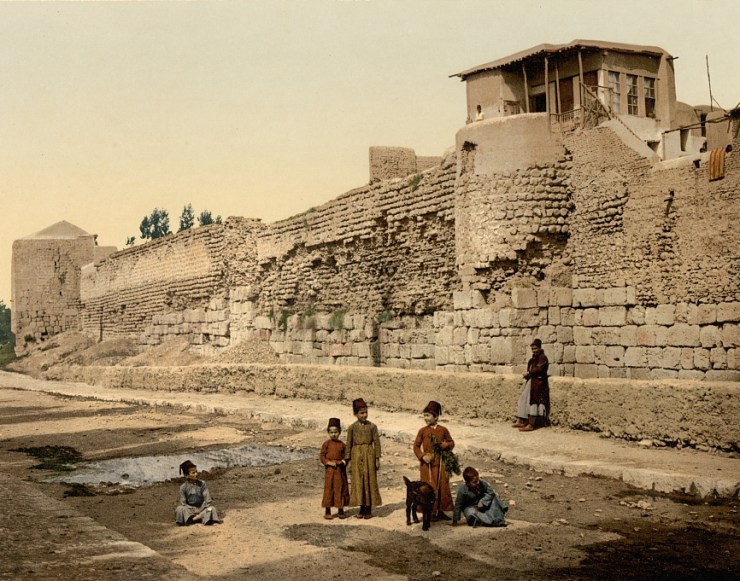
Image from The Library of Congress Prints & Photographs Online Catalog
Early photograph (taken between around 1890 and1900) of an old city wall in Damascus, and entitled Wall over which St. Paul escaped, Damascus . . . . This wall is, of course, much later and much changed from the days of Paul, but nonetheless it does evoke the scene we read about in Acts 9:23-25 and 2 Corinthians 11:32-33. Note the house built on the wall―it’s easy to imagine how Paul could be let down from a window set in the wall.
For a whole year Barnabas and Paul teach the church in Antioch―teaching is crucial for the church’s growth to maturity. And, here in Antioch, Jews and Gentiles are able to share meals, which includes celebrating the Lord’s Supper together.
Next time . . .
Paul is God’s missionary theologian. We follow his life on the move, tirelessly preaching and teaching, church planting, spearheading the advance of the gospel and the Church, all the way to Rome.
Bible Readings and Questions
You may like to read Acts 2:22-41 and 10:34-43. Here are questions to think about:
?In these passages (as well as others), Luke gives a lot of detail about what Peter preached. Why?
?What are Peter’s main points?
?Why do you think he included these points?
Videos
Here are three short videos, entitled The Beautiful and the Beggar: The Story of Peter and a Crippled Man (Acts 3) , Philip and the Man from Africa: The Story of a Eunuch Coming to Faith (Acts 8) , and Saul Sees the Light: The Story of Paul’s Conversion (Acts 9) . They’re designed for children ages 6 to 12. But youth and adults may well enjoy them, too. These videos are from a series published by Crossway. They’re based on the book called The Biggest Story Bible Storybook. All the videos can be viewed at The Biggest Story videos website. You can also create a free account to enable you to download them.
REFERENCES [1] See His Waiting Bride: an Outline of Church History in the Light of the Book of Revelation, from the lectures of Edgar F. Parkyns, pages 6-7. Published by Wheatcorn Publications, West Ewell, Surrey, United Kingdom, in 1996. [2] See The Acts of the Apostles (The Pillar New Testament Commentary), by David G. Peterson, page 341. Published by William B. Eerdmans Publishing Company, Grand Rapids, Michigan, and Cambridge, U.K., in 2009. [3] See The Book of Acts, Revised (The New International Commentary on the New Testament) by F.F. Bruce, page 225. Published by William B. Eerdmans Publishing Company, Grand Rapids, Michigan, in 1988. [4] See The Acts of the Apostles (The Pillar New Testament Commentary), by David G. Peterson, page 317. Published by William B. Eerdmans Publishing Company, Grand Rapids, Michigan, and Cambridge, U.K., in 2009.
CREDITS ► Text copyright © 2025 Robert Gordon Betts ► Unless otherwise indicated, all Scripture is taken from the ESV® Bible (The Holy Bible, English Standard Version®), copyright © 2001 by Crossway, a publishing ministry of Good News Publishers. Anglicized English Standard Version copyright © 2002 by Crossway. Used by permission. All rights reserved. The ESV text may not be quoted in any publication made available to the public by a Creative Commons license. The ESV may not be translated in whole or in part into any other language. ► Scripture quotations marked ‘NIV’ are taken from The Holy Bible, New International Version (Anglicised edition). Copyright © 1979, 1984, 2011 by Biblica (formerly International Bible Society). Used by permission of Hodder & Stoughton Publishers, an Hachette UK company. All rights reserved. ‘NIV’ is a registered trademark of Biblica (formerly International Bible Society). UK trademark number 1448790.
 52 Steps


