
Part 4 ► “In God’s Image”
Click the icon below to download a 4-page PDF version of this page.

Last time we looked at God’s wonderful creation. But what’s the most wonderful thing in creation? It’s us! We humans are “fearfully and wonderfully made” (Psalm 139:14). And the most amazing thing about us is this: God made us “in his own image” (Genesis 1:27). We aren’t actually divine, of course. But we are as like God as it’s possible for any created being to be.
The most amazing thing about us is this: God made us “in his own image” (Genesis 1.27). We’re are as like God as it’s possible for any created being to be.
Personality and conscience
So how are we like God?
► We’re self-conscious, personal beings. Like God, we’re relational. We reflect God in having moral capacity―an inner sense of right and wrong. We have minds; we’re able to reason and think logically. We have emotions―we’re able to feel things deeply, such as love, compassion, and anger at injustice. We possess wills―we choose, we plan, we make decisions.
►God speaks, and so can we. God’s words are all-powerful; ours, of course, are not. Nonetheless, our words do have great power.
►God is creative, and so are we. Of course, we can’t create out of nothing, as God can. But we can create things out of what already exists. And, of course, we can procreate―children in our own image. We reflect God, too, in being imaginative, inventive, artistic.
►We reflect God in being able to rule. He rules over everything. But He’s also created us to be rulers―He appointed us to “have dominion over” every living creature on His behalf (Genesis 1:26).
►There’s another very special way in which we’re like God. God is love (1 John 4:8,16). And so we, too, can love in the same way as God does. When we love God and love each other―selflessly and sacrificially―then we are reflecting God’s own love.

We are “fearfully and wonderfully made” (Psalm 139:14)
Our relationship with others
God has given us the ability to love. Love implies relationship. So God has created us for relationship.
Firstly, God created us “male and female” (Genesis 1:27). We’re designed to enjoy the lifelong intimacy of marital union.
When the New Testament speaks about the church as a family, and as a body with different parts, this isn’t a completely new idea. God built it into our human nature right from the very beginning.
Secondly, God created the human race not as isolated individuals, but as a family. We’re all related to each other. Only Adam was created by God directly. Eve was made from Adam’s body. And all of us are the descendants of this human pair. So we’re all connected. That’s why John Donne could write: “No man is an island, entire of itself”.[1] And because we’re all connected, we instinctively need to feel part of a group. We fear exclusion, isolation, loneliness. Without human companionship and intimacy we find it hard, even impossible, to live.

We’re not isolated individuals; we’re all connected.
And so when the New Testament speaks about the church as a family, and as a body with different parts, this isn’t a completely new idea. God built it into our human nature right from the very beginning.
Our relationship with God
We’re made for relationship with each other. And God has made us for relationship with Himself. As Saint Augustine famously wrote, God made us for Himself, and our heart is restless, until it rests in Him.[2] In fact, He has made us in such a way that―by His Holy Spirit―God can live within us (see John 14:15-18,23).
Precious to God
God made us in His image. And because we’re in His image, we have great value. We’re very precious to God. The pastor and writer Derek Prince wrote this: “For more than fifty years, I have tried to help people with innumerable problems in their lives. Eventually, I have come to a surprising conclusion: Our basic problem as human beings is that we do not realize how valuable we are.”[3]
How should we then live?
And our value as God’s precious image-bearers has huge bearing on how we should live. We treat precious objects with great care. So we’re to treat ourselves with great care, too. We’re to take care about what we do with our bodies, what we fill our minds with, how we use our talents and how we spend our time.
And, if I’m so valuable, then so is my friend and my neighbour―and so is my enemy. My friend and neighbour and enemy are created in God’s image. And so we should love them and respect them.
Born to finish God’s work of creation
God put us humans here on Earth for a reason. He’s given us work to do. God blessed Adam and Eve and said to them, “Be fruitful and multiply and fill the earth and subdue it, and have dominion over the fish of the sea and over the birds of the heavens and over every living thing that moves on the earth” (Genesis 1:28). And God put Adam into the garden of Eden “to work it and keep it” (Genesis 2:15).
Our task began in that garden. But as our human race grew in number, we were to expand the borders of the garden until it extended across the entire planet. It was to be a wonderful world where God lived with us, and where we lived in harmony with each other and with creation. In other words, this world was to be a place where God’s people lived in God’s paradise in God’s presence.
God’s fellow-workers
So God gave us work to do here on Earth. Today, work can so often involve toil and stress. But that’s not how it was in the beginning. In the garden of Eden, work was pleasurable and fulfilling.
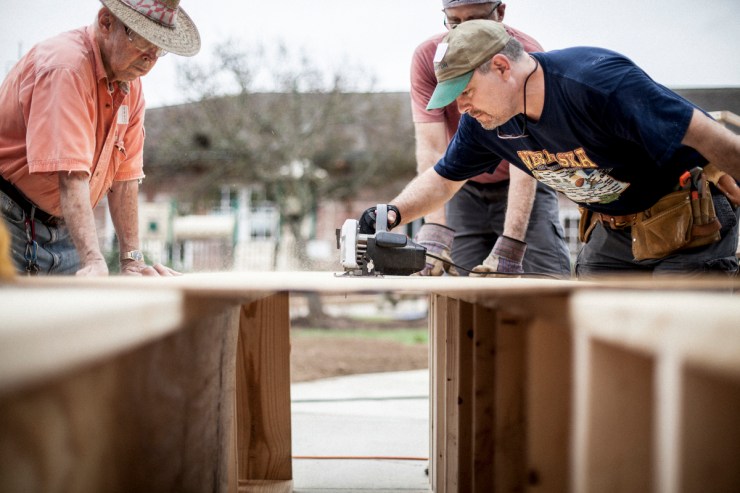
Cutting timber. All kinds of work have dignity. Jesus Himself was a skilled manual worker―a carpenter (the Greek word can also mean ‘builder’)―for most of his adult life.
In fact, God Himself is a worker. Remember that God “formed the man of dust from the ground” (Genesis 2:7). Then God “planted a garden” (Genesis 2:8). And He formed beasts and birds “out of the ground” (Genesis 2:19).
Jesus Himself was a skilled manual worker―a carpenter (the Greek word can also mean ‘builder’)―for most of his adult life. We might have expected the Son of God to come as a great philosopher, or a noble statesman. But He didn’t. He came as a workman, a carpenter.[4]
All kinds of work have dignity―manual work as well as intellectual work. Jesus Himself was a manual worker―a carpenter and builder.
God is a worker. And since He created us in His image, we’re created to be workers, too. All kinds of work have dignity―manual work as well as intellectual work. It’s said that the wife of the famous preacher Billy Graham had a sign above their kitchen sink which read: ‘Divine service done here daily’!

It’s said that the wife of the famous preacher Billy Graham had a sign above their kitchen sink which read: ‘Divine service done here daily’!
And the sort of work God made us for puts our natural creativity to use. We are creative from our very earliest years. We make things that are not merely functional, but also beautiful. And we humans are natural born explorers―we’re constantly expanding our understanding of ourselves and of God’s creation. All this is a natural outworking of our God-given calling to subdue the earth, rule it and make it a paradise.
Notice that God told Adam to “subdue” the Earth. That word “subdue” suggests that our task would challenge us. It would engage all our physical, mental, imaginative, and creative powers.
And we weren’t to work on our own. God intended us to work in dependence on Him and in relationship with Him. We were to be guided and empowered in our task by His Holy Spirit.
God’s royal people
God said to mankind: “. . . have dominion over the fish of the sea and over the birds of the heavens and over every living thing that moves on the earth” (Genesis 1:28). To have dominion is what kings do. It’s a royal vocation. God appointed us―men and women together―to rule this Earth on His behalf.
Caretakers of God’s garden
As we said above, God put Adam into the garden of Eden “to work it and keep it” (Genesis 2:15). This word “keep” can also be translated “guard”. Adam and Eve were to care for and guard God’s garden. That word ‘guard’ suggests there was something―or someone―that the garden needed to guarded from. Adam and Eve were to make sure no-one entered the garden to spoil it, or to harm them.
In the next part . . .
Adam and Eve were to guard the garden―to ensure nothing and no-one got in to spoil the garden, or harm them. But someone did get in. Who was that, and what happened? We’ll find out next time.
Bible Reading and Questions
You may like to read Psalm 139. This psalm’s key theme is God’s complete and intimate knowledge of us. He’s present with us wherever we may be. He formed us in our mother’s womb. David, the psalmist, hates those who rebel against God. And he hates sin within himself, too. He asks God to search his heart and lead him in “the way everlasting” (139:24). Here are some questions to think about:
?As we read in Psalm 139, we’re “fearfully and wonderfully made” (139:14). And we’re God’s precious image-bearers. How should this impact how we live―what we think, say and do, and how we use our talents and time? And how should it impact our attitude to others, and how we relate to them?
Resource
Here’s a song whose title reflects Psalm 139:10. This verse reads “even there your hand shall lead me, and your right hand shall hold me” (ESV). Ada R. Habershon wrote When I fear my faith will fail in 1906. It’s a wonderful hymn about God’s care for us at all times and in every circumstance. Matt Merker has revitalised it by adapting the words and writing a new tune. Kristyn Getty sings it as a solo in the YouTube video in the video below.
And in the video below, hear it being sung by the thousands of voices in a Together for the Gospel conference.
The lyrics and other resources are available HERE.
REFERENCES [1] Quoted from Devotions Upon Emergent Occasions; Together with Death’s Duel by John Donne, XVII. Meditation. An Ann Arbor paperback, published in 1959 by the University of Michigan Press, Michigan, USA, and simultaneously published by Ambassador Books, Ltd., Toronto, Canada. Available online HERE,accessed on 26 January 2023. [2] See Confessions by Augustine of Hippo, book 1, chapter 1. Newly translated and edited by Albert C. Outler, Perkins School of Theology, Southern Methodist University, Dallas, Texas. Published by the Christian Classics Ethereal Library, Grand Rapids, Michigan, in 1955. Available online HERE, accessed 4 May 2023. In this book, the exact quotation is, “thou hast made us for thyself and restless is our heart until it comes to rest in thee” . [3] Quoted from Rules of Engagement: Preparing for Your Role in the Spiritual Battle by Derek Prince, page 12. Published by Chosen Books, a division of Baker Publishing Group, Grand Rapids, Michigan, in 2006. The italics in the quotation are Derek Prince’s own. [4] This is adapted from What Were We Put Into This World To Do? by Tim Keller, page 13. Published by Redeemer Presbyterian Church, New York, in 2006. Dr. Keller is here quoting from from Beginnings: Eden and Beyond: Genesis 1-11, by Phillip D. Jensen and Tony Payne, page 40. Published by Crossway Books, Wheaton, Illinois, in 1999, and first published under the title Beyond Eden by Matthias Media, Sydney, Australia, in 1990.
CREDITS ► Text copyright © 2024 Robert Gordon Betts ► All Scripture is taken from the ESV® Bible (The Holy Bible, English Standard Version®), copyright © 2001 by Crossway, a publishing ministry of Good News Publishers. Anglicized English Standard Version copyright © 2002 by Crossway. Used by permission. All rights reserved. The ESV text may not be quoted in any publication made available to the public by a Creative Commons license. The ESV may not be translated in whole or in part into any other language.
 52 Steps