
Part 39: The Promised Spirit Comes
Click the icon below to download a 4-page PDF version of this page.

“The promise of the Father”
After His resurrection, Jesus instructs His disciples “not to depart from Jerusalem, but to wait for the promise of the Father, . . . you will be baptized with the Holy Spirit not many days from now” (Acts 1:4-5). Only a short time before, hours before His arrest, He’d promised them: “I will ask the Father, and he will give you another Helper, . . . the Spirit of truth . . . .” He continues, “You know him, for he dwells with you and will be in you” (John 14:16-17). The Holy Spirit―the Third Person of the Trinity―was with them. But very soon, He will be in them! And so will the Father and the Son―as Jesus says: “If anyone loves me, . . . my Father will love him, and we will . . . make our home with him” (14:23). The three Persons of the Holy Trinity are one. So where the Spirit is, so is the Father and the Son. The Triune God will live in each believer!
The indwelling Holy Spirit will be the disciples’ Teacher; Jesus promised them, “the Holy Spirit, . . . will teach you all things and bring to your remembrance all that I have said to you” (John 14:26, see also 16:13).
The coming of the Kingdom of God
And before His ascension, Jesus teaches His disciples about God’s kingdom (Acts 1:3). They ask, “Lord, will you at this time restore the kingdom to Israel?” (Acts 1:6). Jesus responds, “It is not for you to know times or seasons that the Father has fixed” (1:7). God’s kingdom will indeed come―but in His timing, and in a way far beyond the limited, nationalistic vision the disciples have in mind.
And He “opened their minds to understand the Scriptures”, which foretold His death and resurrection, and “that repentance and forgiveness of sins should be proclaimed in his name to all nations, beginning from Jerusalem” (Luke 24:45-47 NIV). The disciples are to proclaim the good news about Jesus Christ and “make disciples of all nations, . . . .” (Matthew 28:19). But they can only do that in the power of the Spirit. So Jesus tells them, “you will receive power when the Holy Spirit has come upon you, and you will be my witnesses in Jerusalem and in all Judea and Samaria, and to the end of the earth” (1:8). These words set the scene for the Book of Acts. God’s gospel goes out like a great wave from Jerusalem. People from every nation will be made citizens of God’s Kingdom.
In the Book of Acts, we see God’s gospel going out like a great wave from Jerusalem. People from every nation will be made citizens of God’s Kingdom.
The outpouring of the Holy Spirit
After His ascension, Jesus’s disciples and many others devote themselves to prayer, waiting for “the promise of the Father”. (Judas had killed himself, so the remaining disciples elected Matthias to take his place and restore their number to 12.) God answers their prayers. Ten days after Jesus’s ascension, the Father and the Son pour out the Holy Spirit on them. “When the day of Pentecost came, they were all together in one place. Suddenly a sound like the blowing of a violent wind came from heaven and filled the whole house . . . . They saw what seemed to be tongues of fire that separated and came to rest on each of them. All of them were filled with the Holy Spirit and began to speak in other tongues as the Spirit enabled them.” (Acts 2:1-4 NIV).
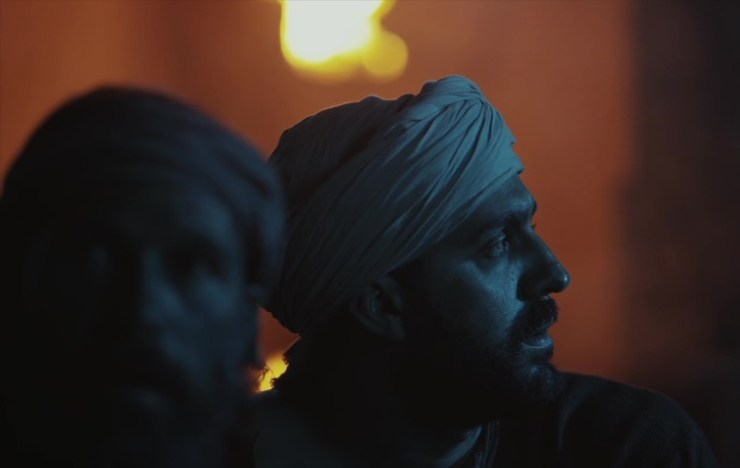
Photo courtesy of LUMO Project
“They saw what seemed to be tongues of fire that separated and came to rest on each of them. (Acts 2:3 NIV). A still from a video produced by the LUMO Project
Jerusalem is heaving with Jewish pilgrims―including from such far-flung regions as Iran, Mesopotamia, Asia Minor, Egypt, North Africa, Crete and Italy. Everyone hears the apostles proclaim God’s mighty works in their own language! A crowd gathers. They’re all “amazed and perplexed, saying . . . ‘What does this mean?’” But others mock, saying “They are filled with new wine” (2:12-13).
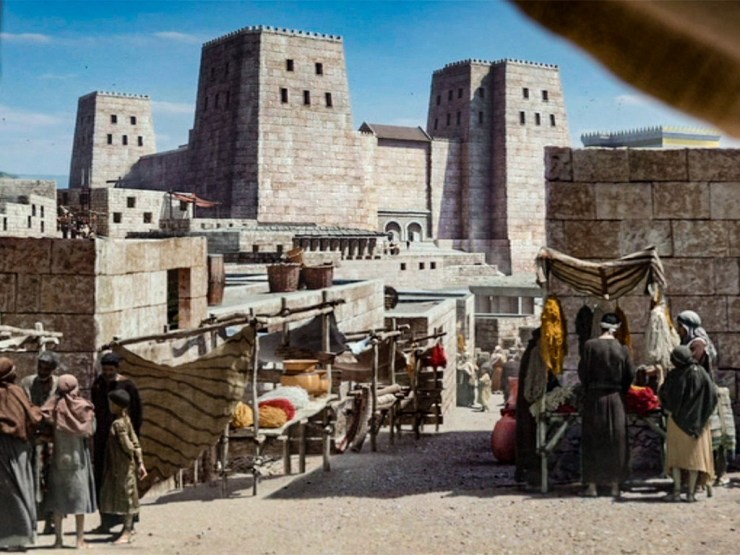
Photo courtesy of LUMO Project and made available by FreeFreeBibleimages
An artist’s impression of the streets of Jerusalem in Jesus’s time. You can see the fortress of Antonia in the background. On the Day of Pentecost, these streets would have been crowded with pilgrims. A still from a video produced by the LUMO Project
The first gospel message
Peter stands with the other disciples―now called apostles (1:26), meaning ‘people who are sent’―and launches into the very first gospel message. And what a message it is! The Holy Spirit empowers Peter, an “uneducated, common” man (see Acts 4:13), to preach an eloquent, powerful message. He begins by quoting Joel 2:28-32: “in the last days . . . God declares, . . .I will pour out my Spirit on all flesh, . . . .; everyone who calls upon the name of the Lord shall be saved.” God is now fulfilling that prophecy. Peter continues, “Jesus of Nazareth, a man attested to you by God with mighty works . . . this Jesus, delivered up according to the definite plan and foreknowledge of God, you crucified . . . This Jesus God raised up, and of that we all are witnesses. Being therefore exalted at the right hand of God, and having received from the Father the promise of the Holy Spirit, he has poured out this that you yourselves are seeing and hearing.” (Acts 2:22-23,32-33). Finally, he declares, “. . . God has made him both Lord and Christ, this Jesus whom you crucified” (2:36).
Joel prophesied, “in the last days . . . God declares, . . .I will pour out my Spirit on all flesh, . . . .; everyone who calls upon the name of the Lord shall be saved” (Joel 2:28-32). God is now fulfilling that prophecy.
His listeners are “cut to the heart” and ask, “what shall we do?” (2:37). Peter tells them, “Repent and be baptized . . . in the name of Jesus Christ for the forgiveness of your sins, and you will receive the gift of the Holy Spirit.” (2:38). Those who believe are baptised in water; that day, 3,000 people are added to the community of believers.
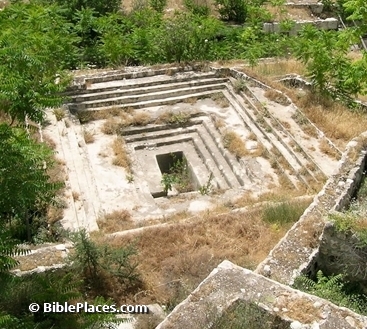
Image © BiblePlaces.com
Peter tells those who accept his message “Repent and be baptized . . . in the name of Jesus Christ for the forgiveness of your sins, and you will receive the gift of the Holy Spirit” (Acts 2:38). This large pool is from the period of Herod’s Temple, and was used for ritual washing. Who knows whether it might have been used for the baptism of some of the new believers on the Day of Pentecost?
Pentecost celebrated the grain harvest (see Part 19). On this Day of Pentecost, God begins a great harvest of people into His Kingdom.
On this Day of Pentecost, God opens a new phase in establishing His Kingdom on Earth. He’s beginning to fulfil, in a wonderful new way, His promise that through Abraham “all the families of the earth shall be blessed” (Genesis 12:3). But notice that the first believers comprise Jews and proselytes (converts to Judaism). At the very beginning, the Church is Jewish. God is keeping His promise to Israel, just as He said (see Jeremiah 31:31 and compare Romans 1:16).
On this Day of Pentecost, God opens a new phase in establishing His Kingdom on Earth. He’s beginning to fulfil, in a wonderful new way, His promise that through Abraham “all the families of the earth shall be blessed” (Genesis 12:3).
Entering the New Covenant
On the Day of Pentecost, the Spirit begins to bring people into the blessings of the “new covenant” foretold in Jeremiah 31:31-34 and Ezekiel 36:25-27, and activated by Jesus’s death and resurrection (Luke 22:20). Through this covenant, God is bringing people into a new kind of relationship with Him―a relationship that goes way beyond what Old Testament believers enjoyed. He cleanses everyone who repents from sin, and forgives them. He gives them “a new heart”, and writes His law on it. He puts His Holy Spirit within them―causing them to be “born again” (John 3:3-7, 1 Peter 1:3,23). And the indwelling Spirit equips and empowers them to live and to serve God. Truly, “the old has passed away; . . . the new has come” (2 Corinthians 5:17)!
Recalling Old Testament events
What happens on this Day of Pentecost echoes some key events of the Old Testament.
● There’s a new creation. God’s Spirit comes with “a sound like a mighty rushing wind” (Acts 2:2). God breathed into Adam’s nostrils “the breath of life” (Genesis 2:7). The Greek word “breath” here (in the Greek translation of the Old Testament) is the same word for “wind” here in Acts. God is creating again. He’s creating a new humanity. On this wonderful day, God’s Church is born.
●God reverses what happened at Babel (Genesis 11:1-9). As we saw in Part 8, after the Flood, people began to build a city with a great tower. They tried to create a society united in defiance of God. Now God starts to build a new society―united by His Spirit and under God’s authority. At Babel, God divided humanity into many different language groups. Now God symbolically breaks that language barrier. Everyone can hear about His wonderful works in their own language.

Image from Wikimedia Commons
The Tower of Babel by Pieter Bruegel the Elder. At Babel, God divided humanity into many different language groups. Now on the Day of Pentecost, God symbolically breaks that language barrier.
●God is creating a new dwelling place for Himself on Earth. When the Tabernacle was completed “the cloud of the LORD” was on it “by day” and “fire . . . by night” (Exodus 40:38). Now God again reveals Himself in fire―“divided tongues as of fire” on His disciples. God once lived in a Tabernacle, then the Temple. Now He lives within His people.

Image © Steve Creitz at ProphecyArt.com
An artist’s impression of the Tabernacle at night, with the pillar of fire above it.
●There’s a new giving of the Law. The Jews traditionally associate Pentecost with the giving of the Law on Mount Sinai―they calculate the Law was given on the same day of the year. At Sinai, God wrote His Law on tablets of stone. Now God writes His law on human hearts―just as He foretold through Jeremiah: “I will put my law within them, and I will write it on their hearts” (Jeremiah 31:33).
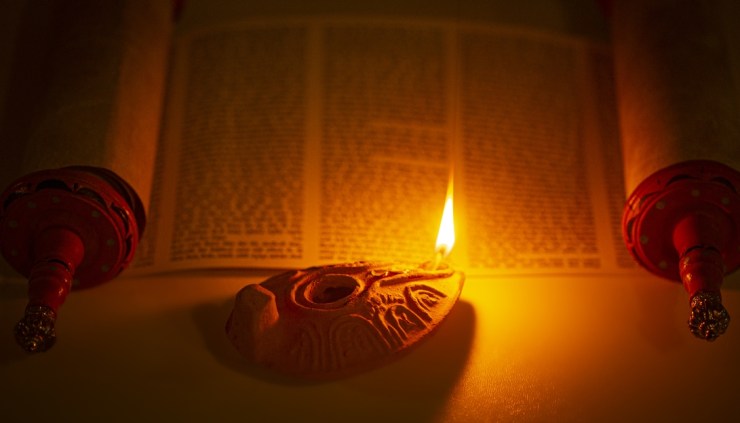
A Hebrew Torah scroll of the first five books of the Bible, which includes the Law of Moses. On the Day of Pentecost, God begins to write His law on human hearts―just as He foretold through Jeremiah: “I will put my law within them, and I will write it on their hearts” (Jeremiah 31:33).
●Finally, this Day of Pentecost points back to the Year of Jubilee. Jubilee brought rest; it released from debt and servitude; and it brought people home (see Part 19). [1][2] It was a time of great blessing for God’s people. As we saw in Part 30, Daniel 9:24-27 tells us about a promised eternal Jubilee―a ‘super-Jubilee’. Jesus launched this ‘super-Jubilee’ through His ministry (Luke 4:18-19, see Part 34). Now it’s come in a new and greater way. ◆ God releases people―He releases them from guilt (Acts 2:38) and slavery to sin (see Romans 6:22). ◆ God brings people home. When someone receives the Holy Spirit, the Triune God―Father, Son and Spirit―make Their home in them. ◆ God gives people rest. In His presence there’s rest for our souls (compare Matthew 11:28-30).[3]
The fledgling church grows
The apostles witness to Jesus’s resurrection “with great power” (Acts 4:33). And God does “many wonders and signs” . . . “ through them (2:43). The fledgling church grows apace; the Lord adds “to their number day by day those who” are “being saved” (Acts 2:47). The believers devote themselves “to the apostles’ teaching and the fellowship, to the breaking of bread and the prayers . . . day by day, attending the temple together and breaking bread in their homes,” they eat together “with glad and generous hearts, praising God and having favour with all the people.” (Acts 2:42,46-47). The believers’ unity and mutual love is wonderful to see: they’re “of one heart and soul” (4:32); they’re “together” and have “everything in common”; they sell “property and possessions to give to anyone who had need” (2:44-45 NIV).
The non-believers in Jerusalem are filled with awe as they see all that’s happening. They’re witnessing the dawn of a new age! [4]
The non-believers in Jerusalem are filled with awe as they see all that’s happening. They’re witnessing the dawn of a new age!
In the next part . . .
The gospel begins its journey out to the whole world. But alongside blessing comes persecution. Yet even that spurs believers to go out preaching the gospel. It’s not too long before the city of Antioch, rather than Jerusalem, becomes the hub of gospel outreach.
Bible Reading and Question
You may like to read John 14:15-23. Here’s a question to think about:
?In this passage Jesus says that all three Persons of the Holy Trinity will live in the believer―in us. What impact should this truth have on how we think of ourselves, and how we relate to other people?
Video
Here’s a short video, entitled The Spirit Comes: The Story of Pentecost (Acts 2). It’s designed for children ages 6 to 12. But youth and adults may well enjoy it, too. This video is in a series published by Crossway. They’re based on the book called The Biggest Story Bible Storybook. All the videos can be viewed at The Biggest Story videos website. You can also create a free account to enable you to download them.
REFERENCES [1] See The Old Testament Pentecost: Why Did Jesus Pour Out His Spirit on This Particular Day? by Chad Bird. Available online HERE, accessed 20 March 2025. [2] See The Seventy Weeks of Daniel 9, Part One by Daniel Baker. Available online at HERE, accessed 20 March 2025. [3] See Matthew: All Authority in Heaven and Earth (Preaching the Word) by Douglas Sean O’Donnell, page 306. Published by Crossway, Wheaton, Illinois, in 2013. [4] Adapted from The Book of Acts, Revised (The New International Commentary on the New Testament) by F.F. Bruce, page 73. Published by William B. Eerdmans Publishing Company, Grand Rapids, Michigan, in 1988.
CREDITS ► Text copyright © 2025 Robert Gordon Betts ► Unless otherwise indicated, all Scripture is taken from the ESV® Bible (The Holy Bible, English Standard Version®), copyright © 2001 by Crossway, a publishing ministry of Good News Publishers. Anglicized English Standard Version copyright © 2002 by Crossway. Used by permission. All rights reserved. The ESV text may not be quoted in any publication made available to the public by a Creative Commons license. The ESV may not be translated in whole or in part into any other language. ► Scripture quotations marked ‘NIV’ are taken from The Holy Bible, New International Version (Anglicised edition). Copyright © 1979, 1984, 2011 by Biblica (formerly International Bible Society). Used by permission of Hodder & Stoughton Publishers, an Hachette UK company. All rights reserved. ‘NIV’ is a registered trademark of Biblica (formerly International Bible Society). UK trademark number 1448790.
 52 Steps
_-_Google_Art_Project_-_edited.jpg)