
Part 38: “The Firstborn from the Dead”
Click the icon below to download a 4-page PDF version of this page.

Resurrection day
It’s the early hours of Sunday morning. Jesus’s body has lain in the tomb since Friday evening. Suddenly, “there was a great earthquake, for an angel of the Lord descended from heaven and came and rolled back the stone and sat on it. His appearance was like lightning, . . . . the guards trembled and became like dead men.” (Matthew 28:2-4).
Jesus had paid the penalty for our sin―spiritual death and physical death―in full. Death no longer had any hold over Him (see Romans 6:9)! So, in the darkness that morning, Jesus was raised from death.
The Bible tells us about others who were raised from death. But Jesus’s resurrection was totally different. No-one else had yet been raised with a transformed resurrection body, never to die again.
Very early that morning, some women go to the tomb to finish embalming Jesus’s body. One is Mary Magdalene. We can’t be sure of the exact order of events on that momentous day. But the following sequence seems very probable.[1]
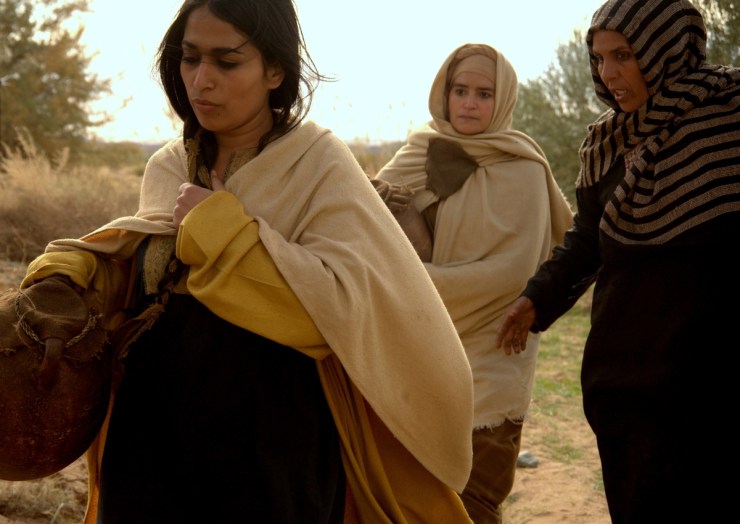
On the Sunday morning “at early dawn” the women “went to the tomb, taking the spices they had prepared” (Luke 24:1). A still from a video produced by the LUMO Project.
The women arrive at the tomb; they find the stone rolled back. Immediately, Mary assumes Jesus’s body has been removed. She dashes off to tell Peter and John. Meanwhile, the other women enter the tomb. It’s empty! Two angels appear. One says “He is not here, for he has risen, . . . . Come, see the place where he lay. Then go quickly and tell his disciples that he has risen from the dead, and behold, he is going before you to Galilee; there you will see him.” (Matthew 28:6-7). Dazed and trembling, yet full of joy, the women rush back to the city.
As soon as Peter and John hear Mary’s news, they race to the tomb. They take a different route, so they don’t meet the women returning from the tomb. We read, “Simon Peter came, . . . and went into the tomb. He saw the linen cloths lying there, and the face cloth, which had been on Jesus’ head, not lying with the linen cloths but folded up in a place by itself.” (John 20:6-7). John follows him into the tomb. From the orderly position of the burial cloths, it dawns on John that Jesus has risen―even though he and Peter don’t yet realise that the Scriptures had foretold this all along!
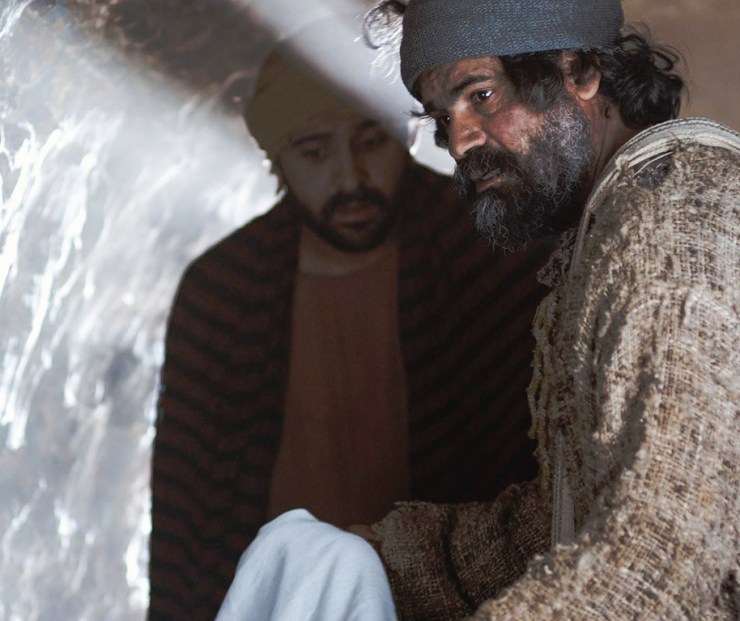
Photo courtesy of the LUMO Project and made available by FreeFreeBibleimages
“Simon Peter . . . went into the tomb. He saw the linen cloths lying there, and the face cloth, which had been on Jesus’ head, not lying with the linen cloths but folded up in a place by itself. Then the other disciple, who had reached the tomb first, also went in, and he saw and believed” (John 20:6-8). A still from a video produced by the LUMO Project.
Peter and John go home―probably John’s house in Jerusalem. Mary Magdalene now returns to the tomb; John records what happens (John 20:11-17). She still doesn’t know the other women have seen the angels. Weeping, she peers into the tomb. She sees the angels, who ask, “‘Woman, why are you weeping?” She replies: “They have taken away my Lord, and I do not know where they have laid him.” Then she turns and sees Jesus. He asks, “Woman, why are you weeping? Whom are you seeking?”. She replies, thinking Him to be the gardener; then Jesus speaks her name, “Mary”. Her grief is swallowed up in joy; she cries out “Rabboni”, meaning, ‘my teacher’. Jesus says: “Do not cling to me, for I have not yet ascended to the Father; but go to my brothers and say to them, ‘I am ascending to my Father and your Father, to my God and your God.’ ” Mary races back to John’s house to break the wonderful news to those gathered there. Two or more of the women hurry off to tell the other disciples, who are probably lying low in Bethany. On the way, Jesus appears to these women, too (Matthew 28:9).
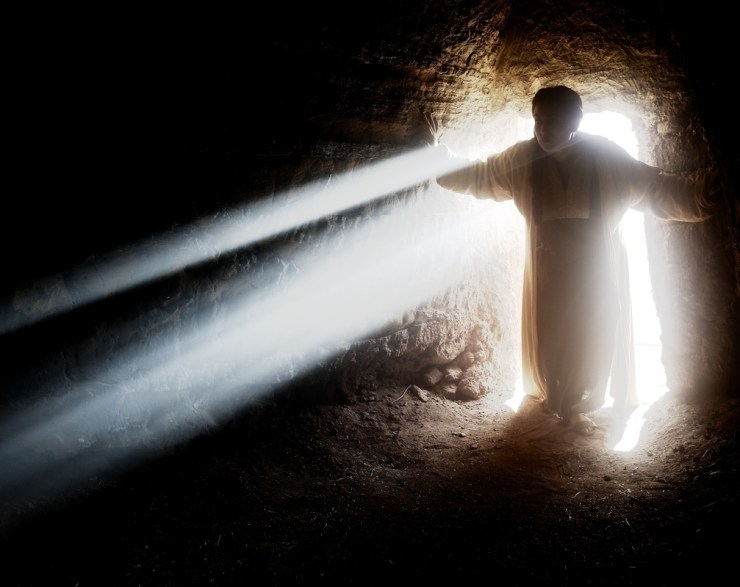
“Mary stood weeping outside the tomb, and as she wept she stooped to look into the tomb” (John 20:11). A still from a video produced by the LUMO Project.
The tomb was in a garden (John 19:41). So the risen Jesus meets Mary in a garden. That takes us back to another garden and another woman―Eve in the Garden of Eden. In that garden, God told the snake: “I will put enmity between you and the woman, and between your offspring and hers; he will crush your head, and you will strike his heel” (Genesis 3:15 NIV). One day, a single offspring of Eve would “crush” Satan’s “head”―in other words, defeat him. Now the Serpent-Crusher has crushed the serpent! By His death and resurrection, Jesus has defeated Satan. And who’s the first to hear this glorious news? Another woman, in another garden!
By His death and resurrection, Jesus has defeated Satan. The Serpent-Crusher has crushed the serpent!
Meanwhile, the guards report to the chief priests (Matthew 28:11-15). They and the Jewish leaders know something supernatural has happened. In desperation, they invent a story―they claim the disciples stole Jesus’s body while the guards were sleeping. It’s laughably improbable. But it’s the best they can do!
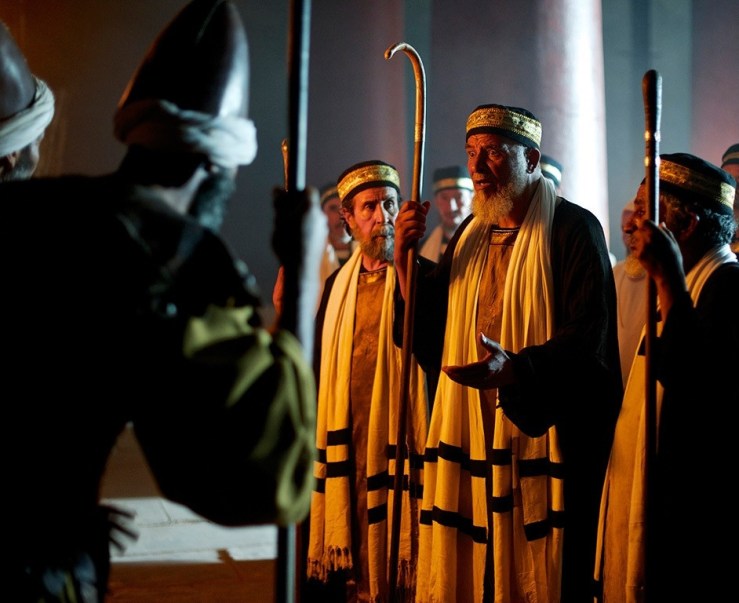
Photo courtesy of the LUMO Project and made available by FreeFreeBibleimages
Some of the guards “told the chief priests all that had taken place. And when they had assembled with the elders and taken counsel, they gave a sufficient sum of money to the soldiers and said, ‘Tell people, “His disciples came by night and stole him away while we were asleep.”’” (Matthew 28:11-13). A still from a video produced by the LUMO Project.
At some point during that day, the other disciples return to the city. That day, too, Jesus appears to Peter (Luke 24:33-34, 1 Corinthians 15:5). Three times, during Jesus’s trial before the Jewish leaders, Peter has denied His Lord (Matthew 26:69-75). How tenderly must Jesus have spoken to Peter, to assure him of His love and forgiveness.
On that Sunday, too, Jesus joins two men walking from Jerusalem to a village called Emmaus (Luke 24:13-35). He talks with them, but they don’t recognise Him. They invite Him to stay with them in Emmaus. At the meal table, their unknown guest takes bread, blesses it and breaks it. Then he gives it to them; then He vanishes! Now they realise who their guest is! They hurry back to Jerusalem, where they find ten of the disciples and others gathered with them. As they talk over all that’s happened, Jesus Himself appears among them (Luke 24:36-49). Frightened, they think He’s a ghost. But Jesus reassures them, saying, “. . . it is I myself. Touch me, and see. For a spirit does not have flesh and bones as you see that I have.” Then He eats some food in front of them. So conclude the events of that momentous day.
Witnesses to the risen Lord

Photo courtesy of the LUMO Project and made available by FreeFreeBibleimages
Jesus “said to Thomas, ‘Put your finger here, and see my hands; and put out your hand, and place it in my side. Do not disbelieve, but believe.’ Thomas answered him, ‘My Lord and my God!’” (John 20:27-28). A still from a video produced by the LUMO Project.
The Bible records Jesus appearing a number of times during the 40 days until His ascension. There were plenty of eyewitnesses alive during the early years of the Church to testify to Jesus’s resurrection. In addition to His appearances on Sunday, He appears again to His disciples in Jerusalem, now including Thomas (John 20:24-29), and to seven disciples by the Sea of Galilee (John 21:1-14).
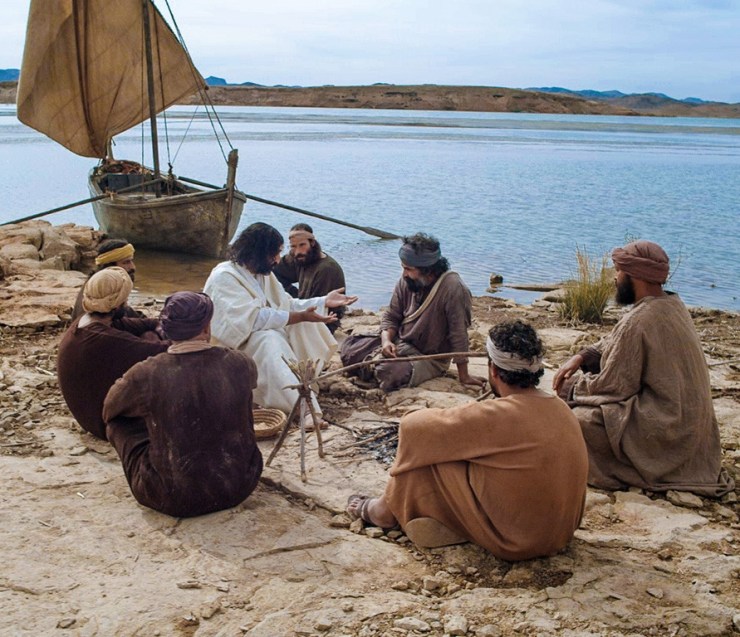
Photo courtesy of the LUMO Project and made available by FreeFreeBibleimages
Jesus met with seven of His disciples by the Sea of Galilee (John 21:1-24). A still from a video produced by the LUMO Project.
Jesus also meets with over 500 of His followers in Galilee (1 Corinthians 15:6). This meeting is planned; it seems to have been like a one-day conference with the Lord Himself as the Guest Speaker. It’s probably the occasion when Jesus gives His disciples His great commission (Matthew 28:16-20). Jesus also appears to His half-brother James (1 Corinthians 15:7). Finally, Jesus meets with His disciples in Jerusalem, probably on the evening before His ascension. He then leads them out to the Mount of Olives, blesses them, and is lifted up into Heaven (Luke 24:50-53, Acts 1:9-12). And, one day, He will return to Earth (see Acts 1:11, Revelation 1:7).

Photo courtesy of the LUMO Project
After Jesus’s ascension into Heaven, the disciples “worshipped him and returned to Jerusalem with great joy” (Luke 24:51-52). A still from a video produced by the LUMO Project.
The New Testament writers make it clear that the Resurrection happened and could be verified. Luke wrote that Jesus “presented himself alive to them after his suffering by many proofs” (Acts 1:3). And the apostles made Jesus’s resurrection a key point in their preaching. Paul writes: “. . . if Christ has not been raised, then our preaching is in vain and your faith is in vain” (1 Corinthians 15:14).
The apostles made Jesus’s resurrection a key point in their preaching. Paul writes: “. . . if Christ has not been raised, then our preaching is in vain and your faith is in vain” (1 Corinthians 15:14).
Jesus’s resurrection and ours
Jesus is the “firstborn from the dead” (Colossians 1:18). He’s “the firstfruits” (1 Corinthians 15:20,23), the first of the crop. We’re the full harvest―we, too, will get resurrection bodies like His when He returns to Earth (1 Corinthians 15:23).
And we’re already spiritually resurrected with Christ. Paul writes: “God, . . . made us alive together with Christ . . . and raised us up with him and seated us with him in the heavenly places in Christ Jesus” (Ephesians 2:4-6). We’ll explore this later in our series.
At the Father’s right hand
Forty days after His resurrection, Jesus ascends into Heaven (Luke 24:50-51, Acts 1:9-11). There He takes His seat at the Father’s right hand―the place of supreme honour. In Part 31, we saw Daniel’s vision of God, “the Ancient of Days”, in His heavenly courtroom (Daniel 7:9). One “like a son of man” is led into God’s presence and ”given dominion and glory and a kingdom, that all peoples, . . . should serve him; his dominion is an everlasting dominion, . . . .” (7:13-14). Daniel seems to be viewing the Ascension from Heaven’s perspective―Jesus coming up from Earth to His Father in Heaven. He’s now seated there, enthroned in absolute authority over all creation―including over Satan and all the forces of evil. His enemies are now being defeated; as David prophesied, “The LORD says to my Lord: ‘Sit at my right hand, until I make your enemies your footstool'” (Psalm 110:1).
A king of David’s dynasty, Jesus Christ, now sits on the throne of the Universe―“the throne of his father David” (Luke 1:32).
Of course, the Son of God has always ruled creation: after all, “by him all things were created” (Colossians 1:16), and He sustains everything (see Colossians 1:17, Hebrews 1:3). But now Jesus Christ rules creation as a Man, too―God’s Messiah, the Son of David (see Luke 1:30-33). A king of David’s dynasty, Jesus Christ, now sits on the throne of the Universe―“the throne of his father David” (Luke 1:32). The Father has given Him a kingdom that will last for ever―the Kingdom of God. Now our King has commanded us to gather in citizens for His kingdom.[2] That’s why He gives His disciples, and us, His great commission: “All authority in heaven and on earth has been given to me. Go therefore and make disciples of all nations, . . . .” (Matthew 28:18-20).

Jesus said to His disciples, “All authority in heaven and on earth has been given to me. Go therefore and make disciples of all nations, baptizing them in the name of the Father and of the Son and of the Holy Spirit, teaching them to observe all that I have commanded you. And behold, I am with you always, to the end of the age.” (Matthew 28:18-20).
A Man for ever
Jesus’s risen body is the very same body that He had during His earthly life. It was His tortured, crucified, and thoroughly dead body that rose again―a body that still bore the marks of His crucifixion (John 20:20,27), and (we may assume) still does. His resurrection body has new powers; He could, for example, appear and disappear from human sight at will. But His body was solid, able to be handled, and to eat and drink.
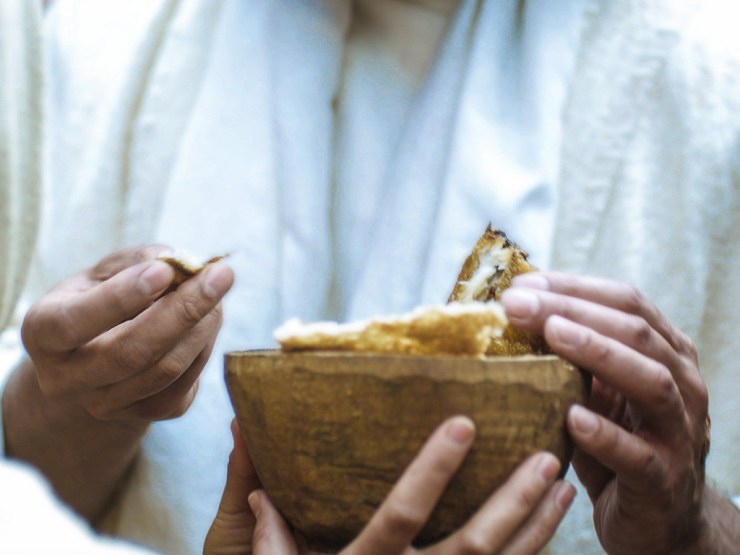
Photo courtesy of the LUMO Project and made available by FreeFreeBibleimages
Jesus appeared to His disciples (except Thomas) on the evening following His resurrection. While “they still disbelieved for joy and were marvelling, he said to them, “Have you anything here to eat?” They gave him a piece of broiled fish, and he took it and ate before them.” (Luke 24:41-43). A still from a video produced by the LUMO Project.
And Jesus still has a physical body in Heaven. It’s a glorious body―but it’s a human body, nonetheless. When He returned to Heaven at His ascension He didn’t stop being a Man. Jesus loves us so much that He’ll always be a Member of our human race. He’s glad to be called our Brother (see Hebrews 2:11). Such is His love and grace!
God gave Adam and Eve dominion over the Earth. In Jesus, humanity’s dominion has been restored. A Member of our human race rules Earth, and every planet and star, and the invisible heavenly realms, too. And, even now, we believers share His rule over Earth and Heaven. We share in His victory over the evil powers.

A Member of our human race―Jesus Christ―rules Earth, and every planet and star, and the invisible heavenly realms, too.
Next time . . .
Ten days after Jesus’s ascension, God launches a new phase in His plan of salvation. Jesus pours out the Holy Spirit on His disciples. We call this ‘The Day of Pentecost’. We’ll see what happens next time.
Bible Readings and Question
You may like to read Acts 2:22-36 and 1 Corinthians 15:14. Here’s a question to think about:
? Why is Jesus’s resurrection such a central and vital part of the gospel message?
Videos
Here are two short videos, entitled Jesus Lives: The Story of the Resurrection (Luke 24) and A Mission for the Ages: The Story of the Great Commission (Matthew 28). They’re designed for children ages 6 to 12. But youth and adults may well enjoy them, too. These videos are in a series published by Crossway. They’re based on the book called The Biggest Story Bible Storybook. All the videos can be viewed at The Biggest Story videos website. You can also create a free account to enable you to download them.
Book recommendation
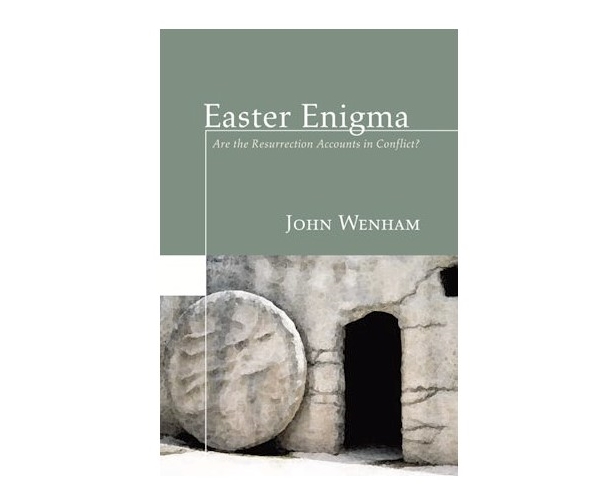
Easter Enigma by John Wenham brings vividly to life the events of the Resurrection. This book weaves together the five accounts of Jesus’s Resurrection and His subsequent appearances, and gives us a compelling overview of what happened during those momentous 40 days. The book tells us about Jerusalem and the areas around the city relevant to the Bible account, and about key people involved―including Mary Magdalene and the five writers who record the events. Then it recounts the events from Good Friday right through to Jesus’s ascension. It’s a convincing and enthralling read. View the publisher’s description page HERE.
REFERENCES [1] The sequence of events outlined here follows John Wenham’s book Easter Enigma: Are the Resurrection Accounts in Conflict? Published by Paternoster Press, Exeter, United Kingdom, in 1987. A second edition is also available, published in 1992. [2] See The Arrival of God’s Kingdom by S.M. Baugh. Available online at https://www.beautifulchristianlife.com/blog/the-arrival-of-gods-kingdom (accessed 12 March 2025).
CREDITS ► Text copyright © 2024 Robert Gordon Betts ► Unless otherwise indicated, all Scripture is taken from the ESV® Bible (The Holy Bible, English Standard Version®), copyright © 2001 by Crossway, a publishing ministry of Good News Publishers. Anglicized English Standard Version copyright © 2002 by Crossway. Used by permission. All rights reserved. The ESV text may not be quoted in any publication made available to the public by a Creative Commons license. The ESV may not be translated in whole or in part into any other language. ► Scripture quotations marked ‘NIV’ are taken from The Holy Bible, New International Version (Anglicised edition). Copyright © 1979, 1984, 2011 by Biblica (formerly International Bible Society). Used by permission of Hodder & Stoughton Publishers, an Hachette UK company. All rights reserved. ‘NIV’ is a registered trademark of Biblica (formerly International Bible Society). UK trademark number 1448790.
 52 Steps