
Part 37: The Crossing Point of History
Click the icon below to download a 4-page PDF version of this page.

On trial before the Jewish leaders
The Gospels tell us about the last few days of Jesus’s life, and about His death and resurrection, in great detail. These are the climactic events of His life on Earth. They’re the great climactic events of all history.
Jesus’s death and resurrection are the climactic events of His life on Earth. They’re the great climactic events of all history.
Last time, we saw how Judas betrayed Jesus, and arranged His arrest. Jesus is now taken into the city. He’s questioned by a Jewish leader called Annas, father-in-law of Caiaphas, the High Priest (John 18:12-14,19-23). Annas is looking for evidence that will enable them to have Jesus executed. [1,2] It’s probably now the small hours of Friday morning.
Annas sends Jesus to Caiaphas; the Jewish leaders have gathered with him (Matthew 26:57-68). They call witnesses; but their testimony is false, and their statements don’t agree. But Caiaphas, determined to have Jesus executed, persists. He questions Jesus, who says nothing. Then Caiaphas puts Jesus under oath and demands: “. . . Tell us if you are the Messiah, the Son of God” (26:63 NIV). Jesus answers, “You have said so, . . . . But I say to all of you: from now on you will see the Son of Man sitting at the right hand of the Mighty One and coming on the clouds of heaven.” (26:64 NIV). His words, recalling Psalm 110:1 and Daniel 7:13, seal His fate. To His accusers, this is blasphemy. Mark tells us “they all condemned Him as deserving death” (Mark 14:64). Jesus is mocked and beaten―a foretaste of the brutality to come.
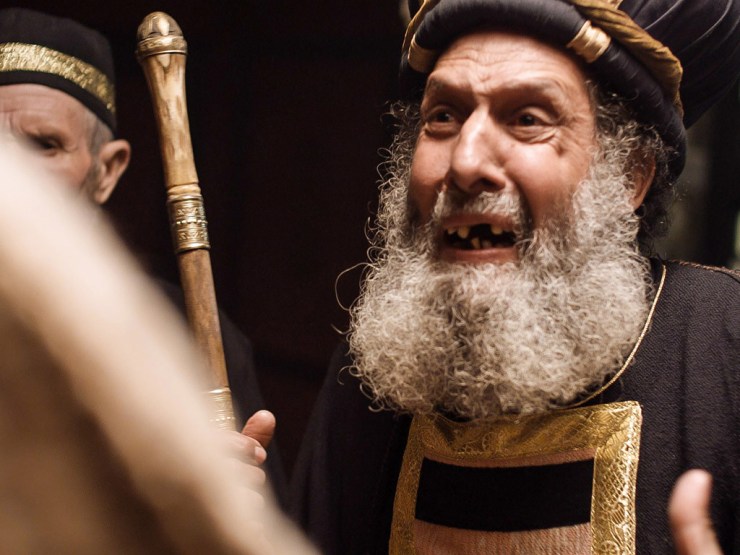
Photo courtesy of LUMO Project and made available by FreeFreeBibleimages
Caiaphas puts Jesus under oath and demands: “. . . Tell us if you are the Messiah, the Son of God” (Matthew 26:63 NIV). A still from a video produced by the LUMO Project
Early on Friday morning, the Jewish authorities reach their final verdict. They want Jesus executed. But only the Romans have authority to carry out the death sentence. So they submit the case to the Roman governor, Pontius Pilate (Matthew 27:1-2). The Jewish leaders accuse Jesus of telling people not to pay taxes, and claiming to be Christ, a king. These are political charges, designed to goad Pilate into having Jesus executed.
On trial before Pilate
Pilate questions Jesus. Historical accounts reveal Pilate to be stubborn and cruel. But here he acts out of character; he senses there’s something different about Jesus. He says he finds no grounds for charging Jesus with any crime. He sends Jesus to the Jewish king, Herod. The king questions Him, but Jesus gives no answer. The Jewish leaders stand by, ferociously accusing Jesus. Herod then sends Jesus back to Pilate―but not before he and his soldiers have ridiculed and mocked Him (Luke 23:1-12).
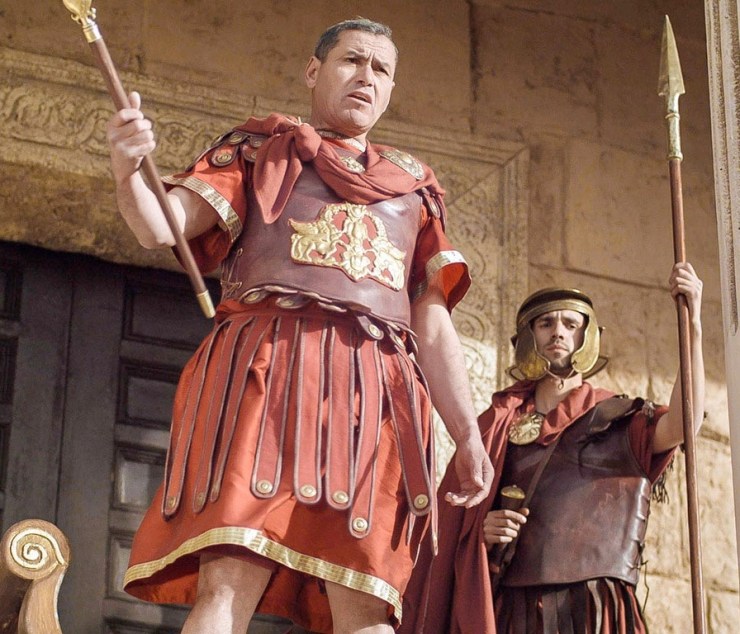
Photo courtesy of LUMO Project and made available by FreeFreeBibleimages
“Pilate said to the chief priests and the crowds, ‘I find no guilt in this man.'” (Luke 23:4). A still from a video produced by the LUMO Project
Pilate now calls together the Jewish leaders and the people and tells them that neither he nor Herod have found Jesus guilty of the charges brought against Him. Pilate declares, “I will therefore punish and release Him” (Luke 23:16). There was a custom that the people could ask for one prisoner to be released at the Passover festival. The Jewish leaders persuade the people to ask for a rebel and murderer called Barabbas to be released, not Jesus. The people save a murderer, and want our Saviour murdered.
Again Pilate declares that he finds no grounds to execute Jesus―he wants to punish Him and then let Him go. But the crowd keeps shouting, “Crucify Him! Crucify Him!” (Luke 23:21 NIV). To try to placate them, Pilate has Jesus flogged. Soldiers put a crown made from thorns on His head; they clothe Him in a mock royal robe. They ridicule Him and slap Him (John 19:1-3).
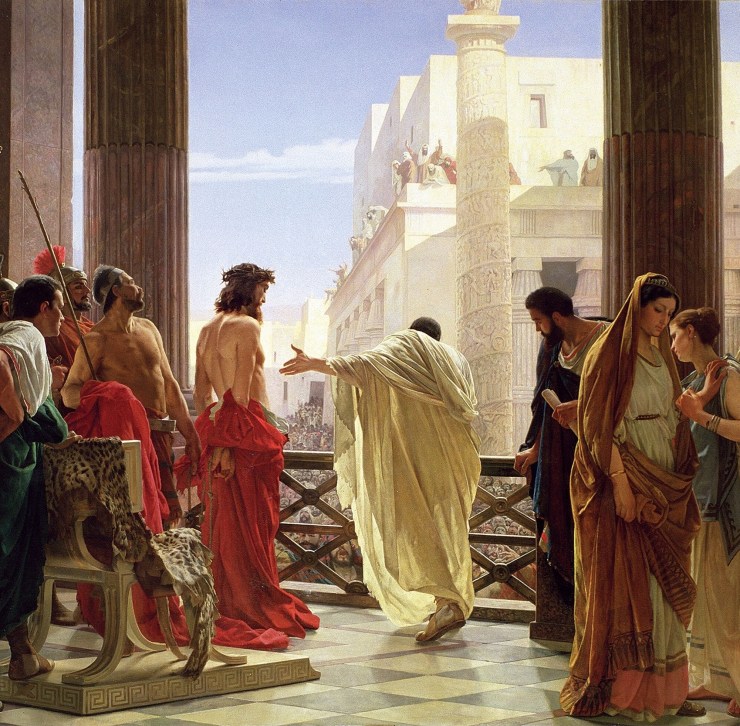
Pilate goes out to the crowd again and says, “I am bringing him out to you that you may know that I find no guilt in him” (John 19:4). He brings Jesus out and declares, “Behold the man!” (19:5). His words echo down the ages: Jesus really is the Man―the second Adam, the Man who represents all mankind. There He stands, soon to suffer the penalty of death on our behalf.
Pilate brings Jesus out and declares, “Behold the man!” (John 19:5). Jesus really is the Man―the second Adam, the Man who represents all mankind.
Ecce Homo (Behold the Man!) from Wikimedia Commons
Ecce Homo (Behold The Man!) by Antonio Ciseri. “So Jesus came out, wearing the crown of thorns and the purple robe. Pilate said to them, ‘Behold the man!'” (John 19:5).
Pilate doubtless hopes the pitiful sight of Jesus―still wearing the mock kingly robe and thorny crown, His face swollen, bruised, and bleeding―will placate the crowd. But no. The chief priests and their officers cry out, “Crucify Him, crucify Him!” (19:6). Again Pilate declares he finds Jesus not guilty; again he tries to release Him. But the Jewish leaders are adamant. They shout, “Away with Him, away with Him, crucify Him!” (John 19:15). Defeated, Pilate caves in to their demands. It seems that Jesus is now flogged again, more brutally than before, and again mocked and abused by the Roman soldiers.
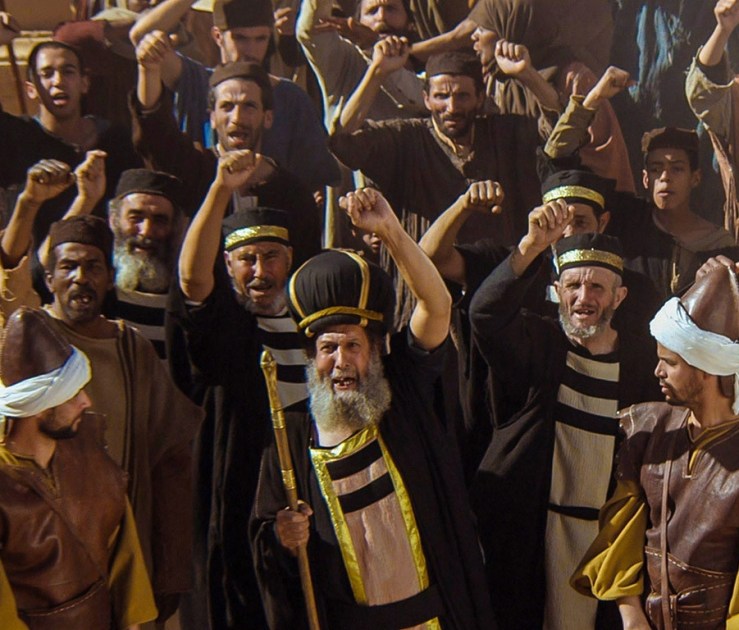
Photo courtesy of LUMO Project and made available by FreeFreeBibleimages
“Pilate addressed them once more, desiring to release Jesus, but they kept shouting, ‘Crucify, crucify him!'” (Luke 23:20-21). A still from a video produced by the LUMO Project
Crucified for us
It’s now around 9 in the morning; Jesus is taken to the place of execution―called Golgotha―outside the city walls. His hands and feet are nailed to a rough wooden stake, probably bearing a crossbeam to form a cross. Two criminals are crucified with Him, one either side (Luke 23:32-33); Jesus is “numbered with the transgressors” (Isaiah 53:12). The soldiers on duty divide Jesus’s clothes among them. But His tunic is woven in one piece; rather than tearing it, they cast lots for it (John 19:23-24)―fulfilling David’s prophetic words, “they divide my garments among them, and for my clothing they cast lots” (Psalm 22:18).
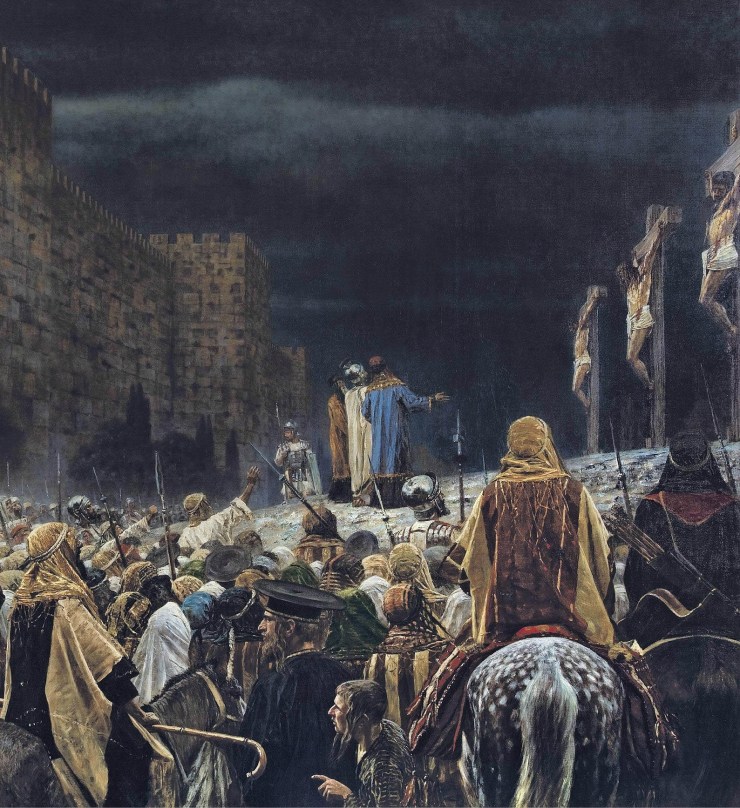
Image from Wikimedia Commons
Detail from Crucifixion by the Romans by Vasily Vereshchagin. The artist focuses on the crowd; we viewers almost become part of the crowd. Among the crowd, Roman soldiers with their spears and lances stand ready to quieten disorder.
Crucifixion was a brutal, revolting, and agonisingly slow form of execution. The victim―disfigured, almost certainly naked, and in unspeakable agony―was exposed to ridicule and shame. At noon, darkness falls for three hours. This is supernatural darkness (Matthew 27:45). Why does God shroud the scene in darkness? There’s more than one reason―especially, perhaps, it shows God’s judgment on sin.
The apostle Peter tells us that Jesus “. . . Himself bore our sins in His body on the cross” (1 Peter 2:24 NIV). Isaiah wrote, ”He was pierced for our transgressions, . . . the punishment that brought us peace was on Him, . . . . the LORD has laid on Him the iniquity of us all.” (Isaiah 53:5-6 NIV). Paul writes, “For our sake [God] made Him to be sin who knew no sin” (2 Corinthians 5:21). Jesus never once sinned. But, on the Cross, He is held guilty of all human sin―from mass murders, cruelty, immorality, and injustice, to the acts of unkindness that daily spoil our lives. To the spotless, pure Son of God, this is an ordeal so terrible we cannot possibly imagine it. A sense of shame, abandonment, intense loneliness, and emptiness will have overwhelmed Him. And because He bears our guilt, He suffers our penalty. That penalty is “everlasting destruction” (2 Thessalonians 1:9 NIV)―being alienated from God, and enduring His righteous wrath for ever. That’s spiritual death; it’s what Hell is.
On the Cross, Jesus is held guilty of all human sin―from mass murders, cruelty, immorality, and injustice, to the acts of unkindness that daily spoil our lives.
But this is the staggering truth: God loves us so much that He Himself has provided the way to rescue us (see John 3.16); Jesus Himself―on our behalf―is alienated from His Father, and endures His righteous wrath. In the darkness, Jesus cries “My God, my God, why have you forsaken Me?” (Matthew 27:46, citing Psalm 22:1). From eternity past, He has enjoyed perfect, unclouded fellowship with His Father. But now He is forsaken by Him. We all know the pain of broken friendships. But we cannot imagine what Jesus endures while estranged from His Father. But through it all, Jesus loves His Father and obeys Him to the end. And He loves us, and suffers until the full price of our sin is paid.
The Cross and the Trinity
We must not think of God the Father as standing remote from this scene of anguish, dispassionately punishing His Son. The Father Himself suffered the pain of alienation from His beloved Son. All Three Persons of the Trinity were involved at the Cross. The Father is reconciling the world to Himself through Christ (see 2 Corinthians 5:18-19). And Jesus offers Himself “through the eternal Spirit” (Hebrews 9:14).
Suddenly, a triumphant cry pierces the air. Jesus shouts “It is finished” (John 19:30) – in other words, “It is accomplished!”. His work is complete; the darkness lifts. Jesus releases His spirit and dies. At that moment, “the curtain of the temple” is “torn in two, from top to bottom” (Matthew 27:51). This curtain is probably the one blocking the way into the Most Holy Place―the room reserved for God’s presence on Earth. No-one could enter it except the High Priest on just one day each year. That curtain showed that people were barred from God’s presence because of their sin. But Jesus has now borne the penalty for our sin. So the barrier between God and humanity is now removed. To show this, God Himself tears that thick, heavy curtain from top to bottom.
Jesus has now borne the penalty for our sin. The barrier between God and humanity is now removed.
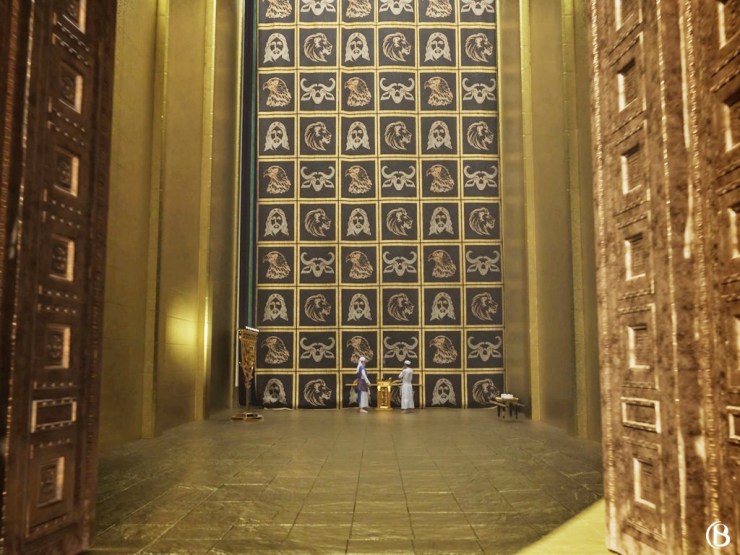
Photo courtesy of Bible-Scenes.com (CC BY 4.0 International) and made available by FreeFreeBibleimages
An artist’s impression of the Holy Place in the Temple. At the back is the huge, heavy curtain blocking the way into the Most Holy Place―the room reserved for God’s presence on Earth. It’s probably this curtain that’s torn when Jesus dies.
And a great earthquake splits the rocks; tombs open and the bodies of many godly people rise from death―a foretaste of the resurrection of the dead at the end of this age. They enter Jerusalem and appear to many people. Awestruck, the centurion and his soldiers on crucifixion duty declare, “Truly this was the Son of God!” (Matthew 27:51-54).
Buried in a new tomb
It’s now mid-afternoon. The sun will set in just a few hours, and the Sabbath will begin. And this Sabbath is “a high day”, too―the first Sabbath of the festival of Unleavened Bread (John 19:31, see Exodus 12:16). Crucified victims could take days to die, and the Romans typically let their bodies remain on the cross to rot. According to Deuteronomy 21:22–23, the bodies of hanged criminals defile the land; so the Jewish leaders ask Pilate to have the victims’ legs broken to bring on death, and their bodies removed (John 19:31-37). But Jesus is already dead. So they don’t break his legs; instead, a soldier pierces His side with a spear. And so the Scriptures are fulfilled: “Not one of his bones will be broken” and “They will look on him whom they have pierced” (see Psalm 34:20 and Exodus 12:46, and see Zechariah 12:10).
A Jewish leader called Joseph of Arimathea, a follower of Jesus, arranges Jesus’s burial. No work could be done on the Sabbath. So Jesus’s body is hastily embalmed with spices, and laid in Joseph’s own new tomb. It’s a cave; a huge round stone is placed over its entrance to close it (Mark 15:42-47). The Jewish leaders fear that Jesus’s disciples might try to steal His body and pretend He has risen from death. So they have the tomb sealed, and guarded by soldiers (Matthew 27:62-66).

An ancient rolling stone tomb in Israel. “Joseph took the body and wrapped it in a clean linen shroud and laid it in his own new tomb, which he had cut in the rock. And he rolled a great stone to the entrance of the tomb . . . .” (Matthew 27:59-60).
Next time . . .
Death’s decay cannot touch our Lord. In that new tomb something quite new and staggeringly wonderful will take place. A new day in the history of this world is soon to dawn.[3]
Bible Reading and Question
You may like to read one of the Gospel accounts of our Lord’s crucifixion. Here’s a question to think about:
? Jesus wasn’t murdered or killed in battle. He was put on trial, and executed. He died a criminal’s death; He was “numbered with the transgressors” (Isaiah 53:12). Why did He die in this particular way? Isaiah 53:5 points us to the answer.
Videos
Here is a short video, entitled The Snake Crusher Is Crushed for Us: The Story of the Crucifixion of Jesus (Mark 15). It’s designed for children ages 6 to 12. But youth and adults may well enjoy it, too. This video is one of a series published by Crossway. They’re based on the book called The Biggest Story Bible Storybook. All the videos can be viewed at The Biggest Story videos website. You can also create a free account to enable you to download them.
Song
Here’s a song performed by Emu Music, an Australian group who are one of the bands who have led worship at the Keswick Convention. The song’s first line is My Song Is Love Unknown; it sings of our Saviour’s love to us, in going to the Cross for our sake. It’s an old hymn, now arranged and reintroduced to us by the group. The lyrics and more information are available HERE.
REFERENCES [1] For the chronology and events of Jesus’s trials, flogging and crucifixion, see The Final Days of Jesus by Andreas J. Köstenberger and Justin Taylor, with Alexander Stewart, pages 95-167. Published by Crossway, Wheaton, Illinois, in 2014; and A Four-column Parallel and Chronological Harmony of the Gospels of Matthew, Mark, Luke and John by Robert M. Sutherland. Published in 2021 and available online at https://ebible.org/eng-web/helps/ParallelGospels.pdf (accessed 5 March 2025). [2] See Jesus the Messiah: a Survey of the Life of Christ by Robert H. Stein. Published by interVarsity Press, Downers Grove, Illinois and Leicester, England, in 1996. [3] Adapted from The Cross of Christ by John R.W. Stott, page 167. Published by Inter-Varsity Press, Leicester, England, in 1986.
CREDITS ► Text copyright © 2024 Robert Gordon Betts ► Unless otherwise indicated, all Scripture is taken from the ESV® Bible (The Holy Bible, English Standard Version®), copyright © 2001 by Crossway, a publishing ministry of Good News Publishers. Anglicized English Standard Version copyright © 2002 by Crossway. Used by permission. All rights reserved. The ESV text may not be quoted in any publication made available to the public by a Creative Commons license. The ESV may not be translated in whole or in part into any other language. ► Scripture quotations marked ‘NIV’ are taken from The Holy Bible, New International Version (Anglicised edition). Copyright © 1979, 1984, 2011 by Biblica (formerly International Bible Society). Used by permission of Hodder & Stoughton Publishers, an Hachette UK company. All rights reserved. ‘NIV’ is a registered trademark of Biblica (formerly International Bible Society). UK trademark number 1448790.
 52 Steps
.jpg)
.jpg)