
Part 36: “The New Covenant In My Blood”
Click the icon below to download a 4-page PDF version of this page.

The Last Supper
It’s now Thursday evening, a few days after Jesus’s triumphant ride into Jerusalem. Tomorrow is the festival of Passover, the day when Passover lambs will be sacrificed in the Temple. Jesus and His disciples now share their final meal together. We call it the Last Supper. It seems to be a Passover meal, but celebrated a day earlier than the official day.
Judas Iscariot is watching for a moment when the authorities can arrest Jesus quietly. During the meal, Jesus, as the host, passes a special portion to Judas. It’s an act of love. Judas receives the portion, but not the love.[1] Satan enters into him; he slips away into the night to arrange Jesus’s arrest (John 13:21-30).

Photo courtesy of LUMO Project and made available by FreeFreeBibleimages
Judas at the Last Supper―a still from a video produced by the LUMO Project. After Jesus gives him a special portion, Judas slips away into the night to arrange Jesus’s arrest.
At this meal, Jesus breaks bread and gives it to His disciples, saying, “This is my body given for you; do this in remembrance of me.” After the meal, He takes the cup, saying “This cup is the new covenant in my blood, which is poured out for you” (Luke 22:19-20 NIV). Notice the words “given for you” and “poured out for you”. The bread symbolises Jesus’s body; the wine His blood. The bread and wine given to the disciples represents Jesus being given for them. He is going to die for them―and for us.
The bread and wine given to the disciples represents Jesus being given for them. He is going to die for them―and for us.
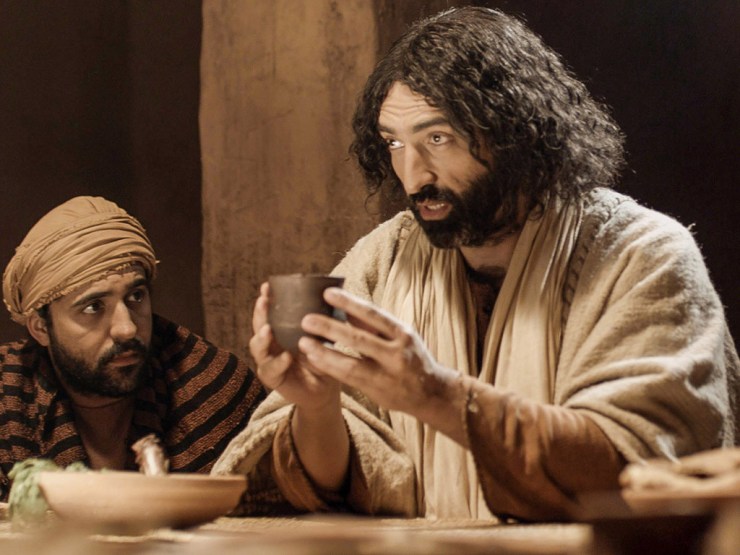
Photo courtesy of LUMO Project and made available by FreeFreeBibleimages
Jesus takes the cup, saying, “This cup is the new covenant in my blood, which is poured out for you” (Luke 22:20 NIV). A still from a video produced by the LUMO Project.
The “new covenant”
Notice also Jesus’s words, “the new covenant in my blood”. To see what He means by this, we need to go back to two Old Testament events.
► The Passover and Exodus. Every Passover, God’s people remembered how God had saved their firstborn from death, overthrown their Egyptian oppressors, and, led by Moses, guided them to freedom through the Red Sea (Exodus 12:1-14:31). Now (as we saw in the previous part) a new ‘Moses’, Jesus, is going to lead people in another, greater Exodus. Through His Exodus―His death, resurrection, and ascension into Heaven―God will release people from guilt and from slavery to sin.
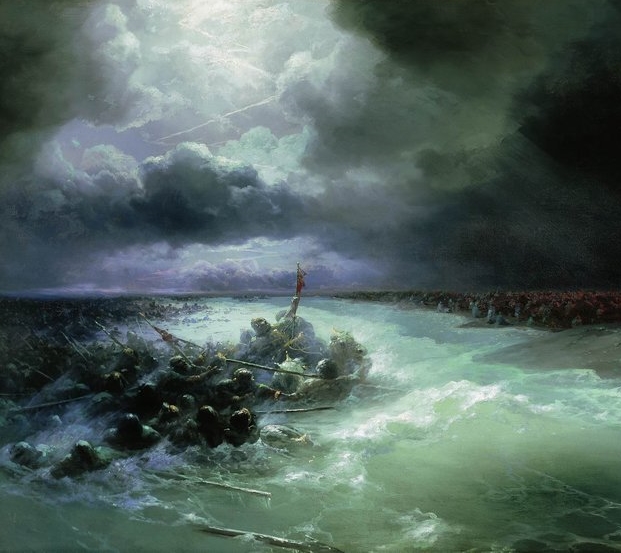
Passage of the Jews Through the Red Sea from Wikimedia Commons
Detail from Passage of the Jews through the Red Sea painted by Ivan Aivazovsky. The Egyptians flounder and drown in the Red Sea, whilst God’s people, safe on dry land, look on. Now a new ‘Moses’, Jesus, is going to lead people in another, greater Exodus.
►The second Old Testament event is the covenant God made with His people at Mount Sinai, some weeks after the Exodus (Exodus 24:1-11). Moses sprinkled blood on the altar and on the Book of the Covenant. And he sprinkled it on the people, saying: “Behold the blood of the covenant that the LORD has made with you . . . .” (Exodus 24:8). When Jesus says, “the new covenant in my blood” He’s echoing these words of Moses at Sinai.
A covenant―as we’ve seen earlier in this series―brings two parties into a binding relationship. At Sinai, God brought His people into relationship with Him―a relationship that was like a marriage! Through this new covenant, God is going to bring people into a new relationship with Himself. Again, it’ll be like a marriage. But it’ll be a more wonderful, more intimate marriage than the Sinai covenant could bring about. Through the prophet Jeremiah, God promised, “I will make a new covenant with the house of Israel and the house of Judah, . . . . I will put my law within them, and I will write it on their hearts. And I will be their God, and they shall be my people. . . . . For I will forgive their iniquity, and I will remember their sin no more.” (Jeremiah 31:31-34). And in Ezekiel 36:25-27, we read “I will sprinkle clean water on you, and you shall be clean from all your uncleannesses, . . . . And I will give you a new heart, and a new spirit I will put within you. And . . . I will put my Spirit within you, and cause you to walk in my statutes . . . .”.
Through the prophet Jeremiah, God promised, “I will make a new covenant with the house of Israel and the house of Judah, . . . .” (Jeremiah 31:31).
Through this new covenant:
●God will cleanse His people from sin, and forgive them.
●He’ll give His people “a new heart”―a new character that instinctively hates sin, loves God and wants to obey Him. He’ll put His law “within” His people, and “write it on their hearts”.
●God will put His Holy Spirit within people.
●God will bring His people into an intimate relationship with Himself. He will be their God, and they will be His people.
All these blessings can be summed up in a single word―salvation.
That first covenant at Sinai was sealed with blood. This new covenant would be sealed with blood, too―the blood of Jesus. His blood would be “poured out for many for the forgiveness of sins” (Matthew 26:28).
The indwelling Holy Spirit
Jesus is going to lead people through a new Exodus. They’ll cross over “from death to life” (John 5:24); they’ll be released from guilt and slavery to sin. Jesus now prepares His disciples for this new life that awaits them (14:1-16:33). He says to them, “If you love me, you will keep my commandments. And I will ask the Father, and he will give you another Helper, to be with you for ever, even the Spirit of truth, . . . . You know him, for he dwells with you and will be in you.” (John 14:15-17). A little later, He says “If anyone loves me, he will keep my word, and my Father will love him, and we will come to him and make our home with him” (14:23). The Triune God―Father, Son and Spirit―will dwell in His people!
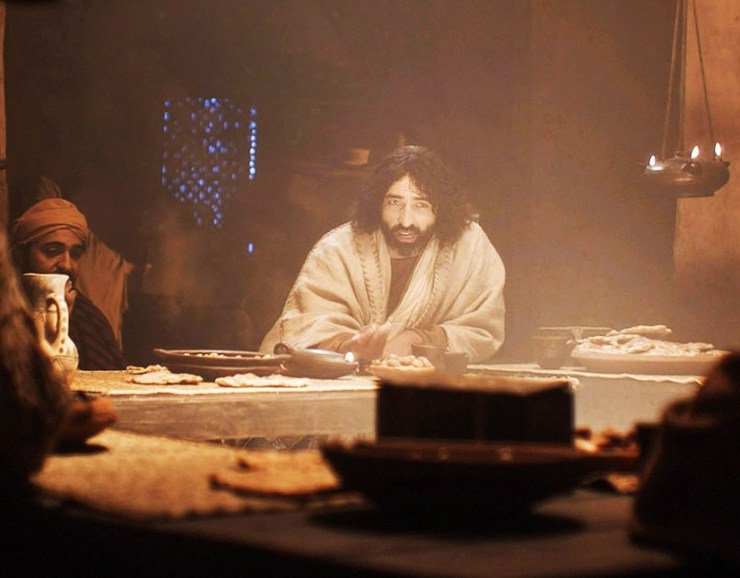
Photo courtesy of LUMO Project and made available by FreeFreeBibleimages
At the Last Supper, Jesus prepares His disciples for the new life that awaits them―a life that will begin in earnest on the Day of Pentecost. A still from a video produced by the LUMO Project.
Jesus’s prayer
We now overhear Jesus’s wonderful prayer recorded in John 17:1-26. He prays for Himself (17:1-5), for His disciples (17:6-19), and for all believers―including you and me (17:20-26).
Jesus begins by praying: “Father, . . . ; glorify your Son that the Son may glorify you, since you have given him authority over all flesh, to give eternal life to all whom you have given him” (17:1-2). But how can Jesus’s crucifixion, so gruesome and degrading to human eyes, possibly bring glory to God?
●The Cross displays God’s righteousness and justice. Because He’s righteous and just, He must impose a penalty for sin―a penalty paid by Jesus on the Cross.
●The Cross displays God’s perfect love. It was our sin’s penalty that Jesus paid. He took our punishment, and saved us from Hell. As Paul writes, “God shows his love for us in that while we were still sinners, Christ died for us” (Romans 5:8).
●Believers’ salvation will glorify God. Through the Cross, Jesus will draw many to trust in Him and receive “eternal life” (see John 12:32). They’ll receive a new identity and destiny so glorious we can’t really imagine it now: God is “bringing many sons to glory” (Hebrews 2:10). This, too, will glorify our God who planned and accomplished all this! “To him be glory for ever” (Romans 11:36).
A little later, Jesus prays for His disciples: “Holy Father, keep them in your name, which you have given me, . . . .” (17:11). The Father’s name means His character―all that He is. Jesus asks His Father to keep the disciples in the Father’s name―in other words, loyal to the truth about who His Father is. That way, they’ll be united (“one”), just as the Son and Father are “one” (17:11). Jesus is sending these men on a mission; they’ll be on the front line of a spiritual war zone. So He prays, “I do not ask that you take them out of the world, but that you keep them from the evil one . . . . They are not of the world . . . .” (17:15). He continues: “Sanctify them in the truth; your word is truth” (17:17). He prays that the Father will sanctify them―in other words, set them apart to serve God. How? By thinking and living in line with the truth about God.
Jesus then prays for those who’ll believe in Him through His disciples, “that they may all be one, just as you, Father, are in me, and I in you, that they also may be in us, . . . .” (17:21). His disciples’ unity (17:11) and these believers’ unity (17:21) is modelled on the unity of the Father and the Son in the Godhead! This is spiritual unity―a unity unlike anything the world has ever seen. It will make a deep impression on unbelievers. They’ll see that Jesus really is sent by the Father. And they’ll see that Christians are loved people―loved by the Father with the same love that the Father loves Jesus! And Jesus prays that believers “may be with me where I am, to see my glory that you have given me” (17:24). One day “we shall see him as he is” (1 John 3:2).
Jesus “always lives to make intercession for” us (Hebrews 7:25); He continues to pray these things for us now!
Jesus “always lives to make intercession for” us (Hebrews 7:25); He continues to pray these things for us now!
Gethsemane
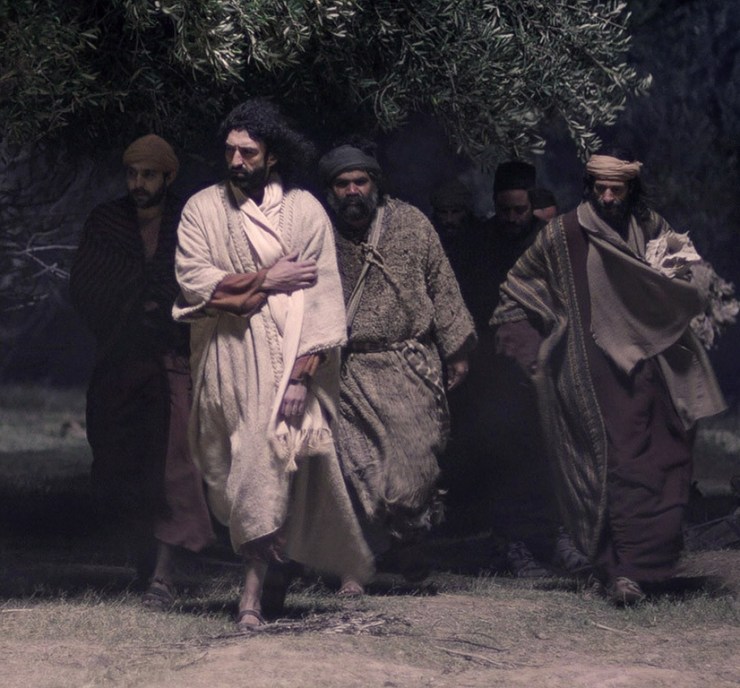
Photo courtesy of LUMO Project and made available by FreeFreeBibleimages
Jesus and His disciples enter the Garden of Gethsemane after the Last Supper―a still from a video produced by the LUMO Project.
Jesus and His disciples leave the city and enter a walled olive orchard called the Garden of Gethsemane. Asking His disciples to keep watch, Jesus prays. He begins to be “greatly distressed and troubled”; He tells His disciples: “My soul is very sorrowful, even to death” (Mark 14:33-34). The enormity of what He will endure on the Cross now seizes Him and fills Him with stark horror. He will endure humiliation and excruciating agony. But this isn’t what so horrifies Him. He must endure something far worse than physical torture. He will bear responsibility for all humanity’s sin for all time. He will be treated as if He were guilty of it all. As Isaiah prophesied, “the LORD has laid on him the iniquity of us all” (Isaiah 53:6). And He will bear the penalty for that sin. That penalty is death―not only physical death, but also spiritual death―to be alienated from His Father and to endure His Father’s righteous anger. Before the first Exodus, the Passover lambs died instead of the firstborn sons. Now “Christ, our Passover lamb, has been sacrificed” (1 Corinthians 5:7). Jesus is going to die instead of us.
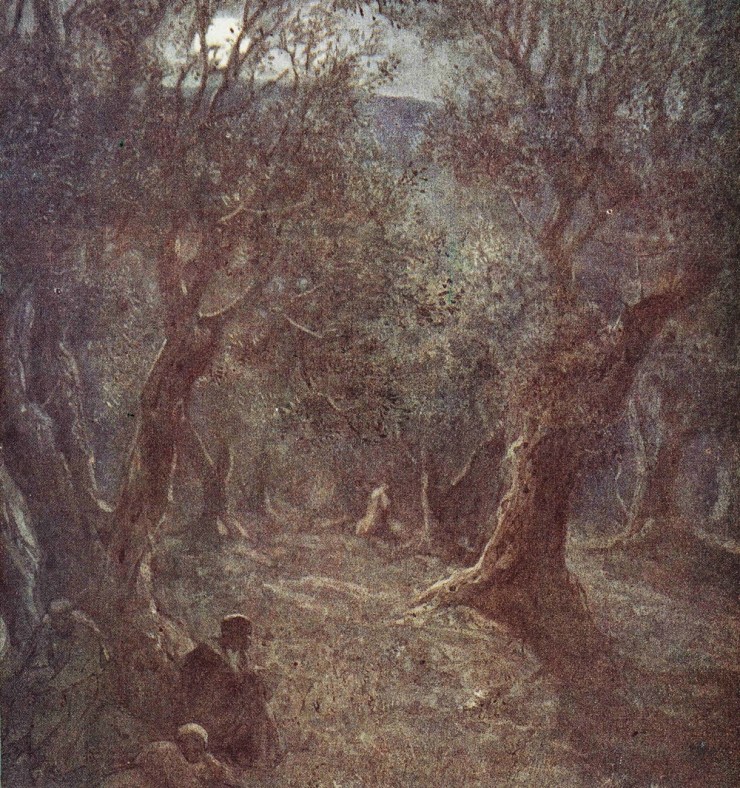
Jesus praying in the Garden of Gethsemane: a painting by William Hole. Jesus is seen in the middle distance in the centre of the painting; the disciples are seen at the bottom left. The Passover was around the time of the full moon, which throws a silvery light over the solemn scene.
Jesus had never once sinned; to Him sin was totally alien and abhorrent. How could He endure being held responsible for all humanity’s sin? How could He suffer its penalty? It is this that so horrifies our Lord. But, as He has always done, Jesus yields Himself to obey His Father. In the Garden of Eden, Adam had, in effect, said to God: “I’ll do what I want, not what You want”. Now, in this garden, Jesus, the second Adam, says, “not as I will, but as you will” (Matthew 26:39). And so He submits Himself to rescue us from all the consequences of the first Adam’s rebellion.
Adam had, in effect, said to God, “I’ll do what I want, not what You want”. Now, in this garden, Jesus, the second Adam, says, “not as I will, but as you will” (Matthew 26:39).
Judas Iscariot knows where Jesus will be. He knows that only Jesus’s disciples will be with Him. Judas seizes his chance. He arrives at the garden, with a great crowd armed with swords and clubs, sent by the Jewish authorities. Jesus, always in command, is quite ready for them. His hour has come (John 17:1) and He gives Himself freely to His captors. Judas betrays his Lord with a kiss, and Jesus is taken into the city to be tried (Matthew 26:47-50). Nine disciples flee; but Peter and another disciple (very possibly John) follow at a distance (Luke 22:54, John 18:15).
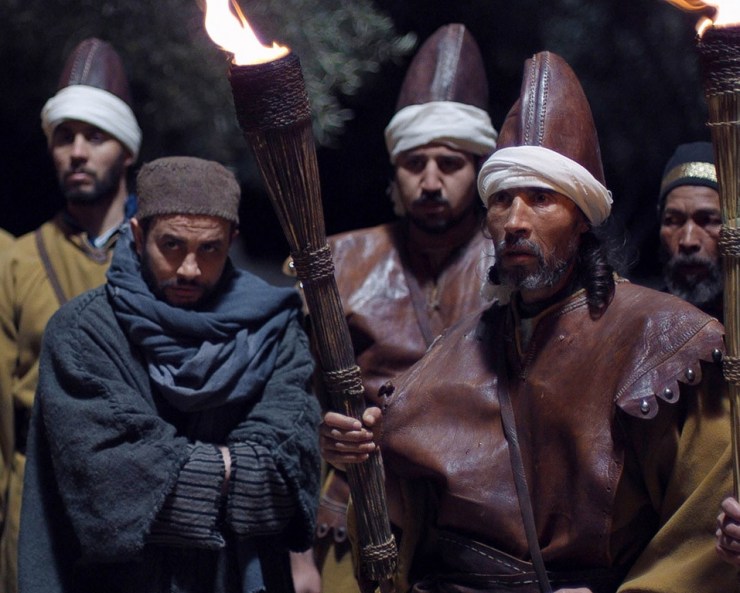
Judas arrives in the Garden of Gethsemane, with the arresting party sent by the Jewish authorities. A still from a video produced by the LUMO Project.
Next time . . .
We see Jesus put on trial, condemned, flogged, crucified, and buried. To worldly eyes, this looks like a humiliating, tragic failure. It is, in fact, the crowning achievement of Jesus’s earthly life.
Bible Readings and Question
You may like to read Leviticus 19:18 and John 13:34-35. Here’s a question to think about:
?Through Moses, God commanded His people to love their neighbour as themselves. So why is Jesus’s command to love one another a new commandment? How is it new?
Videos
Here are two short videos, entitled A Meal for the Ages: The Story of the Last Supper (Matthew 26) and Everyone Leaves Jesus: The Story of Jesus’ Betrayal (Mark 14). They’re designed for children ages 6 to 12. But youth and adults may well enjoy them, too. These videos are in a series published by Crossway. They’re based on the book called The Biggest Story Bible Storybook. All the videos can be viewed at The Biggest Story videos website. You can also create a free account to enable you to download them.
REFERENCES [1] See The Gospel According to John (The Pillar New Testament Commentary) by D.A. Carson, pages 474-475. Published by Inter-Varsity Press, Nottingham, U.K., and William B. Eerdmans Publishing Company, Grand Rapids, Michigan and Cambridge, U.K., in 1991.
CREDITS ► Text copyright © 2024 Robert Gordon Betts ► Unless otherwise indicated, all Scripture is taken from the ESV® Bible (The Holy Bible, English Standard Version®), copyright © 2001 by Crossway, a publishing ministry of Good News Publishers. Anglicized English Standard Version copyright © 2002 by Crossway. Used by permission. All rights reserved. The ESV text may not be quoted in any publication made available to the public by a Creative Commons license. The ESV may not be translated in whole or in part into any other language. ► Scripture quotations marked ‘NIV’ are taken from The Holy Bible, New International Version (Anglicised edition). Copyright © 1979, 1984, 2011 by Biblica (formerly International Bible Society). Used by permission of Hodder & Stoughton Publishers, an Hachette UK company. All rights reserved. ‘NIV’ is a registered trademark of Biblica (formerly International Bible Society). UK trademark number 1448790.
 52 Steps
