
Part 34: The Kingdom of God is Near!
Click the icon below to download a 4-page PDF version of this page.

The Jubilee has come!
Jesus opens His public ministry with these words: “The time has come, . . . The kingdom of God has come near. Repent and believe the good news!” (Mark 1:15 NIV). God’s Kingdom is God’s perfect world―where God’s people live in God’s presence in God’s paradise. That’s the Kingdom Jesus is going to establish. And now it’s near!
God’s Kingdom is God’s perfect world. That’s the Kingdom Jesus is going to establish. And now it’s near!
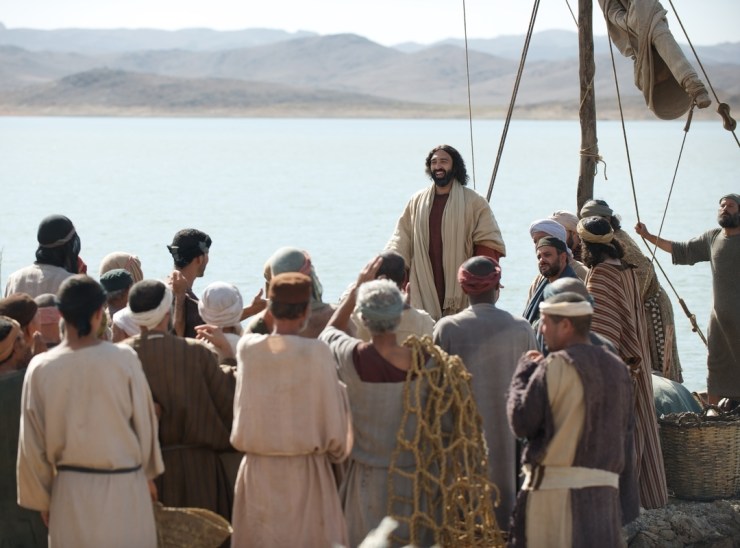
Jesus opens His public ministry with these words: “The time has come,” . . . “The kingdom of God has come near. Repent and believe the good news!” (Mark 1:15 NIV).
Jesus’s ministry begins after His baptism and temptation, when He’s “about thirty years of age” (Luke 3:23). It probably lasts around 3½ years, starting in AD26 or AD29.
We fast forward about a year into His ministry. It’s the Sabbath morning service in Nazareth’s synagogue. Jesus rises to His feet and is handed the scroll of Isaiah to read. Unrolling it to the place He wants to read from, He begins: “The Spirit of the Lord is upon me, because he has anointed me to proclaim good news to the poor. He has sent me to proclaim liberty to the captives and recovering of sight to the blind, to set at liberty those who are oppressed, to proclaim the year of the Lord’s favour.” (Luke 4:18-19, quoting from Isaiah 61:1-2 and 58:6.)
These passages in Isaiah recall the Year of Jubilee, celebrated every 50th year (Leviticus 25:8-55, see Part 19). It was a year of rest from agricultural work, release from debt and servitude, and homecoming for those who’d had to sell off land or property. The Jubilee was a new beginning―a year of freedom and rest and joy.
Jesus sits down. All eyes are fixed on Him; then He declares: “Today this Scripture has been fulfilled in your hearing” (4:21). What Isaiah prophesied all those centuries ago is being fulfilled at that very moment! For around a year now, Jesus has been doing what the Jubilee pointed to―healing people from sickness, disability, demonic possession, giving sight to the spiritually blind, proclaiming good news to the poor, and releasing people from guilt by forgiving their sins.
Twelve disciples
From among His many followers, Jesus chooses 12 ordinary men to be His special disciples―to be with Him, to learn from Him, and to begin to share in His teaching and healing ministry. That number 12 is quite deliberate: they represent Israel with its 12 tribes. Jesus is symbolically renewing the nation of Israel. They’re a mixed bunch―they include impetuous Simon Peter, the “Sons of Thunder” James and John (Mark 3:17), “Simon . . . called the Zealot” (Luke 6:15), likely a zealous Jewish nationalist, and Matthew, tax collector and thus collaborator with the Roman occupiers (Matthew 10:3). The tensions between these men can only be imagined! And then there’s ambitious, greedy, unscrupulous Judas Iscariot, who in the end betrays our Lord.
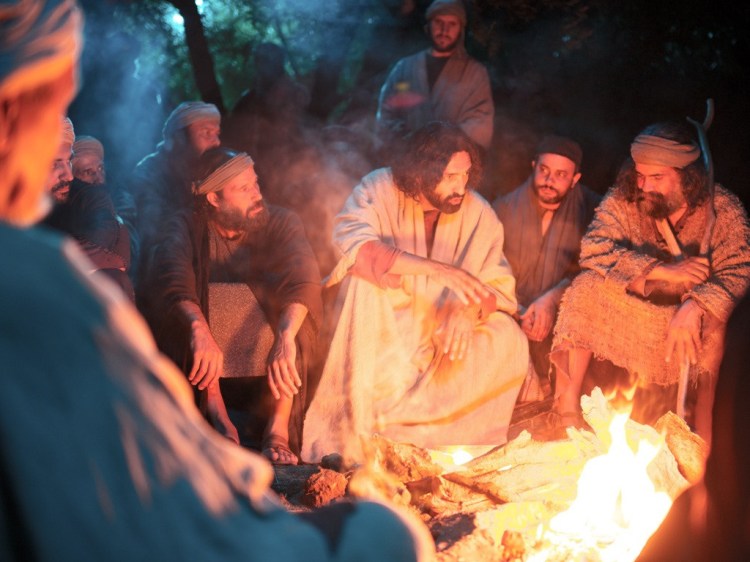
Photo courtesy of LUMO Project and made available by FreeFreeBibleimages
From among His many followers, Jesus chooses 12 ordinary men to be His special disciples―to be with Him, to learn from Him, and to begin to share in His teaching and healing ministry.
A new conquest of the land
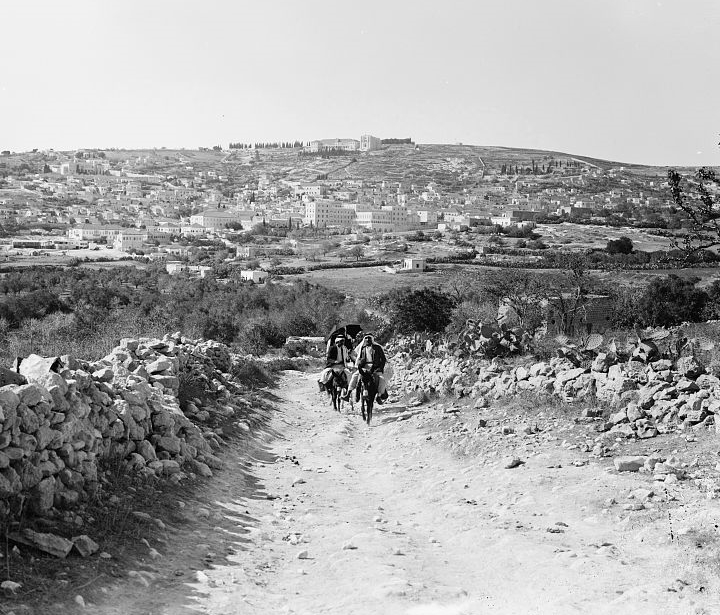
Image from The Library of Congress Prints & Photographs Online Catalog
A road near Nazareth (which you can see in the background)―a photograph taken between 1898 and 1946. Jesus travelled many hundreds of miles, and may have travelled down this very road seen here.
Jesus and His disciples go throughout the land of Palestine―Galilee, Judea, Perea (east of the Jordan), and beyond Palestine to the region of Tyre and Sidon. Centuries before, the Promised Land was occupied by the depraved Canaanites. It was a stronghold of Satan. Joshua and his army set about conquering the land and releasing it from Satan’s grip. Now a new ‘Joshua’, Jesus, is conquering the land. He’s releasing people from Satan’s grip―forgiving, healing, resurrecting from death, casting out demons. His ministry opens a new phase in the cosmic war against Satan and his kingdom of darkness.
A new ‘Joshua’, Jesus, is conquering the land. He’s releasing people from Satan’s grip―forgiving, healing, resurrecting from death, casting out demons.
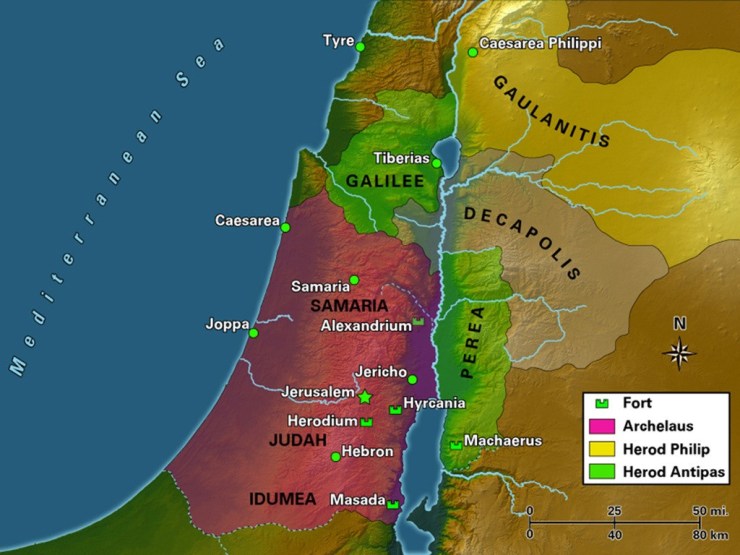
Image created by A.D. Riddle of Riddle Maps and © 2015 Society of Biblical Literature, and made available by (CC BY-NC-ND 3.0)
Palestine and the regions to the north-east in Jesus’s time, showing Galilee, Judea, Perea, Decapolis, and Gaulanitis.
Jesus says, “no one can enter a strong man’s house and plunder his goods, unless he first binds the strong man” (Mark 3:27). Jesus is binding Satan and plundering his house. He’s robbing Satan of his prey. He’s come “to destroy the works of the devil” (1 John 3:8): He’s beginning to put right the harm that Satan and sin has done to people. He’s giving them a foretaste of what God intended life to be like.
Jesus shows His authority over nature, too. He turns water into wine; He multiplies a few fish and loaves to satisfy great crowds; at His word, the disciples haul in a huge catch of fish. He walks on water; He calms the raging sea. It foreshadows the day when Earth will be set free from its ”bondage to decay” caused by human sin (Romans 8:21 NIV).
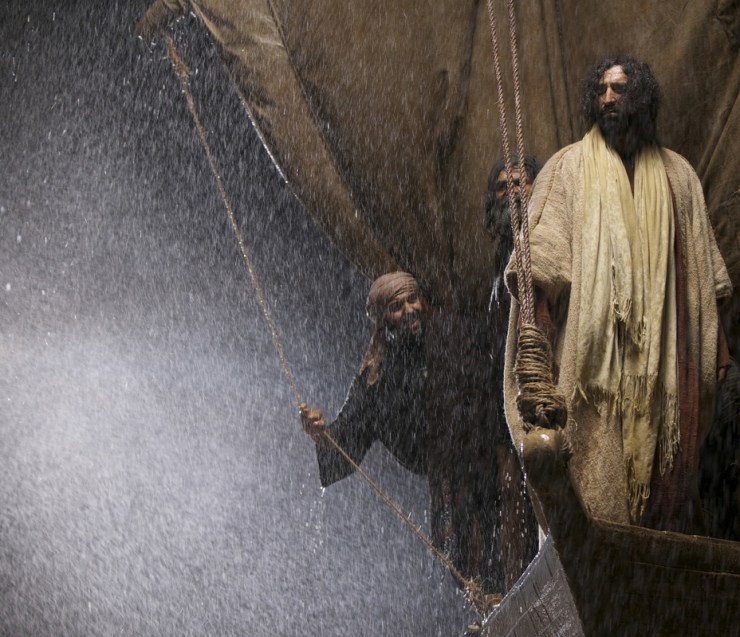
Jesus calming a storm: “he awoke and rebuked the wind and said to the sea, ‘Peace! Be still!’ And the wind ceased, and there was a great calm.” (Mark 4:39).
Healing on the Sabbath
God appointed the Sabbath day as a day for His people to enjoy―as we saw in Part 19. The Sabbath days, Sabbath years and Years of Jubilee were glimpses of life in the new creation, a life in which death shall be no more, neither shall there be mourning, nor crying, nor pain any more” (Revelation 21:4). No wonder Jesus made such a point of healing on the Sabbath day―see, for example, Luke 13:10-17. He’s giving people a foretaste of life in the new creation. [1]
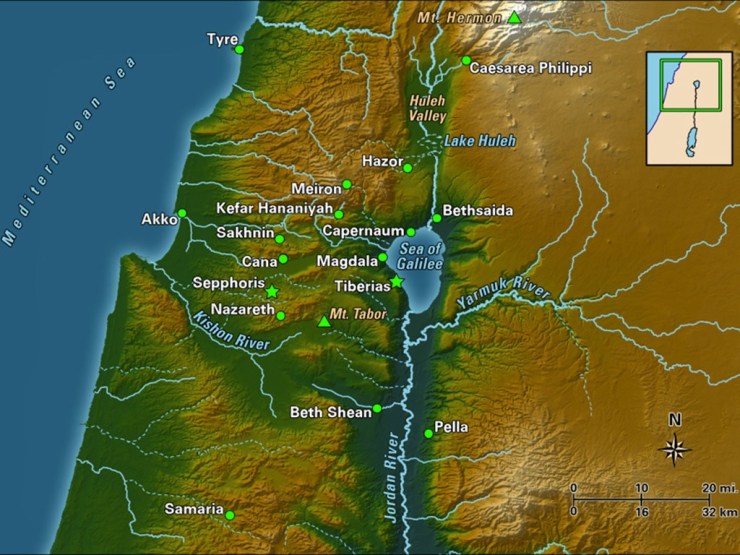
Image created by A.D. Riddle of Riddle Maps and © 2015 Society of Biblical Literature, and made available by (CC BY-NC-ND 3.0)
Map showing northern Palestine, including Nazareth, Cana, the Sea of Galilee, Capernaum, Bethsaida and Caesarea Philippi, all mentioned in the Gospels.
Miracles as messages
Jesus performed these miracles, of course, because He cared for people. But His miracles are also messages:
● They show us He’s the promised Messiah. While in prison, John the Baptist sends disciples to ask Him whether He’s really “the one who is to come”―the promised Messiah (Luke 7:19). Jesus replies: “tell John what you have seen and heard: the blind receive their sight, the lame walk, lepers are cleansed, and the deaf hear, the dead are raised up, the poor have good news preached to them” (7:22). This is the proof John needs.
● They show us He’s the Son of God. Old Testament prophets did miracles; but it’s clear they didn’t do them by their own power. But, as we read the Gospels, we see that Jesus has inherent, innate power to work miracles. He’s the divine Son of God Himself.
● They show us about salvation. In John 9:1-41, for example, we see Jesus restoring sight to a man blind from birth. This is a sign: it pictures healing from spiritual blindness. Jesus gives people spiritual sight, so they realise who He is, believe in Him and receive salvation.
But Jesus’s miracles are only proof for those willing to believe. Most of the Jews still refuse to believe Him; John writes, “though he had done so many signs before them, they still did not believe in him” (John 12:37).
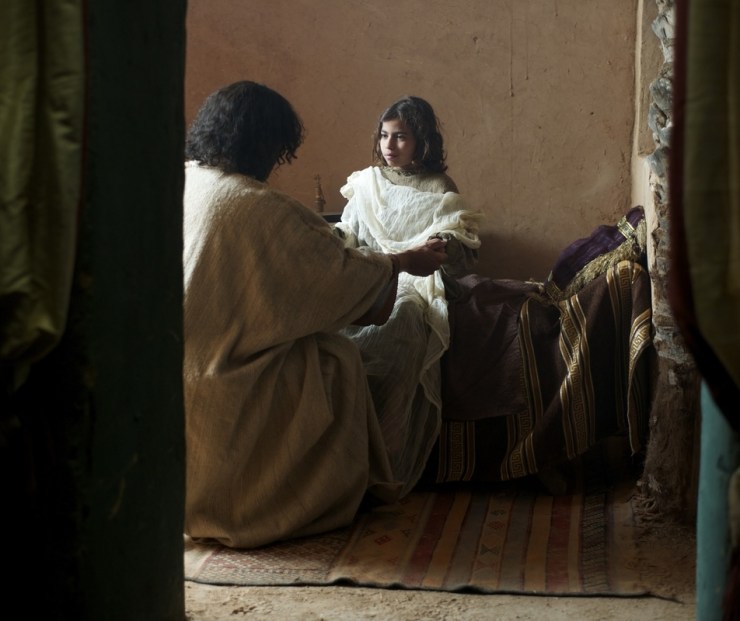
Jesus healing Jairus’s daughter. “Taking her by the hand he said to her, ‘Talitha cumi’, which means, ‘Little girl, I say to you, arise.’ And immediately the girl got up and began walking (for she was twelve years of age), and they were immediately overcome with amazement.” (Mark 5:41-42).
The Friend of sinners
Jesus comes for everyone―and that includes social outcasts, delinquents, the despised and disreputable, the unclean, the dregs of society. He shares meals “with sinners and tax collectors” (Mark 2:16). By eating with them, Jesus is befriending them: He’s the Friend of sinners. It shocks the Jewish leaders. But He declares “I have not come to call the righteous but sinners to repentance” (Luke 5:32).
Teaching with authority
And Jesus teaches people with amazing power; people are “astonished at his teaching” because His words carry such authority (Matthew 7:28-29, Luke 4:32). Even officers sent to arrest Him have to admit “No one ever spoke like this man!” (John 7:46). [2]

Photo courtesy of LUMO Project and made available by FreeFreeBibleimages
People were astonished at Jesus’s teaching, and they hung on His every word.
The central theme of Jesus’s teaching is the Kingdom of God.[3] His ‘Sermon on the Mount’ tells us what life in the Kingdom is like (Matthew 5:1-7:29). Jesus tells us how to enter it. And He teaches us to pray for its arrival on Earth (Matthew 6:10). But God’s Kingdom isn’t what many of Jesus’s hearers would have expected. It’s an ‘upside-down’ Kingdom! The ‘beatitudes’ show that so clearly. Jesus begins, “Blessed are the poor in spirit, for theirs is the kingdom of heaven” (Matthew 5:5). Those who are “poor in spirit” know they can’t save themselves; they come to God with empty hands. “Blessed are the merciful, for they shall receive mercy” (5:7). Merciful people are forgiving and kind to people. To depend solely on God, to live to bless others: this is ‘Kingdom life’. It’s a total contrast to the worldy idea of how we should live―self-sufficient, self-assertive, serving self alone!
God’s Kingdom isn’t what many of Jesus’s hearers would have expected. It’s an ‘upside-down’ Kingdom!
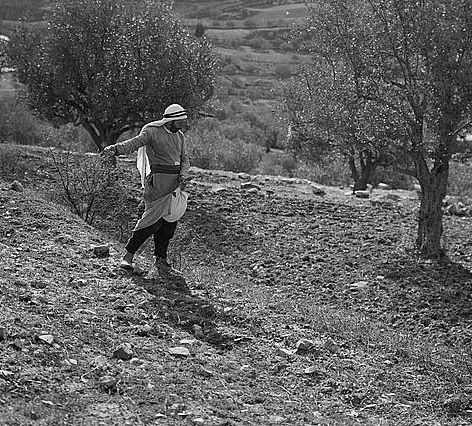
Image from The Library of Congress Prints & Photographs Online Catalog
“And he told them many things in parables, saying: ‘A sower went out to sow'” (Matthew 13:3). This is a photograph of a farmer sowing seed in the traditional way near Jerusalem, taken between about 1920 and 1933.
Jesus’s teaching is radical, in the original sense of that word―it goes to the root of things. He reveals what’s really true, and what’s really important―in the light of eternity. He uses picture language and parables so we understand and don’t forget―a farmer sowing seed; a grain of wheat dying and springing into life; the carefree beauty of the flowers; bridesmaids waiting for the bridegroom’s arrival; a father’s astonishing love for his delinquent son; a shepherd’s care for his flock; a vine and its branches.
Jesus’s teaching is radical―it goes to the root of things. He reveals what’s really important―in the light of eternity.
He teaches us what His Father is like―the Father who loves His children, the Father who provides everything for them, the Father who can be trusted. He teaches His disciples to call God their Father, and to rely on His Fatherly care and provision.

Anenomes in Moshav Ma’ona from Wikimedia Commons courtesy of Shlomo Roded via the PikiWiki – Israel free image collection project (CC BY 2.5).
Wild anemones in Northern Israel. Jesus said, “Consider the lilies of the field, how they grow: they neither toil nor spin, yet I tell you, even Solomon in all his glory was not arrayed like one of these. . . . will [your heavenly Father] not much more clothe you, O you of little faith? Therefore do not be anxious, . . . .” (Matthew 6:28-31).
And Jesus teaches us how to live. He teaches us how to love God (Matthew 22:37-38, Luke 12:32-34) and love other people (for example, Luke 10:29-37). He teaches us that we must forgive (Matthew 18:21-35).
A striking aspect of Jesus’s humanity is His prayer life (for example, Luke 5:16, 6:12, 11:1). He often withdraws “to lonely places” to pray (Luke 5:16 NIV). And He teaches His disciples―and us―how to pray, too (Matthew 6:5-15, Luke 11:9-13).
Jesus often talks about a great division. There’s a broad way that leads to spiritual death, and a narrow way that leads to spiritual life (Matthew 7:13-14). There are wise and foolish builders (Luke 6:46-49); trees with good fruit and those with bad (Luke 6:43-45); wheat and weeds (Matthew 13:24-30). But He doesn’t just teach about a great division. His teaching itself divides people. And that division isn’t where we might have expected it. The Jewish religious leaders, by and large, reject Him. But those whom decent folk might avoid―the tax-collectors and sinners―flock to Him and hang on His every word.
Next time . . .
Around 30 months into Jesus’s ministry there’s a turning point. He begins to tell His disciples about His suffering, death and resurrection, and what it really means to follow Him. And opposition escalates until the final plot to kill Him is triggered into action by Judas’s betrayal. Our Lord takes the road to the Cross.
Bible Reading and Questions
You may like to read Matthew 5:2-12. Here are some questions to think about:
?In what ways do these beatitudes contrast with conventional ways of thinking and acting?
?The final beatitude about persecution might seem rather unexpected. Why does Jesus end His beatitudes on this note?
?Jesus begins each beatitude with “Blessed”. What do you think this blessing consists of?
Videos
Here are three short videos, entitled Get Up!: The Story of a Paralytic, His Friends, and a Hole in the Roof (Mark 2), A Story about Soils: The Story of Hearing the Word and Bearing Fruit (Mark 4), and The Scary Boat Ride: The Story of Jesus Calming the Storm (Mark 4). They’re designed for children ages 6 to 12. But youth and adults may well enjoy them, too. These videos are in a series published by Crossway. They’re based on the book called The Biggest Story Bible Storybook. All the videos can be viewed at The Biggest Story videos website. You can also create a free account to enable you to download them.
The LUMO Project Gospel videos
The above video portrays the events we read about in Matthew 9:9-26―the call of Matthew, John’s disciples’ question about fasting, and the healing of the synagogue ruler’s daughter and of a woman suffering with a haemorrhage. This is one of a series of Gospel videos produced by the LUMO Project. These videos bring the Gospels vividly to life. The actors and the settings are true to first-century Palestinian life, and the audio consists of the simple Bible text―nothing added or removed. For added authenticity, the actors speak Aramaic (the common language of Judea in Jesus’s time), but the dialogue is muted, and overlaid with a narration in English or other languages. You can view these videos on YouTube―each Gospel is split into a series of short videos of between around 2 to 5 minutes in length. At the end of the video, the next in the series begins automatically, allowing you, if you wish, to continue watching a larger section, or the complete Gospel. The LUMO Youtube site is
HERE. Here are the links to the YouTube playlists for the videos with narrations in the NIV (New International Version) of the Gospels: Matthew’s Gospel is HERE; Mark’s Gospel is HERE; Luke’s Gospel is HERE; John’s Gospel is HERE. Videos are also available on YouTube with narrations in the ESV (English Standard Version) and KJV (King James Version) of the Gospels, as well as a variety of different languages. Click HERE for more information about the LUMO Project.
REFERENCES [1] See Rich Wounds: The Countless Treasures of the Life, Death, and Triumph of Jesus by David Mathis, pages 21,45-48. Published by The Good Book Company, Epsom, Surrey, U.K., in 2022. [2] See The Gospel According to John (The Pillar New Testament Commentary) by D.A. Carson, pages 246-249. Published by Inter-Varsity Press, Nottingham, U.K., and William B. Eerdmans Publishing Company, Grand Rapids, Michigan and Cambridge, U.K., in 1991. [3] See The Kingdom of God in the teaching of Jesus (i). Available online at https://www.psephizo.com/biblical-studies/the-kingdom-of-god-in-the-teaching-of-jesus-i/#_edn1 (accessed 15 February 2025).
CREDITS ► Text copyright © 2024 Robert Gordon Betts ► Unless otherwise indicated, all Scripture is taken from the ESV® Bible (The Holy Bible, English Standard Version®), copyright © 2001 by Crossway, a publishing ministry of Good News Publishers. Anglicized English Standard Version copyright © 2002 by Crossway. Used by permission. All rights reserved. The ESV text may not be quoted in any publication made available to the public by a Creative Commons license. The ESV may not be translated in whole or in part into any other language. ► Scripture quotations marked ‘NIV’ are taken from The Holy Bible, New International Version (Anglicised edition). Copyright © 1979, 1984, 2011 by Biblica (formerly International Bible Society). Used by permission of Hodder & Stoughton Publishers, an Hachette UK company. All rights reserved. ‘NIV’ is a registered trademark of Biblica (formerly International Bible Society). UK trademark number 1448790.
 52 Steps
