
Part 33: Jesus, Our Messiah
Click the icon below to download a 4-page PDF version of this page.

Growing into manhood
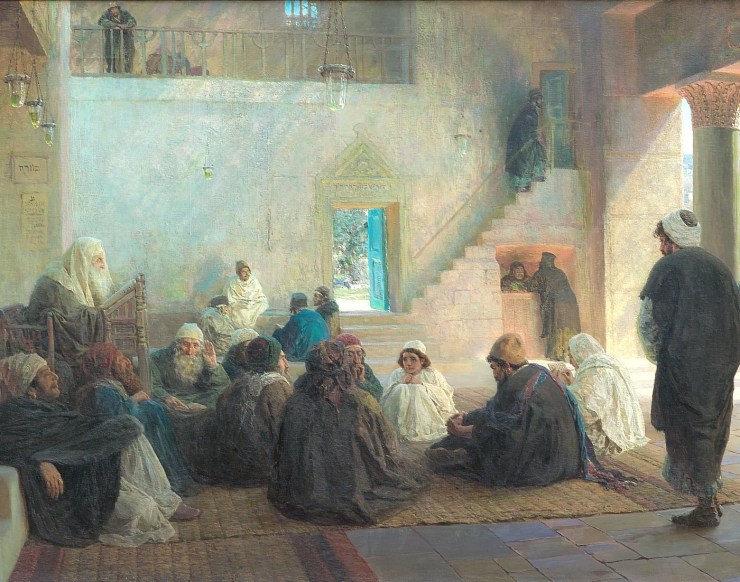
The child Jesus “grew and became strong, filled with wisdom. And the favour of God was upon him.” (Luke 2:40). We’re told of just one event from His early years (Luke 2:41-51). Mary and Joseph are returning home from their annual visit to Jerusalem for Passover, along with relatives and others. Unknown to them, Jesus remains behind. After a frantic search His parents find Him “in the temple, sitting among the teachers, listening to them and asking them questions”. Everyone is “amazed at his understanding and his answers”. Jesus says to his parents, “Did you not know that I must be in my Father’s house?” Already, at 12 years old, Jesus knows He’s to fulfil His Father’s mission.
Detail from Christ Among The Doctors from Wikimedia Commons
Detail from Christ Among The Doctors painted by Vasily Polenov. Mary and Joseph found Jesus ” in the temple, sitting among the teachers, listening to them and asking them questions” (Luke 2:46).
Jesus returns to Nazareth with Mary and Joseph, and is “submissive to them”. He increases “in wisdom and in stature and in favour with God and man” (2:52). The Son of God spends most of his earthly life in Nazareth, working in the family carpentry and building business.
Background sattelite image is of the Middle East courtesy of Jacques Descloitres, MODIS Land Science Team, NASA Visible Earth
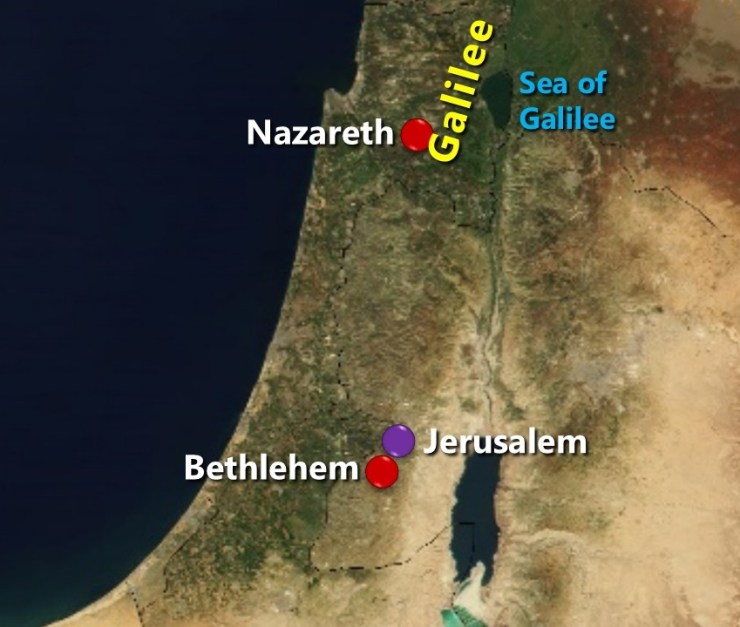
Map of key places in Jesus’s life.
Four Gospel portraits
Each Gospel writer gives us a unique view of Jesus’s life and character.

Matthew (also called Levi) has a Jewish audience in mind. In Matthew’s Gospel, we see Jesus as the promised King of David’s dynasty―the Messiah who will save God’s people and establish God’s Kingdom. But Matthew also shows us that people of all nations will enter God’s Kingdom. He alone records Jesus’s great commission to make disciples of all nations (Matthew 28:16-20).
Matthew arranges his account of Jesus’s public ministry systematically―the way a teacher might arrange his material. There are five sections of Jesus’s teaching, which alternate with sections telling us what He did.
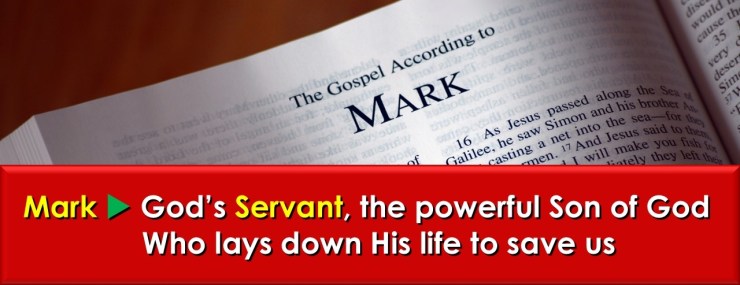
Mark’s Jewish name was John. John Mark appears a number of times in the New Testament. In Mark’s Gospel we see Jesus especially as God’s suffering Servant, the powerful Son of God who lays down His life to save us―thus fulfilling Isaiah’s wonderful prophecy about God’s “servant” (Isaiah 52:13-53:12). He “came not to be served but to serve, and to give his life as a ransom for many” (Mark 10:45). Appropriate to his theme of service, Mark’s Gospel is full of action. It reads like an eye-witness account, and that eye-witness was almost certainly Peter―it’s thought Mark got much of his material from Peter.
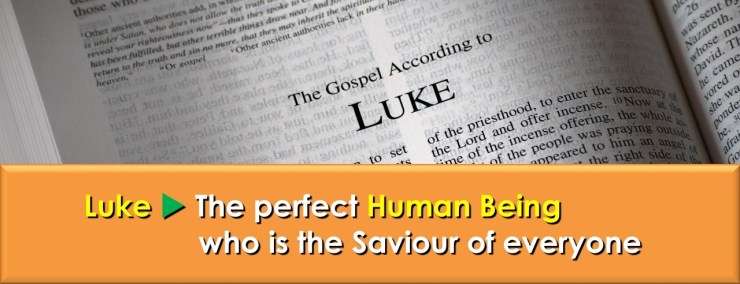
Luke may well have been a Gentile (a non-Jew). Like a true historian, Luke “carefully investigated everything from the beginning” (1:3 NIV), and places his account in its wider historical setting (see 2:1-2, 3:1-2).
Luke was a doctor―Paul’s “beloved physician” (Colossians 4:14). He’s a keen observer of people. Zechariah and Elizabeth, Martha and Mary, Zacchaeus, and others, spring to life in his Gospel. And in line with this, Luke portrays Jesus especially as a human being. For example, he alone mentions Jesus’s baby clothes, and His boyhood.
And Luke presents Jesus as the Saviour of all kinds of people. When chief tax-collector Zacchaeus receives Jesus and repents, Jesus tells him, “Today salvation has come to this house, . . . . For the Son of Man came to seek and to save the lost.” (Luke 19:9).
And from the beginning we see the Holy Spirit active―filling John the Baptist, Elizabeth, and Zechariah; guiding Simeon; filling, leading and empowering our Lord Himself. Luke also wrote Acts; there he records the pouring out of the Spirit on the Day of Pentecost (Acts 2:1-41).
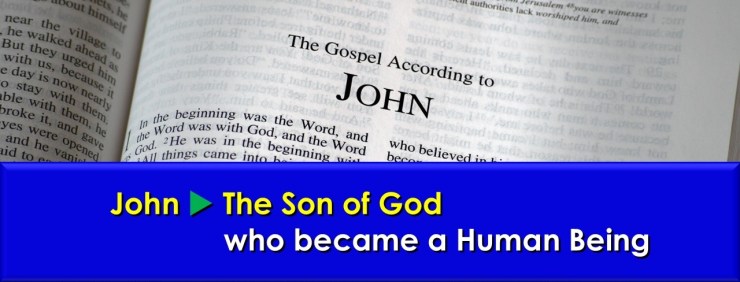
John portrays Jesus as the Son of God incarnate. He writes, “In the beginning was the Word, and the Word was with God, and the Word was God”; “the Word became flesh and dwelt among us, and we have seen his glory, glory as of the only Son from the Father, full of grace and truth” (1:1,14). John shows us the closeness of Jesus’s relationship with His Father (for example, 10:30,17:21).
John writes, “the Word became flesh and dwelt among us, and we have seen his glory, glory as of the only Son from the Father, full of grace and truth” (1:14).
John records Jesus speaking of Himself as “I Am” ; “I am the bread of life” (6:35,48), “. . . the light of the world” (8:12), “. . . the door of the sheep” (10:7), “. . . the good shepherd” (10:11,14), “. . . the resurrection and the life” (11:25), “. . . the way, and the truth, and the life” (14:6), “. . . the true vine” (15:1). And Jesus says, “before Abraham was, I am” (8:58), echoing what God said to Moses: “I AM WHO I AM” (Exodus 3:14, see Part 13). Through declaring Himself “I Am”, Jesus is showing us He’s divine, and that He’s the One who brings salvation and blessing. As the divine Son of God, Jesus has “life in Himself” (John 5:26), and can give eternal life to us (for example, John 6:54). In fact, John wrote his Gospel: “so that you may believe that Jesus is the Christ, the Son of God, and that by believing you may have life in his name” (John 20:31). And John records just eight miracles―they’re ‘signs’ (for example, 2:11), chosen to teach us about Jesus.[1]
John weaves spiritual principles, such as believing, life, love, light, and truth, through his Gospel. We learn about truths like new birth, eternal life, spiritual worship, living water. John alone records Jesus teaching about God making His home in the believer (14:23). He tells us more about the work of the Holy Spirit (for example, 3:8, 14:16-17,26).
And John’s Gospel is full of allusions to the Old Testament.[2] For example, we read about “water and the Spirit” (3:5, Ezekiel 36:25-27); the bronze snake in the wilderness (3:14, Numbers 21:8-9), and Jesus as the true Manna (6:48-51, Exodus 16:13-35).
Each Gospel writer gives us a unique view of Jesus’s life and character.
Matthew depicts Jesus as the King; he gives Jesus’s descent from Abraham through David and the kings of David’s dynasty. A servant’s genealogy isn’t important―Mark doesn’t give one. Luke emphasises Jesus’s humanity―he traces His descent back to the first man, Adam. John presents Jesus as God incarnate. He gives His ‘divine genealogy’: He’s “the only Son from the Father” (1:14).
Why did the Son of God come?
Why did the Son of God become a Man?
● Firstly, the Father sent Jesus to reveal what He Himself is like. Satan caused Adam and Eve to think wrongly about God. From that moment, God began to reveal Himself to humanity. Before Jesus was born, God revealed His nature and character especially through His dealings with His people and through the Old Testament Scriptures. But, finally, He reveals Himself on Earth in the Man Jesus Christ. He’s “the image of the invisible God” (Colossians 1:15); “the radiance of the glory of God and the exact imprint of his nature” (Hebrews 1:3). Jesus Himself said, “Whoever has seen me has seen the Father” (John 14:9).
The Father sent Jesus to reveal what He Himself is like. Jesus said, “Whoever has seen me has seen the Father” (John 14:9).
●Secondly, Jesus came to show us what we should be like. In His selfless love, His humility, His reaction to insults, His patience and kindness, His fearless courage, His dependence on God and obedience to Him―in every way, Jesus shows us how we should live.
●Thirdly, Jesus came to be our Saviour. The angel Gabriel said to Joseph: “you shall call his name Jesus, for he will save his people from their sins” (Matthew 1:21). His unblemished life on Earth from cradle to Cross qualified Him to be our Saviour, to ransom us from all the consequences of our sin, and to give us a new life in Him.
Jesus’s baptism
Before beginning His public ministry, Jesus is baptised by John the Baptist (for example, Matthew 3:13-17). John is preparing people for Jesus’s ministry (for example, Luke 3:1-18). He says, “I baptize you with water for repentance, but he who is coming after me . . . will baptize you with the Holy Spirit and fire. His winnowing fork is in his hand, and he will . . . gather his wheat into the barn, but the chaff he will burn with unquenchable fire.” (Matthew 3:11-12).
John’s baptism, first and foremost, pictures cleansing from sin. But Jesus has never sinned. So why is He baptised? Because He is identifying Himself with us. He is going to take our place and die for us on the Cross. As He emerges from the water, the heavens open and the Holy Spirit, visible as a dove, descends and rests on Him. The Spirit is here commissioning Him as God’s Messiah. ‘Messiah’ means ‘anointed one’. But instead of being anointed with oil, the Holy Spirit Himself comes and rests on Jesus. The Father commends Jesus with these words: “This is my beloved Son, with whom I am well pleased” (Matthew 3:17). Notice, at this pivotal moment in history, how all three Persons of the Trinity―Father, Son and Holy Spirit―play a role. The Son is sent by the Father and empowered by the Spirit for the task that lies ahead.
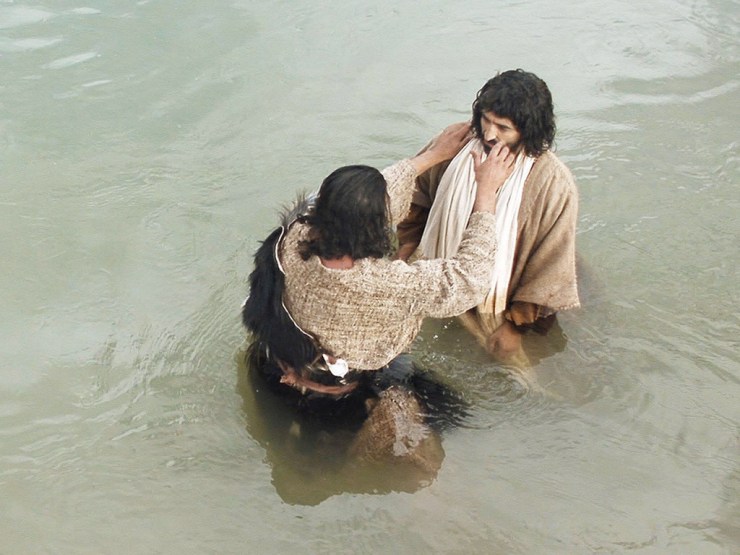
Photo courtesy of LUMO Project and made available by FreeFreeBibleimages
“In those days Jesus came from Nazareth of Galilee and was baptized by John in the Jordan” (Mark 1:9).
Jesus’s temptation
The Holy Spirit then leads Jesus into the wilderness for 40 days to be tempted by Satan. Satan tempts Him in three ways:
►To meet His need for food―but outside of His Father’s will.
►To perform a daring stunt, to test whether God will come to His aid. But Jesus chooses to live in perfect trust―a trust that needs no test.[3]
►To become King of “all the kingdoms of the world” (Matthew 4:8) by an easy, Crossless route―by worshipping Satan, rather than by obeying God.
All three temptations boil down to just one thing―who is at the centre of Jesus’s life? Is it God, or is it Himself? Will He love the Lord His God with all His heart and soul and might (Deuteronomy 6:5)? Will He trust and obey His Father? But Jesus counters each temptation by quoting Scripture (Deuteronomy 6:13,16, 8:3). The word of God is Jesus’s weapon to defeat the devil.
These three temptations recall two events in the Old Testament:
●The temptation of Adam and Eve in the Garden of Eden.
●Israel’s 40 years of trial in the wilderness (see Deuteronomy 8:2-5).
God’s son Adam (he’s called this in Luke 3:38) and God’s son Israel (Exodus 4:22) both refused to trust and obey God. But this Son of God is our second Adam and the True Israel. He always does what pleases His Father. He’s “obedient to the point of death, even death on a cross” (Philippians 2:8).
Jesus is our second Adam and the True Israel. He always does what pleases His Father. He’s “obedient to the point of death, even death on a cross” (Philippians 2:8).
Next time . . .
We look at Jesus’s public ministry. He releases people from guilt, disease, death and demons. And He teaches with authority.
Bible Readings and Questions
You may like to read Luke 1:1-4 and John 21:25. Here are a couple of questions to think about:
? God could have given us just one Gospel. So why does He give us four?
?There’s so much about Jesus that isn’t recorded in the Gospels (see John 21:25). Why does God leave out so much, and focus on what we do have in the Gospels?
Videos
Here are two short videos, entitled The Pointer and the Point: The Story of John the Baptist (Matthew 3) and The Sin That Wasn’t: The Story of Jesus Tempted in the Wilderness (Matthew 4). They’re designed for children ages 6 to 12. But youth and adults may well enjoy them, too. These videos are in a series published by Crossway. They’re based on the book called The Biggest Story Bible Storybook. All the videos can be viewed at The Biggest Story videos website. You can also create a free account to enable you to download them.
Book
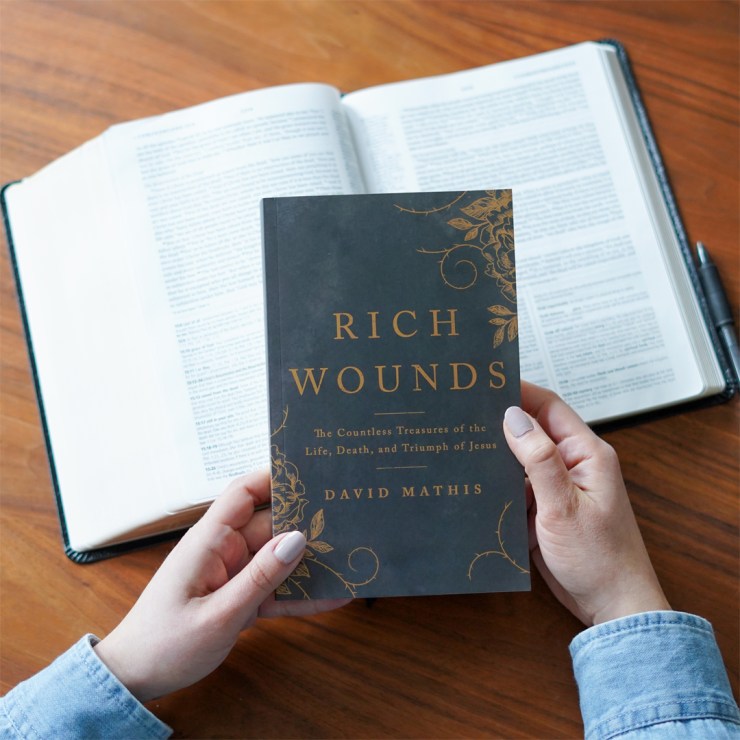
Rich Wounds: The Countless Treasures of the Life, Death, and Triumph of Jesus by David Mathis will help you to meditate on and marvel at Jesus’s life, sacrificial death and glorious resurrection. His now-glorified wounds are a sign of his unfailing love and the decisive victory that He has won. This book can be used as a devotional. The chapters on Holy Week make it especially helpful during the Lent season and at Easter.
Read the publisher’s description (which also provides a free sample and two free Easter reading plans) HERE. The Good Book Company offers a rewards scheme offering a range of benefits―including, for example, your choice of any ebook published by them on your birthday! Find out more HERE.
REFERENCES [1] See ESV Study Bible, English Standard Version, page 2023. Published by Crossway Bibles, a publishing ministry of Good News Publishers, Wheaton, Illinois, in 2008. [2] See The Gospel According to St John with Maps, Notes and Introduction edited by A. Plummer, page xlv. Published by Cambridge University Press, in 1913. [3] Adapted from The Gospel According To Matthew, An Introduction and Commentary by R.T. France, page 99. Published by Inter-Varsity Press, Leicester, U.K, in 1985.
CREDITS ► Text copyright © 2024 Robert Gordon Betts ► Unless otherwise indicated, all Scripture is taken from the ESV® Bible (The Holy Bible, English Standard Version®), copyright © 2001 by Crossway, a publishing ministry of Good News Publishers. Anglicized English Standard Version copyright © 2002 by Crossway. Used by permission. All rights reserved. The ESV text may not be quoted in any publication made available to the public by a Creative Commons license. The ESV may not be translated in whole or in part into any other language. ► Scripture quotations marked ‘NIV’ are taken from The Holy Bible, New International Version (Anglicised edition). Copyright © 1979, 1984, 2011 by Biblica (formerly International Bible Society). Used by permission of Hodder & Stoughton Publishers, an Hachette UK company. All rights reserved. ‘NIV’ is a registered trademark of Biblica (formerly International Bible Society). UK trademark number 1448790.
 52 Steps
