
Part 32: Immanuel, God With Us
Click the icon below to download a 4-page PDF version of this page.

“When the fullness of time had come”
So, after many centuries, “when the fullness of time had come” (Galatians 4:4), the long awaited Messiah is born. “The Word became flesh and dwelt among us” (John 1:14). That Greek word translated “dwelt” is literally “tented”, or “tabernacled”. God once lived on Earth in the Old Testament Tabernacle; now He lives on Earth in the Person of His Son.
God once lived on Earth in the Tabernacle; now He lives on Earth in the Person of His Son.
Our story begins in the Temple in Jerusalem in the days of the Roman Emperor, Caesar Augustus (Luke 1:5-25,57-80). The angel Gabriel tells a priest named Zechariah that his wife Elizabeth will bear him a son. He’s to call him John; he’ll be God’s messenger to prepare the way for the Messiah’s ministry. Elizabeth is barren and, besides, both she and Zechariah are old. But John the Baptist is born and, in time, he withdraws to the desert until his public ministry begins.

Photo courtesy of LUMO Project and made available by FreeFreeBibleimages
Zechariah holding his baby son John. We read, “Zechariah was filled with the Holy Spirit and prophesied, saying, ‘. . . you, child, will be called the prophet of the Most High; for you will go before the Lord to prepare his ways, to give knowledge of salvation to his people in the forgiveness of their sins, . . . .'” (Luke 1:67, 76-77).
Meanwhile, a few months after his announcement to Zechariah, God sends Gabriel to a virgin called Mary, who’s betrothed to a man called Joseph. She lives in Nazareth, a town in Galilee, in what is now northern Israel. Gabriel tells her she’ll bear a baby boy. He’ll be conceived, not by marital union, but by the Holy Spirit. Gabriel explains, “The Holy Spirit will come upon you, . . . therefore the child . . . will be called holy—the Son of God.” (Luke 1:35). She’s to call Him Jesus―a Hebrew name meaning ‘Yahweh saves’ (Yahweh being God’s personal name). He’ll sit on the throne of His father David, and reign over the nation of Israel for ever (Luke 1:32-33).

Photo courtesy of LUMO Project and made available by FreeFreeBibleimages
The angel Gabriel “was sent from God to a city of Galilee named Nazareth, to a virgin betrothed to a man whose name was Joseph, of the house of David. And the virgin’s name was Mary.” (Luke 1:26-27).
An angel also appears in a dream to Joseph. He assures him that Mary’s pregnancy is from the Holy Spirit, and says “. . . you shall call his name Jesus, for He will save His people from their sins” (Matthew 1:21).
Mary is indeed “highly favoured” among women (Luke 1:28 NIV). Yet her life―and Joseph’s―have been turned upside down. In that Jewish society, to be pregnant while betrothed is evidence of adultery. The scorn from those who didn’t believe her pregnancy was a miracle must have hurt her for years. But in Mary, God finds a woman of faith―a woman to whom He can safely entrust these unparalleled joys and sorrows. Her trusting and obedient response to God’s words through Gabriel echoes down the ages: “let it be to me according to your word” (Luke 1:38).
So Mary is “found to be with child from the Holy Spirit” (Matthew 1:18). The Son of God begins human life, conceived in a virgin’s womb. This is more momentous than even the creation of the Universe. He’s called “Immanuel”, meaning ‘God with us’ (Matthew 1:23, Isaiah 7:14). The birth of a mother’s first baby is a life-changing event. The birth of this baby would change the whole world.
The Son of God begins human life, conceived in a virgin’s womb. This is more momentous than even the creation of the Universe.
Born into our broken world
At that time, the Roman Emperor had ordered a census. So Joseph and Mary travel to Bethlehem―a few miles south of Jerusalem―to be registered. They go there because Bethlehem was the home town of Joseph’s ancestor, the great King David.
In Bethlehem, Mary gives birth. The Son of God is born as a helpless baby, needing to be cuddled and fed and changed just like any other baby. How amazing! Mary lays Him “in a manger, because there was no place for them in the inn” (Luke 2:7). That word “inn” can also be translated “guest room”. It seems that Joseph and Mary were staying with relatives; perhaps their guest room was occupied, or too small for the birth. And so Jesus was most likely born in the family room, with space to one side to bring in the family’s animals at night (thus the manger). So He’s probably born in the midst of a family home―just the kind of place you’d expect the One who is “God with us” to be born!
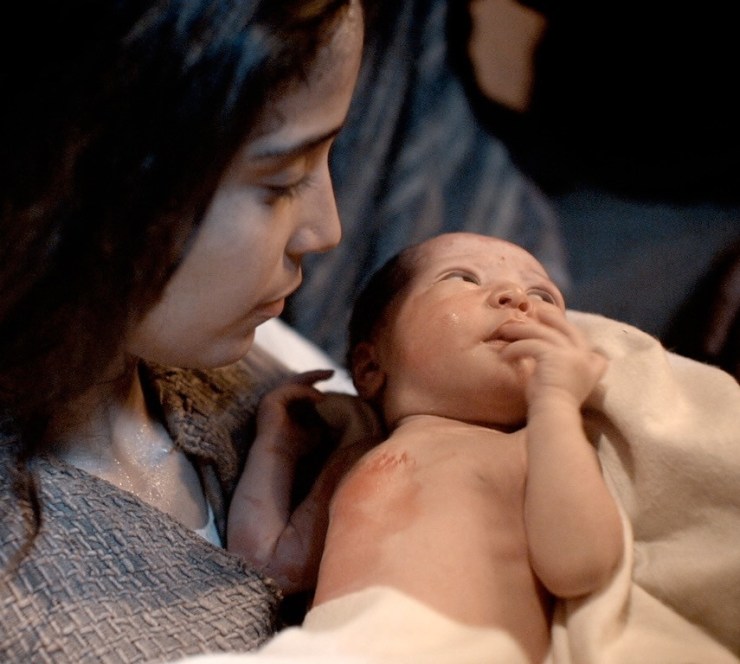
Photo courtesy of LUMO Project and made available by FreeFreeBibleimages
The Son of God is born as a helpless baby, needing to be cuddled and fed and changed just like any other baby. How amazing!
We might have expected the Son of God to come to Earth as a great philosopher or nobleman, living in one of the great cities of the world. But He didn’t. He was born, it seems, in a humble home. He lived most of His life in obscurity, in a nondescript little town in a troubled corner of the Roman Empire.
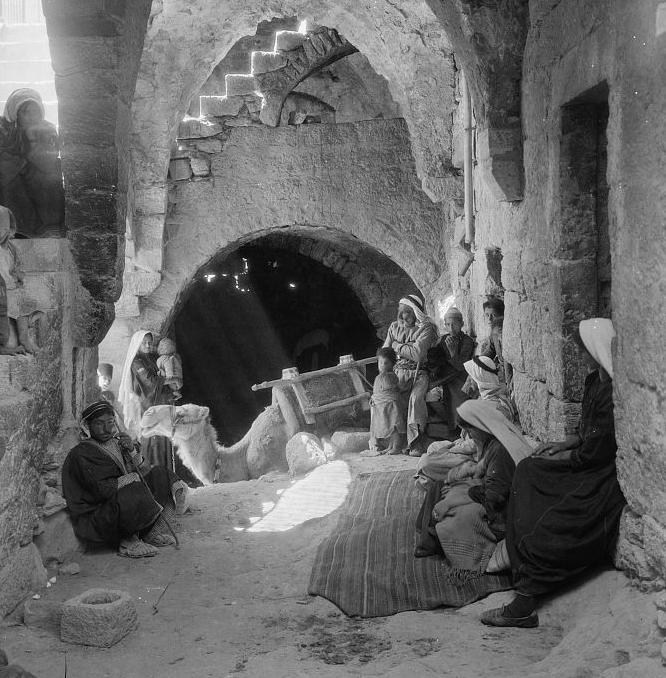
Image from The Library of Congress Prints & Photographs Online Catalog
A photo (taken between 1934 and 1939) of a traditional Middle Eastern house at Beit Sahur, now a Palestinian house east of Bethlehem. Notice the camel in the background, seemingly almost part of the family! This house may be rather like the kind of house that Jesus may have been born in.
Out in the fields nearby, shepherds are guarding their sheep. The stillness of the night is broken by an angel announcing, “unto you is born this day in the city of David a Saviour, who is Christ the Lord” (Luke 2:11). Suddenly, “a great company of the heavenly host appeared with the angel”, praising God (2:13 NIV). The shepherds hurry to Bethlehem and find the baby Jesus. Some of their lambs may have been destined for sacrifice in the Temple. But now they see the Lamb of God.

Image from The Library of Congress Prints & Photographs Online Catalog
Palestinian shepherds keeping watch over their sheep by night; an early photo taken in or before 1919.
That word “host” in Luke 2:13 can also be translated “army”. Recall what we read in Genesis 3:15: a single offspring of Eve will one day defeat Satan. That offspring, of course, is Jesus. Now He’s been born! Satan will soon be defeated! No wonder God’s angelic army rejoice!
A few weeks later, Mary and Joseph go up to Jerusalem to offer the sacrifice for Mary’s purification and to present Jesus to the Lord (Luke 2:22-39, see Leviticus 12:1-8, Numbers 18:15-16). Whilst in the Temple, faithful Simeon blesses Jesus and prophesies about Him; and aged prophetess Anna “began to give thanks to God and to speak of him to all who were waiting for the redemption of Jerusalem”.
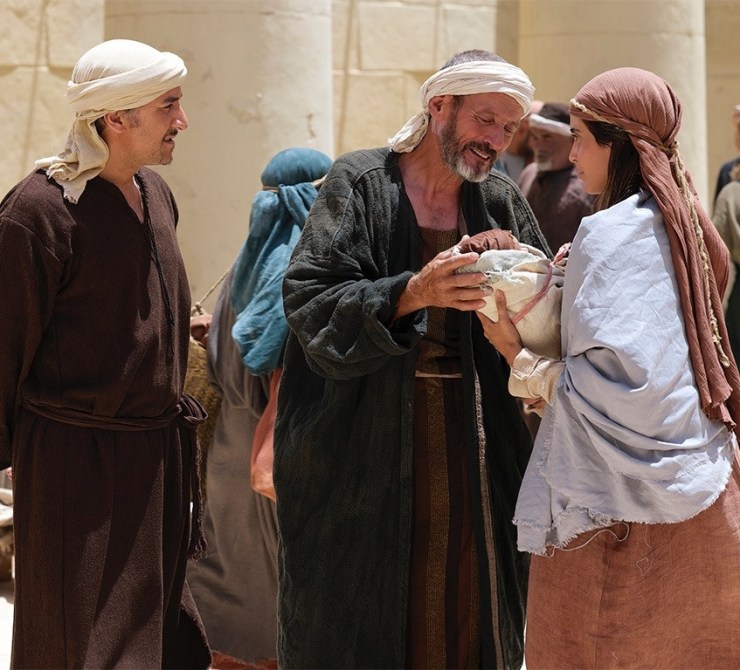
Photo courtesy of LUMO Project and made available by FreeFreeBibleimages
Simeon took the baby Jesus into his arms and blessed God and said, “Lord, now you are letting your servant depart in peace, according to your word; for my eyes have seen your salvation that you have prepared in the presence of all peoples, a light for revelation to the Gentiles, and for glory to your people Israel.” (Luke 2:28-32).
Wise men from the east
Months later, wise men journey from an eastern land to worship Jesus (Matthew 2:1-12). They’ve seen a star that showed them a king of the Jews has been born, and they come to pay him homage. They go first to Jerusalem―that’s where the local king, Herod, lives. They enquire where the new king has been born. Herod is alarmed; so is “all Jerusalem”. He gathers the Jewish leaders and they tell him that the Messiah will be born in Bethlehem (Micah 5:2). So he summons the wise men, and tells them to find the child, so he, too, can go and worship Him. The star leads them to Jesus; they give Him precious gifts―gold, frankincense and myrrh―and worship Him. The coming of these eastern men foreshadows the day when God begins to call people from all nations to worship Jesus.
The coming of the wise men from an eastern land foreshadows the day when God begins to call people from all nations to worship Jesus.
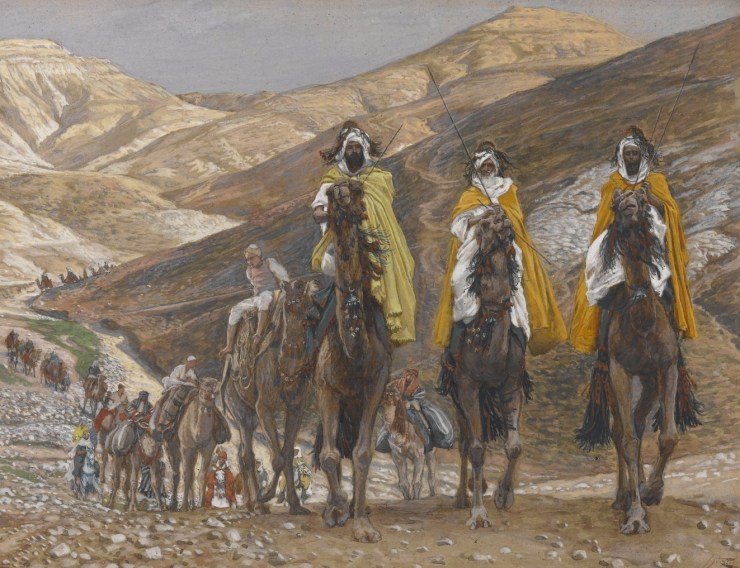
Image courtesy of Brooklyn Museum
Wise men “from the east came to Jerusalem, saying, ‘Where is he who has been born king of the Jews? For we saw his star when it rose and have come to worship him.’” (Matthew 2:1-3).
But Herod has lied. He wants to know where Jesus is, so he can kill Him, fearing He might claim his throne. He slaughters all the infant boys in Bethlehem and all that region. Through this murderous king, Satan tries to destroy Jesus. But an angel has forewarned Joseph in a dream. He and his family escape to Egypt, and Jesus is safe.
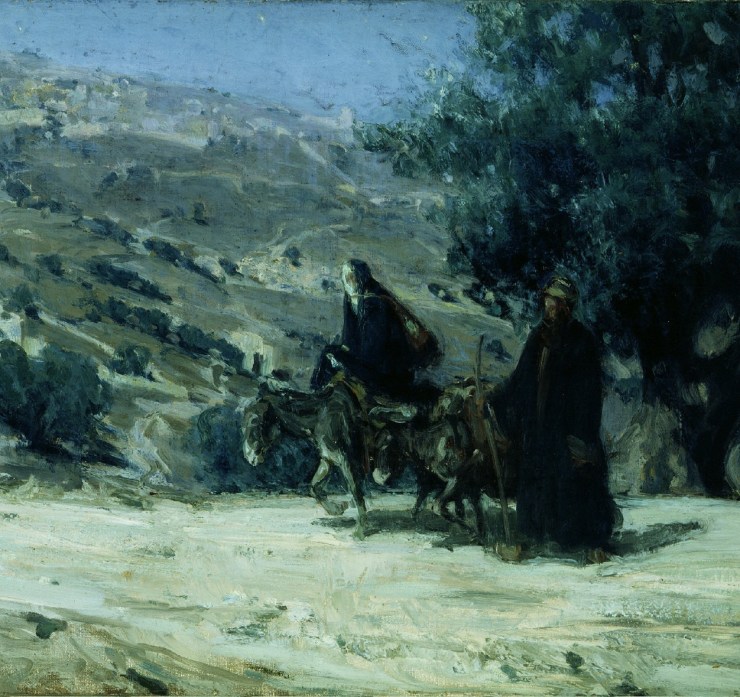
Detail from The Flight into Egypt from Wikimedia Commons
Detail from The Flight Into Egypt painted by Henry Ossawa Tanner. Joseph “took the child and his mother by night and departed to Egypt and remained there until the death of Herod” (Matthew 2:14-15).
“Out of Egypt I called my son”
After Herod’s death, the family returns and settles in Nazareth. This fulfils what Hosea prophesied, “Out of Egypt I called my son” (Matthew 2:15, Hosea 11:1). Just as God rescued His “firstborn son” Israel from Egypt (Exodus 4:22), now He brings His “one and only Son” (1 John 4:9 NIV) out of Egypt. Jesus is the perfect Israelite; He’s the True Israel.
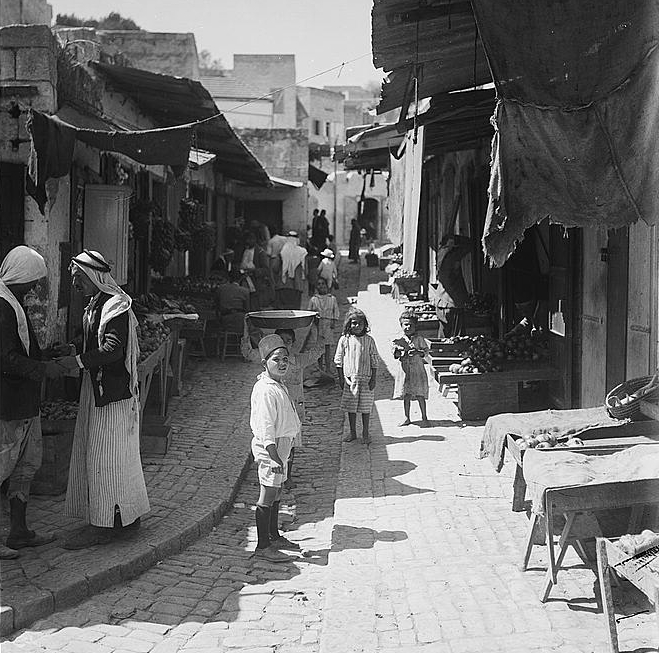
Image from The Library of Congress Prints & Photographs Online Catalog
An early photo (taken between 1898 and 1946) of Nazareth, the ordinary little town where Jesus grew up.
Jesus grows through childhood and adolescence and on into adulthood just as we do, but without sin. He plays and learns; He explores and marvels at the creation He Himself has made.
Fully God and fully man
Jesus was conceived “from the Holy Spirit” (Matthew 1:18). Mary was His biological mother. And Mary, of course, was a direct biological descendant of our forefather Adam. In fact, Jesus’s genealogy in Luke 3:23-38 is probably His biological ancestry through Mary, and it goes all the way back to Adam. So Jesus is related to you and to me, and to every person who has ever lived. It is vital that He should be. Only then could He be our Saviour.
But Jesus was conceived when Mary was a virgin. He had no human father; God is His Father. And so, though He was born as a true member of our human race, He was without sin.
Jesus is related to you and to me, and to every person who has ever lived. It is vital that He should be. Only then could He be our Saviour.
Jesus was fully human in every sense of the word―except without sin. For our sake, He “made himself nothing” (Philippians 2:7) by taking the humble position of a servant―a person without rights or privileges[1]. He was an Israelite; he followed Hebrew customs, and He taught like a first century Jewish rabbi (a Jewish scholar and teacher). Like us, He was subject to temptation, hunger and thirst, weariness and pain. He went through the whole sweep of human experience, from the ordinary daily routine to the worst horrors of humiliation, torture and death. [2] And Jesus’s perfect human nature, far from protecting Him from sorrow, made Him uniquely sensitive to it. He felt, more keenly that we can know, the pain, suffering, and injustice that everywhere confronted Him. [3]
Jesus is fully God; He’s the second person of the Holy Trinity. And He’s fully human, too. Before His conception, He had one nature―a divine nature. But at His conception, he gained a human nature, as well. So our incarnate Lord is a single Person with two natures―a human nature and a divine nature. So, for example, even when he was a newborn infant lying in His mother’s arms He was―at the very same time―continuing to sustain the entire creation (see Colossians 1:17, Hebrews 1:3)!
Next time . . .
We look at the four different Gospels, biographies of Jesus written by Matthew, Mark, Luke and John. We explore why Jesus came to Earth. And we tell the story of his baptism and temptation, which open the way for His public ministry.
Bible Readings and Question
You may like to read Isaiah 7:14, Matthew 1:18-23, Luke 1:26-37. Here’s something to think about:
? Why is it so vital for our salvation that Mary was a virgin when Jesus was conceived?
Videos
Here are two short videos, entitled A New Baby and a New Beginning: The Story of the Birth of Jesus (Matthew 1) and Wise Men, Smart Move: The Story of Happy Magi and Unhappy Herod (Matthew 2). They’re designed for children ages 6 to 12. But youth and adults may well enjoy them, too. These videos are in a series published by Crossway. They’re based on the book called The Biggest Story Bible Storybook. All the videos can be viewed at The Biggest Story videos website. You can also create a free account to enable you to download them.
REFERENCES [1] See Paul’s Letter to the Philippians (New International Commentary on the New Testament) by Gordon D. Fee, page 213. Published by William B. Eerdmans Publishing Company, Grand Rapids, Michigan, in 1995. [2] See Creed or Chaos by Dorothy L. Sayers, page 4. Published by Harcourt, Brace and Company, New York, in 1949, page 4. Available online at https://archive.org/details/dli.ernet.73136/page/n1/mode/2up (accessed 30 January 2025). [3] See Did Christ Have a Fallen Human Nature by Donald MacLeod, page 8. In Reformation Today, number 80, July-August 1984. Available at https://www.reformation-today.org/wp-content/uploads/2016/09/RT_080.pdf (accessed 30 January 2025).
CREDITS ► Text copyright © 2024 Robert Gordon Betts ► Unless otherwise indicated, all Scripture is taken from the ESV® Bible (The Holy Bible, English Standard Version®), copyright © 2001 by Crossway, a publishing ministry of Good News Publishers. Anglicized English Standard Version copyright © 2002 by Crossway. Used by permission. All rights reserved. The ESV text may not be quoted in any publication made available to the public by a Creative Commons license. The ESV may not be translated in whole or in part into any other language. ► Scripture quotations marked ‘NIV’ are taken from The Holy Bible, New International Version (Anglicised edition). Copyright © 1979, 1984, 2011 by Biblica (formerly International Bible Society). Used by permission of Hodder & Stoughton Publishers, an Hachette UK company. All rights reserved. ‘NIV’ is a registered trademark of Biblica (formerly International Bible Society). UK trademark number 1448790.
 52 Steps
.jpg)