
Part 29: God’s Ambassadors
Click the icon below to download a 4-page PDF version of this page.

“God spoke to our fathers by the prophets”
“Long ago, at many times and in many ways, God spoke to our fathers by the prophets” (Hebrews 1:1). [1] Right through the Bible, we meet people whom God specially chose to speak on His behalf. They were His prophets, who “spoke from God as they were carried along by the Holy Spirit” (2 Peter 1:21). God took them into His confidence, and shared His plans with them (see Amos 3:7). [2] They served as His ambassadors to His people and to the nations around.
God took His prophets into His confidence, and shared His plans with them.
We’ve met Enoch (see Jude 14-15), Moses (Deuteronomy 18:15), Samuel (1 Samuel 3:20), Nathan (2 Samuel 7:2), Elijah (1 Kings 18:36), and Elisha (2 Kings 9:1). Later on in Israel’s history, God inspired some prophets to write down their prophecies―now contained in the final 17 books of our Old Testament.
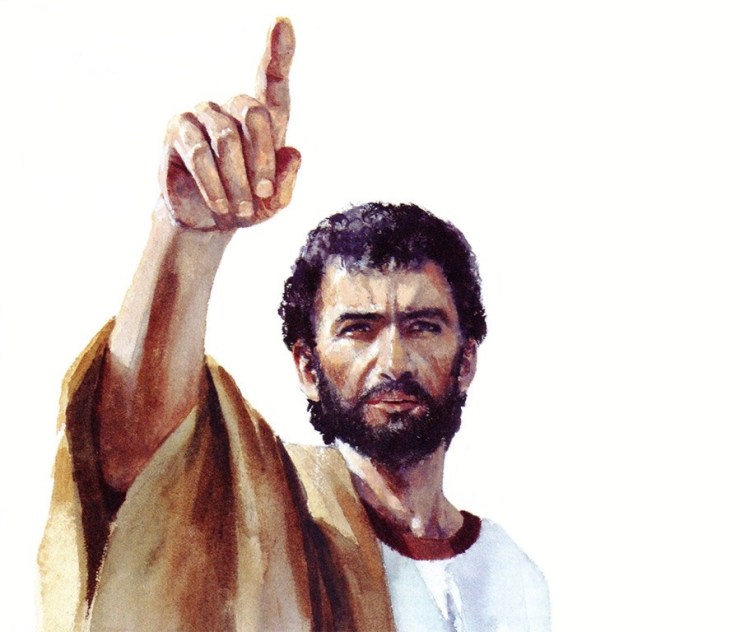
Isaiah: image © John Heseltine 2015 and © Pam Masco 2015. Image courtesy of FreeBible Images (CC BY NC ND 4.0)
An artist imagines what Isaiah―one of the ‘writing prophets’―might have looked like.
Behind the messages of these ‘writing prophets’ lie four key events, which we saw in Parts 25 and 26:
► The division of the nation around 930BC. Israel divides into the northern kingdom, also called Israel, and the southern kingdom, Judah.
►The northern kingdom’s destruction by the Assyrians in 722BC. The Assyrians deport many Israelites and resettle other people in the land.
►Judah’s conquest and exile by the Babylonians over the period 605-582BC. After the conquest, the Babylonians deport most of Judah’s people to Babylonia.
►The return from exile in 538BC. Cyrus, king of Persia, issues a decree encouraging the Jews to return to the land of Judah, and to rebuild the Temple.
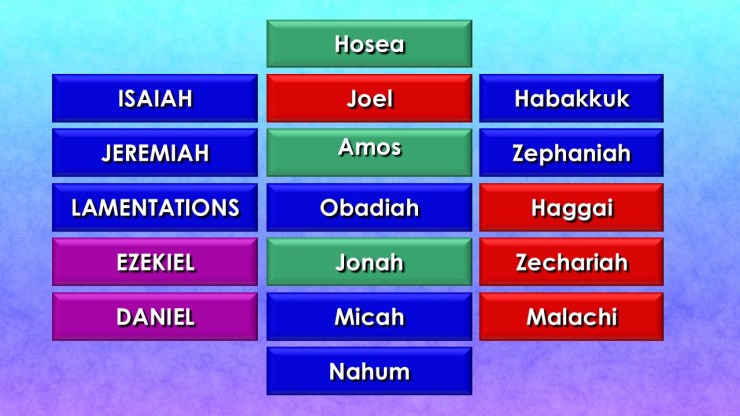
The chart below lists the 17 books written by these prophets. Those in capitals are called ‘major prophets’, because they wrote longer books. Lamentations, although a short book, is included here, as it may have been written by Jeremiah. The other twelve books are shorter, so their writers are called ‘minor prophets’. The books shown in green boxes were written by prophets in the northern kingdom of Israel; those in blue boxes by prophets in Judah. Ezekiel and Daniel, shown in purple boxes, prophesied during the exile in Babylonia. And the four shown in orange boxes prophesied after Judah’s return from exile (it isn’t certain when Joel was written, but it was probably after the exile).
Malachi is the final Old Testament prophet. Four and a half centuries pass. Then God sends another prophet. Malachi prophesies about him, saying, “Behold, I will send you Elijah the prophet before the great and awesome day of the LORD comes.” (Malachi 4:5). That “Elijah” is John the Baptist (Matthew 11:10-14, 17:10-13). Though his story is told in the New Testament, he’s actually the final prophet of the Old Testament age.
But the ultimate Prophet is Jesus Himself. In “these last days” God “has spoken to us by his Son” (Hebrews 1:2). Jesus not only speaks God’s message (John 12:49-50) but He is the Word of God Himself (see John 1:1-2,14). Moses prophesied, “The Lord your God will raise up for you a prophet like me from among you, from your brothers—it is to him you shall listen . . . .” (Deuteronomy 18:15, see Acts 3:22, 7:37). God raised up many prophets after Moses. But ultimately, Moses was prophesying about Jesus.
Our “example of suffering and patience”
Being God’s prophet wasn’t a safe, comfortable occupation. It took courage! Take Jeremiah, for example. He’s called a liar (Jeremiah 43:2), beaten and put in the stocks (20:1-2), threatened with death (26:11), and thrown into a pit, left to sink in its mud, and die (38:6). Jesus Himself tells the Jewish religious leaders: “you are sons of those who murdered the prophets” (Matthew 23:29-31). But the prophets didn’t just suffer physically. We read that God’s people “kept mocking the messengers of God, despising his words and scoffing at his prophets, . . . .” (2 Chronicles 36:16, and see Zechariah 7:11). The “prophets who spoke in the name of the Lord” are “an example of suffering and patience” to us (James 5:10).
The “prophets who spoke in the name of the Lord” are “an example of suffering and patience” to us (James 5:10).
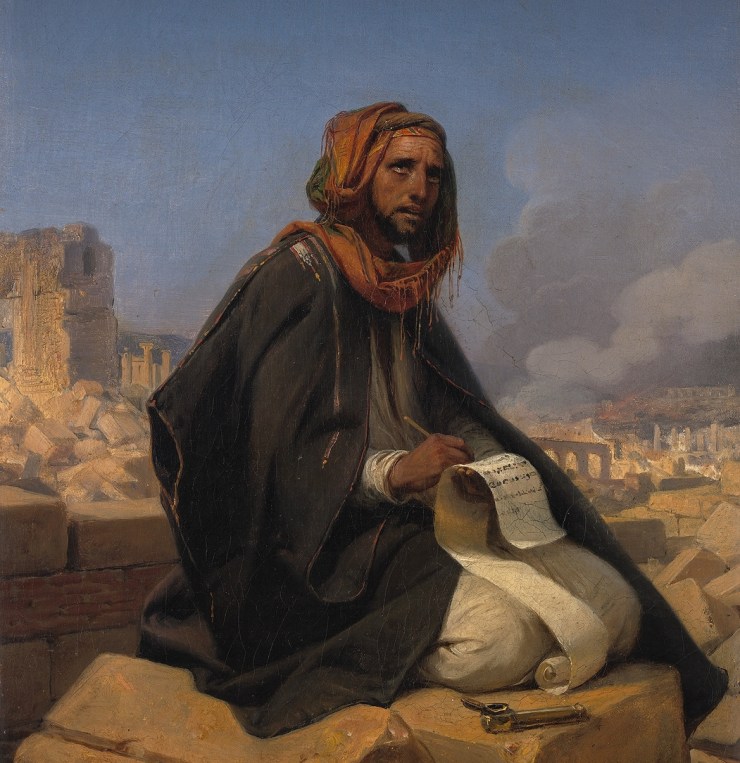
Image from Wikimedia Commons
Jeremiah on the ruins of Jerusalem painted by Horace Vernet. Jeremiah himself lived through the destruction of Jerusalem by the Babylonians, and tells us about it in Jeremiah 39:1-14.
“Remember the law of . . . Moses”
The word ‘prophet’ might suggest that they mainly foretold the future. But they also proclaimed what God was saying to His people in their own day―they were forthtellers as well as foretellers.
The prophets lived in an ancient Near Eastern culture very different from ours. They refer to events, places and people in a long-vanished world. They use a variety of ways to express their message, including poetry (such as Isaiah 1:2-3:26), pictures (like Isaiah 41:15-16), stories (for example, Isaiah 5:1-7 and Ezekiel 16:1-63), and symbolic actions (such as Jeremiah 13:1-7). There are heavenly encounters and visions (like Ezekiel 1:1-28 and Zechariah 4:1-14).

A vineyard. The ‘writing’ prophets use a variety of ways to express their message. Isaiah compares Israel and Judah to a vineyard (5:1-7). He writes, “My beloved had a vineyard on a very fertile hill. . . . . and he looked for it to yield grapes, but it yielded wild grapes.” And so the Lord has to destroy His vineyard―He has to bring judgment on His people.
The foundation of the prophets’ messages is the Law of Moses. Time and again, they bring God’s people back to His Law―His Torah, or ‘instruction’, ‘guidance’. Malachi writes, “Remember the law of my servant Moses, the statutes and rules that I commanded him at Horeb for all Israel” (Malachi 4:4). [3]
The foundation of the prophets’ messages is the Law of Moses―His Torah, His ‘instruction’, ‘guidance’.
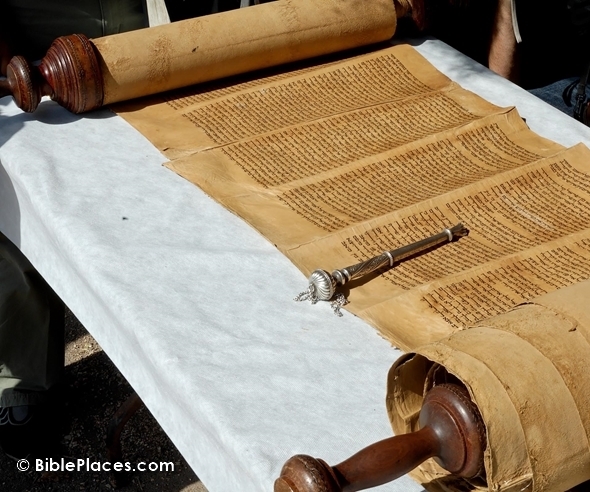
Image © www.BiblePlaces.com
A scroll of the Torah (the Hebrew name for the first five books of the Old Testament). It contains the Law of Moses. Time and again, the prophets remind God’s people of His Law, and urge them to follow it.
Jesus sums up the Law of Moses in just two commands: “You shall love the Lord your God with all your heart and . . . soul and . . . mind. This is the great and first commandment. And a second is like it: You shall love your neighbour as yourself. On these two commandments depend all the Law and the Prophets.” (Matthew 22:37-40, quoting from Deuteronomy 6:5 and Leviticus 19:18). God loves His people “with an everlasting love” (Jeremiah 31:3). [4] And through the Law, God shows us how to love Him, and how to love other people. Micah captures what God requires in these words, “what does the LORD require of you but to do justice, and to love kindness, and to walk humbly with your God?” (Micah 6:8). God wanted His people to enjoy a life rich in blessing. That’s the life they’d enjoy if they obeyed His Law (see Leviticus 26:3-12, Deuteronomy 28:1-14).

The Bible often depicts our relationship with God as walking with Him. Micah writes, “what does the LORD require of you but to do justice, and to love kindness, and to walk humbly with your God?” (Micah 6:8).
Turning away from God
God’s people were to love the Lord their God. But time and again, they turn away from Him (see especially Hosea 1:2, Ezekiel 16:15-34).
●The people give themselves to idols. They “stirred him to jealousy with strange gods; . . . . They sacrificed to demons . . . .” (Deuteronomy 32:16-17, and see also, for example, Jeremiah 22:8-9). That begins at the very start of their national history―as we saw in part 20. Idol worship subjects people to the destructive power of demons, and draws them into immorality, depravity, and brutality. Idolatry destroys people.
●And instead of trusting God, His people turn to nations around to provide their security.
And God’s people were to love their neighbours as themselves. Instead, they sin against them. Zechariah writes, “‘Thus says the LORD of hosts, Render true judgements, show kindness and mercy to one another, do not oppress the widow, the fatherless, the sojourner, or the poor, and let none of you devise evil against another in your heart.’ But they refused to pay attention . . . .” (Zechariah 7:9-11, see also, for example, Isaiah 10:1-2, Ezekiel 22:6-12). Rampant injustice makes life a living hell; injustice destroys people.
Sin “is an acid that mars and destroys whatever it touches”[5]―we saw that in Part 17. Spiritual adultery and injustice was hurling Israel down the road to self-destruction. So our holy God, in His love, sends prophets to warn them of judgment, and to implore them to turn back to Him. Jeremiah prophesies, “Now therefore mend your ways and your deeds, and obey the voice of the LORD your God, and the LORD will relent of the disaster that he has pronounced against you” (Jeremiah 26:13, see also Leviticus 26:40-45, Joel 2:13-14). See what happens when even the pagan citizens of Nineveh repent (Jonah 3:6-10)!
In His love, our holy God sends prophets to warn His people of judgment, and to implore them to turn back to Him.
But persistent disobedience calls down God’s judgment (Leviticus 26:14-39, Deuteronomy 28:15-68). Jeremiah tells the people of Judah: “The LORD could no longer bear your evil deeds and the abominations that you committed. Therefore your land has become a desolation and a waste and a curse, without inhabitant, as it is this day.” (Jeremiah 44:22).
The exile in Babylon is God’s judgment on His people. And during the exile, they turn away from idolatry. Though they still sin after the exile (see Malachi 1:6-2:16), Israel as a nation never falls into idolatry again.
Messages to the nations
God doesn’t speak only to His people. He calls prophets to speak to the nations around, too. For example, Isaiah prophesies about such nations as Babylon, the Philistines, Moab, and Egypt; Jonah prophesies to the Assyrian city Nineveh; most of Obadiah is about Edom. The prophets warn these nations of God’s judgment. Some of these nations were―at one time or another―enemies of God’s people. And so God’s judgment on them would have been a great encouragement to His people. [6]
In the next part . . .
Alongside the prophets’ rebukes and warnings both to God’s people and to the nations around, they unveil an astounding vision of future glory. That’s what we’ll be looking at next time.
Bible Readings and Questions
You may like to read Micah 6:8, and then Genesis 6:9, 2 Chronicles 6:14 and Jeremiah 7:23. Here are questions to think about:
?Why does God use the picture of people ‘walking’ with Him, and walking in all the way that He commands? And what does that look like for us today?
Videos
Here’s three short videos, entitled What Isaiah Saw: The Story of the Throne Room of a Holy God (Isaiah 6), Jeremiah against Everyone: The Story of the Weeping Prophet (Jeremiah 1), and Big Fish, Bigger Mercy: The Story of Jonah (Jonah 1-4). They’re designed for children ages 6 to 12. But youth and adults may well enjoy them, too. These videos are in a series published by Crossway. They’re based on the book called The Biggest Story Bible Storybook. All the videos―there are 104 in all―can be viewed at The Biggest Story videos website. You can also create a free account to enable you to download them.
REFERENCES [1] The following resources have been helpful in writing Part 29. [a] How to Read and Understand the Biblical Prophets by Peter J. Gentry, pages 11-34,39-40,59-70. Published by Crossway, Wheaton, Illinois, in 2017. [b] Biblical Theology: a Canonical Thematic and Ethical Approach by Andreas J Köstenberger and Gregory Goswell, pages 264-275. Published by Crossway, Wheaton, Illinois, in 2023. [c] Introduction to the Major Prophets by Peter Gentry, available online at https://www.thegospelcoalition.org/essay/introduction-to-the-major-prophets/, accessed 6 January 2025. [d] Introduction to the Minor Prophets by Richard Alan Fuhr, available online at https://www.thegospelcoalition.org/essay/minor-prophets/, accessed 6 January 2025. [e] What the Old Testament Authors Really Cared About: a Survey of Jesus’ Bible edited by Jason S. DeRouchie, The Old Covenant Enforced: What the Prophets are Really About Published by Kregel Publications, Grand Rapids, Michigan, in 2013. [f] God’s Big Picture: Tracing the Story-line of the Bible by Vaughan Roberts, pages 89-94. Published by Inter-Varsity Press, Leicester, United Kingdom, in 2003. [g] Introduction to the Prophetic Books by Richard L. Pratt, available online at https://thirdmill.org/answers/answer.asp/file/40899, accessed 6 January 2025. [h] What Was a Prophet in the Old Testament? Available online at https://www.gotquestions.org/prophet-Old-Testament.html, accessed 6 January 2025. [i] The Beginner’s Guide to the Prophets in the Bible, by Jeffrey Kranz. Available online at https://overviewbible.com/prophets/, accessed 6 January 2025. [j] How To Read the Prophets by Bryan Estelle. Available online at https://learn.ligonier.org/articles/how-to-read-the-prophets, accessed 6 January 2025. [k] Introduction to the Prophets, produced by the Theology of Work Project. Available online at https://www.theologyofwork.org/old-testament/introduction-to-the-prophets/, accessed 6 January 2025. [2] See The Prophets, volume 1, by Abraham J. Heschel, page 21. Published by Harper and Row, New York, in 1955. As quoted in Through New Eyes: Developing a Biblical View of the World, by James B. Jordan, page 138. Published Wolgemuth and Hyatt, Publishers, Inc., Brentwood, Tennessee, in1988. Available online at https://biblicalhorizons.com/wp-content/uploads/2017/12/Through-New-Eyes.pdf, accessed 6 January 2025. [3] Biblical Theology: a Canonical Thematic and Ethical Approach by Andreas J Köstenberger and Gregory Goswell, page 274. Published by Crossway, Wheaton, Illinois, in 2023. [4] Jeremiah and Lamentations: From Sorrow to Hope (Preaching the Word), by Philip Graham Ryken, pages 449-451. Published by Crossway, Wheaton, Illinois, in 2001. [5] Quoted from Leviticus (Tyndale Old Testament Commentaries) by Jay Sklar, page 42. Published by InterVarsity Press, Downers Grove, Illinois, and Inter-Varsity Press, Nottingham, U.K., in 2013. [6] How to Read and Understand the Biblical Prophets by Peter J. Gentry, page 65. Published by Crossway, Wheaton, Illinois, in 2017.
CREDITS ► Text copyright © 2024 Robert Gordon Betts ► Unless otherwise indicated, all Scripture is taken from the ESV® Bible (The Holy Bible, English Standard Version®), copyright © 2001 by Crossway, a publishing ministry of Good News Publishers. Anglicized English Standard Version copyright © 2002 by Crossway. Used by permission. All rights reserved. The ESV text may not be quoted in any publication made available to the public by a Creative Commons license. The ESV may not be translated in whole or in part into any other language.
 52 Steps
