
Part 28: Wisdom for Our Way
Click the icon below to download a 4-page PDF version of this page.

Job: Loving God for Himself alone
“There was a man in the land of Uz whose name was Job, . . . blameless and upright, one who feared God and turned away from evil” (1:1). Job lived perhaps around the time of Abraham; Uz was east of Canaan, possibly Edom. God had blessed Job with ten children, and with great wealth and honour; he was “the greatest of all the people of the east” (1:3).[1]
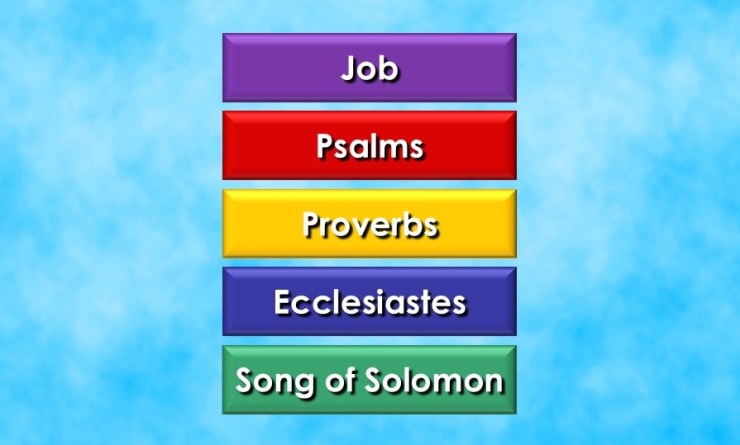
The five books of poetry. We looked at the Book of Psalms last time; in this part we look at the remaining four books―Job, Proverbs, Ecclesiastes, and the Song of Solomon.
From this idyllic scene, we suddenly find ourselves in God’s court in heaven. Angelic beings, called “the sons of God” (1:6), gather before Him. To our surprise, Satan joins them. God asks him, “Have you considered my servant Job, that there is none like him on the earth, a blameless . . . man . . . ?” (1:8). But Satan sneers, “Does Job fear God for no reason? . . . . touch all that he has, and he will curse you to your face.” (1:9-11). Satan accuses Job of fearing God only because of what God gives him. So God allows Satan to strip Job of everything―his livestock, his servants, and his children. But, even in the midst of this devastating loss, Job remains faithful. He says, “The LORD gave, and the LORD has taken away; blessed be the name of the LORD” (1:21).
Satan persists. Again, he appears before God and accuses Job, “touch his bone and his flesh, and he will curse you to your face” (2:5). So the Lord allows Satan to strike Job with “loathsome sores” all over his body (2:7). Even his wife now says to him, “Curse God and die” (2:9). But Job replies, “Shall we receive good from God, and shall we not receive evil?” (2:10). Still he remains faithful to God.
Stripped of everything except life itself, what will Job do?
Enter Job’s three friends, Eliphaz, Bildad, and Zophar. For seven days they mourn with him and stay silent, “for they saw that his suffering was very great” (2:13). What follows is a series of speeches by Job and these three friends. They probe the great questions we all ask: Why do those who love God suffer? Why is there so much injustice in the world? There are no instant answers; these questions must be wrestled with. And that’s what the Book of Job does. But this book isn’t, first and foremost, about suffering in general. Job is suffering because he fears God. Stripped of everything except life itself, what will he do? What would we do? That’s the great question God is asking us in the Book of Job.
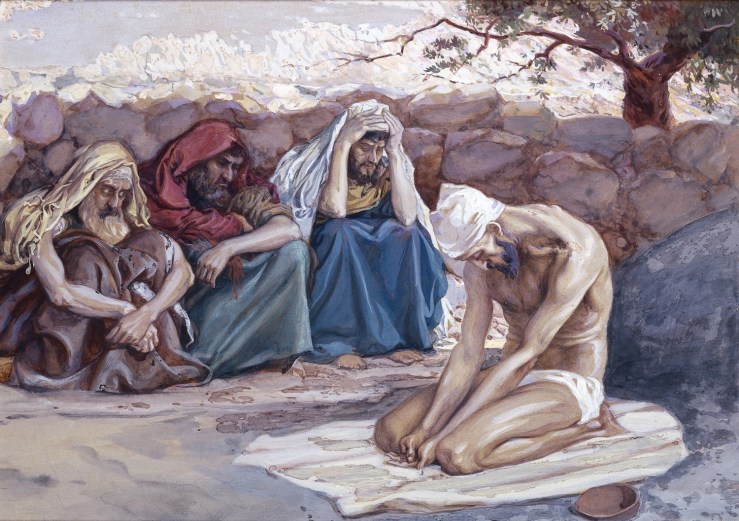
Image courtesy of The Jewish Museum, New York
Job and His Three Friends, painted by James Jacques Joseph Tissot and followers.
And all that Job’s three friends―these “miserable comforters” (16:2)―can come up with is this: “If you’re suffering, you must have sinned”. In their minds, you get what you deserve―good things happen to good people; bad things to bad people. But Job hasn’t sinned (1:8, 2:3). Of course, he knows that―like all of us―he does sin (see 13:23). But hasn’t he been forgiven? His conscience is clear (27:2-6). Job remembers the days “when God’s intimate friendship blessed my house” (29:4 NIV), when “Men listened to me and waited . . . for my counsel” (29:16,21). But “now they laugh at me, men who are younger than I” (30:1). That’s painful. He complains that God “counts me among his enemies” (19:11 NIV). He even accuses God of being unjust (9:22-24, see 40:8).
Job is in the pit of despair. But in his despair, light comes.[2] Job declares: “I know that my Redeemer lives, and at the last he will stand upon the earth. And after my skin has been thus destroyed, yet in my flesh I shall see God” (19:25-26). He “knows the way that I take; when he has tried me, I shall come out as gold” (23:10).
Job’s three friends have given him merely human wisdom. They fall silent; a young man called Elihu takes the stage. He’s angry with Job’s three friends “because they had found no answer” for Job (32:3). And he’s angry with Job, because he’s accused God of injustice. Elihu contends that God is righteous and just. God is all-powerful, and rules over creation. And God is speaking to Job―through his conscience, and through his pain. Through all this affliction, God is bringing Job into “a broad place” (36:16), a place of blessing. Job needs to bow his knee to God, and fear Him. And he’s right. Elihu here speaks as a true prophet of God.

God showcases His unfathomable wisdom and power to Job as He takes him on a whirlwind tour of creation. In His tour, God asks Job, “Can you lift up your voice to the clouds, that a flood of waters may cover you? Can you send forth lightnings, that they may go and say to you, ‘Here we are’?” (38:34-35).
And now God Himself speaks―He addresses Job personally, directly. He rebukes Job for speaking “words without knowledge” and demands, “Where were you when I laid the foundation of the earth?” (38:2,4). He showcases His unfathomable wisdom and power to Job as He takes him on a whirlwind tour of creation. And He challenges Job to have a go at being the judge of all the Earth: “Adorn yourself with majesty . . . . and tread down the wicked” (40:10,12). God paints an unforgettable picture of evil in the form of two monstrous beasts―“Behemoth” (40:15-24)―which perhaps pictures the power of death―and “Leviathan” (41:1-34), which most likely pictures “the great dragon . . . that ancient serpent, who is called the devil and Satan” (Revelation 12:9). Does Job know how to defeat death and Satan? No, Job hasn’t got the first idea. But God knows.
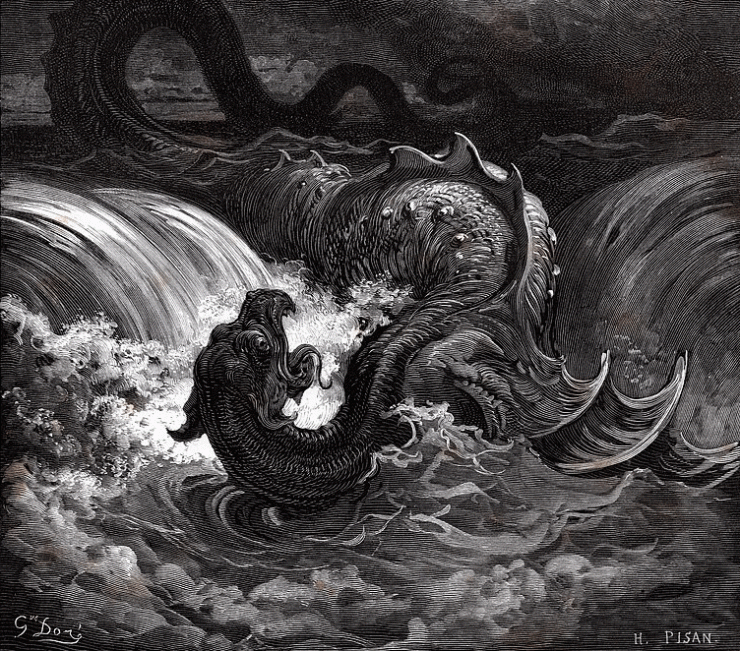
Image from Wikimedia Commons
Detail from The destruction of Leviathan, by Gustav Doré. “Leviathan” (Job 41:1-34) most likely pictures “the great dragon . . . that ancient serpent, who is called the devil and Satan” (Revelation 12:9). This engraving depicts Leviathan’s destruction, as told by the prophet Isaiah: “In that day the Lord with his hard and great and strong sword will punish Leviathan the fleeing serpent, Leviathan the twisting serpent, and he will slay the dragon that is in the sea” (Isaiah 27:1).
Finally, Job says “I had heard of you by the hearing of the ear, but now my eye sees you”, and he repents (42:3,5-6). God graciously gives Job “twice as much as he had before” (42:10), and blesses his latter days “more than his beginning” (42:12). But, above all, Job has come into a deeper, richer understanding of God. Ultimately, this book is about God―His character, His goodness, His justice, and His wise sovereignty over creation.
Job says “I had heard of you by the hearing of the ear, but now my eye sees you”.
And we can be sure that Job considered friendship with God worth far, far more than anything else. So here’s the great question for us: do we worship God for all the blessings He gives us? Or do we worship Him because He’s God? Do we love God for Himself? Do we trust Him even if He allows things in our lives that we ourselves wouldn’t choose?
The sufferings of this righteous man Job prefigure the infinitely greater and totally undeserved sufferings of the only truly righteous man who ever lived―Jesus Christ. He “suffered once for sins, the righteous for the unrighteous, that he might bring us to God” (1 Peter 3:18).
Proverbs: Wisdom from above
When David’s son Solomon becomes king of Israel, he doesn’t ask God for riches or fame. He asks for wisdom (2 Chronicles 1:10). And out of his wisdom, Solomon writes all but the final two chapters of the Book of Proverbs. The book complements God’s Law. It gives us practical wisdom for daily life, for “doing what is right and just and fair” (1:3 NIV).[3]
Solomon repeatedly speaks to “my son” (for example, 3:1, 19:27, 23:26). Proverbs seems to have been intended originally for young men, emerging from adolescence and setting out on their journey through life. But of course, this wisdom is for everyone―for what we say, for our relationships, for our work and business dealings, for humility, and many other things. For example, “A soft answer turns away wrath . . . “ (15:1); “Pride goes . . . before a fall” (16:18); “Train up a child in the way he should go; even when he is old he will not depart from it” (22:6). But the proverbs aren’t promises. For instance, a soft answer doesn’t always turn away wrath; but it’s still wise to give “a soft answer”. God is giving us wise principles. And true wisdom and understanding are more precious than gold or silver (3:13-15, 16:16).

Solomon writes, “Three things are too wonderful for me; four I do not understand”; one of these is “the way of an eagle in the sky “. How amazing it is to see an eagle soaring, apparently effortlessly, in the sky. We simply gaze at God’s handiwork in wonder.
But Proverbs also goes deeper than the practical. Ultimately, wisdom is a matter of the ‘heart’―the inner control centre of our being. Wisdom begins with “The fear of the LORD” (9:10)―humble and reverent submission to God.[4] Wisdom is to walk in the light of the fact that “we must all appear before the judgement seat of Christ” (2 Corinthians 5:10) and give account for all we’ve thought and said and done. And wisdom is founded on humility: Proverbs urges us, “Trust in the LORD with all your heart, and do not lean on your own understanding” (3:5). And humility implies teachability: “a wise man listens to advice” (12:15).
Wisdom begins with “The fear of the Lord” (Proverbs 9:10)―humble and reverent submission to God.
Proverbs pictures life as a journey―a “way”, a “path”, a series of “steps”―words that, together, occur around 100 times in the book. For example, “In all your ways acknowledge him, and he will make straight your paths” (3:6). Each day is a step toward our final destination. We must choose one of two paths: “the way of the righteous” or “the way of the wicked” (Psalm 1:6). So we must be wise with God’s wisdom―“the wisdom from above” (James 3:17).

The Book of Proverbs pictures life as a journey―a “way”, a “path”, a series of “steps”.
Ultimately, the Book of Proverbs points us to the One in whom “are hidden all the treasures of wisdom and knowledge” (Colossians 2:3). It points us to Jesus. His life demonstrates perfect wisdom. Through His Spirit, He now teaches us wisdom (see John 14:26, 16:13). And one way He does that is through this Spirit-inspired Book of Proverbs.
Ecclesiastes: Life “under the sun”
“The words of the Preacher, the son of David, king in Jerusalem. Vanity of vanities, . . . All is vanity.” (1:1-2). So begins the Book of Ecclesiastes. The “Preacher” is traditionally thought to be Solomon. That word “vanity” can be translated ‘breath’. It expresses things that, like a puff of wind, are insubstantial and fleeting. Is the Preacher simply having a fit of depression? No, he’s being realistic. Ecclesiastes jolts us with a God-inspired dose of realism.[5]

Our lives are so short. From the strength and beauty of youth, we seem to be hurled headlong through the advancing years, till―all too soon―our lives are cut short in death. But in the Book of Ecclesiastes, God gives us true perspective on our brief lives here on Earth. And so He helps us to live them wisely and well.
Our lives are so short. In the end, “What does man gain by all the toil at which he toils under the sun? . . . .” (1:2). And the Preacher certainly toiled! He “acquired great wisdom” (1:16), “made great works”, “built houses”, “made . . . gardens and parks” (2:4-5), and amassed possessions, servants and concubines (7-8). But he found it all to be “vanity” (2:11). We ourselves toil, but what do we achieve? Our lives can seem like a patchwork of unexplained twists and turns, gains and losses, joys and sorrows, all with a background of sheer repetitiveness (see 1:3-7), and capped (if we live that long) by the encroaching infirmity of old age (see 12:2-7). Our world is disordered, riddled with injustice, an unpredictable place where “time and chance” happen to us all (9:11). What’s the meaning of it all? We want to know, we want answers: God “has put eternity into [our] heart” (3:11). But we “cannot find out what God has done from the beginning to the end” (3:11). Only God sees the end from the beginning. We simply have to trust Him.
Ecclesiastes jolts us with a God-inspired dose of realism.
The Preacher tells us “there is nothing new under the sun” (1:9). That phrase “under the sun” is a key. It refers to this world now. And so the book subtly points us to the world not under the sun―the eternal world without tears or pain, where “the former things have passed away” (Revelation 21:4). And that brings true perspective on life. With it, we can accept the limitations of our present lives. With it, we can enjoy what―in this fleeting world―God richly provides us to enjoy (1 Timothy 6:17): a good meal (Ecclesiastes 2:24, 5:18, 9:7), marriage (9:9), our daily work (2:24, 5:18), our possessions (5:19). But we’re to enjoy them without clinging on to them, or expecting too much from them.
God is in control of every event, and His timing is perfect: “He has made everything beautiful in its time” (3:11). He will wind up this world, judge everything, and put everything to rights. We’re to live in the light of these glorious truths. The Preacher concludes, “Fear God and keep his commandments, for this is the whole duty of man. For God will bring every deed into judgement, . . . whether good or evil.” (12:13-14).
The Song of Solomon: Love “strong as death”
The Song of Solomon plunges us into a torrent of passionate romantic love between a young man and woman. It’s a love as “strong as death, . . . . Its flashes are flashes of fire, the very flame of the LORD. Many waters cannot quench love” (8:6-7). Through picture language, frank but pure, we see the power and persistence of this couple’s devotion to each other. The lover and his beloved take turns to sing; their audience are virgin girls, perhaps bridesmaids, whom we hear seven times as the song’s chorus.[6]

The Song of Solomon plunges us into a torrent of passionate romantic love between a young man and woman. It’s a love as “strong as death, . . . . Its flashes are flashes of fire, the very flame of the LORD. Many waters cannot quench love” (8:6-7).
The couple may be married right from the start. Or they may begin as a betrothed couple, to be united as man and wife later in the story, probably in 4:16-5:1. The passionate, exclusive love between the man and the woman has obvious lessons for how husbands and wives are to love and cherish each other. And there’s vital advice for the unmarried―don’t “stir up or awaken love until it pleases” (2:7, 3:5, 8:4). In other words, stay a virgin till your wedding night.
The Bible is, at its heart, a love story. It begins with a marriage, and this Song points us back to it. Adam and Eve’s union set the pattern for marriage: “a man shall leave his father and his mother and hold fast to his wife, and they shall become one flesh” (Genesis 2:24). The Song of Solomon celebrates this ‘one flesh’ marital union.
This Song points us back to the marriage at the beginning of the Bible. And it points us forward to the marriage of the Lamb and His bride, the Church.
And the Song points us to another marriage―the marriage at the end of Bible. In Ephesians 5:31-32, Paul quotes Genesis 2:24 and goes on to say, “This mystery . . . refers to Christ and the church”. And right at the end of the Bible, all eyes are fixed on “a bride beautifully dressed for her husband” (Revelation 21:2 NIV)―the Church ready to be married to the Lamb, Jesus Christ.
In the next part . . .
Our God is a speaking God. And throughout the Bible we see Him speaking to His people through His prophets. Who were they, and what kind of messages did they bring? We’ll see next time.
Bible Reading and Question
You may like to read Job 1:1-2:10. Here are a couple of questions to think about:
? Job was God’s friend. So why does God allow Satan to do such harm to His friend? And what’s God saying to us through all this?
Videos
Here’s three short videos, entitled A Hard Life and a Good God: The Story of Job (Part 1) (Job 1), Cover Your Mouth: The Story of Job (Part 2) (Job 38-42), and The Beginning of Wisdom: The Story of the Book of Proverbs (Proverbs 1). They’re designed for children ages 6 to 12. But youth and adults may well enjoy them, too. These videos are in a series published by Crossway. They’re based on the book called The Biggest Story Bible Storybook. All the videos can be viewed at The Biggest Story videos website. You can also create a free account to enable you to download them.
REFERENCES [1] The following books have been especially helpful in explaining the Book of Job. [a] Job: a Commentary by Christopher Ash. Published by The Gospel Coalition and available online at https://www.thegospelcoalition.org/commentary/job/, accessed 13 December 2024. [b] Job: the Wisdom of the Cross (Preaching the Word) by Christopher Ash, page 408. Published by Crossway, Wheaton, Illinois, in 2014. [2] See ESV Expository Commentary, volume IV: Ezra-Job, edited by Iain M. Duguid, James M. Hamilton, and Jay Sklar, page 411. Published by Crossway, Wheaton, Illinois, in 2020. [3] The following books have been especially helpful in explaining the Book of Proverbs: [a] What the Old Testament Authors Really Cared About: a Survey of Jesus’ Bible, edited by Jason S. DeRouchie, Proverbs [Summary] and chapter 18. Published by Kregel Publications, Grand Rapids, Michigan, in 2013. [b] The Beginning and End of Wisdom by Douglas Sean O’Donnell. Published by Crossway, Wheaton, Illinois, in 2011. [4] See The Beginning and End of Wisdom by Douglas Sean O’Donnell, page 37. Published by Crossway, Wheaton, Illinois, in 2011. [5] The following books have been especially helpful in explaining the Book of Ecclesiastes. [a] Wisdom From Ecclesiastes by David Gibson. Available online at https://keswickministries.org/resources/study-guides/, located at Convention 2022 – Gratitude, then Wisdom From Ecclesiastes – David Gibson. [b] Living Life Backward: How Ecclesiastes Teaches us to Live in the Light of the End by David Gibson. Published by Crossway, Wheaton, Illinois, in 2017. [c] What the Old Testament Authors Really Cared About: a Survey of Jesus’ Bible edited by Jason S. DeRouchie, Ecclesiastes [Summary] and chapter 19. Published by Kregel Publications, Grand Rapids, Michigan, in 2013. [6] The following books have been especially helpful in explaining the Song of Solomon. [a] ESV Expository Commentary, volume V: Psalms-Song of Solomon, edited by Iain M. Duguid, James M. Hamilton, and Jay Sklar, pages 1119-1166. Published by Crossway, Wheaton, Illinois, in 2020. [b] See The Song of Solomon: an Invitation to Intimacy (Preaching the Word) by Douglas Sean O’Donnell. Published by Crossway, Wheaton, Illinois, in 2012. [c] What the Old Testament Authors Really Cared About: a Survey of Jesus’ Bible, edited by Jason S. DeRouchie, Song of Songs [Summary] and chapter 20. Published by Kregel Publications, Grand Rapids, Michigan, in 2013.
CREDITS ► Text copyright © 2024 Robert Gordon Betts ► Unless otherwise indicated, all Scripture is taken from the ESV® Bible (The Holy Bible, English Standard Version®), copyright © 2001 by Crossway, a publishing ministry of Good News Publishers. Anglicized English Standard Version copyright © 2002 by Crossway. Used by permission. All rights reserved. The ESV text may not be quoted in any publication made available to the public by a Creative Commons license. The ESV may not be translated in whole or in part into any other language. ► Scripture quotations marked ‘NIV’ are taken from The Holy Bible, New International Version (Anglicised edition). Copyright © 1979, 1984, 2011 by Biblica (formerly International Bible Society). Used by permission of Hodder & Stoughton Publishers, an Hachette UK company. All rights reserved. ‘NIV’ is a registered trademark of Biblica (formerly International Bible Society). UK trademark number 1448790.
 52 Steps
