
Part 27: Praise, Prayer, and Prophecy
Click the icon below to download a 4-page PDF version of this page.

A treasure-store
The Book of Psalms is a treasure-store[1] of 150 Spirit-inspired praises, prayers and prophecies. It was the song book and prayer book of Israel, and of Jesus and His disciples. It’s our song book and prayer book, too.
In the Psalms, God’s people speak to Him. The Psalms give voice to every human emotion―whether we’re joyful or sorrowful, confident or fearful, despairing, perplexed or careworn, angry or thankful, or sorry for our sin. God wants us to speak to Him, whether we feel He’s close to us or far away. God wants us to pour out our hearts to Him. The Psalmist cried, “Out of the depths I cry to you, O LORD!” (Psalm 130:1). God wants us to be totally honest with Him, just as the Psalmists were.
God wants us to speak to Him, whether we feel He’s close to us or far away. God wants us to pour out our hearts to Him.

God wants us to pour out our hearts to Him. The Psalmist cried, “Out of the depths I cry to you, O LORD!” (Psalm 130:1).
God speaks to us in the Psalms, too. He reveals His character, and the wonderful things He’s done. He teaches us about ourselves. And He teaches us about sin and judgment, forgiveness and salvation.
In the Psalms, then, God speaks to us, and we to Him. This implies intimacy. The Psalms are the ‘voiceover’ to our relationship with Him. The Bible story is, at its heart, a love story between God and His people. Psalm after psalm reveals the extent and depth of God’s unfailing love and care for us.
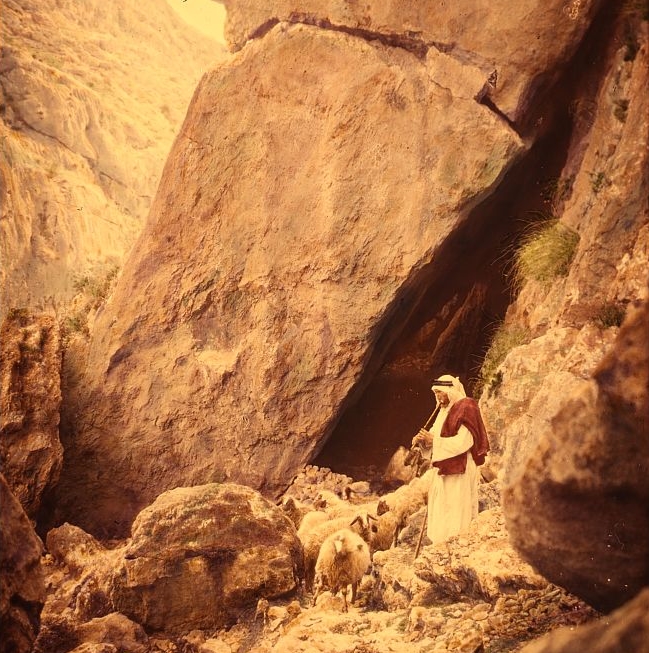
Image from The Library of Congress Prints & Photographs Online Catalog
David wrote “Even though I walk through the darkest valley, I will fear no evil, for you are with me; your rod and your staff, they comfort me” (23:4 NIV). This photograph (taken between 1900 and 1920) is from a set illustrating Psalm 23.
The psalmist sang, “great is [the Lord’s] steadfast love towards us, and the faithfulness of the LORD endures for ever” (Psalm 117:2). God is “our refuge and strength, a very present help in trouble” (46:1). David sang, “The LORD is my shepherd, I lack nothing. . . . Even though I walk through the darkest valley, I will fear no evil, for you are with me; your rod and your staff, they comfort me.” (23:1,4 NIV).
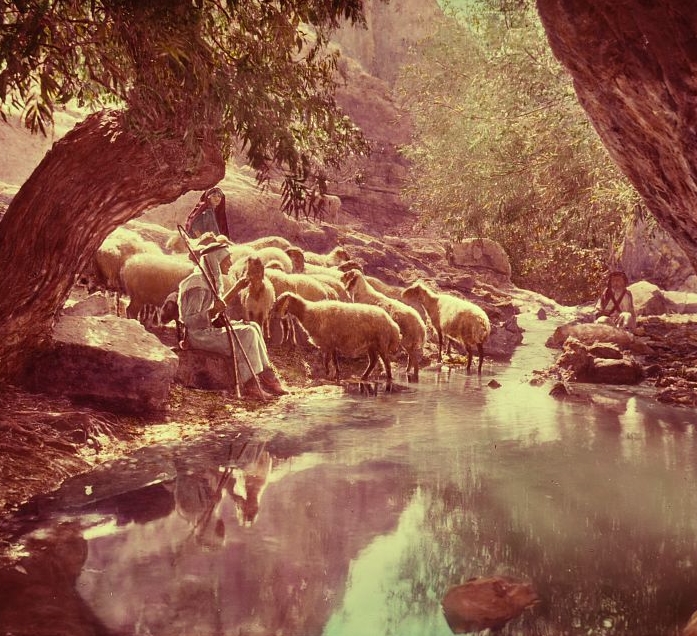
Image from The Library of Congress Prints & Photographs Online Catalog
David wrote “The LORD is my shepherd, I lack nothing. He makes me lie down in green pastures, he leads me beside quiet waters, he refreshes my soul.” (Psalm 23:1-3 NIV). This photograph (taken between 1900 and 1920) is from a set illustrating Psalm 23.
God’s covenant love
God’s love for us is covenant love. A covenant is a binding agreement; it’s about commitment. God’s covenant relationship with His people shows through so powerfully in the Psalms. That’s reinforced by two special words we find throughout them.
The first is one of God’s names, Yahweh. It’s used no less than 695 times in the 150 Psalms! (Most versions translate Yahweh as “LORD” in capitals). Yahweh is God’s personal name, through which God reveals Himself as our living, personal God, who is present with us, and at work to bless us. And that leads us to the second word we find throughout the Psalms. It’s the Hebrew word hesed, translated “steadfast love” in the ESV. It occurs 130 times―as many times as in the rest of the Old Testament put together! God’s love for us is committed, steadfast, unfailing love: “steadfast love surrounds the one who trusts in the LORD” (Psalm 32:10).
From David to David’s Lord
Through the Bible runs a single story; each book of the Bible is part of that story. And that’s no less true of the Book of Psalms. It plays a key role in this story; that’s highlighted by the fact that it’s the Old Testament book most quoted in the New Testament! In fact, the Psalms are at the heart of the Old Testament’s message[2].
A variety of people wrote the Psalms. Nearly half are by King David. Thirteen of his psalms have titles that tell us the event in his life that inspired the psalm. These 13 psalms are a remarkable window into David’s soul at these times. About a third of the Psalms are anonymous; the rest are by six other authors, including Moses and Solomon.
The Psalms are at the heart of the Old Testament’s message.
God inspired the authors when writing each psalm. He also inspired the way the psalms are arranged. So, for example, Psalms 1 and 2 begin the book, and Psalms 146-150 end it for a purpose. Psalms 1 and 2 are the gateway to the Psalms―as we’ll see next. Psalms 146-150 end the book with a great outpouring of praise to God. Each of these five psalms begins and ends with the Hebrew word hallelujah, meaning ‘Praise ye Yah!’ (‘Yah’ being a shortened form of God’s personal name ‘Yahweh’). It’s translated in the ESV as “Praise the LORD!”.
Psalms 1 and 2 are the gateway to the Psalms. Psalm 1 begins, “Blessed is the man” whose “delight is in the law of the LORD, and on his law he meditates day and night” (1:1-2).
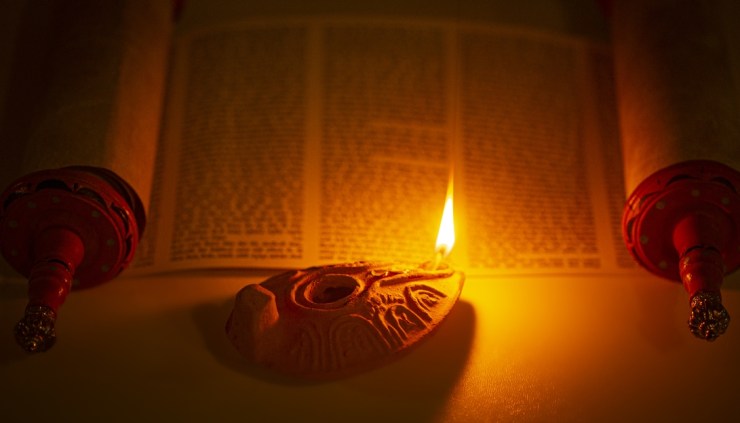
“Blessed is the man” whose “delight is in the law of the LORD, and on his law he meditates day and night” (Psalm 1:1-2).
Then in Psalm 2:6, God says “I have set my King on Zion, my holy hill” (Mount Zion being where Solomon built the Temple). The Law and the king are closely connected. The king of Israel had to write his own personal copy of God’s Law, read it “all the days of his life”, and always obey it (Deuteronomy 17:18-20). Israel’s greatest king was David. Did he always obey God’s Law? Is he the king of Psalm 2:6? No. The very next Psalm puts paid to that thought. The title of Psalm 3 is “A Psalm of David, when he fled from Absalom his son”. David was fleeing from his own son because of his sin. He’d committed adultery with Bathsheba, and got her husband killed. He’d repented (see Psalm 51:1-17), and God had forgiven him. But nonetheless, there were consequences. God told David: “I will raise up evil against you out of your own house” (2 Samuel 12:11). One of those evils was Absalom’s attempt to take the kingdom from his father.
Great as he was, David was a sinner. He wasn’t the king of Psalm 2:6. And so, as we read through the Psalms, we’re looking for that king―the king who always obeys God’s Law. He’ll be a king of David’s dynasty, and he’ll reign for ever. In Psalm 89 God says: “I have made a covenant with . . . David my servant: ‘I will establish your offspring for ever, and build your throne for all generations'” (89:3-4). This Psalm was written long after David’s reign. In fact, by the time the 150 Psalms are collected and arranged into their final form, God’s people are in exile. The final king of David’s dynasty is a distant memory. So who will be the king of David’s dynasty who’ll reign for ever?
The Book of Psalms takes us to Him. It leads us all the way from King David to this eternal King of David’s dynasty. The ‘royal psalms’, for example Psalms 2, 45, 72 and 110, tell us about Him. Psalm 45:4 tells the king, “In your majesty ride out victoriously for the cause of truth and meekness and righteousness . . . .”. In Psalm 72, the psalmist envisions the whole world bowing to his rule. He writes, “May all kings fall down before him, all nations serve him!” (72:11). This king shepherds his people, “he delivers the needy when he calls, the poor and him who has no helper” (72:12). Psalm 110 is a prophecy about this king. We discover that He’s David’s “Lord” (110:1)―a king far greater than the greatest king of Israel. “The LORD” (Yahweh) says to him, “Sit at my right hand, until I make your enemies your footstool” (110:1). He’ll rule at Yahweh’s right hand, until He’s conquered every enemy. He’ll be “a priest for ever after the order of Melchizedek” (110:4), who’ll bring us into God’s presence and keep us there always.
The Book of Psalms leads us all the way from King David to the eternal King of David’s dynasty.
What joy this king will bring! The Book of Psalms traces a journey from sorrow to joy and praise. Most of the 50 or so Psalms of sorrow are in the first half of the book; most of the 45 or so songs of joy are in the second half. There’s a movement from lament to praise, rising to a glorious crescendo of praise in the final five Psalms. Not only that, but all but one of the individual psalms of sorrow ends in praise! God will turn His people’s “mourning into dancing”, just as He did for David (Psalm 30:11). And that will happen when a king of David’s dynasty ascends his throne.
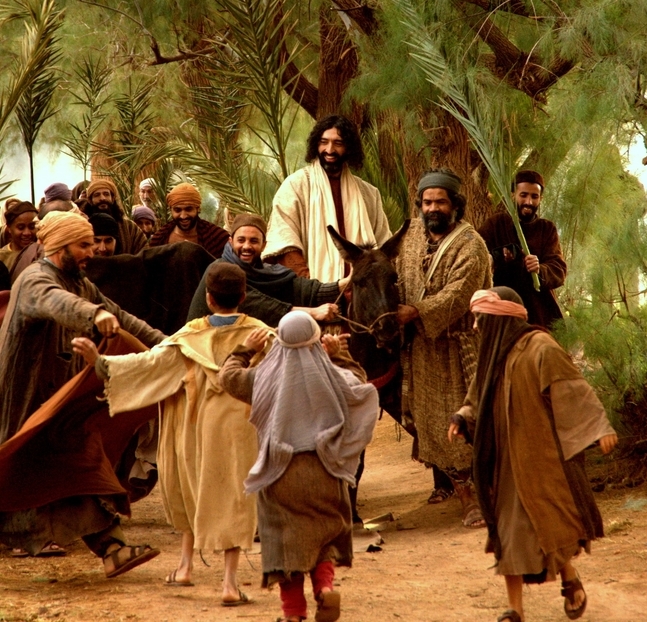
Joyful crowds give a royal welcome to Jesus as He makes His triumphal entrance into Jerusalem, days before His crucifixion. An image from the LUMO Project’s Gospel for the Visual Age. We read: “Most of the crowd spread their cloaks on the road, and others cut branches from the trees and spread them on the road. And the crowds that went before him and that followed him were shouting, ‘Hosanna to the Son of David! Blessed is he who comes in the name of the Lord! Hosanna in the highest!'” (Matthew 21:8-9). The cry “Blessed is he who comes in the name of the Lord!” is a quotation of part of Psalm 118:26.
Pointing to Jesus
This king is the ‘Messiah’―a Hebrew word meaning ‘anointed one’, who’ll save God’s people, defeat their enemies, and rule the world in righteousness and justice. This king is Jesus. The picture of the Messiah begins right back in Genesis 3:15. We learn more and more about Him as we journey through the Old Testament. Now the Psalms add to the picture. Jesus Himself tells us this. When He first appears to His disciples after His resurrection, He tells them: “. . . everything written about me in the Law of Moses and the Prophets and the Psalms must be fulfilled” (Luke 24:44). Here, “the Psalms” probably refers to the part of the Old Testament that the Jews called ‘The Writings’, of which the Book of Psalms is a key book. The Psalms point us to Jesus.
Many Psalms contain prophecies about Jesus. We’ve already looked briefly at four psalms (Psalms 2, 45, 72 and 110). Here are just a very few of the many other examples:
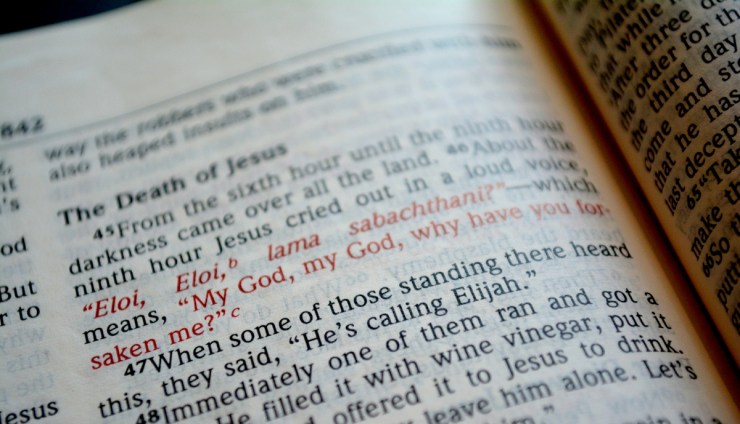
On the Cross, Jesus cried, “My God, my God, why have you forsaken me?” (Matthew 27:46). He was quoting Psalm 22:1.
► In Psalm 22, David feels beseiged by evildoers who mock and attack him. He writes, “they have pierced my hands and feet . . . they divide my garments among them, and for my clothing they cast lots” (22:16,18). We’re taken beyond David’s own distress to see Jesus on the Cross, His hands and feet pierced with nails, His clothing divided among rough Roman soldiers (see John 19:23-24,37). Jesus Himself quotes the first verse of this Psalm, “My God, my God, why have you forsaken me?” (Matthew 27:46).

David writes “they have pierced my hands and feet . . . .” (Psalm 22:16). We’re taken beyond David’s own distress to see Jesus on the Cross, His hands and feet pierced with nails.
►In Psalm 34:19-20, David writes that the Lord delivers the righteous out of their afflictions, “He keeps all his bones; not one of them is broken”. When Jesus is crucified, none of His bones are broken (John 19:31-33,36).
►In Psalm 118:22-23, we read, “The stone that the builders rejected has become the cornerstone. This is the LORD’s doing; it is marvellous in our eyes.” Jesus quotes this just days before His crucifixion (Matthew 21:42). Rejected by the Jewish leaders, He becomes the Cornerstone, the One whom God has “highly exalted” and given “the name that is above every name, so that at the name of Jesus every knee should bow” (Philippians 2:9).
Through King Jesus, God would fulfil His promise that “all the families of the earth shall be blessed” through Abraham (Genesis 12:3).
And through King Jesus, God would fulfil His promise that, through Abraham, “all the families of the earth shall be blessed” (Genesis 12:3). The wonderful little Psalm 117 points us to the fulfilment of that ancient promise. It begins “Praise the LORD, all nations! Extol him, all peoples!” We’re pointed forward to the time when “a great multitude . . . from every nation” will cry “Salvation belongs to our God who sits on the throne, and to the Lamb!” (Revelation 7:9-10).

The Psalmist writes, “Praise the LORD, all nations! Extol him, all peoples!” (Psalm 117:1). This points forward to the time when “a great multitude . . . from every nation” will cry “Salvation belongs to our God who sits on the throne, and to the Lamb!” (Revelation 7:9-10).
Next time . . .
We’ll explore the Bible’s ‘wisdom literature’―the Books of Job, Proverbs, Ecclesiastes, and the Song of Solomon. In these four books, God shows us how to think and to live wisely in this world. And, like the whole of the Old Testament, they point us to Jesus.
Bible Reading and Questions
You may like to read Psalm 139:1-16. Here are questions to think about:
?What does this marvellous passage tell us about God, and about ourselves? And how should it impact the way we live in this world, and the way we relate to God?
Video―the Hallelujah Chorus
On 13th November 2010, customers in a food court got a big surprise while enjoying their lunch. A hundred apparently ordinary customers turn out to be a full-voiced choir―a choral ‘flash-mob’―who proceed to fill the court with this awesome rendition of the famous Hallelujah Chorus from Handel’s oratorio Messiah. It’s unmissable!
Video―The Lord is My Shepherd
Here’s a short video, entitled The Lord Is My Shepherd: The Story of Psalm 23 (Psalm 23). It’s designed for children ages 6 to 12. But youth and adults may well enjoy it, too. These videos are in a series published by Crossway. They’re based on the book called The Biggest Story Bible Storybook. All the videos can be viewed at The Biggest Story videos website. You can also create a free account to enable you to download them.
Book―Psalms For You
Christopher Ash’s book Psalms for You is designed to help us understand and apply the psalms. He takes us through 15 pairs of psalms that represent various ‘types’ of psalm—including some that are very familiar and some that may well be unfamiliar. In doing so, he helps us to see how these psalms are fulfilled by Jesus and so point us to Him. Psalms for You is a clear and simple introduction to this marvellous treasury of praises, prayers and prophecies.
You can read the publisher’s description, which also provides a sample containing the first three devotionals HERE
REFERENCES [1] The contents of this part have been inspired by Treasuring the Psalms: How To Read The Songs That Shape The Soul Of The Church by Ian J. Vaillancourt. Published by InterVarsity Press, Downers Grove, Illinois, in 2023. [2] From How To Read The Psalms by Tremper Longman, page 51. Published by InterVarsity Press, Downers Grove, Illinois, in 1988.
CREDITS ► Text copyright © 2024 Robert Gordon Betts ► Unless otherwise indicated, all Scripture is taken from the ESV® Bible (The Holy Bible, English Standard Version®), copyright © 2001 by Crossway, a publishing ministry of Good News Publishers. Anglicized English Standard Version copyright © 2002 by Crossway. Used by permission. All rights reserved. The ESV text may not be quoted in any publication made available to the public by a Creative Commons license. The ESV may not be translated in whole or in part into any other language. ► Scripture quotations marked ‘NIV’ are taken from The Holy Bible, New International Version (Anglicised edition). Copyright © 1979, 1984, 2011 by Biblica (formerly International Bible Society). Used by permission of Hodder & Stoughton Publishers, an Hachette UK company. All rights reserved. ‘NIV’ is a registered trademark of Biblica (formerly International Bible Society). UK trademark number 1448790.
 52 Steps