
Part 26: Exile and Return
Click the icon below to download a 4-page PDF version of this page.

Carried away to Babylon
The glory days of King Solomon’s early reign are now a distant memory. His kingdom has been torn in two. The northern kingdom Israel is no more, swallowed up by the Assyrians. Godly King Josiah of Judah is dead; four successive kings of Judah do what is “evil in the sight of the LORD” (2 Kings 23:32,37, 24:9,19). How will God’s people―the descendants of Abraham―ever become a blessing to this world?
From the beginning, God told His people that continuing in disobedience to Him means exile from His Promised Land (Deuteronomy 28:63-68, Leviticus 26:33-39). Yet our gracious God continues to plead with His people to return to Him: “The LORD . . . sent persistently to them by his messengers, because he had compassion on his people and on his dwelling place. But they kept . . . despising his words and scoffing at his prophets, until the wrath of the LORD rose against his people, until there was no remedy.” (2 Chronicles 36:15-16).
Around this time, the Babylonians replace the Assyrians as the Near Eastern superpower. They’re now the tool in God’s hand to bring His judgment on Judah. God brings Nebuchadnezzar, King of Babylon, to conquer Judah and deport most of its people to Babylonia. It’s a long drawn-out process, told in several passages (2 Kings 23:36-25:21, 2 Chronicles 36:5-21, Jeremiah 37:1-39:10, 52:1-30, and Daniel 1:1-7).

Nebuchadnezzar: image © John Heseltine 2015 and © Pam Masco 2015. Image courtesy of FreeBible Images (CC BY NC ND 4.0)
An artist imagines what King Nebuchadnezzar of Babylon might have looked like.
Around 605BC, Nebuchadnezzar makes the king of Judah his puppet king, and takes some of the Temple vessels. Sometime after this, he deports a small group of people―good-looking, gifted young men from the royal family and the nobility, with potential to serve in the Babylonian royal court (Daniel 1:3-4). They include the prophet Daniel. In 597BC Nebuchadnezzar captures Jerusalem and plunders all the treasures from the Temple and the royal palace. He deports 10,000 more Judeans, including government personnel, warriors and craftsmen. This group includes the prophet Ezekiel. The greatest blow comes around 586BC: the Babylonians destroy Jerusalem and Solomon’s beautiful Temple, and deport more Judeans. Four years later, a final group are taken captive. Some people are left in Judah, but they’re mostly the poor. Adam and Eve were sent eastwards from God’s garden paradise. Now God’s people are marched eastward out of their paradise, the Promised Land.
Adam and Eve were sent eastwards from God’s garden paradise. Now God’s people are marched eastward out of their paradise, the Promised Land.

Image courtesy of The Jewish Museum, New York.
The Flight of the Prisoners painted by James Jacques Joseph Tissot and followers. The artist imagines the scene as captive Jews are marched away from the burning city of Jerusalem.
Blessing in Babylon
Jerusalem is ruined. The Temple is destroyed. God’s people are in exile. There’s no king of David’s dynasty on the throne. All the hopes that had blossomed with Solomon’s reign are now withered and dead. The writer of the Book of Lamentations weeps bitter tears over the plight of God’s people.
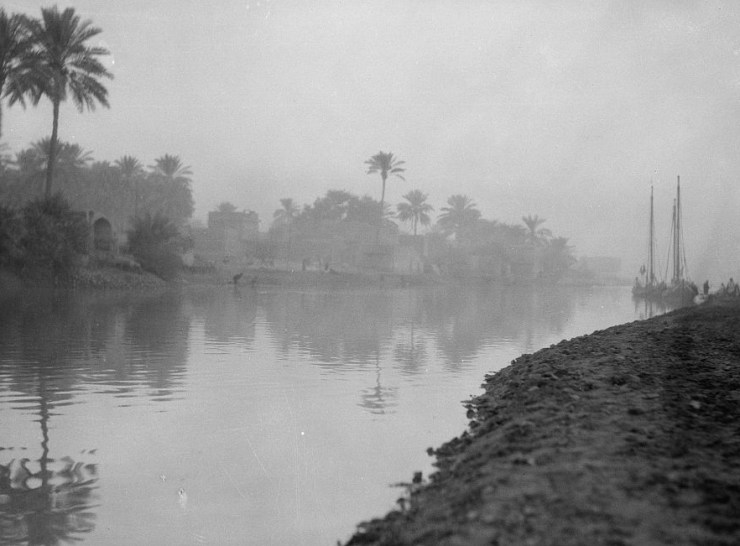
Image from The Library of Congress Prints & Photographs Online Catalog
An early photograph, taken in 1932, of the Euphrates at Hilla, a town close to the ancient city of Babylon. The kind of scene the captive in Babylon would have been familiar with. By these waters they wept, homesick for Zion (Jerusalem): “By the waters of Babylon, there we sat down and wept, when we remembered Zion” (Psalm 137:1).
But God still speaks to His people. Jeremiah prophesies to them: “Thus says the LORD of hosts, the God of Israel, to all the exiles whom I have sent . . . from Jerusalem to Babylon: Build houses and live in them; plant gardens and eat their produce. Take wives and have sons and daughters; . . . multiply there, . . . . But seek the welfare of the city where I have sent you into exile, and pray to the LORD on its behalf, for in its welfare you will find your welfare.” (Jeremiah 29:4–7).
And God’s people do prosper in exile. Jews (Judeans) become part of Babylonian society, and contribute to the Babylonian economy.[1] They’re to seek the welfare of Babylon. And they’re to pray for it. God promised Abraham “in you all the families of the earth shall be blessed” (Genesis 12:3). Babylon is now their mission field;[2] they’re to be a blessing to that city. In fact, the Bible tells us that Jews are promoted to positions of leadership in exile. Daniel is given high office by the kings Nebuchadnezzar, Belshazzar and Darius. Daniel’s three friends, Shadrach, Meshach and Abednego are also given leading positions. In later years, too, Mordecai is described as being “great” in the palace of the Persian king Xerxes I, also called Ahasuerus (Esther 9:4). And Nehemiah is cupbearer to Xerxes’ son, King Artaxerxes I.
God promised Abraham “in you all the families of the earth shall be blessed” (Genesis 12:3). Babylon is now their mission field; they’re to be a blessing to that city.
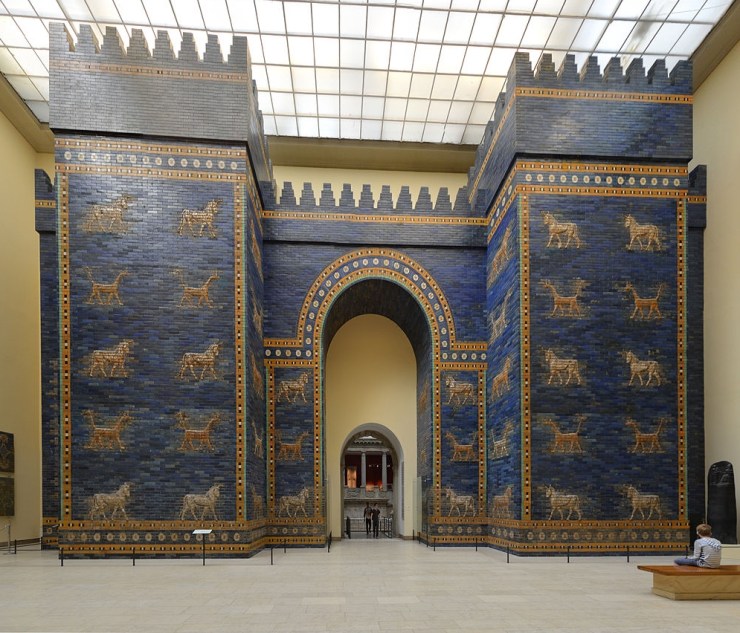
The Ishtar Gate in the Pergamon Museum in Berlin © Radomir Vrbovsky at Wikimedia Commons (CC BY-SA 4.0)
A reconstruction of the Ishtar Gate, one of the gateways into the ancient city of Babylon. Built about 12 years after the destruction of Jerusalem, many of the captive Jews would have seen and even passed through this gate. This is the front gate of what was originally a double gate; it’s more than 38 feet (12 metres) high. This reconstruction incorporates original bricks alongside replacements.
But it’s not all plain sailing. In the days of King Nebuchadnezzar, some Babylonians, out of malice, accuse Daniel’s friends, Shadrach, Meshach and Abednego, and they’re thrown into a fiery furnace. Daniel himself refuses to pray to the king, and is thrown into a den of lions. A century or so later, God uses a Jewish girl called Esther, who’s become queen of Persia, and her relative Mordecai, to thwart a plot to destroy the Jews.
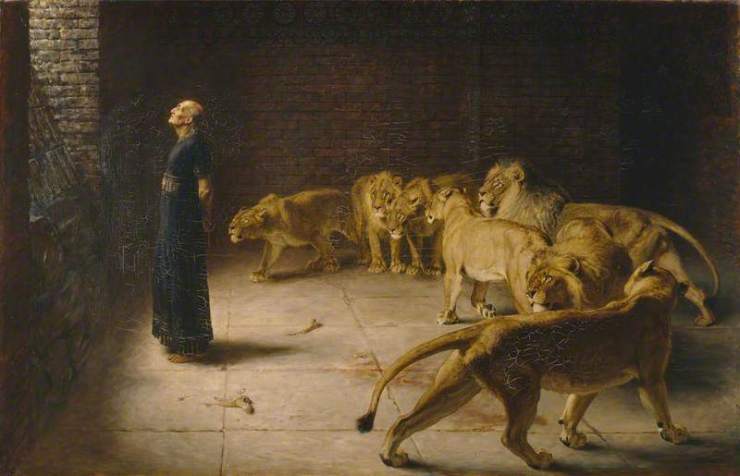
Daniel’s Answer to the King © Manchester Art Gallery (CC BY-NC-ND)
Daniel’s Answer to the King painted by Briton Riviere. The artist imagines the elderly Daniel in the den of lions, which pace around but which God restrains from attacking him.
The promise of coming home
But the exile won’t be for ever. God’s people are going to come home! Jeremiah writes to the exiles: “For thus says the LORD: When seventy years are completed for Babylon, . . . I will fulfil to you my promise and bring you back to this place. For I know the plans I have for you, . . . to give you a future and a hope. Then you will . . . come and pray to me, and I will hear you. You will seek me and find me, when you seek me with all your heart. . . . I will . . . gather you from all the nations . . . and I will bring you back to the place from which I sent you into exile.” (Jeremiah 29:10-14).
One day Babylonia will fall. God is going to bring His people back to the Promised Land.
God has His hand firmly on the events of history. He alone causes empires to rise and fall. Proud Babylonia was a tool in God’s hand to chasten and discipline His people. One day Babylonia will fall (Jeremiah 25:11 14, 50:1-51:64), just as God crushed Assyria after they’d fulfilled His judgment on the northern kingdom Israel (Isaiah 10:5-19). God is going to bring His people back to the Promised Land.
In 539BC the Persians capture Babylon. The Persian Empire is now the superpower of the Near East. Daniel knows, from what Jeremiah prophesied (Jeremiah 25:11-12, 29:10), that the exile is coming to an end. So he prays. He confesses Israel and Judah’s sins, and asks God to forgive and restore His people.
God responds by sending the angel Gabriel to him. This is the same angel who, centuries later, will bring news of Jesus’s birth! So, as you can imagine, he’s got some really important things to say. They’re recorded in Daniel 9:24-27. This is a key Old Testament prophecy. Gabriel assures Daniel that Jerusalem will be rebuilt. But he also shows this prayer warrior a prophetic panorama of world history―as we’ll see in a later part.
God answers Daniel’s prayers. “The LORD stirred up the spirit of Cyrus king of Persia” to issue a decree encouraging the Jews to return to their homeland. He proclaims: “The LORD, the God of heaven, . . . has charged me to build him a house at Jerusalem . . . . Whoever is among you of all his people, may his God be with him, and let him go up to Jerusalem, . . . and rebuild the house of the LORD, the God of Israel . . . .” (Ezra 1:1-3, see 2 Chronicles 36:22-23). The prophet Isaiah had foretold this more than 150 years earlier! He’d prophesied: “Thus says the LORD, your Redeemer, . . . “I am the LORD, . . . who says of Jerusalem, ‘She shall be inhabited,’ and of the cities of Judah, ‘They shall be built, and I will raise up their ruins’; . . . who says of Cyrus, ‘He is my shepherd, and he shall fulfill all my purpose’; saying of Jerusalem, ‘She shall be built,’ and of the temple, ‘Your foundation shall be laid.’”” (Isaiah 44:24-28). And Isaiah wrote that Cyrus “shall build my city and set my exiles free” (45:13).

Image © The Trustees of the British Museum. Shared under aCC BY-NC-SA 4.0 licence)
The Cylinder of Cyrus, a clay cylinder (inscribed with cuneiform script) describing Babylon’s conquest by the Persian king Cyrus in 539 BC. In it, Cyrus claims to have restored the temples and religious cults of people of neighbouring countries, and to have repatriated their gods and people. It’s clear evidence for what we read in Ezra 1:2-3 and Isaiah 44:24-28.
Rebuilding the Temple and the nation
Many Jews respond to Cyrus’s decree. They make the long journey back to Judah in at least two groups over a period of some years. They settle the land, and rebuild the altar of the Temple. Then they begin to rebuild the Temple. Satan hates God’s house being built, and opposition brings work to a halt. But after some years, work resumes, encouraged by the prophets Haggai and Zechariah. The people complete the Temple around 516BC, about 70 years after its destruction.

Image © David P. Barrett of BibleMapper.com and made available by FreeBibleimages.com (CC BY-NC 4.0)
Map showing the routes of two groups of returning exiles, the first led in 539BC by Zerubbabel, and the second in around 458BC by Ezra. It also shows Nehemiah’s route in around 445BC.
After the Temple is completed, king Artaxerxes I sends two key people back to Judea.
► He sends Ezra in around 458BC. One of his key goals is to teach God’s Law to Israel. We read: “For Ezra had set his heart to study the Law of the LORD, and to do it and to teach his statutes and rules in Israel” (Ezra 7:10). In this, Ezra succeeds brilliantly. He establishes God’s Law as the basis for the nation’s life.[3]
►In around 445BC, Artaxerxes sends Nehemiah. His key task is to oversee the rebuilding of Jerusalem’s walls. But―as with the rebuilding of the Temple―there’s opposition. Enemies try to discourage the people and interfere with the work. But the walls are complete in 52 days!

Image © BiblePlaces.com
This is part of Jerusalem’s ancient city wall. The vertical section of stonework to the right has been identified as part of the wall built under Nehemiah’s oversight. The sloping stonework is a retaining wall of earlier date.
“Behold, I am doing a new thing”
But the nation remains a pale shadow of what it was in Solomon’s day. When the new Temple’s foundations are laid, the old men who’ve seen Solomon’s Temple in all its glory weep with disappointment (Ezra 3:10-13, compare Haggai 2:3). It seems that the new Temple is, compared to Solomon’s magnificent building, “drab and utilitarian”[4]. The Ark of the Covenant, with its mercy seat, is missing, never to return. The Bible doesn’t record God filling the new Temple with His presence, as He did in the Tabernacle and Solomon’s Temple. Judah is still under Persian control. And there’s no Davidic king on the throne.
The nation remains a pale shadow of what it was in Solomon’s day. But this isn’t the end of the story. God’s prophets reveal a glorious future for God’s people.
And the people still backslide into sin (see, for example, Nehemiah 13:15-18, Malachi 2:10-12). It was their wilful, persistent sin that had cost them the land. Yet they don’t seem to have learned their lesson. But God’s prophets tell His people that this isn’t the end of the story. They reveal a glorious future for God’s people, as we’ll see in Part 28.
Next time
We’ll explore the Book of Psalms―a treasury of Spirit-inspired prayers and praises and prophecies. It was the song book and prayer book of Jesus and His disciples. It’s our song book and prayer book. And the Book of Psalms plays a key role in the Bible story. It takes us from King David to the final King of David’s dynasty, Jesus the Messiah.
Bible Reading and Questions
You may like to read Jeremiah 29:1-14. Here are questions to think about:
?What does this marvellous passage tell us about God? And how is what it tells us about God an encouragement to you personally, and to all God’s people corporately?
Videos
Here are two short videos, entitled Promises Broken and Promises Kept: The Story of the Babylonian Exile (2 Chronicles 36) and Walls and Worship: The Story of Nehemiah (Nehemiah 6-8). They’re designed for children ages 6 to 12. But they’re so good, youth and adults may well enjoy them, too. These videos are in a series published by Crossway. They’re based on the book called The Biggest Story Bible Storybook. All the videos can be viewed at The Biggest Story videos website. You can also create a free account to enable you to download them.
Book

In Part 28, we’ll be exploring the wisdom books of the Old Testament―Job, Proverbs, Song of Solomon, and Ecclesiastes. A great place to start with the Book of Ecclesiastes is David Gibson’s beautifully-written and insightful book Living Life Backwards: How Ecclesiastes Teaches Us to Live in Light of the End. What should our expectations of life be? What should our priorities be? We need wisdom to grapple with these questions. A key to such wisdom is to consider the end of our lives―death―and let this show us how to live here and now. In other words, it means living life backwards. David Gibson wrote this book to shake up our expectations and priorities for what it means to live ‘the good life’. Considering the reality of death helps us pay attention to our limitations as human beings and receive life as a wonderful gift from God—freeing us to live wisely, generously, and faithfully for God’s glory and the good of His world.
Read the publisher’s description HERE. Download an excerpt HERE.
REFERENCES [1] See The Progress of Redemption, by Willem A. VanGemeren page 297. Published by Paternoster Press, Carlisle, U.K., in 1995. [2] See ESV Expository Commentary, Volume VI: Isaiah-Ezekiel edited by Iain M. Duguid, James M. Hamilton Jr., and Jay Sklar. Published by Crossway, Wheaton, Illinois, in 2022. [3] H.G.M. Williamson, Ezra and Nehemiah, page xlvii. Published by Word, Incorporated, Waco, Texas, in 1996. [4] Quoted from The Minor Prophets: An Exegetical and Expository Commentary edited by Thomas Edward McComisky, page 987. Published by Baker Academic, Grand Rapids, Michigan, in 2009.
CREDITS ► Text copyright © 2024 Robert Gordon Betts ► Unless otherwise indicated, all Scripture is taken from the ESV® Bible (The Holy Bible, English Standard Version®), copyright © 2001 by Crossway, a publishing ministry of Good News Publishers. Anglicized English Standard Version copyright © 2002 by Crossway. Used by permission. All rights reserved. The ESV text may not be quoted in any publication made available to the public by a Creative Commons license. The ESV may not be translated in whole or in part into any other language.
 52 Steps
