
Part 25: Downfall and Division
Click the icon below to download a 4-page PDF version of this page.

Solomon’s sin
King Solomon is on the throne, and God’s people prosper as never before. We read, “King Solomon excelled all the kings of the earth in riches and in wisdom. And the whole earth sought the presence of Solomon to hear his wisdom, which God had put into his mind.” (1 Kings 10:23-24). God dwells in the magnificent Temple Solomon has built; Israel is poised to become a blessing to the nations.
God had told His people what their kings should be like (Deuteronomy 17:14-20). The king was to write a copy of God’s Law and “it shall be with him, and he shall read in it all the days of his life, that he may learn to fear the Lord his God by keeping all the words of this law . . . , and doing them, . . . .”. Israel’s kings weren’t to acquire lots of horses (used primarily to give military power). And they weren’t to have many wives, or gather great stores of silver and gold. Power, women and wealth―these are the sources of greatest temptation for a man, especially rich and powerful men like Solomon. He falls for every one.
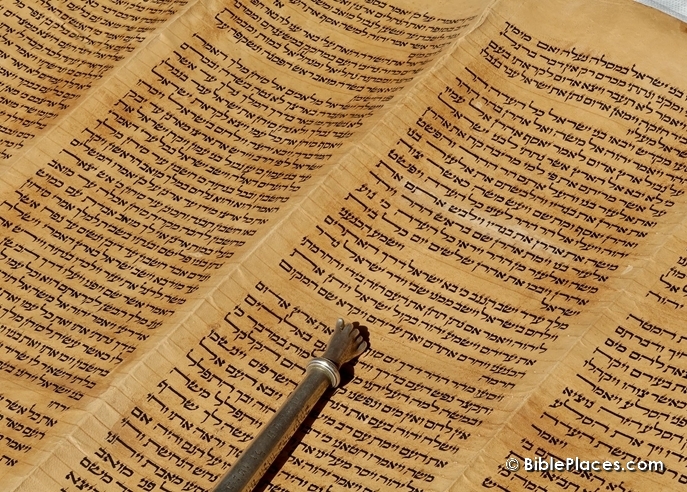
Image © BiblePlaces.com
A scroll of the ‘Torah’ (the Hebrew name for the first five books of the Old Testament). The king was to write a copy of God’s Law and read it “all the days of his life” (Deuteronomy 17:18). And he was to obey God’s Law.
God has given Solomon great wealth (1 Kings 3:13). Stupendous riches come his way (1 Kings 10:14-21). But, sadly, he lets his wealth lead him astray. He gathers chariots and horsemen until he has “1,400 chariots and 12,000 horsemen” (1 Kings 10:26). And he loves “many foreign women, along with the daughter of Pharaoh . . . from the nations concerning which the Lord had said to the people of Israel, ‘You shall not enter into marriage with them, . . . for surely they will turn away your heart after their gods’” (1 Kings 11:1-2). He has 700 wives and 300 concubines! When he’s old, his wives do indeed turn his heart away from the Lord towards pagan gods, and his heart isn’t “wholly true to the Lord his God, as was the heart of David his father” (1 Kings 11:4). God had given him unsurpassed wisdom. But his wisdom becomes dulled by disobedience to God.
Power, women and wealth―the sources of greatest temptation for a man, especially rich, powerful men like Solomon. He falls for every one.
Israel torn in two
And so, because of Solomon’s disobedience, the Lord resolves to tear the kingdom of Israel in two after his death (1 Kings 11:9-13,26-40). And the Lord raises up enemies against Solomon. One of these is Jeroboam, who’s served as a foreman under Solomon. It’s through him that God divides the kingdom.
After Solomon dies, his son Rehoboam goes to Shechem to be made king. Jeroboam and the people come to him and say, “Your father made our yoke heavy. Now therefore lighten the hard service of your father and his heavy yoke on us, and we will serve you.” (1 Kings 12:4). But Rehoboam chooses to make their burden even heavier (12:6-15). This is the trigger for rebellion. Ten tribes, under Jeroboam’s leadership, revolt against Rehoboam and set up their own kingdom (12:16-24). This happens around 930BC.
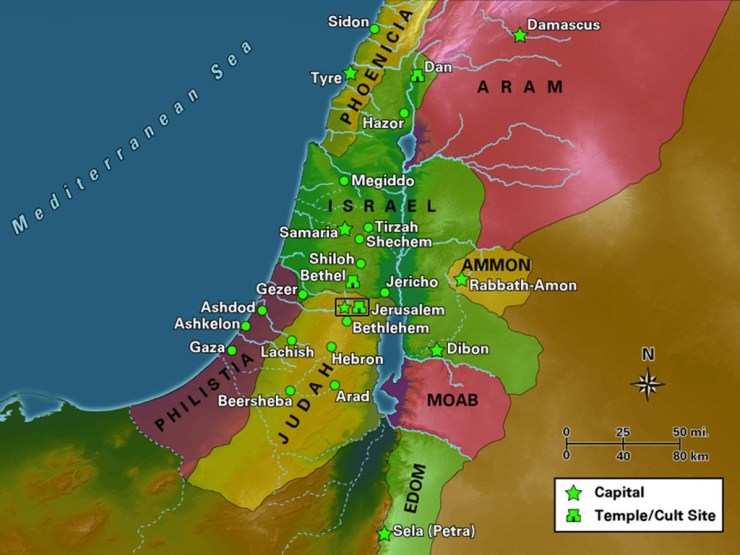
Image created by A.D. Riddle of Riddle Maps and © 2015 Society of Biblical Literature, and made available by (CC BY-NC-ND 3.0)
Map showing the divided kingdom of Israel and Judah, and the surrounding nations.
Jeroboam’s kingdom takes the name Israel. Its capital is Shechem at first, later it’s Samaria. Rehoboam’s kingdom is called Judah, and his capital is Jerusalem. His kingdom comprises the tribes of Judah and Benjamin, as well as many priests and Levites and some members of other tribes, too.
Israel’s idolatry and destruction
To discourage people from straying outside his kingdom to worship God at Jerusalem, Jeroboam sets up golden calves for them to worship at Dan and Bethel (1 Kings 12:26-33). Israel descends into gross idolatry.
The northern kingdom has no godly kings; king after king follows Jeroboam’s evil ways. One of these, Ahab, is worse than any king of Israel before him (1 Kings 16:30-33). He sets up a temple for Baal in Samaria, and marries Jezebel, an evil woman from Sidon. It’s as if the conquest is being reversed; the kingdom of Israel is becoming like Canaan.
The northern kingdom, Israel, descends into gross idolatry. King after king follows Jeroboam’s evil ways.
But God doesn’t leave Himself without witness in these dark days. He sends His prophets. Our gracious God still speaks to His people. Two of these prophets are Elijah and Elisha. The high point of Elijah’s ministry comes when God demonstrates His supremacy over Baal by sending fire on Elijah’s sacrifice; Elijah then slaughters 450 prophets of Baal (1 Kings 18:17-40).
God doesn’t leave Himself without witness in these dark days. He sends His prophets.
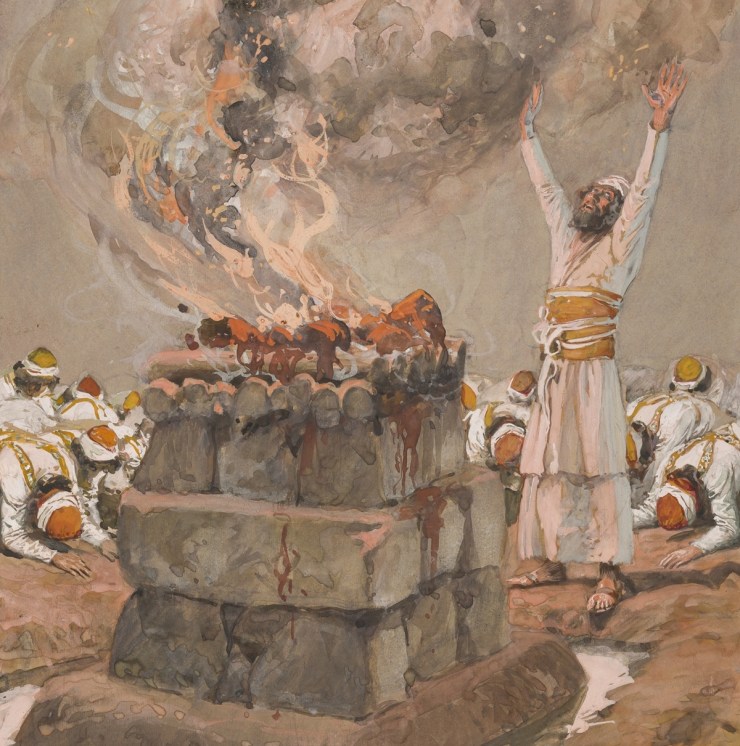
Image courtesy of The Jewish Museum, New York.
Fire from Heaven Consumes the Sacrifice painted by James Jacques Joseph Tissot. In 1 Kings 18:20-40 we read that Elijah gathers 450 prophets of the false god Baal at Mount Carmel. He sets a contest involving two sacrifices. One is offered to Baal by his prophets; Elijah offers another to the Lord. The Lord alone is able to send fire: this painting captures the scene when “the fire of the LORD fell and consumed the burnt offering” (1 Kings 18:39).
Elisha is his successor. He anoints Jehu king of Israel, who destroys Ahab’s dynasty, slays his wicked wife Jezebel, and slaughters the Baal worshippers (2 Kings 9:1-10:28). But Jehu doesn’t remove Jeroboam’s golden calves. And he doesn’t obey God with all his heart.
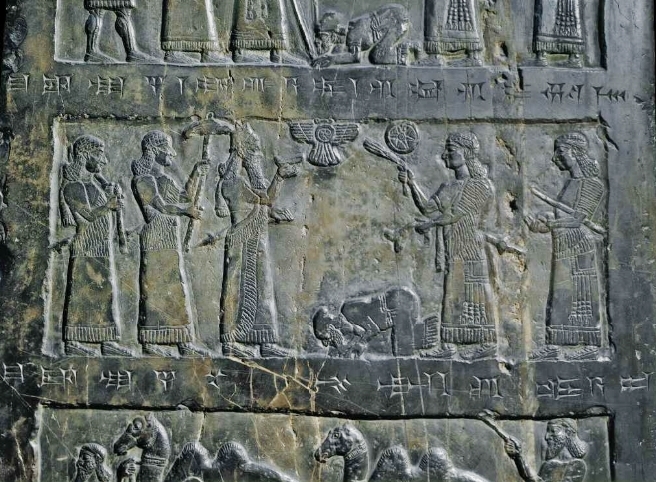
Image © The Trustees of the British Museum (CC BY-NC-SA 4.0)
A scene on the black obelisk (a four-sided pillar) depicting King Jehu of Israel kneeling before the Assyrian king, and offering him tribute, in 841BC. Jehu was attempting to stop the Assyrians attacking Israel. Although this incident isn’t recorded in the Bible, this obelisk gives us a fascinating archaeological insight into one of Israel’s kings.
God sends other prophets―Amos and Hosea―to speak to the northern kingdom, too. But Israel’s wickedness and idolatry continue (2 Kings 17:7-17). So God brings His judgment on them in the form of the barbaric Assyrians, whose empire is to the north and east of Israel. Israel as an independent nation is finally extinguished at the siege of Samaria in 722BC. The Assyrians deport many Israelites into other parts of their empire. And they resettle people from other regions in the cities of the northern kingdom, displacing the Israelites. Israel becomes just another part of the Assyrian Empire.
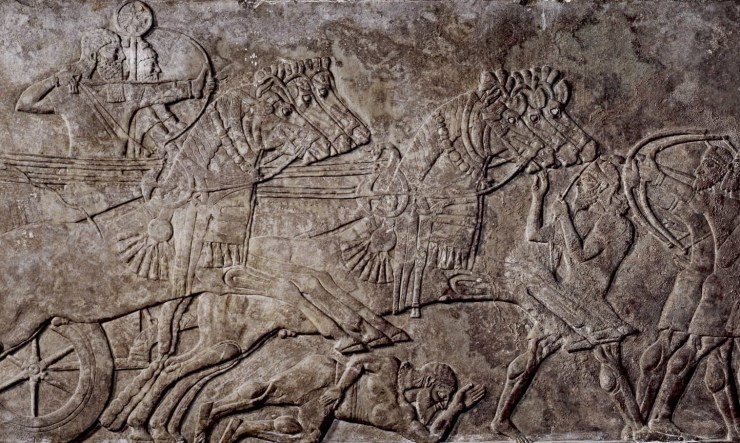
Image © The Trustees of the British Museum (CC BY-NC-SA 4.0)
A wall panel showing Assyian chariots charging into battle. It’s dated to the time of Elijah. About 130 years later, the Assyrians overran the northern kingdom of Israel.
Judah’s journey to judgment
Unlike the northern kingdom Israel, Judah has some good kings. But there are bad kings, too, and time and time again the nation falls into idolatry. But despite their sin, God keeps His promise to preserve David’s dynasty. Except for one brief interlude, David’s dynasty rules throughout Judah’s history. God speaks to Judah, too, through His prophets, such as Isaiah and Micah.
Unlike the northern kingdom Israel, Judah has some good kings. But there are bad kings, too, and time and time again the nation falls into idolatry.
The two best kings of Judah are Hezekiah and Josiah. Hezekiah becomes king a few years after the fall of the northern kingdom. He purges Judah from idolatry, cleanses the Temple, restores the worship of God and keeps a Passover. His story is told in 2 Kings 18:1-20:21, 2 Chronicles 29:1-32:33, and Isaiah 36:1-39:8.
In Hezekiah’s 14th year, Sennacherib, king of Assyria, invades Judah. He captures the fortified cities of Judah and threatens Jerusalem itself. But Hezekiah trusts God and prays. God assures him that He’ll save Jerusalem. The angel of the Lord slays 185,000 Assyrian troops overnight! Sennacherib never takes Jerusalem.
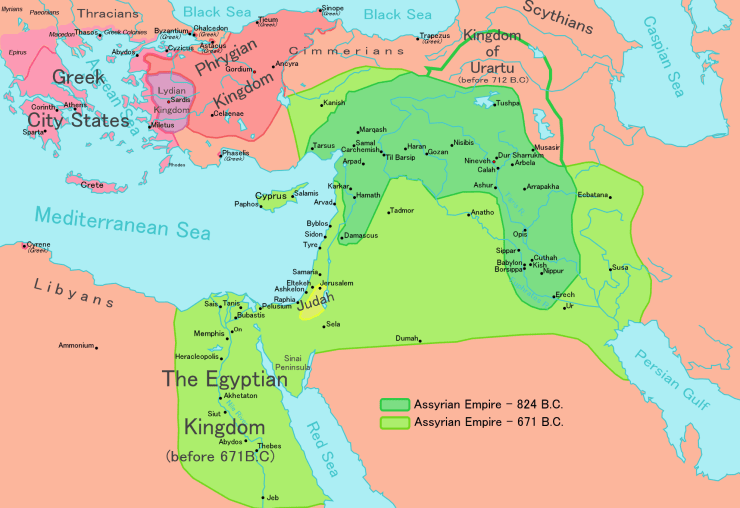
Image from Wikimedia Commons
Map of the Assrian Empire. The darker green area shows its extent in 824BC, during the ministry of the prophet Elisha. The lighter green area is its extent in 671, during the reign of King Manasseh of Judah.
But, later on, Hezekiah entertains a delegation from the king of Babylon. Foolishly, he shows them “all his treasure house, . . . all that was found in his storehouses. There was nothing in his house or in all his realm that Hezekiah did not show them.” (2 Kings 20:13). So Isaiah tells him that one day the Babylonians will capture Jerusalem.
And everything Hezekiah has done to restore the nation is undone by his son, King Manasseh. Like King Ahab of the northern kingdom, Manasseh does terrible evil. He even sets up pagan altars and images of Asherah (a Canaanite goddess) in God’s Temple.
Judah has become a Canaan again. Israel has long since fallen to the Assyrians; now the Assyrians come for Judah. They seize Manasseh and take him to Babylon, controlled at this time by Assyria. It’s a foretaste of what’s to come.
But, exiled and distressed, Manasseh repents. God enables him to return to Judah, and he cleanses Judah of idolatry―though, it seems, not completely. But Manasseh’s grandson Josiah rids the land of idolatry, repairs the Temple and restores the worship of God. He orders the newly-rediscovered Book of the Law to be read to all the people. The nation renews their covenant with God, and celebrates a great Passover. Josiah’s story is told in 2 Kings 22:1-23:30 and 2 Chronicles 34:1-35:27. We’re told that before and after Josiah “there was no king like him, who turned to the LORD with all his heart and with all his soul and with all his might, according to all the Law of Moses” (2 Kings 23:25).
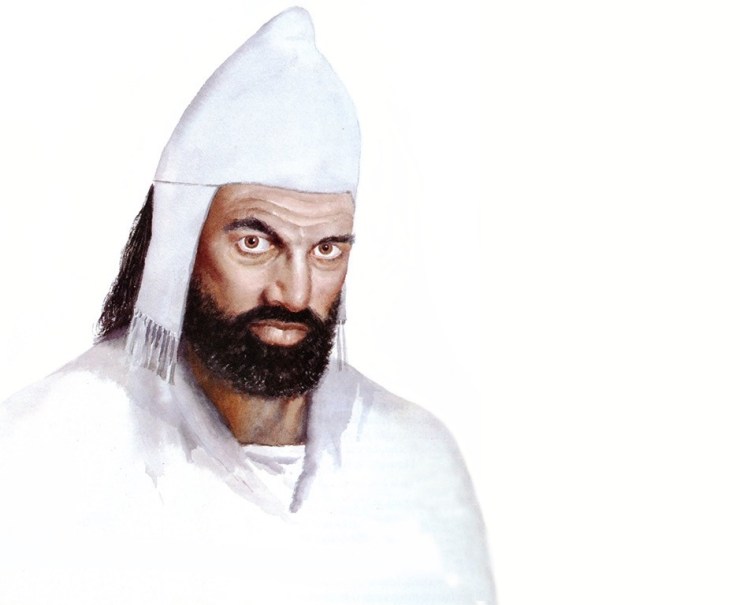
Josiah: image © John Heseltine 2015 and © Pam Masco 2015. Image courtesy of FreeBible Images (CC BY NC ND 4.0)
An artist imagines what Josiah might have looked like.
But even with King Josiah’s reforms, “the LORD did not turn from the burning of his great wrath, by which his anger was kindled against Judah, because of all the provocations with which Manasseh had provoked him. And the LORD said, ‘I will remove Judah also out of my sight, as I have removed Israel, and I will cast off this city that I have chosen, Jerusalem, and the house of which I said, My name shall be there.'” (2 Kings 23:26-27). Judah is beyond the point of no return.
Time and again, God’s people break His heart. Israel is His beloved “firstborn son”, but they rebel against Him. Israel is His cherished bride, but she forsakes her Husband.
Two verses later, we see Josiah killed in battle. This godly king is dead; his son, who succeeds him, does what is “evil in the sight of the Lord” (2 Kings 23:32). Once more, an evil king rules the nation.
Time and again, God’s people break His heart. Israel is His beloved “firstborn son” (Exodus 4:22), but they rebel against Him (Isaiah 1:2-4). Israel is His cherished bride, but she forsakes her Husband: the people worship pagan idols and, instead of staying loyal to God and trusting Him alone, Israel allies herself to the world powers of her day. She “played the whore” (Ezekiel 16:26,28) with the Egyptians and the Assyrians, and “multiplied [her] whoring” (Ezekiel 16:29) with Babylonia. God’s Law demanded execution for rebellious sons (Deuteronomy 21:18-21) and for adulterous women (Leviticus 20:10, Deuteronomy 22:22). What was God to do with His people?
In the next part . . .
Over hundreds of years, God faithfully sends prophets to rebuke and warn His people. Even before they entered the Promised Land, He’d told them that sin means exile (Deuteronomy 28:63-68, Leviticus 26:33-39). The northern kingdom of Israel is now just part of the Assyrian empire. Judah has gone beyond the point of no return; God’s judgment will come. What will happen to Judah? We’ll see next time.
Bible Readings and Question
You may like to read 2 Kings 17:7-23 and Jeremiah 17:1-4; and then read Jeremiah 31:31-34 and Ezekiel 36:22-27. Here’s a question to think about:
? Time and again, we’ve seen God’s people rebel against him and sink into terrible sin. From these four passages, what do you think needs to happen to them in order to break this cycle of sin?
Book
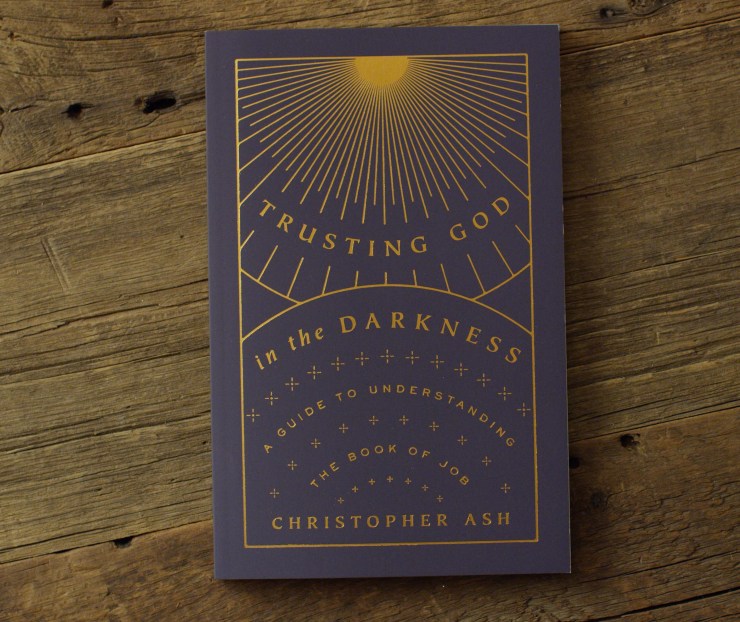
In a couple of weeks’ time, we’ll be exploring the poetic and wisdom books of the Old Testament―Job, Psalms, Proverbs, Song of Solomon, and Ecclesiastes. So this week and the next two weeks, we’ll be recommending some books on this part of the Bible. A great place to start is Christopher Ash’s book on Job, Trusting God in the Darkness. We’ll discover that the Book of Job is about God, and how He relates to His faithful people in their suffering. It demonstrates what it really means for us to “walk by faith, not by sight” (2 Corinthians 5:7). And it foreshadows the sufferings of our Saviour, Jesus Christ. The Book of Job is a treasure. Dr Ash guides us through it simply, clearly, and with pastoral wisdom.
Read the publisher’s description HERE. Download an excerpt HERE. There’s also an earlier British edition of this book published by Inter-Varsity Press (IVP), entitled Out of the Storm. The publisher’s page for Out of the Storm is HERE.
Videos
Here are three short videos, entitled The Wise and Foolish King: The Story of King Solomon (1 Kings 3; 11), The Kingdom Cracks: The Story of Rehoboam (1 Kings 12), and The Boy Who Sought the Lord: The Story of Josiah (2 Chronicles 34). They’re designed for children ages 6 to 12. But they’re so good, youth and adults may well enjoy them, too. These videos are in a series published by Crossway. They’re based on the book called The Biggest Story Bible Storybook. All the videos can be viewed at The Biggest Story videos website. You can also create a free account to enable you to download them.
CREDITS ► Text copyright © 2024 Robert Gordon Betts ► All Scripture is taken from the ESV® Bible (The Holy Bible, English Standard Version®), copyright © 2001 by Crossway, a publishing ministry of Good News Publishers. Anglicized English Standard Version copyright © 2002 by Crossway. Used by permission. All rights reserved. The ESV text may not be quoted in any publication made available to the public by a Creative Commons license. The ESV may not be translated in whole or in part into any other language.
 52 Steps
