
Part 23: A Tale of Two Kings
Click the icon below to download a 4-page PDF version of this page.

Revival under Samuel
We saw last time how Israel fails to drive out all the Canaanites and falls into a downward spiral of idolatry. God graciously gives them leaders, called judges, to deliver them from their enemies. But every time they return to idolatry. The Promised Land becomes a place of appalling depravity.
But God is still at work. Faithful Ruth gives birth to Obed, grandfather of Israel’s great king, David (Ruth 4:13-17). And Samuel is born―the last judge, and a prophet. Samuel’s birth marks a new phase in Israel’s history. He’s a Levite boy, and serves under Eli the priest at God’s Tabernacle in Shiloh. We read, “Samuel grew, and the LORD was with him and let none of his words fall to the ground. And all Israel from Dan to Beersheba knew that Samuel was established as a prophet of the LORD.” (1 Samuel 3:19-20).
But Eli is weak and his sons are corrupt priests. God’s sanctuary has become a place of immorality and greed. The Philistines―who’ve settled in the southern coastal region of the Promised Land―capture the Ark of the Covenant. God plagues them and they send the Ark back.
Twenty years pass. During those years, there’s a stirring in the hearts of God’s people. We read, “all the house of Israel lamented after the LORD” (1 Samuel 7:2). They put away their idols, and Samuel leads them in an act of reconsecration to God. The Philistines advance to attack Israel again. But God “thundered . . . against the Philistines and threw them into confusion, and they were routed before Israel” (1 Samuel 7:10). Israel turns to God, and God gives them victory.
Israel turns to God, and God gives them victory.
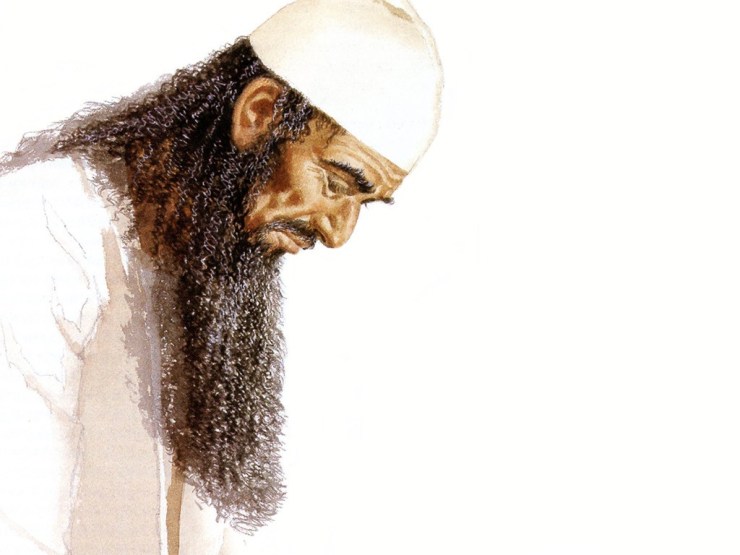
Samuel: image © John Heseltine 2015 and © Pam Masco 2015. Image courtesy of FreeBible Images (CC BY NC ND 4.0)
An artist imagines what Samuel might have looked like.
A king “like all the nations”
When Samuel grows old, he makes his sons judges over Israel. But they’re unfit for office. So the elders of Israel demand “a king . . . that we also may be like all the nations, and that our king may judge us and . . . fight our battles” (1 Samuel 8:5).
But in asking for a king “like all the nations”, God says they’ve rejected Him. All along, God is planning to give them a king (see Genesis 49:10). So why is He displeased? It’s because the whole point about Israel is that they’re not to be like other nations. They’re to be “distinct . . . from every other people” (Exodus 33:16), God’s “treasured possession among all peoples”, “a kingdom of priests and a holy nation” (Exodus 19:5-6). God is to be their Lord. The king God wanted would lead them in obeying Him, a king who’d rely on Him to defeat their enemies, a king like the one described in Deuteronomy 17:14-20.
God gives Israel what they want. But Samuel warns them, “These will be the ways of the king who will reign over you: he will take your sons and appoint them to his chariots and to be his horsemen . . . . He will take your daughters to be perfumers and cooks and bakers. He will take the best of your fields and vineyards and olive orchards. . . . you shall be his slaves.” (1 Samuel 8:10-18). God’s people will end up as slaves, just like they’d been in Egypt!
So God gives His people a king―tall, handsome Saul. He rules well at first. But he proves to be disobedient and foolish. He’s a rebel against God, and that’s as bad as fortune-telling and idolatry (1 Samuel 15:23). So God rejects him.
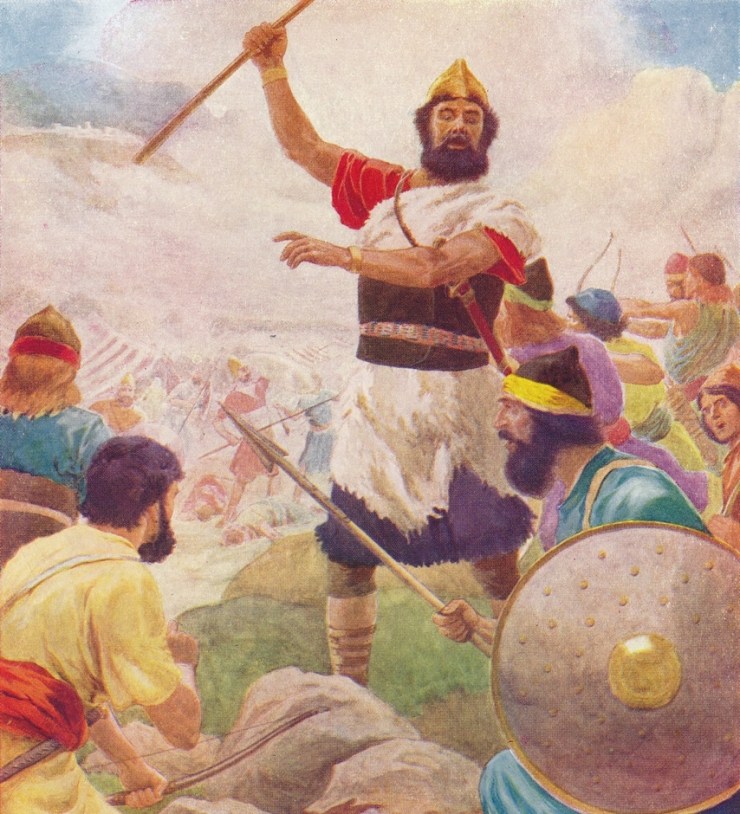
Saul Gains His Kingdom painted by Frank Adams. This scene probably pictures the battle in which Saul led Israel to victory against the Ammonites.[1]
A king after God’s own heart
God shows Samuel to anoint a young shepherd called David to replace Saul. David is a different kind of man from Saul. God says, “I have found in David the son of Jesse a man after my heart, who will do all my will.” (Acts 13:22, see 1 Samuel 13:14).
God says, “I have found in David the son of Jesse a man after my heart, who will do all my will” (Acts 13:22).
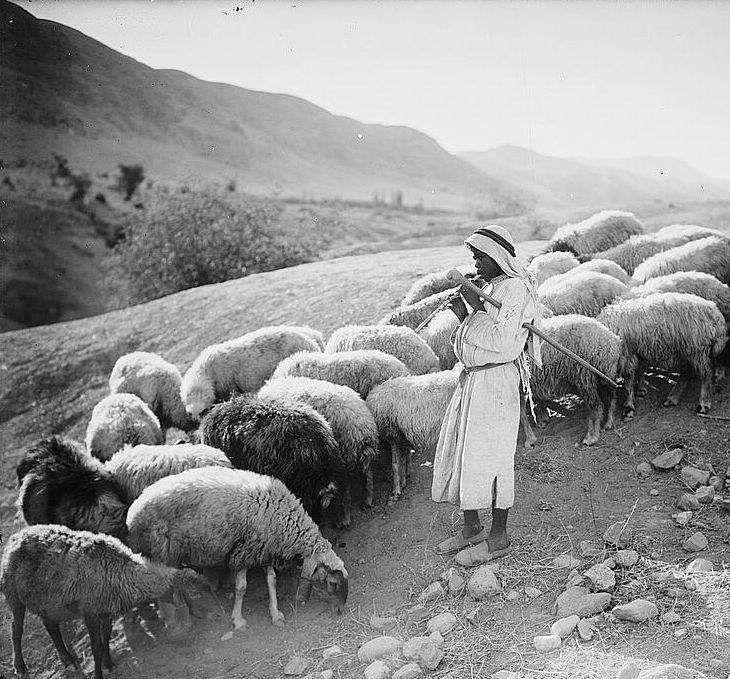
Image from The Library of Congress Prints & Photographs Online Catalog
A shepherd boy plays to his sheep in the Jordan Valley, a photograph taken between around 1920 and 1933. The Lord “chose David his servant and took him from the sheepfolds . . . to shepherd Jacob his people, Israel his inheritance” (Psalm 78:70-71).
Saul becomes gripped by hatred for David, forcing David into the life of a fugitive. But, in the end, Saul ends up dead on the battlefield, defeated by the Philistines. David is proclaimed king by the tribe of Judah, then eventually by all Israel.
The completion of the conquest
Long before he becomes king, David fights a famous duel with a giant Philistine called Goliath. It’s a great story―but it’s much more than that. It takes us back to Genesis. In Part 6, we saw that God told the evil snake: “I will put enmity between you and the woman, and between your offspring and hers; he will crush your head, and you will strike his heel” (Genesis 3:15 NIV). A single offspring of Eve will crush Satan’s head. That ‘serpent-crusher’ is Jesus.
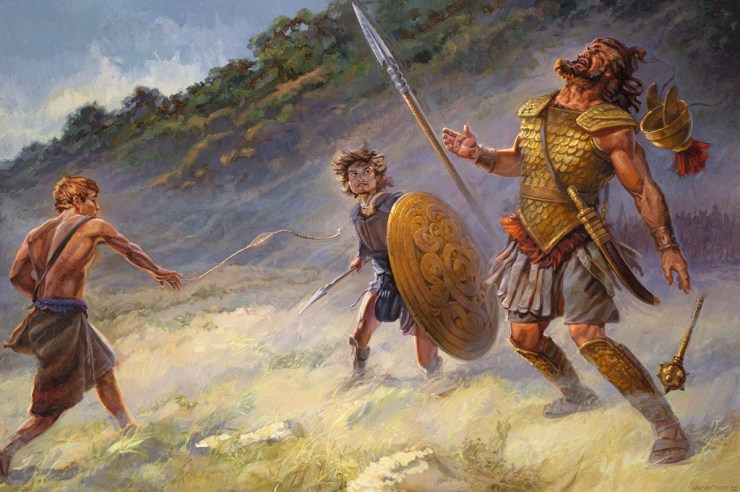
David and Goliath © Gospelimages licenced to Free Bible images (CC BY-NC-ND 4.0)
David and Goliath. We read, “David put his hand in his bag and took out a stone and slung it and struck the Philistine on his forehead. The stone sank into his forehead, and he fell on his face to the ground.” (1 Samuel 17:49).
David is a ‘serpent-crusher’, too. Goliath reminds us of a snake: he wears “a coat of scale armour” (1 Samuel 17:5 NIV). And David ‘crushes’ his head―he sinks a slingstone into Goliath’s forehead, then beheads him. David’s victory over Goliath foreshadows Jesus’s victory over Satan.
David’s victory over Goliath foreshadows Jesus’s victory over Satan.
David is God’s warrior king. There’s “a long war between the house of Saul and the house of David”; David grows “stronger and stronger”; “the house of Saul” becomes “weaker and weaker” (2 Samuel 3:1). In the end, David is anointed king over all Israel (2 Samuel 5:1-5). He captures Jerusalem, and conquers the Philistines, Moabites and other kingdoms. The Lord “gave victory to David wherever he went” (2 Samuel 8:14).

Image courtesy of The Jewish Museum, New York
Three of David’s Captains painted by James Jacques Joseph Tissot. The artist portrays three of David’s “mighty men”, fearless and fearsome warriors (2 Samuel 23:8-39).
God’s covenant with David
David brings the Ark of the Covenant to Jerusalem, which he’s made his capital. He wants to build a permanent house for God. But God speaks to David through the prophet Nathan. He makes these wonderful promises, recorded in 2 Samuel 7:4-17 and 1 Chronicles 17:3-15:
► God will make David’s “name”―his fame and reputation―great.
►God will provide a secure home for His people Israel. “Wicked people shall not oppress them any more . . . .” (NIV). David subdues all Israel’s enemies, and Israel begins to enjoy a period of peace and security. Sadly, it doesn’t last. But one day, “Israel will dwell securely” (Jeremiah 23:6) for ever. God’s people will enjoy everlasting peace and security in the New Jerusalem (Revelation 21:9-22:4). Satan and sin will never touch them again.
►David will enjoy rest from all his enemies. As we’ve seen, the Lord “gave victory to David wherever he went” (2 Samuel 8:14).
►God will build David a “house”―meaning a royal dynasty. David’s “offspring”―a son―will succeed him. And David’s dynasty and kingdom and throne will last for ever. Many generations of David’s dynasty did indeed rule as kings (see Matthew 1:6-11). But that came to an end with king Zedekiah (2 Kings 24:18). So how will David’s royal dynasty last for ever? It’s because the supreme member of that dynasty is Jesus Christ (see Matthew 1:16). The angel Gabriel announces to Mary that the Lord God will give Him “the throne of his father David, and he will reign over the house of Jacob forever, and of his kingdom there will be no end” (Luke 1:32–33).
►David’s son will build “a house” for God’s “name”. David’s son Solomon did indeed build God a house―a magnificent Temple. But Jesus, the great Son of David, is now building a far more wonderful temple―a temple built of God’s people and indwelt by God through His Spirit. That temple is the Church.
►God will be a Father to David’s offspring, and he’ll be a son to God. This refers to David’s son Solomon, and to the other kings of David’s dynasty. When they sin, God will discipline them. But He’ll never remove His “steadfast love” from them. But, again, this promise ultimately points to Jesus: He’s the unique divine Son of God (for example, Mark 1:1).
Jesus, the great Son of David, is now building a temple built of God’s people and indwelt by God through His Spirit. That temple is the Church.
These promises God makes to David are a covenant (see 2 Samuel 23:5 and Psalm 89:3). We call it the Davidic Covenant. It’s another step in God’s great plan of salvation. And notice how it points to the One who’ll bring about that salvation. It points to the Son of David, Jesus Christ.
God had promised Abraham that through him “all peoples on earth will be blessed” (Genesis 12:3). God will fulfil that promise through one of Abraham’s descendants. That descendant is David’s Son―King Jesus. He will bring blessing to this world (see Psalm 72:17). From this point on in the Bible, we’re waiting for God’s King, the Son of David, to arrive.[2] When will He come?
From 2 Samuel 7 onwards in the Bible, we are waiting for the arrival of God’s king, the son of David.
David’s fall
Time and again, when things begin to look really hopeful for God’s people in the Old Testament, something goes wrong. Only four chapters after Nathan’s remarkable prophecy, we read that―at the season “when kings go out to battle”―David is relaxing in his palace instead. From his rooftop, he sees a beautiful woman bathing, named Bathsheba. David commits adultery with her and conspires to get her husband killed in battle, so he can take her as his wife.
David repents (see Psalm 51:1-17), and God forgives him. But God also sends judgment (2 Samuel 12:10-14). The consequences of this sin cast a deep shadow over the rest of David’s life.
Solomon, the man of rest
But God’s promises to David stand secure. His son Solomon succeeds him around 970 BC. Israel enters a period of peace and prosperity unequalled before or since. God had told David: ” . . . a son shall be born to you who shall be a man of rest. I will give him rest from all his surrounding enemies. For his name shall be Solomon, and I will give peace and quiet to Israel in his days.” (1 Chronicles 22:9). Solomon, the man of rest, rules over a nation at rest, peaceful and secure. It’s a little foretaste of what God wants for the whole world.
In the next part . . .
Israel is now a nation at peace, free from enemy oppression. So it’s the appropriate time for God’s house to be built. We’ll look at this magnificent building next time. And God placed Israel in this land for a reason. They were a missional people. But how? We’ll see next time.
Bible Reading and Questions
You may like to read 2 Samuel 7:1-29. Here’s something to think about:
?As we’ve journeyed through the Bible story, we’ve seen God making covenants. In His covenant with David, God makes promises. What do you think is the key promise? And why do you think this is?
Book Recommendation
Here is another great Advent devotional: The Dawn of Redeeming Grace: Daily Devotions for Advent by Sinclair B. Ferguson. This one takes us through the first two chapters of Matthew’s Gospel. In his introduction, the author writes, “. . . if you read through the Bible from the beginning, there is something thrilling about turning over the blank page between the Old Testament and the New Testament. The first thing you encounter is Matthew’s summary of the long years of waiting (1:1-17). But now the snow is melting, and winter is giving way to Christmas (1:18–2:23). The arrival of the Lord Jesus is the dawn of a glorious new era.” Sinclair B. Ferguson is a Scottish pastor, author, conference speaker, and professor of systematic theology.
Read the publisher’s description (which also provides a free sample) HERE.
Videos
Here are three short videos, entitled The Lord’s Word and Samuel: The Story of the Man Who Would Anoint the First King (1 Samuel 1; 3), The Rise and Fall of King Saul: The Story of Israel’s First King (1 Samuel 8-15), and David Stands Tall: The Story of David and Goliath (1 Samuel 16-17). They’re designed for children ages 6 to 12. But they’re so good, youth and adults may well enjoy them, too. These videos are in a series published by Crossway. They’re based on the book called The Biggest Story Bible Storybook. All the videos can be viewed at The Biggest Story videos website. You can also create a free account to enable you to download them.
REFERENCES [1] Image entitled Saul Gains His Kingdom by Frank Adams and scanned from the picture published in The Bible Picture Book by Muriel J. Chalmers, opposite page 28. Published by Thomas Nelson and Sons, Ltd., London, Edinburgh, New York, Toronto, and Paris, undated. [2] Adapted from God’s Big Picture: Tracing the Storyline of the Bible by Vaughan Roberts, page 82. Published by Inter-Varsity Press, Leicester, England, in 2003.
CREDITS ► Text copyright © 2024 Robert Gordon Betts ► Unless otherwise indicated, all Scripture is taken from the ESV® Bible (The Holy Bible, English Standard Version®), copyright © 2001 by Crossway, a publishing ministry of Good News Publishers. Anglicized English Standard Version copyright © 2002 by Crossway. Used by permission. All rights reserved. The ESV text may not be quoted in any publication made available to the public by a Creative Commons license. The ESV may not be translated in whole or in part into any other language. ► Scripture quotations marked ‘NIV’ are taken from The Holy Bible, New International Version (Anglicised edition). Copyright © 1979, 1984, 2011 by Biblica (formerly International Bible Society). Used by permission of Hodder & Stoughton Publishers, an Hachette UK company. All rights reserved. ‘NIV’ is a registered trademark of Biblica (formerly International Bible Society). UK trademark number 1448790.
 52 Steps