
Part 22: Conquest and Corruption
Click the icon below to download a 4-page PDF version of this page.

God’s bridgehead into the world
Israel has crossed the River Jordan. They have kept their covenant with God. Uncircumcised males have now been circumcised―the sign of God’s covenant with them. And they’ve eaten the Passover―the covenant meal. Now they’re ready to conquer the Promised Land.
And this was no ordinary land. The Promised Land was God’s strategic bridgehead into occupied territory―into the world oppressed by Satan.
The enemy in the land
But that land―that strategic bridgehead―was under enemy occupation. The Canaanites lived there. Their depravity is legendary. They practised idolatry, child sacrifice, incest, homosexuality, sexual relations with animals, fortune-telling and other occult practices―all of which were expressly forbidden in God’s Law (Leviticus 18:6-23, 19:31). The land was a stronghold of Satan.
The Promised Land was God’s strategic bridgehead into occupied territory―into the world oppressed by Satan.
God had given the Canaanites centuries to turn from their sin (Genesis 15:16). They knew the Lord’s power and greatness (see Joshua 2:8-11). Why didn’t they turn to Him? But it was too late. Their wickedness called down God’s judgment. God told Moses to command His people: “When the LORD your God brings you into the land . . . and clears away many nations before you, . . . and you defeat them, then you must devote them to complete destruction. You shall make no covenant with them and show no mercy to them. You shall not intermarry with them, . . . for they would turn away your sons from following me, to serve other gods. . . . . But . . . you shall break down their altars . . . and burn their carved images with fire.” (Deuteronomy 7:1-5, see also 20:16-18).
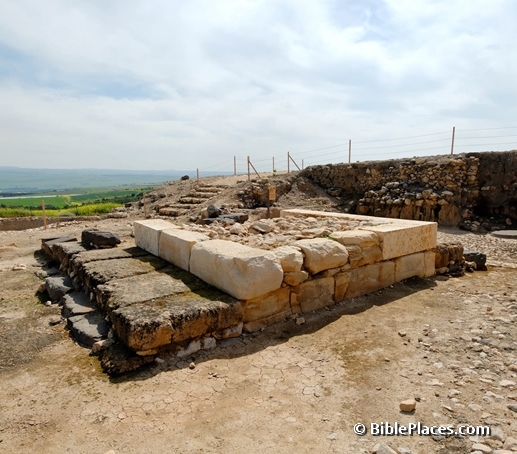
Image © BiblePlaces.com
The partially reconstructed remains of a Canaanite altar at Hazor, a key Canaanite stronghold. Joshua and his warriors defeated “a great horde” of northern Canaanites, led by Jabin, king of Hazor (Joshua 11:1-9). Then “Joshua turned back . . . and captured Hazor and struck its king with the sword, . . . . And they struck with the sword all who were in it, devoting them to destruction; there was none left that breathed. And he burned Hazor with fire.” (Joshua 11:10-11).
The Canaanites’ evil culture had to be destroyed. But God also speaks a number of times about driving out the Canaanites. For example, we read, “the LORD will drive out all these nations before you, and you will dispossess nations greater and mightier than yourselves” (Deuteronomy 11:23). It’s possible to destroy a nation and its culture, without destroying every individual citizen. It seems that many individual Canaanites―if they hadn’t already migrated elsewhere―were “driven out” (Joshua 23:9) but not killed. Only those who remained―that would have included many leaders and fighting men―were actually slaughtered.
First blood
The very first battle of the conquest is at Jericho. God tells Joshua, “See, I have given Jericho into your hand . . .” (Joshua 6:2). Priests carry the Ark of the Covenant round the city each day for seven days―once on the first six days, seven times on the Sabbath. Armed men march in front and behind them. The Mercy Seat on the Ark is God’s footstool. God Himself is Israel’s Commander in Chief. God commands the people to shout; Jericho’s walls collapse and the Israelites take the city.

Image © Gospelimages licenced to Free Bible images (CC BY-NC-ND 4.0 International)
Painting of the moment when the priests blow the trumpets, God’s people shout, and Jericho’s walls collapse. We read, the people shouted, and the trumpets were blown. As soon as the people heard the sound of the trumpet, the people shouted a great shout, and the wall fell down flat” (Joshua 6:20). The priests are carrying the Ark of the Covenant. The artist has shown the Ark draped in a blue cloth (see Numbers 4:6).
But where there’s faith, God shows mercy. Rahab, a prostitute in Jericho, believes in the Lord and helps the two spies Joshua sent (Joshua 2:1-21). She and her family are saved (Joshua 6:17). And not only that, but Rahab becomes an ancestor of Jesus Himself (Matthew 1:5)!
Jericho’s capture sets the context for the conquest of all the Promised Land. Every subsequent victory hinges on obeying God. But disobedience brings defeat. Israel attacks the city of Ai next. They fail because one man disobeys God. This one sin weakens the whole nation. Not until that sin is dealt with will God give His people victory at Ai. Sin always has a much bigger impact than we may realise.
Jericho’s capture sets the context for the conquest of all the Promised Land. Every subsequent victory hinges on obeying God.
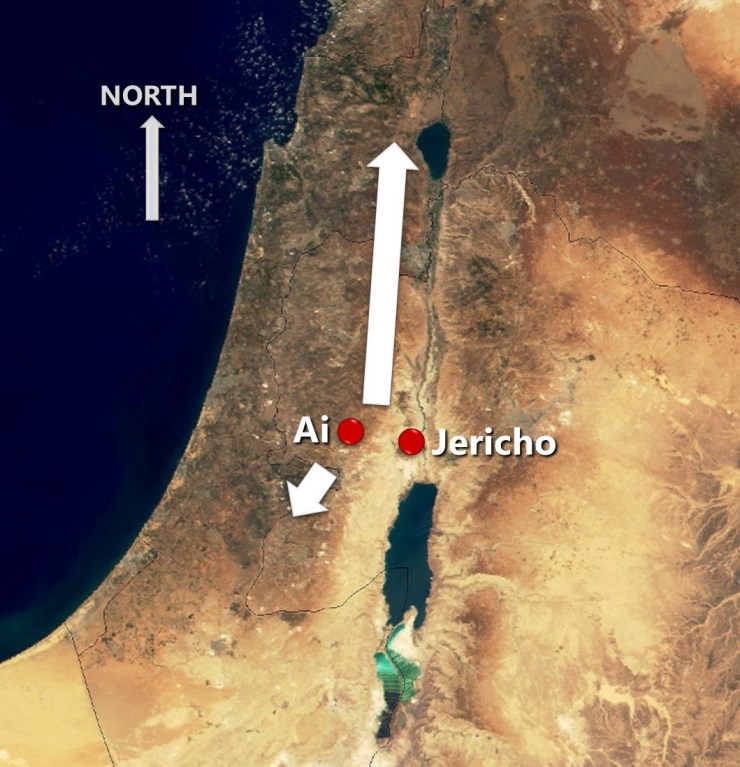
Capturing Jericho and Ai gives Israel a base in the centre of the Promised Land. From here, they conduct two major campaigns:
● The southern campaign (Joshua 10:1-43) begins by defending the Gibeonites against five Canaanite kings. The people from Gibeon, a Canaanite city a few miles north-west of Jerusalem, have tricked Israel into making peace with them (9:1-27). Rashly, Israel didn’t “ask counsel from the LORD”. So, bound by their covenant with the Gibeonites, Israel has to defend them. But the Lord gives them victory over these Canaanite kings―helping them by throwing down huge hailstones, and causing the sun and moon to stop in their tracks! Israel continues to defeat the southern Canaanites, leaving “none remaining”, but devoting “to destruction all that breathed, just as the LORD God . . . commanded” (10:40).
●The northern campaign (11:1-15) begins by defeating “a great horde” of northern Canaanites, led by Jabin, king of Hazor.
The Israelites’ conquests are summarised in Joshua 11:16-12:24. The land now enjoys “rest from war” (11:23). But much land still remains in enemy hands (13:1-6).
Background image: Image of Middle East courtesy of Jacques Descloitres, MODIS Land Science Team, NASA Visible Earth
Map showing the position of Jericho and Ai in the centre of the Promised Land, and the general direction of the southern and northern campaigns.
God commands Joshua to allocate land west of the Jordan to nine and a half tribes―the remaining two and a half tribes already have land allocated on the eastern side of Jordan. The Tabernacle is set up at Shiloh, around 20 miles north of Jerusalem. The Levites are given 48 cities spread through the land, together with pasture land.
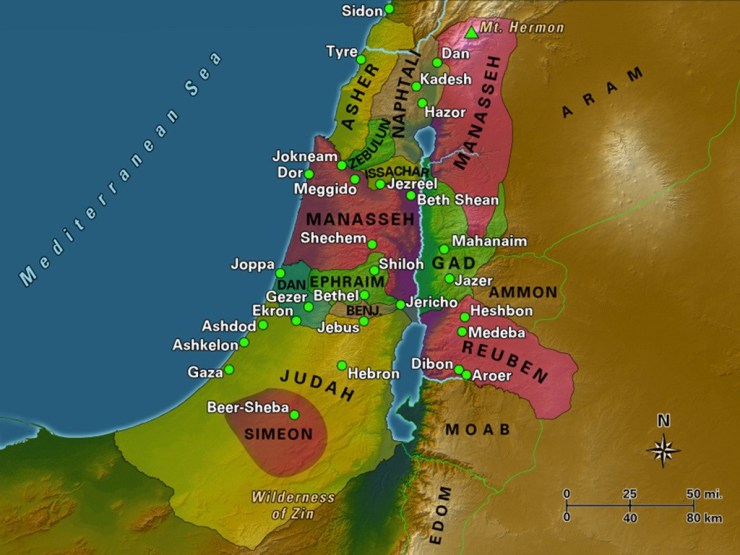
Image created by A.D. Riddle of Riddle Maps and © 2015 Society of Biblical Literature Free Bible images (CC BY-NC-ND 3.0 Unported)
The territories allotted to the twelve tribes (see Joshua 13:8-19:51). However, this doesn’t necessarily reflect the land each tribe actually occupied. Some tribes weren’t able to drive out all the Canaanites in their territory. There were also cases where tribes occupied land not originally allocated to them.
The main phase of the conquest is over. We read that, “Not one word of all the good promises that the LORD had made to the house of Israel had failed; all came to pass.” (Joshua 21:45). God is faithful to His people! Before his death, Joshua―like Moses before him―reminds Israel of their history, and charges them to be faithful to God (Joshua 23:1-16). He then renews God’s covenant with His people (24:1-28).
“Not one word of all the good promises that the Lord had made to the house of Israel had failed; all came to pass.” (Joshua 21:45). God is faithful to His people!.
Spiralling down into depravity
Israel continues to serve God until all the elders who’ve led the nation under Joshua die. The tribes start to complete the conquest of the land. They begin well (Judges 1:1-18). Then things begin to go wrong; time and again we read that the tribes “did not drive out” the Canaanites (1:19,21,27-35). In fact, we begin to hear these ominous words as far back as Joshua 13:13 and 16:10. The Psalmist tells us: “They did not destroy the peoples, as the LORD commanded them, but they mixed with the nations and learned to do as they did. They served their idols, . . . . They sacrificed their sons . . . to the idols of Canaan, and the land was polluted with blood.” (Psalm 106:34-38). And so God says He won’t drive out the Canaanites before them, “but they shall become thorns in your sides, and their gods shall be a snare to you” (Judges 2:1-3).
A recurring cycle follows (Judges 2:11-19):
●Israel commits idolatry.
●God gives them into the hands of their enemies, who oppress and afflict them.
●The people cry to God to save them.
●God gives them a deliverer, called a judge, who defeats their enemies and gives them a period of peace. Judges 3:7-16:31 is a portrait gallery of these varied and often rather unlikely leaders. They include Othniel; left-handed Ehud; Deborah, a prophetess, and Barak; Gideon (who defeats a vast horde with 300 men chosen by God), Jephthah, a prostitute’s son; and womaniser Samson who, blinded and helpless, kills the Philistine leaders in a final spectacular act of heroism.
●Israel then falls back into idolatry.
This recurring cycle goes on for up to 300 years or even more.

Samson Slays a Thousand Men painted by James Jacques Joseph Tissot courtesy of The Jewish Museum, New York
Samson Slays a Thousand Men painted by James Jacques Joseph Tissot. This painting illustrates one of Samson’s great feats of strength. We read, “When he came to Lehi, the Philistines came shouting to meet him. Then the Spirit of the LORD rushed upon him, and the ropes that were on his arms became as flax that has caught fire, and his bonds melted off his hands. And he found a fresh jawbone of a donkey, and put out his hand and took it, and with it he struck 1,000 men.” (Judges 15:14-15).
The end of the Book of Judges paints a picture of Israel’s appalling depravity. Judges 19:16-30 tells what is surely the most sickening story in the Bible. It involves homosexuality and gang-rape, echoing what happened in Sodom.[1] Adam and Eve were tasked with keeping God’s paradise garden holy. Likewise, God’s people Israel were tasked with keeping God’s new paradise―the Promised Land―holy. But now the Promised Land has become a scene of vile wickedness.
The Book of Judges ends with this lament: “In those days there was no king in Israel. Everyone did what was right in his own eyes.” (Judges 21:25, see 17:6). Israel is God’s new humanity. They do just what Adam and Eve had done. Israel rebels against God and does their own thing.
Israel is God’s new humanity. They do just what Adam and Eve had done. Israel rebels against God and does their own thing.
Moses taught God’s people, “You shall love the Lord your God with all your heart and with all your soul and with all your might. And these words that I command you today shall be on your heart. You shall teach them diligently to your children, . . . .” (Deuteronomy 6:5-7). They failed. And so we read that, after Joshua’s generation died out, “there arose another generation after them who did not know the Lord or the work that he had done for Israel” (Judges 2:10). But ultimately something was fundamentally wrong with their character. They needed “a new heart” (Ezekiel 36:26). How was that going to happen? We’ll see later in our journey.
Beacons of hope
But even in these darkest of times, God is working His purposes out. The little book of Ruth is set in the time of the judges. It ends with a Gentile, Ruth, becoming great-grandmother to the great Israelite king, David―a man after God’s own heart. And David is a forerunner of God’s great King―Jesus the Messiah, who’ll strike the mortal blow against Satan. God is sowing the seeds of His people’s salvation. Once again, we see God’s grace “outrunning the avalanche of sin”![2]
God is sowing the seeds of His people’s salvation. Once again, we see God’s grace “outrunning the avalanche of sin”!
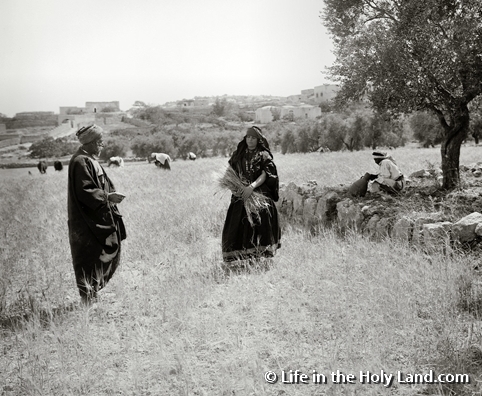
Image © Life in the Holy Land.com
This image is one of a series of early photographs of a re-enactment of the story of Ruth, the great-grandmother of King David. The photographs were taken between 1898 and 1946. This scene seems to capture the moment when Boaz speaks to Ruth, saying, “Now, listen, my daughter, do not go to glean in another field . . . , but keep close to my young women. Let your eyes be on the field that they are reaping, . . . . And when you are thirsty, go to the vessels and drink what the young men have drawn.” (Ruth 2:8-9).
Then there’s another beacon of hope. Samuel is born (around 1100BC). He’s the last of the judges. And he’s also the first of a new order of prophets that ends with Malachi, sixteen of whom wrote books included in the Old Testament. We read that “the word of the LORD was rare in those days; there was no frequent vision” (1 Samuel 3:1). But God begins once more to speak to His people.
In the next part . . .
Israel’s elders ask Samuel to appoint a king to judge them “like all the nations” (1 Samuel 8:5). How will God respond? And how will things work out? We’ll see next time.
Bible Reading and Question
You may like to read Deuteronomy 8:1-20. Here’s a question to think about:
?Twice in this passage, God tells His people to “remember” (8:2,18). They were to remember Him. They were to remember how He’d led them. And they were to “remember all the commandments of the LORD, to do them” (Numbers 15:39). We, too, are to remember Him, all He’s done for us, and all He’s said to us. How, practically, may we do these things, and make sure we don’t forget?
Videos
Here are three short videos, entitled The Walls Came Tumbling Down: The Story of Joshua and the Battle of Jericho (Joshua 6), The Fight of Gideon and the Flight of Midian: The Story of a Mighty Warrior (Judges 6-7), and The Girl Who Wouldn’t Go Away: The Story of Ruth (Ruth 1-4). They’re designed for children ages 6 to 12. But they’re so good, youth and adults may well enjoy them, too. These videos are in a series published by Crossway. They’re based on the book called The Biggest Story Bible Storybook. All the videos can be viewed at The Biggest Story videos website. You can also create a free account to enable you to download them.
REFERENCES [1] See Dominion and Dynasty: A Theology of the Hebrew Bible by Stephen G. Dempster, page 131. Published jointly by Apollos (an imprint of Inter-Varsity Press, Leicester, U.K., and Intervarsity Press, Downers Grove, Illinois, in 2003. [2] This phrase is quoted from The Story of All Stories: Genesis 1-11 by Darrell Johnson, pages 75, 83 and 85. Published by Regent College Publishing, Vancouver, Canada, in 2019. The phrase “avalanche of sin” was used by Gerhard von Rad (see note 5 on page 74 of The Story of All Stories).
CREDITS ► Text copyright © 2024 Robert Gordon Betts ► Unless otherwise indicated, all Scripture is taken from the ESV® Bible (The Holy Bible, English Standard Version®), copyright © 2001 by Crossway, a publishing ministry of Good News Publishers. Anglicized English Standard Version copyright © 2002 by Crossway. Used by permission. All rights reserved. The ESV text may not be quoted in any publication made available to the public by a Creative Commons license. The ESV may not be translated in whole or in part into any other language.
 52 Steps