
Part 21: Poised for Conquest
Click the icon below to download a 4-page PDF version of this page.

On the march again
God had promised Abraham, “To your offspring I give this land, from the river of Egypt to the great river, the river Euphrates, . . . .” (Genesis 15:18–21). But―as we saw last time―Israel can’t now enter the Promised Land till all their men “able to go to war” (Numbers 1:3) have died―all except Caleb and Joshua. And so they have to wait. For nearly 40 years, Israel has been wandering in the wilderness―perhaps based for much of the time at Kadesh-barnea.
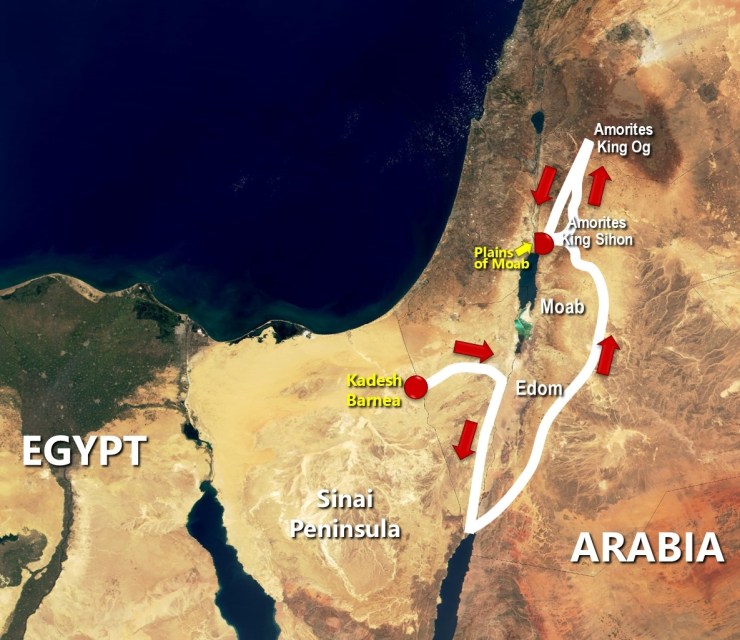
Then the people finally resume their journey to the Promised Land, perhaps travelling eastwards as shown on the map. Israel asks the king of Edom if they can pass through his land, but he refuses. Then the king of Arad in southern Canaan attacks them and captures some of them. Now the tide turns! Israel vows to God “If you will indeed give this people into my hand, then I will devote their cities to destruction” (Numbers 21:2). God gives Israel victory over these Canaanites, and they destroy them and their cities.
Background image: Image of Middle East courtesy of Jacques Descloitres, MODIS Land Science Team, NASA Visible Earth
The route of Israel’s journey from Kadesh-barnea to the Plains of Moab.
They continue their journey, travelling south toward the Gulf of Aqabah, then north-eastward, by the eastern border of Edom and Moab. God gives them victories over Sihon, king of the Amorites, and Og, king of Bashan―they leave no survivors, as God has commanded. These victories give them possession of land east of the river Jordan.
The Conquest of the Amorites painted by James Jacques Joseph Tissot courtesy of The Jewish Museum, New York
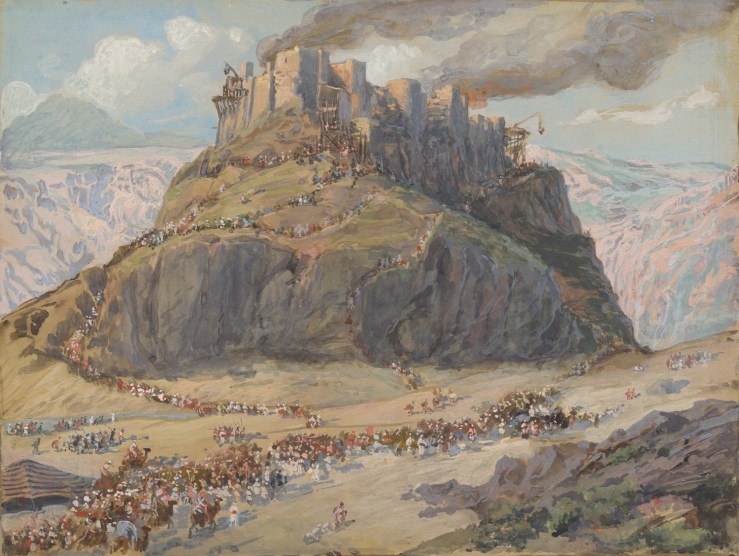
The Conquest of the Amorites painted by James Jacques Joseph Tissot. An artistic conception of Israel’s conquest of an Amorite city.
Balaam’s prophecy
Israel’s final camp is in the plains of Moab on the east bank of Jordan, overlooking Jericho. They’re poised for conquest.
Balak, the king of Moab, has seen how ruthlessly Israel defeated the Amorites. No wonder Moab is “overcome with fear of the people of Israel” (Numbers 22:3)! So the Moabites talk with the elders of a neighbouring people, the Midianites. They join forces to hire a prophet called Balaam to curse God’s people.
But Balaam can’t curse Israel―God forbids him. Instead, he blesses them (Numbers 23:7-10,18-24, 24:3-9,15-24). And what a wonderful blessing it is! He sees God’s people as a vast nation without misfortune or trouble, invincible, living in a well-watered paradise―like a new Garden of Eden! In his final prophecy he declares: “. . . a star shall come out of Jacob, and a sceptre shall rise out of Israel; it shall crush the forehead of Moab and break down all the sons of Sheth. Edom shall be dispossessed; . . . . Israel is doing valiantly.” (Numbers 24:17-18). This amazing prophecy has King David in view. But it also looks forward to the promised Messiah, who will crush the head of the supreme enemy of God’s people―Satan (Genesis 3:15). This is a key prophecy about Jesus―from the lips of a pagan prophet!
Balaam can’t curse Israel―God forbids him. Instead, he blesses them. And what a wonderful blessing it is!
Seduced into sin
But with this wonderful prophecy still ringing in our ears, we’re shocked by what we read next. Israel indulges in sexual immorality with “the daughters of Moab” and commits idolatry (Numbers 25:1-9). Balak, king of Moab, was furious with Balaam for not cursing Israel. Did he encourage these women as another ploy to ruin Israel?
Such wickedness brings judgment. A faithful priest, Phinehas, kills one of the immoral Israelites and the Midianite woman he’s with. God plagues Israel; 24,000 die. And God tells Moses, “Avenge the people of Israel on the Midianites” (Numbers 31:2)―the people who’d collaborated with the Moabites to seduce Israel. All the Midianites, except the female children, are killed―including Balaam.
Moses’ final message
As Israel waits, east of the Jordan in the plains of Moab, Moses preaches to them. The book of Deuteronomy records what he said. He recounts their history, urges them to obey God, and reminds them of God’s commandments. And he tells them what a paradise the land is.
When the people enter the land, they’re to write the law on memorial stones on Mount Ebal. They’re to confirm their covenant commitment to God on Mount Ebal and its twin, Mount Gezirim―peaks that stand as sentinels in the heart of the Promised Land (Deuteronomy 27:2-13).
Moses pronounces the blessings of obedience and the curses of disobedience. He renews the covenant between God and His people, setting before them “life and good, death and evil” (Deuteronomy 30:15). Just as Adam and Eve had the life-defining choice between the tree of life and the tree of the knowledge of good and evil, so God sets before Israel the choice of life or death, blessing or curse. If they obey Him they’ll enjoy His blessing in the land; if they reject Him, they’ll be driven into exile (Leviticus 26:32-39), just as Adam and Eve were driven from the garden. So Moses urges them, “Therefore choose life” (Deuteronomy 30:19)!
Just as Adam and Eve had the life-defining choice between the tree of life and the tree of the knowledge of good and evil, so God sets before Israel the choice of life or death, blessing or curse.
Moses writes down the Law and orders it to be read to the nation every seven years. He commands his successor Joshua, and the whole nation, to be “strong and courageous” as they take possession of the Promised Land (Deuteronomy 31:6-7). He declares, “It is the LORD who goes before you. He will be with you; he will not leave you or forsake you. Do not fear or be dismayed.” (31:8).
Moses recites a song to Israel―a song God gives him. It tells of God’s faithfulness, guidance, care, and provision for them. It speaks, too, of Israel’s rebellion and God’s judgment on them. But the song ends in triumph―God will punish Israel’s enemies and restore His people.
Finally, Moses blesses the 12 tribes. Then he climbs Mount Nebo and views the Promised Land. There, on the mountain, this faithful servant of God dies. God Himself buries him. Joshua now takes leadership of the nation. God commissions him to lead the people into the Land.
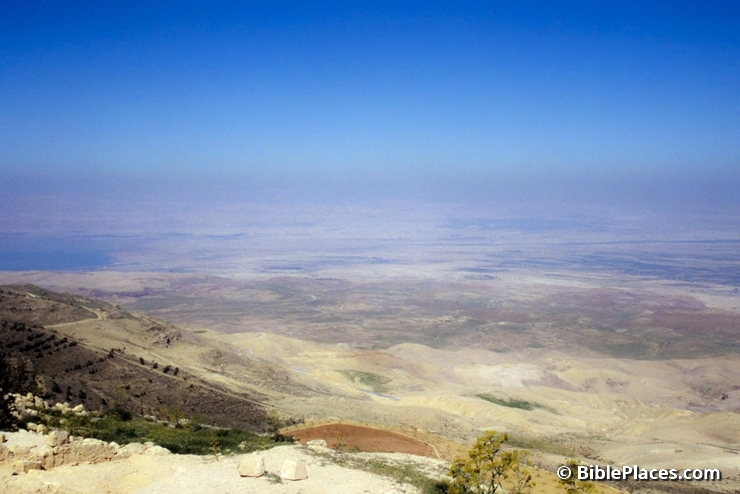
Image © BiblePlaces.com
View of the Plains of Moab and the Dead Sea from Mount Nebo. This was the mountain from which God showed Moses the Promised Land. We read, “Then Moses went up from the plains of Moab to Mount Nebo, to the top of Pisgah, which is opposite Jericho. And the LORD showed him all the land, . . . .” (Deuteronomy 34:1.)
Into the Promised Land

The Flight of the Spies painted by James Jacques Joseph Tissot courtesy of The Jewish Museum, New York
The Flight of the Spies painted by James Jacques Joseph Tissot. The painter depicts Rahab the prostitute letting the two spies down the wall of Jericho. We read, “she let them down by a rope through the window, for her house was built into the city wall, so that she lived in the wall”(Joshua 2:15).
Like Moses, Joshua sends spies into the Land. They return and encourage Israel: “Truly the LORD has given all the land into our hands. And also, all the inhabitants of the land melt away because of us” (Joshua 2:24).
Israel crosses the Jordan. It’s in flood, but God holds back the waters and the people cross on dry land. It’s like another Exodus. Notice that they enter the land from the east. God sent Adam and Eve eastwards out of the Garden of Eden. Now His people enter the Promised Land from the east. It’s like entering a new Garden of Eden. And the Promised Land really is like that garden. It’s a fertile well-watered paradise, overflowing with natural resources, “flowing with milk and honey” (Deuteronomy 8:7-10; 11:9-12).
God sent Adam and Eve eastwards out of the Garden of Eden. Now His people enter the Promised Land from the east. It’s like entering a new Garden of Eden.
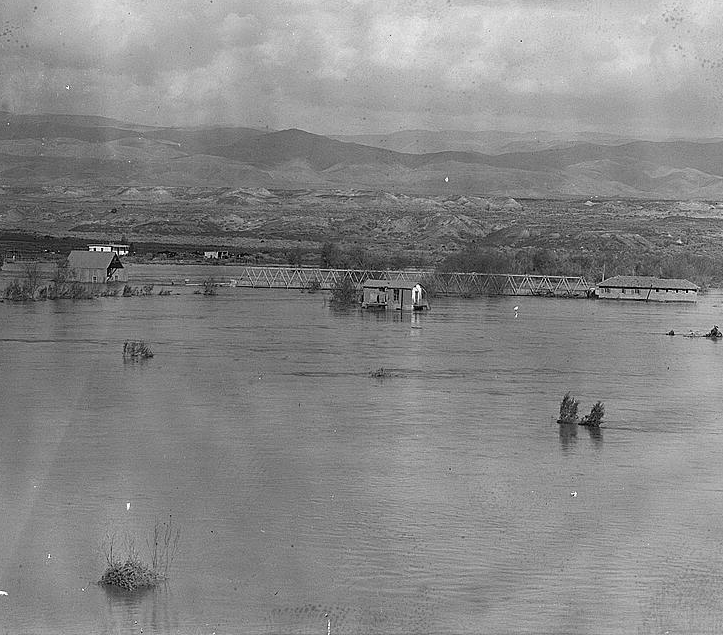
Jordan floods. (Taken at Allenby Bridge.) Floods covering entire area by bridge. from The Library of Congress Prints & Photographs Online Catalog
The Jordan in flood near the Allenby Bridge (also known as the King Hussein Bridge) which spans the Jordan near the city of Jericho. This is close to where Israel crossed the Jordan. At the time Israel crossed, the Jordan was in flood (Joshua 3:15). This photograph was taken in 1935.
In covenant with the Lord
We read, ”all the people who were born on the way in the wilderness after they had come out of Egypt had not been circumcised” (Joshua 5:5). In Part 10, we saw that God commanded Abraham and all the males aged eight days old or over in his household to be circumcised (Genesis 17:10-13). Circumcision was “a sign”―in other words, a symbol―of the covenant between God and Abraham. It showed that Abraham and his household, and now the nation of Israel that Abraham fathered, were in covenant relationship with God.
Then the nation celebrates their first Passover in the land (Joshua 5:10). Everyone eating this meal is showing they’re in covenant with God. He’s their covenant Lord―”the faithful God who keeps covenant and steadfast love with those who love him and keep his commandments . . .” (Deuteronomy 7:9). Israel, in turn is to keep covenant with God. They’re to love Him, obey Him, and stay loyal to Him. Then God will give them victory over the inhabitants of the land. Keeping covenant with God is the key to their future.
Israel’s coming of age
The nation of Israel was born at the Exodus. Those years in the wilderness were their formative years―a time of discipline and training. God said to them, “you shall remember the whole way that the LORD your God has led you these forty years in the wilderness, . . . . And he humbled you and let you hunger and fed you with manna, . . . that he might make you know that man does not live by bread alone, but . . . by every word that comes from the mouth of the LORD.” (Deuteronomy 8:2-3). God showed Israel His love and His holiness. He taught them to obey Him. He trained them to rely on His provision and power. That’s how Adam and Eve should have lived in the Garden of Eden. That’s how God’s people are now to live in the Promised Land.
The nation of Israel was born at the Exodus. Those years in the wilderness were their formative years―a time of discipline and training.
Crossing the Jordan into the Promised Land was like Israel’s coming of age. They now took on the privileges and responsibilities of adulthood. Until then, God had provided food and drink for them, and ensured their clothes and shoes didn’t wear out―just as we, too, provide for our children. And God continued to provide for them despite their rebellion―just as we keep providing for our children even when they’re disobedient.
But when they crossed Jordan, God stopped treating them like children. Now they had responsibility for their lives. When they began to eat the produce of the land, the manna ceased (Joshua 5:12). From then on they had to till the ground and sow the seed and tend the crops. If they were obedient, God would bless their labours. If they were disobedient, they would go without―something that never happened in the wilderness, despite their repeated rebellion.
In the next part . . .
What happens when Israel starts to conquer the land? The campaign begins so well. But it’s not all plain sailing. We’ll see why next time.
Bible Reading and Questions
You may like to read Joshua 5:1-15. Here are a couple of questions to think about:
? Having crossed the Jordan, you might have expected God’s people to immediately start conquering the land. But they don’t. First, the uncircumcised males are circumcised―the sign of God’s covenant with Abraham and his descendants. Secondly, the people celebrate Passover, a meal only those in covenant relationship with God may eat. Finally, Joshua meets “the commander of the army of the LORD” (Joshua 5:13-15). It seems that this “man” is a preincarnate appearance of Christ―Israel’s covenant Lord Himself! Why is the covenant emphasised at this point? And what’s the lesson for us?
Book Recommendation
Read This First: a Simple Guide to Getting the Most from the Bible by Gary Millar is a great introduction to the Bible for new believers, or for Christians who’ve not yet got into the habit of regular Bible reading. It’s short, conversational, and engaging, and underpinned by a scholar’s knowledge and wisdom. But it’s not just for newbies―even those who’ve spent years reading the Bible could benefit from it. The author is the Principal of Queensland Theological College in Brisbane, and head of The Gospel Coalition Australia.
Read the publisher’s description (which also provides a free sample) HERE
CREDITS ► Text copyright © 2024 Robert Gordon Betts ► Unless otherwise indicated, all Scripture is taken from the ESV® Bible (The Holy Bible, English Standard Version®), copyright © 2001 by Crossway, a publishing ministry of Good News Publishers. Anglicized English Standard Version copyright © 2002 by Crossway. Used by permission. All rights reserved. The ESV text may not be quoted in any publication made available to the public by a Creative Commons license. The ESV may not be translated in whole or in part into any other language. ► Scripture quotations marked ‘NIV’ are taken from The Holy Bible, New International Version (Anglicised edition). Copyright © 1979, 1984, 2011 by Biblica (formerly International Bible Society). Used by permission of Hodder & Stoughton Publishers, an Hachette UK company. All rights reserved. ‘NIV’ is a registered trademark of Biblica (formerly International Bible Society). UK trademark number 1448790.
 52 Steps