
Part 20: Wilderness Wilfulness
Click the icon below to download a 4-page PDF version of this page.

The golden calf
Several weeks after the Exodus, God’s people are camped at the foot of Mount Sinai. God has given them His commandments (Exodus 20:1-17; 21:1-23.33), and made a covenant with them (Exodus 24:1-11).
God calls Moses to meet with Him again on Mount Sinai, “that I may give you the tablets of stone, with the law and the commandment, which I have written for their instruction” (Exodus 24:12). Before he and Joshua climb the mountain, Moses tells the elders, “Wait here for us until we return to you” (24:14). Moses and Joshua are on the mountain for 40 days and nights. All the elders and the people have to do is to trust God and be patient.

Image © Steve Creitz at ProphecyArt.com (image cropped)
The camp of Israel
But nearly six weeks go by, with no sign of Moses. Where is he? Moses spoke God’s words to Israel; has God now abandoned them? God had bound Himself to them as their Husband by a solemn covenant. How could they even think that God might abandon them? But we read, “the people gathered themselves together to Aaron and said to him, ‘Up, make us gods who shall go before us. As for this Moses, . . . , we do not know what has become of him.’” (Exodus 32:1). The angry mob bullies Aaron into making a golden calf from their gold earrings.
So Aaron makes this idol, and the people proclaim, “These are your gods, O Israel, who brought you up out of the land of Egypt!” (Exodus 32:4). Aaron builds an altar to the calf. He announces, “Tomorrow shall be a feast to the LORD” (32:5). A bull was often used as an idol in the ancient Near East. From Aaron’s use of God’s name ‘LORD’ (the Hebrew is Yahweh), it seems he’s associating Yahweh’s presence with this idol. This breaks the second commandment. The people seem to be associating this idol with pagan gods. This breaks the first commandment. The people offer sacrifices, eat and drink and have a party. They rebel against God and take their lives into their own hands―just like Adam and Eve did. It’s “Genesis 3 all over again”.[1]
God’s people rebel against God and take their lives into their own hands― just like Adam and Eve did. It’s “Genesis 3 all over again”.
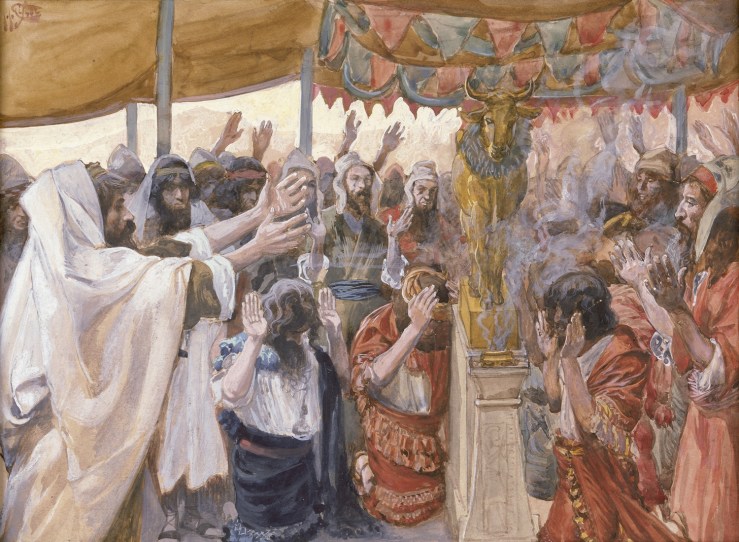
The Golden Calf painted by James Jacques Joseph Tissot, courtesy of The Jewish Museum, New York
The Golden Calf painted by James Jacques Joseph Tissot.
When Moses and Joshua come down from the mountain, wild revelry confronts them. In his fury, Moses smashes the stone tablets of the Law that God Himself had written. But the Law has already been broken in the hearts of God’s people.
Moses grinds the golden calf to powder, mixes the powder with water and makes the people drink it. Later, we read about a similar ritual for a woman suspected of adultery (Numbers 5:11-31). That may provide the background to this scene. Israel has committed spiritual adultery. They’ve forsaken their Husband, and joined themselves to idols.
Moses cries out, “Who is on the LORD’s side? Come to me.” (Exodus 32:26). The Levites respond. They execute judgment, killing around 3,000 men. And the Lord Himself sends a plague among the people.
The covenant renewal
God’s people mourn. Moses intercedes with God, pleading with Him to forgive the people and lead them into the Promised Land. Then he asks God, “Please show me your glory” (Exodus 33:18). God answers, “I will make all my goodness pass before you and will proclaim before you my name ‘The LORD’.” (Exodus 33:19).
Moses asks God, “Please show me your glory” (Exodus 33:18). God answers, “I will make all my goodness pass before you and will proclaim before you my name ‘The Lord’.” (Exodus 33:19).
Moses takes two new stone tablets and climbs Mount Sinai again. God puts Moses in a cleft in the mountain. He covers him with His hand, then removes it when He’s passed by. So Moses sees God’s back, but not His face. Then follows one of the most wonderful descriptions of God’s character in the Bible. God proclaims: “The LORD, the LORD, a God merciful and gracious, slow to anger, and abounding in steadfast love and faithfulness, keeping steadfast love for thousands, forgiving iniquity and transgression and sin, but who will by no means clear the guilty, visiting the iniquity of the fathers on the children and the children’s children, to the third and the fourth generation” (Exodus 34:6-7).
God graciously renews the covenant with His people. He tells Moses “Write these words, for in accordance with these words I have made a covenant with you and with Israel” (Exodus 34:27). And God again writes His Ten Commandments on the new tablets. Moses returns to the camp, his face glowing from exposure to God’s glory.
With the people chastened and the covenant renewed, work on the Tabernacle begins. Within a year of Israel’s arrival at Mount Sinai, it’s complete. God fills it with His glory, and makes it His earthly home. The priesthood is installed, and the sacrificial system begins to function.
“A people whose hearts go astray”
After celebrating their second Passover, Israel breaks camp and sets off for the Promised Land. There must have been an electric sense of anticipation! God leads them to the wilderness of Paran, about 150 miles north-east of Sinai.But on the journey, the people complain about “their misfortunes” (Numbers 11:1). Then they complain about the food God provides them! But this wasn’t the first time they’d complained. Before they even got to Mount Sinai, they “grumbled” (Exodus 15:24, 16:2, 17:3).
God had delivered Israel from cruel slavery in Egypt. He’d provided food―manna and quails―and water for them. And He Himself was present with them―visible as the pillar of smoke by day, and fire by night! The living God, Creator of the Universe, was their deliverer, their companion, their guide, and their provider. How could they complain?
God’s people grieved Him throughout their time in the wilderness. The Holy Spirit said: “For forty years I loathed that generation and said, ‘They are a people who go astray in their heart, and they have not known my ways.’” (Psalm 95:10, quoted in Hebrews 3:10). Only Divine grace born of Divine love could endure His people’s wilfulness. And their wilfulness serves as an example for us not to follow, as Paul explains in 1 Corinthians 10:1-12. He writes, “these things happened to them as an example, but they were written down for our instruction”.
Spying out the Promised Land
So Israel encamps in the Wilderness of Paran, at Kadesh-barnea. Moses sends 12 men, one from each tribe, to spy out the Promised Land. They return carrying grapes, pomegranates and figs―proving the land to be a paradise. But the inhabitants of the land are powerful; they live in fortified cities.
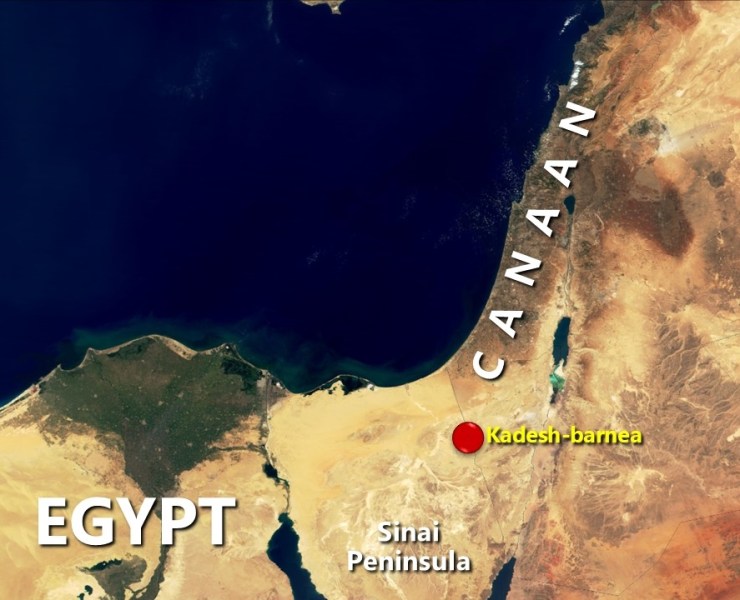
Background image: Image of Middle East courtesy of Jacques Descloitres, MODIS Land Science Team, NASA Visible Earth
The approximate location of Kadesh-barnea.
Two spies, Caleb and Joshua, are sure that God will give them victory over the inhabitants of the land. The other ten aren’t, and their report wins the day. The people wail, “. . . Why is the LORD bringing us into this land, to fall by the sword? . . . Would it not be better for us to go back to Egypt?” (Numbers 14:2-3). They speak of choosing a leader to take them back to Egypt―back to the old familiar life of slavery! They’ve completely forgotten what it was really like.
God’s people speak of choosing a leader to take them back to Egypt―back to the old familiar life of slavery! They’ve completely forgotten what it was really like.
God had promised He’d give them victory. The land’s inhabitants were themselves in dread of God and His people (see Joshua 2:9-11)! Israel’s unbelief is gross disobedience. God is present with them. He cares for them in so many ways. And untold blessings await them in the Promised Land. Yet they slander Him, saying, “‘Because the LORD hated us he has brought us out of the land of Egypt, to give us into the hand of the Amorites, to destroy us.” (Deuteronomy 1:27). How could they possibly say this? That is the selfsame lie Satan tempted Adam and Eve with―to think wrongly about God. And just like Adam and Eve, God’s people fall for it.
God can’t allow such rank unbelief to continue like a cancer in His people. So He decrees that all the men “able to go to war” (Numbers 1:3)―the men who should have defeated the Canaanites―will die in the wilderness, except Caleb and Joshua.
For the best part of four decades, Israel wanders in the wilderness―perhaps based for much of the time at Kadesh-barnea. This is just inside the southern boundary of the Promised Land itself! And yet much time and much travelling lay ahead before they invaded the land. So near and yet so far! The Bible reveals little about that period in the wilderness. Year followed year in dreary succession until all the warriors, except Caleb and Joshua, have died.

Qadesh Barnea (Israel) from Wikimedia Commons courtesy of Benno Rothenberg / Meitar Collection / National Library of Israel / The Pritzker Family National Photography Collection (CC BY 4.0)
Tell el-Qudeirat (probably the location of Kadesh-barnea). A photograph taken in 1954.
The waters of Meribah
Even after nearly 40 years in the wilderness, God’s people still complain. An angry mob confronts Moses and Aaron, crying: “. . . why have you made us come up out of Egypt to bring us to this evil place? It is no place for grain or figs or vines or pomegranates, and there is no water to drink.” (Numbers 20:5). Our patient God responds to His thirsty people’s complaint in love. Moses and Aaron just have to speak to a rock, and out of it water will flow.
But Moses―this longsuffering, faithful servant of God―has borne with this rebellious people for nearly 40 years. He’s had enough. In the heat of rage and exasperation, he shouts at them: “Listen, you rebels, must we bring you water out of this rock?” (Numbers 20:10 NIV). He speaks as if he and Aaron were sick and tired of the people―and thus implies God is sick and tired of them, too. And notice that he says “must we bring you water”―thus crediting this miraculous provision to his and Aaron’s own power! And rather than just speaking to the rock, he whacks it―not once but twice! Water comes out abundantly, and the people and their livestock drink. In His grace, God simply wanted to give His people water. But Moses has misrepresented and dishonoured God. And he’s disobeyed Him. So God bars Moses from entering the Promised Land.
In the next part . . .
We might well ask at this point: can this rebellious and faithless nation ever conquer the land and be God’s instrument of blessing to the world? But God has promised it will happen―and God never breaks His promises! We’ll see what happens next time.
Bible Reading and Questions
You may like to read Exodus 33:12-16. Here are a couple of questions to think about:
? What was the key thing that set Israel apart from the other nations? And what does this show us about ourselves as God’s people today?
Video
Here’s a short video, entitled Big People, Little Faith. It’s designed for children ages 6 to 12. But youth and adults may well enjoy it, too. This video is in a series published by Crossway. This series is based on the book called The Biggest Story Bible Storybook. All the videos can be viewed at The Biggest Story videos website. You can also create a free account to enable you to download them.
Book
The One True Story, by Tim Chester, is subtitled Daily Readings for Advent from Genesis to Jesus. Tim Chester writes, “Everyone loves the Christmas story . . . . But the Christmas story is not just a great story. It’s the great story. It’s the story that ties together a thousand other stories. . . . . The Christmas story is the one true story because it completes and fulfils all the stories of the Bible. But it also goes on being the one true story. This is the story that makes sense of my story and your story. We were made to know God. All our longings only truly find their fulfilment in him and through him. The plotlines of our lives are meant to find their resolution in the enjoyment of God. But we’ve set our lives on other trajectories which always lead to disappointing endings. But through the Christmas story God is rewriting the story of human history, bringing it to a glorious climax.”
Each of the 24 chapters traces a theme from the Old Testament that finds its culmination in Jesus – for example, The new Adam, The dragon-slayer, The new ark, The rock, The anointed one, The good shepherd, and The end of exile. The chapters also explore how the Christmas story connects with our stories. Each chapter ends in a meditation, and a prayer.
Read the publisher’s description, which also provides a sample containing the first three devotionals HERE.
Tim Chester has also written two other Advent daily reading books: The One True Light: Daily Readings for Advent from the Gospel of John (read the publisher’s description HERE), and The One True Gift: Daily Readings for Advent to Encourage and Inspire (read the publisher’s description HERE).
REFERENCES [1] See Exodus (Interpretation: A Bible Commentary for Teaching and Preaching) Terence E. Fretheim, page 279. Published by Westminster John Knox Press, Louisville, Kentucky, in 2010.
CREDITS ► Text copyright © 2024 Robert Gordon Betts ► Unless otherwise indicated, all Scripture is taken from the ESV® Bible (The Holy Bible, English Standard Version®), copyright © 2001 by Crossway, a publishing ministry of Good News Publishers. Anglicized English Standard Version copyright © 2002 by Crossway. Used by permission. All rights reserved. The ESV text may not be quoted in any publication made available to the public by a Creative Commons license. The ESV may not be translated in whole or in part into any other language. ► Scripture quotations marked ‘NIV’ are taken from The Holy Bible, New International Version (Anglicised edition). Copyright © 1979, 1984, 2011 by Biblica (formerly International Bible Society). Used by permission of Hodder & Stoughton Publishers, an Hachette UK company. All rights reserved. ‘NIV’ is a registered trademark of Biblica (formerly International Bible Society). UK trademark number 1448790.
 52 Steps
