
Part 2 ► In God’s Garden
Click the icon below to download a 4-page PDF version of this page.

In Genesis 1:2-2:3 we learned how, step by step, God transformed Earth. From a dark and lifeless sphere, He created a world filled with life and beauty. Now, in Genesis 2:4-25, God ‘zooms in’ to a specific region on Earth called Eden. He gives us a more detailed and intimate view of how He made the first man and woman, and the paradise that was to be their first home.
Where was Eden?
Eden was undoubtedly somewhere in the Middle East. Two of its rivers―the Tigris and the Euphrates―are still called by those names today. Perhaps Eden was close to where these rivers join, not far from the head of the Persian Gulf. Or it may have been near the headwaters of these rivers―perhaps somewhere in Armenia. Opinion is divided, but the second view seems more likely.
God’s “breath of life”
In Genesis 2:7 we learn how God created the first man, Adam. God shaped a human body from the dust of the ground. Then He breathed into this body “the breath of life”. Adam sprang to life: he became “a living creature”―a living person.
So God sculpted Adam from the dust of the ground. We humans are made from physical materials―the same kind of stuff that the Earth is made of. But we also have something invisible and alive. We have a human spirit. We are spiritual beings as well as physical beings. Our bodies and our spirits are both essential parts of our human nature. We can’t be human without our bodies, any more than we can be human without our spirits.
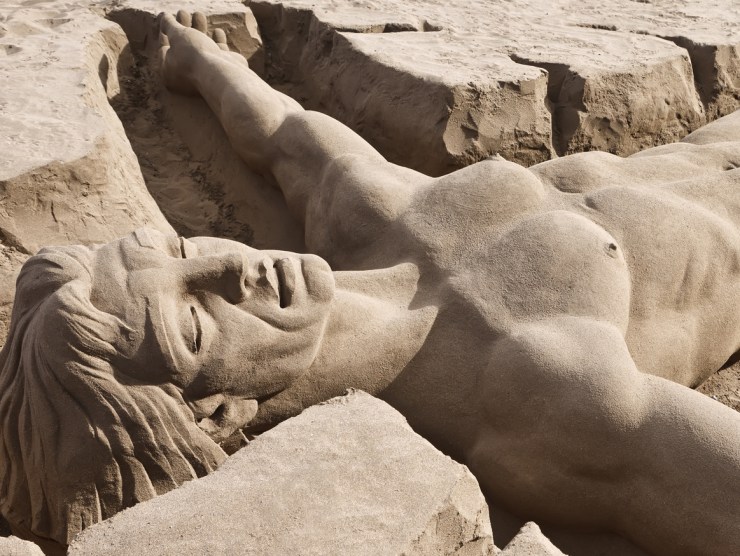
Sand sculpture of Adam. God shaped Adam’s body from the dust of the ground. Then He breathed into this body “the breath of life”.
Before we go on, notice the intimate way in which God brings Adam into life. God breathes His breath of life into Adam’s nostrils. One writer comments, “breathed is warmly personal, with the face-to-face intimacy of a kiss . . . .”[1] God, so to speak, gave Adam ‘the kiss of life’. We can imagine Adam awakening into consciousness and finding God, as it were, bending over him, having just breathed him into being. Adam’s very first experience was intimacy with God.
This note of intimacy is significant. The Bible is, at its heart, a love story. It tells of God’s love for mankind. That love story begins at the very moment of mankind’s creation.
“The Bible is, at its heart, a love story. It tells of God’s love for mankind. That love story begins at the very moment of mankind’s creation.”
The garden in Eden

Detian Waterfall on the China-Vietnam border. A present day ‘garden of Eden’.
God then planted a garden in Eden with beautiful and fruitful trees. Two trees are given special mention―the ”tree of life” and ”the tree of the knowledge of good and evil” (2:9). We’ll learn more about these trees later in this series. In that garden, God “put the man whom he had formed” (2:8).
A suitable helper
In 2:18, we read “The LORD God said, “It is not good . . . .”. This startles us. Until now, God had pronounced everything to be good. Now something was not good. Adam was alone.
God made animals and birds and brought them to Adam to see what he would call them. Some of the animals that Adam named could indeed be his faithful companions and helpers―just as some animals are to their owners today. But “for Adam no suitable helper was found” (2:20 NIV). He still needed a real soulmate―someone with whom he could truly be united, someone he could share his life with.
So God caused Adam to fall into “a deep sleep”. While he slept, God ”took one of his ribs and closed up its place with flesh. And the rib that the LORD God had taken from the man he made into a woman . . . .” (2:21-22). Then God brought the woman to Adam. Here at last was the one he was looking for! Overjoyed, Adam exclaimed, “This at last is bone of my bones and flesh of my flesh; she shall be called Woman, because she was taken out of Man”. God made the woman out of part of Adam’s body―she was his bone and flesh. God then gave her to Adam and they became “one flesh” again (2.24).
Matthew Henry, a Bible commentator who lived over 300 years ago, remarked: “the woman was . . .not made out of his head to rule over him, nor out of his feet to be trampled upon by him, but out of his side to be equal with him, under his arm to be protected, and near his heart to be beloved.”[2]
“The woman perfectly complements the man, and vice versa. She completes him, and he in turn completes her.”
God made the woman to be “a helper suitable for” the man (2:18 NIV). This word “helper” might perhaps suggest an ‘assistant’, someone inferior in status. In fact, the original Hebrew word here is most often used to describe the help that God provides for people (for example Psalm 121:1-2). The phrase “suitable for” could be translated ‘corresponding to’ or ‘complementing’. The woman perfectly complements the man, and vice versa. She completes him, and he in turn completes her. She is to be the man’s partner, one who matches him perfectly; his co-worker, supporting him in a task he couldn’t do alone. Both man and woman together were to be fruitful, to subdue the Earth and have dominion over every living creature (see 1:28).[3]

The woman is to be the man’s partner, one who matches him perfectly; his co-worker, supporting him in a task he couldn’t do alone.
There were areas in which the woman would be more gifted than the man, and vice versa. There were to be areas of special male responsibility and areas of special female responsibility. But though there were differences of role and responsibility, there was to be exact balance and perfect equality in the value that man and woman each brought to their partnership. And this inter-dependence of the sexes goes beyond marriage. It embraces all kinds of male-female relationships―mother and son, father and daughter, brother and sister, male and female friend or co-worker.[3]
Nonetheless, several things indicate that Adam was the leader in his marriage relationship: ◆ Adam was formed first. ◆ The woman―who Adam later named Eve―was created as Adam’s helper. In no way does this imply Eve’s inferiority. But it does imply that the man is the leader. ◆ Adam named Eve (2:23). ◆ Finally, after they ate from the forbidden tree, God questioned Adam first (3:9), even though Eve was the first to eat. This shows that God held the man, not the woman, ultimately responsible for their actions. The buck stopped with Adam, not Eve.
Humanity’s first home
The garden of Eden was mankind’s first home. It was also God’s home. In Genesis 3:8 we read that He walked “in the garden in the cool of the day” . God, of course, lives in Heaven. In fact, He’s present everywhere. But He was also present in the garden and enjoyed times of companionship with Adam and Eve there.

God walked “in the garden in the cool of the day” . He enjoyed times of companionship with Adam and Eve there.
So in the beginning, the first humans lived in God’s presence in God’s garden paradise. And that introduces us to the basic theme of the whole Bible―the Kingdom of God. What is the Kingdom of God? The simplest way to explain it is this: it’s God’s people living in God’s presence in God’s paradise. That’s what we see here in Genesis 2. God intended Adam and Eve―and all their descendants, including you and me―to live with Him in His paradise! He intended all humanity to be with Him. He wanted all humanity to enjoy a warmly personal relationship with Him.
“God intended Adam and Eve―and all their descendants, including you and me―to live with Him in His paradise!”
Our vocation
God gave humanity work to do. Adam and Eve were called to be “fruitful and multiply and fill the earth and subdue it, and have dominion over the fish of the sea and over the birds of the heavens and over every living thing that moves on the earth” (1:28). We also read that God put Adam in the garden “to work it and keep it” (2:15). We’ll look at this in more detail in the next part.
Naked without shame
Adam and Eve were both naked, and without shame (2:25). This probably means more than just that they didn’t wear any clothes. It seems to picture open, trusting relationship. Their relationship with each other, and with God, was open and transparent. They had nothing to hide from each other. They had nothing to hide from God.
In the next part . . .
What does the creation tell us about God? How should we think about the created world we live in? And why did God create? We’ll explore these questions in the next part of our series.
Bible Reading and Questions
You may like to read Genesis 2:1-25. Here are a couple of questions to think about:
? The garden of Eden was mankind’s first home. It was God’s earthly home, too. He enjoyed times of companionship with Adam and Eve. What does this teach us about God? And what does this teach us about ourselves?
Video
Here’s a short video, entitled And So It Begins. It’s designed for children ages 6 to 12. But it’s so good, I think everyone will enjoy it. This video is the first of a series published by Crossway. They’re based on the book called The Biggest Story Bible Storybook. All the videos can be viewed at The Biggest Story videos website. You can also create a free account to enable you to download them.
REFERENCES [1] Quoted from Genesis. An Introduction and Commentary. (Tyndale Old Testament Commentaries.) by Derek Kidner, page 60. Published by Inter-Varsity Press, Leicester, England, and Downers Grove, Illinois, U.S.A. First published by The Tyndale Press in 1967. [2] Quoted from Matthew Henry’s Commentary on the Whole Bible, Unabridged. Volume I: Genesis to Deuteronomy. Available online HERE, accessed 6 March 2023. [3] These ideas are from God’s Glory, Man’s Sexuality by Geoffrey Bingham, page 233. Published by New Creation Publications Inc., Blackwood, South Australia, in 1988. Available online HERE, accessed 28 April 2024.
CREDITS ► Text copyright © 2024 Robert Gordon Betts ► Unless otherwise indicated, all Scripture is taken from the ESV® Bible (The Holy Bible, English Standard Version®), copyright © 2001 by Crossway, a publishing ministry of Good News Publishers. Anglicized English Standard Version copyright © 2002 by Crossway. Used by permission. All rights reserved. The ESV text may not be quoted in any publication made available to the public by a Creative Commons license. The ESV may not be translated in whole or in part into any other language. ► Scripture quotations marked ‘NIV’ are taken from The Holy Bible, New International Version (Anglicised edition). Copyright © 1979, 1984, 2011 by Biblica (formerly International Bible Society). Used by permission of Hodder & Stoughton Publishers, an Hachette UK company. All rights reserved. ‘NIV’ is a registered trademark of Biblica (formerly International Bible Society). UK trademark number 1448790.
 52 Steps