
Part 19: God’s Holy Calendar
Click the icon below to download a 4-page PDF version of this page.

In His Law, God appointed special days and weeks and years for His people―the “appointed feasts of the LORD” (Leviticus 23:1-2). They were His holy calendar for His holy people.
The Sabbaths
The Sabbath day
The seventh day of each week was the Sabbath―“a day of sabbath rest, a day of sacred assembly” (Leviticus 23:3 NIV). We learn about this day in Exodus 20:8-11, 23:12, 31:13-17, and Deuteronomy 5:12-15. In Exodus 20:8-11 we read this: “Remember the Sabbath day, to keep it holy. Six days you shall labour, . . . , but the seventh day is a Sabbath to the LORD your God. On it you shall not do any work, you, or your son, or your daughter, your male servant, or your female servant, or your livestock, or the sojourner . . . within your gates. For in six days the LORD made heaven and earth, . . . and rested on the seventh day. Therefore the LORD blessed the Sabbath day and made it holy.”
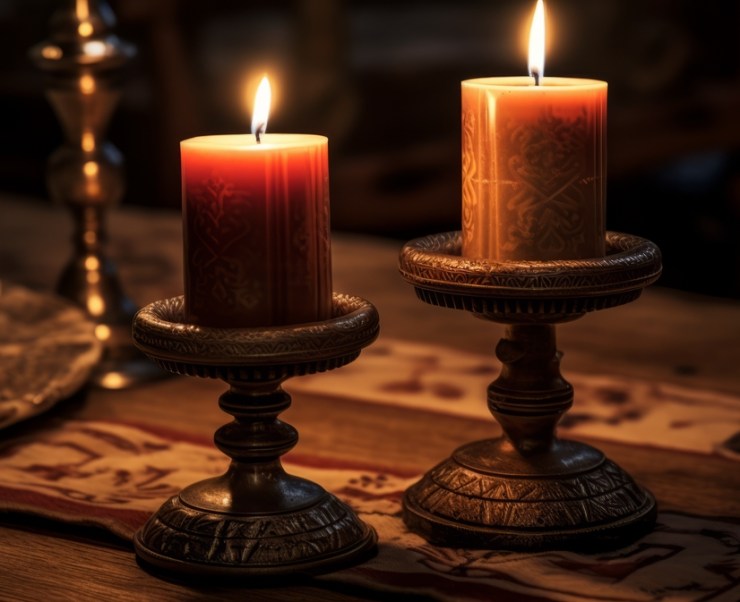
It is traditional to light Sabbath candles shortly before sunset on Friday, which marks the beginning of the Jewish Sabbath.
On the seventh day of creation, God “rested and was refreshed” (Exodus 31:17). He’d finished all His creative work. He was delighted with it. Now on the seventh day, He could enjoy it! Above all, He could enjoy fellowship with Adam and Eve, and they with Him. No wonder He “blessed the Sabbath day and made it holy”! And so He appoints the Sabbath day for His people Israel to enjoy.
On the seventh day of creation, God “rested and was refreshed”. He’d finished all His creative work. Now He could enjoy it! Above all, He could enjoy fellowship with Adam and Eve, and they with Him.
God said that the Sabbath “will be a sign between me and the Israelites for ever” (Exodus 31:17 NIV). It was a sign of the covenant He made with them at Mount Sinai. But how is the Sabbath a sign? It’s because it was a day to enjoy their covenant relationship with God to the full. It was a day of respite from the ‘daily grind’, a day to gather and worship Him, a day to learn of Him and and enjoy time in His presence, a day to enjoy time with family, friends and neighbours. It was also a day to remember their rescue from Egypt (Deuteronomy 5:15). Once they toiled as slaves in Egypt. Now they enjoyed rest in God’s presence!
And that helps explain why the penalty for breaking the Sabbath was so severe. God said, “the seventh day is a Sabbath of solemn rest, holy to the LORD. Whoever does any work on the Sabbath day shall be put to death.” (Exodus 31:15). To refuse to rest on the Sabbath was to say, in effect, “I don’t care enough about God or His people to spend time with them! I’ll do what I think best.” It echoes Adam and Eve’s rebellion against God―whose penalty, too, was death.
The Sabbath year
Every seventh year was a Sabbath year (Leviticus 25:1-7,20-22, Deuteronomy 15:1-11). God’s people were released from agricultural work for the whole year. God Himself would provide for them―they ate what the land yielded naturally. During this year, too, debts owed by fellow-Israelites were cancelled.
The Year of Jubilee
Every 50th year was a Year of Jubilee (Leviticus 25:8-55). As in the Sabbath year, God’s people were released from agricultural work for the whole year. They ate what the land yielded naturally. In addition, Israelites who were servants to fellow Israelites were released. Families who’d sold off land could now go home and reclaim it (with one exception detailed in Leviticus 25:29-30). It was a year of rest, and it was a time of release from debt and servitude, a time of homecoming. It was a new beginning, a year of liberty and rest and joy.
Recalling the Garden of Eden
The first six creation days ended with evening and morning (Genesis 1:5,8,13,19,23,31) but not the seventh. It seems God intended the seventh day to never end. But then sin entered. God said to Adam: “Cursed is the ground because of you; through painful toil you will eat food from it . . . .” (Genesis 3:17). Sin brought toil. Now, during the Sabbath days and years, God released His people from toil. He was taking His people back to life in the Garden of Eden, to life without toil.
Foreshadowing the new creation
And God was giving Israel a foretaste of life in the world to come. The Sabbath days and years, and especially the Year of Jubilee, are glimpses of what life in the new Earth will be like―a life without sorrow or pain or death, a life in the presence of God (Revelation 21:3).
The Sabbath days and years, and especially the Year of Jubilee, are glimpses of what life in the new Earth will be like.
The festivals
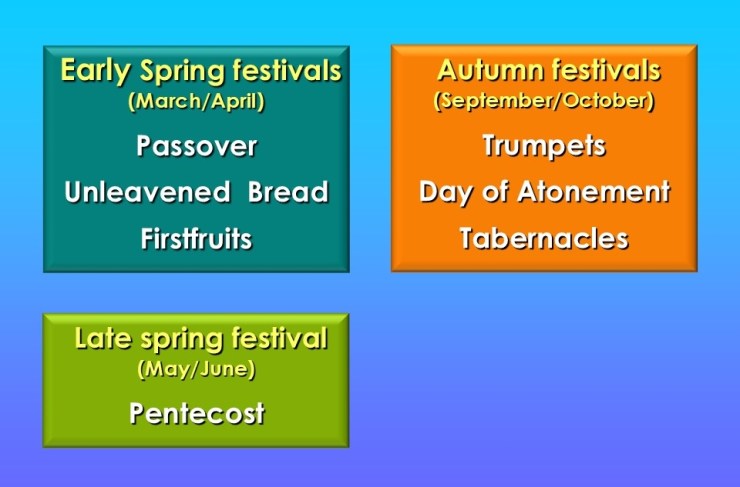
The calendar of Jewish festivals.
As well as the Sabbath, God appointed seven other festivals or “feasts” (Exodus 23:14-17, Leviticus 23:4-43).
● Four were in the spring. Passover was followed by the week-long Festival of Unleavened Bread. During this week, the people also offered the firstfruits of their cereal harvest at the Festival of Firstfruits. Fifty days later was Pentecost (also called the Festival of Weeks, the Festival of Harvest, or the Day of the Firstfruits).
●Three were in the autumn. The Festival of Trumpets marked the start of the seventh month. The trumpet blasts reminded God and His people of their covenant commitment to each other. His people needed this reminder. But God, of course, can’t forget―the trumpet blasts served as Israel’s prayer, asking God to ‘remember’, in other words, to continue His commitment to them. In this seventh month, the Day of Atonement and the Festival of Tabernacles (also called the Festival of Booths or the Festival of Ingathering) also occurred.
Celebrating the past

Image Edsel Little on Wikimedia Commons (CC BY-SA 2.0)
A ‘seder’ plate. This plate contains symbolic foods eaten or displayed at the Passover meal. These foods symbolise something about the first Passover and the Exodus from Egypt. Starting with the top left, you can see (1) the shankbone of a lamb, (2) a roasted hard-boiled egg, (3) horseradish, (4) onion, (5) ‘charoset’, a mixture of finely chopped fruits and nuts, and (6) parsley. You can see a numbered version of this plate, with explanations of the food items HERE.
God wanted His people to remember what He’d done for them.
►The Festivals of Passover and Unleavened Bread celebrated their exodus from Egypt, and the first Passover meal with unleavened bread.
►Pentecost was a day to remember they were once slaves in Egypt.
►And during the Festival of Tabernacles, they were to lodge in temporary shelters―recalling their life in the wilderness, living in tents.
Rejoicing in the present
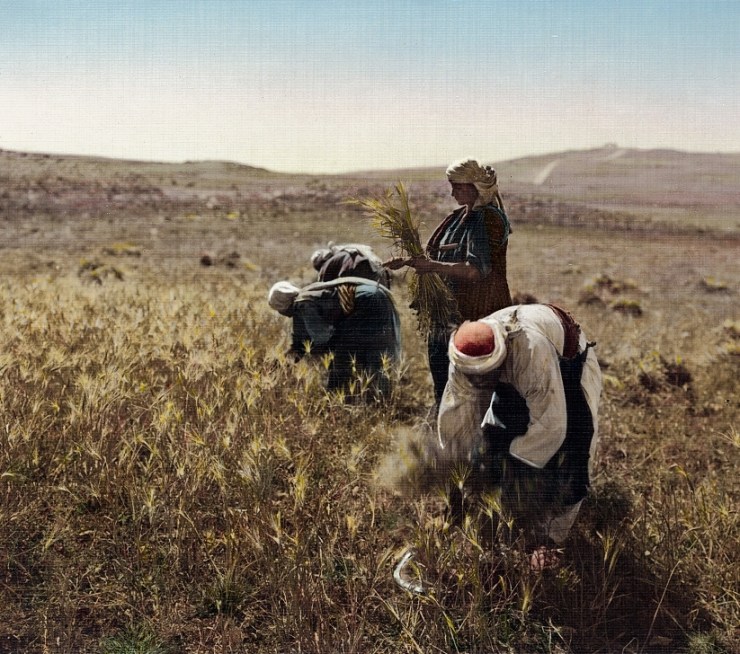
Image courtesy Library of Congress Prints & Photographs Online Catalog
An old photograph (taken between 1898 to 1919) of Arab reapers harvesting barley―a scene not much changed from Biblical times. At the Festival of Firstfruits, God’s people were to offer God the firstfruits (the first and best) of the barley harvest.
And God wanted His people to thank Him for His bountiful provision year by year. He promised them, “If you . . . observe my commandments . . . the land shall yield its increase, and the trees . . . shall yield their fruit” (Leviticus 26:3-4).
►At the Festival of Firstfruits, the people offered God the firstfruits (the first and best) of the barley harvest. Through this offering, they acknowledged that God provided the harvest, and that He was worthy of the very best.[1]
►At Pentecost, they offered the firstfruits of the wheat harvest, in the form of two loaves.
►The Festival of Tabernacles occurred at the end of the fruit harvest, when all the crops had been gathered in. It was a celebration of thanksgiving for the year’s harvests (see Deuteronomy 6:10-13).
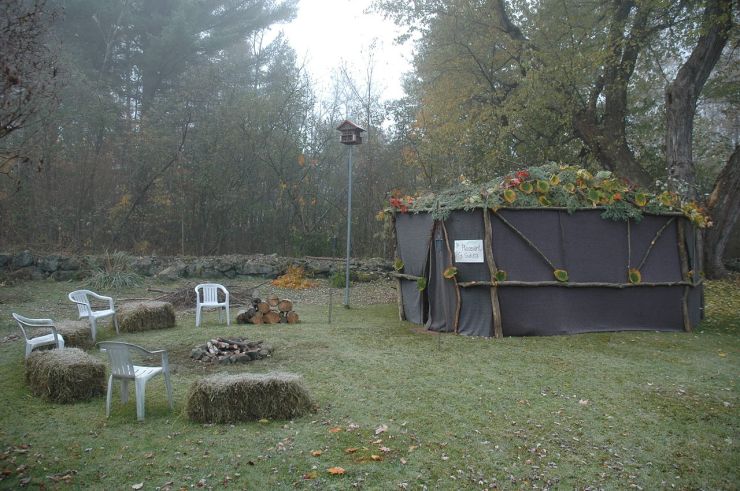
Image from Wikimedia Commons
A sukkah in New Hampshire. The sukkah is an outdoor temporary shelter that many Jewish people live in during the week-long holiday of Sukkot (Tabernacles).
Looking forward to the future
And, as so often in the Old Testament, the festivals point us to Jesus―to His work of salvation for us and restoration of the creation.
► Jesus fulfilled the Festival of Passover. He was our Passover Lamb.
►At the Festival of Unleavened Bread, God’s people removed leaven (containing yeast) from their houses. They typically made bread rise by adding a piece of dough from a previous batch. But if that piece was contaminated with germs, it would pass those on to the new batch, which would contaminate the next batch, and so on. And so removing all the leaven from their homes was a decontamination process. It symbolised cleansing away sin. Then for seven days they would eat only unleavened bread. By His death, Jesus broke the chain of contamination with sin that began with Adam. And so He fulfilled the Festival of Unleavened Bread.
►Jesus fulfilled the Festival of Firstfruits. He rose on the Festival of Firstfruits. He’s the firstfruits―the first human to rise from death.
►And 50 days after His resurrection, Jesus fulfilled the Festival of Pentecost, when He poured out the Holy Spirit. A gospel harvest began on that day that will continue until Jesus returns.
►The Festival of Trumpets points to the end of the age when “the Lord himself will descend from heaven with a cry of command, with the voice of an archangel, and with the sound of the trumpet of God” to gather His people from every age and place (1 Thessalonians 4:16).
►The sacrifices on the Day of Atonement foreshadow Jesus’s atoning sacrifice on the Cross. He is our great High Priest, who entered the Most Holy Place in Heaven with His own blood (Hebrews 9:11-12). He is our Scapegoat: God laid our sin on Him, and He bore its penalty.
►Finally, the Festival of Tabernacles points forward to the end of the age. God’s gospel harvest will then be fully gathered in. His people will enjoy perfect rest and joy in the New Heaven and Earth.
The festivals point us to Jesus―to His work of salvation for us and restoration of the creation.
Firstfruits and tithes
God promised that, if His people obeyed Him, He’d make them, their livestock, and their land fruitful (see Deuteronomy 28:1-6). They were to give a portion of this abundance back to God―thus acknowledging that all they possessed belonged to God, their Lord and Provider.
►They were to consecrate their firstborn sons to God. Later, the tribe of Levi was given to God and served Him instead of the firstborn.
►The firstborn males of the livestock were to be given to God, too, as were the firstfruits of the agricultural produce.
►A ten-per-cent portion (called a tithe) of the crops, herds and flocks was to be set aside. Most of the tithes went to the Levites; a portion was given to the priests. But the people who gave the tithes also enjoyed a portion―a joyful feast in God’s presence! God said: “you shall eat . . . before the LORD your God and rejoice, you and your household” (Deuteronomy 14:26, see the passage 14:22-28). And in some years, the tithes were shared with immigrants, the fatherless and widows―the people who need most support.
In the next part . . .
We pick up the story at Exodus 32:1. Moses and Joshua are on Mount Sinai receiving God’s plans for the Tabernacle and the priests. The people wait below. But, at this pivotal moment in their history, things go wrong―terribly wrong. What happens? We’ll see next time.
Bible reading and questions
You may like to read Leviticus 25:1-22. Here’s something to think about:
?Imagine you’re an Israelite. It’s the beginning of the Sabbath year. You’re to down tools and leave your fields fallow and your vines and figs untended for a whole year. But you depend on these crops to feed you and your family. What would this Sabbath year teach you about God? And how would it impact your walk with God?
Video
Here’s a video entitled A Wedding in the Wilderness. It’s a visual guide to God’s Law. You’ll see what happened at the covenant ceremony at Mount Sinai, you’ll be taken on a tour of the Tabernacle, and you’ll learn about the Law, including the sacrifices and priests, and about God’s holy calendar.
REFERENCES [1] See Leviticus (Tyndale Old Testament Commentaries) by Jay Sklar, page 282. Published by InterVarsity Press, Downers Grove, Illinois, and Inter-Varsity Press, Nottingham, U.K., in 2013.
CREDITS ► Text copyright © 2026 Robert Gordon Betts ► Unless otherwise indicated, all Scripture is taken from the ESV® Bible (The Holy Bible, English Standard Version®), copyright © 2001 by Crossway, a publishing ministry of Good News Publishers. Anglicized English Standard Version copyright © 2002 by Crossway. Used by permission. All rights reserved. The ESV text may not be quoted in any publication made available to the public by a Creative Commons license. The ESV may not be translated in whole or in part into any other language. ► Scripture quotations marked ‘NIV’ are taken from The Holy Bible, New International Version (Anglicised edition). Copyright © 1979, 1984, 2011 by Biblica (formerly International Bible Society). Used by permission of Hodder & Stoughton Publishers, an Hachette UK company. All rights reserved. ‘NIV’ is a registered trademark of Biblica (formerly International Bible Society). UK trademark number 1448790.
 52 Steps


