
Part 18: Brought Near By The Blood
Click the icon below to download a 4-page PDF version of this page.

The sacrifices―God’s gracious provision for His people
God’s people are camped in the wilderness by Mount Sinai. In the middle of their camp is the Tabernacle, where God lives among them.
What must it have been like having the Lord Almighty, Creator and Sustainer of the Universe living so close to you? Imagine you’re emerging from your tent for an evening stroll. It’s dark, but there, towering above the Tabernacle, is the pillar of fire―the visible sign of God’s holy presence! As you walk, you’re reminded that you need to be holy, too. You remember how God has shown you how to live a holy life―through the Ten Commandments, and through everything else in His Law that He taught you through Moses.
What must it have been like having the Lord Almighty, Creator and Sustainer of the Universe living so close to you?
You think, too, of all the times you haven’t obeyed God’s Law. But you also thank God that He’s provided forgiveness for you, through the sacrifices offered to Him. As you make your way homewards, you can still see smoke rising from the Tabernacle courtyard―a sacrifice has just been offered on the altar there. In fact, hardly a moment goes by when there isn’t smoke rising from that altar!

Image © Steve Creitz at ProphecyArt.com
An artist’s impression of the Tabernacle at night, with the pillar of fire above it.
But why sacrifice? Many of the sacrifices were animals. And so we enter a world of butchery and blood and burning animal carcases. Our God is not bloodthirsty; neither does He delight in death for its own sake. So why all the death? Why all the blood? To explain that, we need (as we so often do) to go back to the beginning. When Adam and Eve disobeyed God, their relationship with Him was broken―we saw that in Part 6. They were now alienated from Him, spiritually dead. And because we’re all connected to our ancestor Adam, we’re all born sinners, alienated from God, spiritually dead.
How can we be forgiven? How can we be reconciled with God? Only if someone dies in our place and pays the penalty for our sin. Centuries later, of course, someone did die in our place―Christ died for us (Romans 5:8). But, before Christ came, God arranged for animals to die. He accepted their death as payment for His people’s sins. And so He was able to continue living among His people.
In His Law, God set out detailed instructions about sacrifices. That included what had to be done with the animal’s blood. But why the emphasis on blood? Blood is essential to life. So when blood is shed, it pictures life being extinguished. It represents death.
The sacrifices
To explain the sacrifices, let’s take an example. When an ordinary Israelite sinned unintentionally (for example, through carelessness), and wanted to put things right, they had to offer a sacrifice. If they could afford it, they had to take a female goat or lamb without any defects to the altar in the Tabernacle courtyard. Then they had to lay their hand “on the head of the sin offering and kill the sin offering” (Leviticus 4:29). Laying their hand on its head showed that the animal was going to die in their place. Then “the priest shall take some of its blood with his finger and put it on the horns of the altar . . . and pour out all the rest of its blood at the base of the altar. And all its fat he shall remove, . . . and the priest shall burn it on the altar for a pleasing aroma to the LORD. And the priest shall make atonement for him, and he shall be forgiven.” (Leviticus 4:29-31). The animal has died instead of the sinner. God has accepted their offering, and they’re now forgiven!
These sacrifices enabled God to forgive you and welcome you into fellowship with Him. They brought you to God. The Bible calls this atonement.

Image © www.BiblePlaces.com
The altar in the courtyard of the full-scale replica of the Tabernacle, Timna Park, Israel (see Exodus 27:1-8). It’s often called “the altar of burnt offering”.
There were different kinds of sacrifice. To explain them, think about this: what do you need to do when you’ve done something wrong, and you’re now sorry about it? First, you need to confess your sin to God, and to any people you’ve wronged. Then:
► You need to be cleansed―sin often makes us feel dirty (see Psalm 51:2)[1]. That’s what the purification offering, also called the sin offering was for (Leviticus 4:1-5:13).
►Where necessary, you’d need to put things right. And so you’d offer a restitution offering, also called the guilt offering or the trespass offering (Leviticus 5:14-6:7). Where possible, you’d also need to pay money as compensation.
►To dedicate yourself again to God, you could offer a burnt offering (Leviticus 1:1-17). If it was from your herd or flock, then it was cut up, and all of it (except the skin, Leviticus 7:8) was burnt―picturing your complete dedication to God. And through the grain offering, also called the cereal offering (Leviticus 2:1-16), you could offer a gift to God from your agricultural produce. In this way, you acknowledged that you owe everything to God.
►You could, if you wished, offer a fellowship offering, also called the peace offering (Leviticus 3:1-17). This offering became a meal that you and your guests would enjoy in God’s presence. It celebrated your fellowship with God.
These sacrifices enabled God to forgive you and welcome you into fellowship with Him. They brought you to God. The Bible calls this atonement.

The five basic sacrifices detailed in Leviticus 1:1-6:7.
There were various other instructions that we haven’t space to go into. Here are some examples. ◆ What if you were too poor to afford a large animal as a purification offering? In that case, God graciously allowed you to offer two birds, or even some flour. ◆ Burnt offerings, accompanied by cereal and drink offerings, were also offered for the whole nation at least twice daily. These pictured the perpetual consecration of the nation to God. ◆ Sacrifices were offered for various other reasons―for example, for ritual impurity.
The Passover and the Day of Atonement
There were two special annual sacrifices―the Passover lambs in the spring, and a special sacrifice on the Day of Atonement in the autumn.
The Passover
At the festival of Passover, each Israelite family would kill a lamb or goat and eat it as part of a meal. It celebrated their deliverance from slavery in Egypt, and their covenant relationship with God. We looked at the very first Passover in Part 14.
The Day of Atonement
Despite all the sacrifices offered through the year, there would still have been many sins that hadn’t been dealt with―including sins that couldn’t be covered by the sacrifices we’ve looked at above. So what could be done? God’s answer was a special offering on the Day of Atonement.
Once a year, on the Day of Atonement, a special purification offering was made for the whole nation. It comprised a pair of goats. The first goat was killed. The high priest sprinkled its blood (together with that of a bull offered for himself) in the Most Holy Place, in the Holy Place and on the altar of burnt offering.
Then the high priest placed both hands on the head of the other goat. This was the scapegoat. Over this goat the high priest confessed “all the iniquities of the people of Israel, and all their transgressions, all their sins” (Leviticus 16:21). Notice how comprehensive this is―“iniquities . . . transgressions . . . sins”. By doing this, he symbolically transferred the sins of the whole nation onto that goat. It was as if the goat was now considered responsible for all the nation’s sins over the previous year!
The scapegoat wasn’t killed. Instead, it was led out eastwards into the wilderness and released, never to return. That sin-laden goat’s journey pictured the removal of the nation’s sins “as far as the east is from the west” (Psalm 103:12). And perhaps there was another reason why the goat was led into the wilderness. It was banished there, far from God’s presence. That was what the whole nation should have suffered―everlasting separation from God’s presence. But the scapegoat symbolically suffered this in their place, so God’s beloved people didn’t have to. Once again, we see God’s grace “outrunning the avalanche of sin”![2]
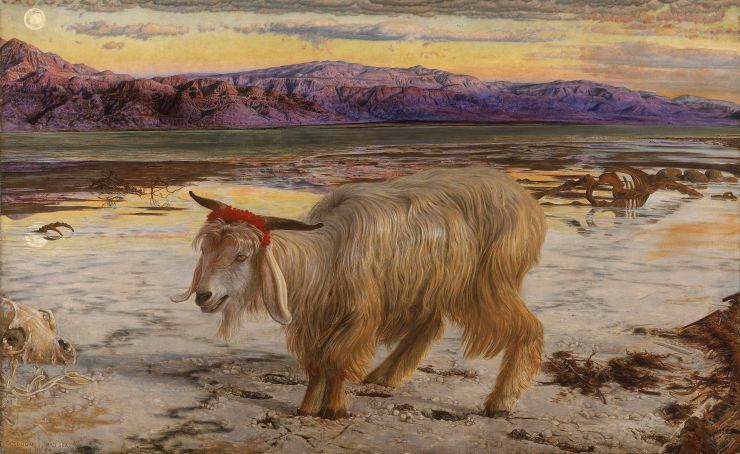
The Scapegoat by William Holman Hunt, from Wikimedia Commons
‘The Scapegoat’ painted by William Holman Hunt. The goat is shown near the southern end of the Dead Sea, in a desolate wilderness. Abandoned, it stands shakily, soon to be just another skeleton embedded in the mud. The goat bears a piece of red cloth. Although not prescribed in Leviticus, the High Priest in Jesus’s time tied a piece of scarlet cloth to its horn. This identified it as the scapegoat; and the red colour, it seems, represented the sins of the people.
The sacrifices of the Day of Atonement purified the Tabernacle from the defilement caused by the people’s sins and ritual impurities (see Leviticus 16:16,19). And they made atonement for the sins and ritual impurities of the people themselves. Now God could continue to dwell among them for the coming year.
Once again, we see God’s grace “outrunning the avalanche of sin”!
The writer to the Hebrews tells us: “it is impossible for the blood of bulls and goats to take away sins” (Hebrews 10:4). So what was the point of offering them? Because God really did forgive those who offered them―if they truly repented. The penalty for their sin was still due. But God graciously postponed that penalty. One day that penalty would be paid. Jesus paid it on the Cross. His death fulfilled the whole sacrificial system. We can’t fully understand all that Jesus did for us on the Cross, until we know about these Old Testament sacrifices. So you can see why they’re so relevant to us.
The sacrificial system used huge numbers of animals, and employed many priests. It showed the great lengths God needed to go to in order to deal with sin. The fact that this system is now superseded must not blunt our awareness of how serious sin is.
The priests
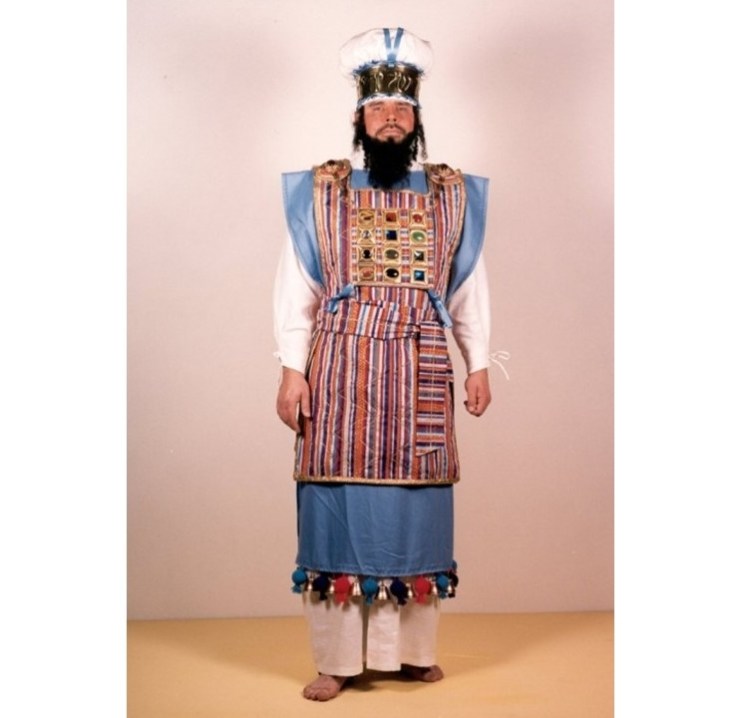
Image © George Bates at The Bible Zone
Here’s a picture of what the High Priest, dressed in robes, would have looked like. Under the outer, multicoloured ephod (rather like a kind of apron) is the blue robe, and under that, the white tunic. Over the ephod is the breastpiece with its 12 gemstones, representing the 12 tribes of israel. His turban bears a gold plate inscribed ‘Holy to the LORD’.
No ordinary Israelite could serve God in the Tabernacle. God chose only the priests―Aaron and his sons―to come near to Him and serve Him there (compare Ezekiel 45:4). They were mediators (or ‘go-betweens’) between God and His people. They were to worship and serve God on behalf of the whole nation. They were to keep the Tabernacle holy, and offer sacrifices. And they had other roles, too―for example, teaching God’s Law, praying for the people, and pronouncing God’s blessing on them (Numbers 6:22-27). The rest of the tribe of Levi helped the priests.
But God also called the whole nation to be “a kingdom of priests” (Exodus 19:6). They were all to worship and serve God. They were all to keep the camp―and later, the Promised Land―holy. Now we believers are “a royal priesthood” (1 Peter 2:9)―as we’ll see later in our series.
In the next part . . .
God appoints special days and weeks and years for His people―the “appointed feasts of the LORD” (Leviticus 23:1-2). They included the Sabbath days and years, the Year of Jubilee, and the seven annual festivals. Why did God appoint these special times? And what do they tell us about His wonderful plan of salvation? We’ll see next time.
Bible reading and question
You may like to read Leviticus 16:1-34. Here’s something to think about:
?Imagine you’re in the camp on the Day of Atonement. You see the scapegoat, bearing the nation’s sins―including your own sins―and disappearing into the wilderness. What would you feel?
Video
Here’s a short video, entitled A Tale of Two Goats. It’s designed for children ages 6 to 12, but youth and adults may well enjoy it, too. This video is in a series published by Crossway. They’re based on the book called The Biggest Story Bible Storybook. All the videos can be viewed at The Biggest Story videos website. You can also create a free account to enable you to download them.
REFERENCES [1] See Leviticus (Tyndale Old Testament Commentary), by Jay Sklar, page 108. Published by InterVarsity Press, Downers Grove, Illinois, and Inter-Varsity Press, Nottingham, England, in 2013. [2] This phrase is quoted from The Story of All Stories: Genesis 1-11 by Darrell Johnson, pages 75, 83 and 85. Published by Regent College Publishing, Vancouver, Canada, in 2019. The phrase “avalanche of sin” was used by Gerhard von Rad (see note 5 on page 74 of The Story of All Stories).
CREDITS ► Text copyright © 2024 Robert Gordon Betts ► All Scripture is taken from the ESV® Bible (The Holy Bible, English Standard Version®), copyright © 2001 by Crossway, a publishing ministry of Good News Publishers. Anglicized English Standard Version copyright © 2002 by Crossway. Used by permission. All rights reserved. The ESV text may not be quoted in any publication made available to the public by a Creative Commons license. The ESV may not be translated in whole or in part into any other language.
 52 Steps
