
Part 17: God’s Blueprint for Blessing
Click the icon below to download a 4-page PDF version of this page.

The Law―God’s gracious gift to His people
God’s people are camped at the foot of Mount Sinai. There God makes a covenant with them―we saw this in Part 15. It’s like a wedding: God becomes their Husband. God vows to bless His people. Israel, in turn, vows to love, serve and obey God. God shows them how to do this by giving them His Law.
The Hebrew word for ‘Law’ is torah, meaning ‘teaching’, ‘instruction’ or ‘guidance’. Its basis is the Ten Commandments (Exodus 20:1-17). These are supplemented and expanded by Exodus 20:22-23:33 and other passages in Exodus to Deuteronomy. The Ten Commandments begin, “I am the LORD your God, who brought you out of the land of Egypt, out of the house of slavery. You shall have no other gods besides me.” (Exodus 20:2–3, ESV margin). This first commandment is the foundation for all the other nine.
The Law was God’s gift to His people. To King David, the Law was more precious than gold and sweeter than honey (Psalm 19:7-11).
The Law was God’s gift to His people. To King David, the Law was more precious than gold and sweeter than honey.

“Your word is a lamp to my feet and a light to my path” (Psalm 119:105). A traditional lamp illuminating the Hebrew text of the Torah.
Returning to the garden of Eden
God says to Israel, “I will make my dwelling among you, . . . . And I will walk among you and will be your God, and you shall be my people.” (Leviticus 26:11–12). What God says here is repeated many times through the Bible―it’s a key to the whole Bible story. God loves us so much that He wants to live among us!
In the beginning, God walked in the garden of Eden “in the cool of the day” (Genesis 3:8). Adam and Eve enjoyed times of companionship with Him there. Now God has a new ‘garden of Eden’―the Tabernacle. We looked at this tent in Part 16. For the first time since Adam and Eve’s first sin, God makes a home for Himself on Earth. [1]
But remember how Mount Sinai shook and smoked and burned as God descended on it. One writer imagines an Israelite asking: “How in the world can the holy and pure King of the universe dwell among his sinful and impure people? How can he live here, in our very midst, without his holiness melting us in our sin and impurity?”[2]

Photo by Aaron Thomas on Unsplash
Fire and smoke erupt from Volcán de Fuego, Guatamala. This scene reminds us of the time when Mount Sinai shook and smoked and burned as God descended on it.
God’s answer was His Law. The Law wasn’t “a set of arbitrary restrictions intended to inhibit people and make them miserable and guilty”.[3] On the contrary, it was God’s blueprint for blessing. Sin “is an acid that mars and destroys whatever it touches”.[4] God loved His people. He didn’t want sin to destroy them. He wanted them to enjoy a truly satisfying life―the ‘good life’, life to the full. That’s why He gave them His Law. Tremendous blessing would overtake them if they obeyed (see Leviticus 26:3-12, Deuteronomy 28:1-14).
And God didn’t want slavish, grudging obedience to the Law. Israel was to obey it with all their heart and soul (Deuteronomy 26:16).
The Law was God’s blueprint for blessing. He wanted them to enjoy a truly satisfying life―the ‘good life’, life to the full.
The Torah
According to Jewish tradition, the Law (in other words, the torah) comprises 613 individual laws drawn from the first five books of the Bible (Genesis to Deuteronomy). In a wider sense the torah consists of all of those five books. For our purposes we’ll consider laws we find in the four books Exodus to Deuteronomy.
So what was God teaching His people through the Law?
► He was teaching them about holiness. He said “. . . be holy, for I am holy” (Leviticus 11:44-45). If His people were going to enjoy living in His presence, they needed to be holy. The Law showed them how.
►The Law taught God’s people how to love. Remember what we saw in Part 5: sin is, in the end, worshipping and serving ourselves. That wrecks all our relationships. And that’s what happened right from the beginning―as we saw in Part 6. Now God is showing His people how to love―how to love Him, and how to love others. In fact, that’s the basis of the whole Law. Quoting from Deuteronomy 6:5 and Leviticus 19:18, Jesus says: “You shall love the Lord your God with all your heart and with all your soul and with all your mind. This is the great and first commandment. And a second is like it: You shall love your neighbour as yourself. On these two commandments depend all the Law and the Prophets.” (Matthew 22:37-40).
►Adam and Eve’s sin wrecked their relationship with creation, too. So God included laws about how His people should care for their animals.
►The Law curbed sin by defining it and setting out penalties for breaking it. And so it deterred people from doing wrong. And it enabled lawbreakers to be dealt with righteously and fairly.
►God spelled out how Israel’s king should rule, in preparation for the day when a king would rule over them.
►God gave instructions about priests. These were mediators (or ‘go-betweens’) between God and His people. We’ll look at the priests in the next part.
►God tells us about various sacrifices. These sacrifices enabled God to forgive His people for their sins and welcome them into fellowship with Him. They brought them to God. The Bible calls this atonement. We’ll look at the sacrifices in the next part.
►The Law showed God’s people how to keep themselves, the Tabernacle, and their camp―and the Promised Land they would one day inhabit―pure and holy. The holy God can only live among a holy people in a holy place. God told Aaron: “You are to distinguish between the holy and the common, and between the unclean and the clean” (Leviticus 10:10). For example, the Law explained what they should eat; it told them how to deal with skin diseases, and with mould in textiles and houses. All this seems rather obscure and complicated to us. Some of these laws relate to good hygiene. But, taken as a whole, they seem to be object lessons―through these purity laws, God was teaching His people about living pure lives.
►God set out a calendar of holy days and festivals, and prescribed the tithes (portions of crops given to God) and the offerings of firstfruits. We’ll look at these in Part 19.
The Law wasn’t a way to earn God’s salvation. God’s people were already saved. They were already His people. He’d rescued them from slavery in Egypt and brought them to Himself (Exodus 19:4, 20:2). Through the Law, God was teaching Israel how to live as His people.
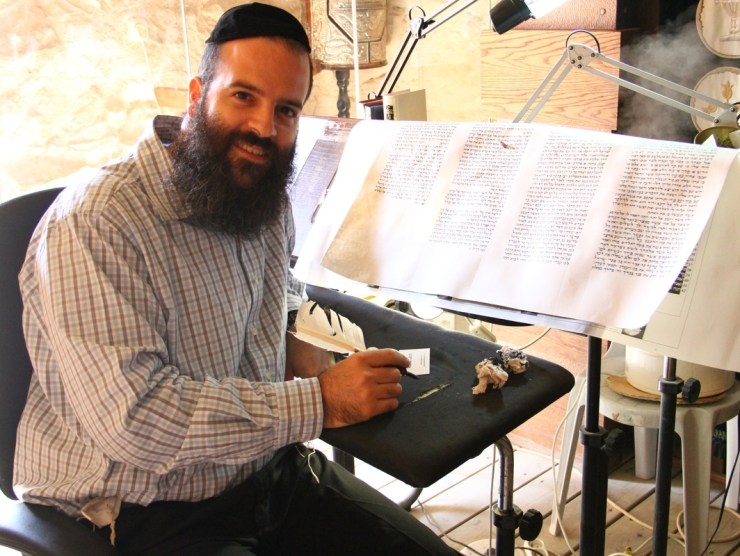
A Jewish scribe writing the Torah by hand.
Refuting Satan’s lies
Back in Part 5, we saw how Satan tempted Adam and Eve to think wrongly about God. Satan wanted them to believe God wasn’t trustworthy, that He didn’t love them, that He was selfish, and didn’t want the best for them. The Law explodes those lies. It shows us God’s perfect holiness, righteousness and justice, His goodness and love, His grace and mercy.
The Law shows us God’s perfect holiness, righteousness and justice, His goodness and love, His grace and mercy.
And Satan wanted Adam and Eve to think wrongly about themselves, too―that their lives would be better without God, that they could be their own gods and decide for themselves how to live. The Law exposes this lie, too. Following God’s Law was the doorway to the ‘good life’, the best life possible in those days before Christ came.
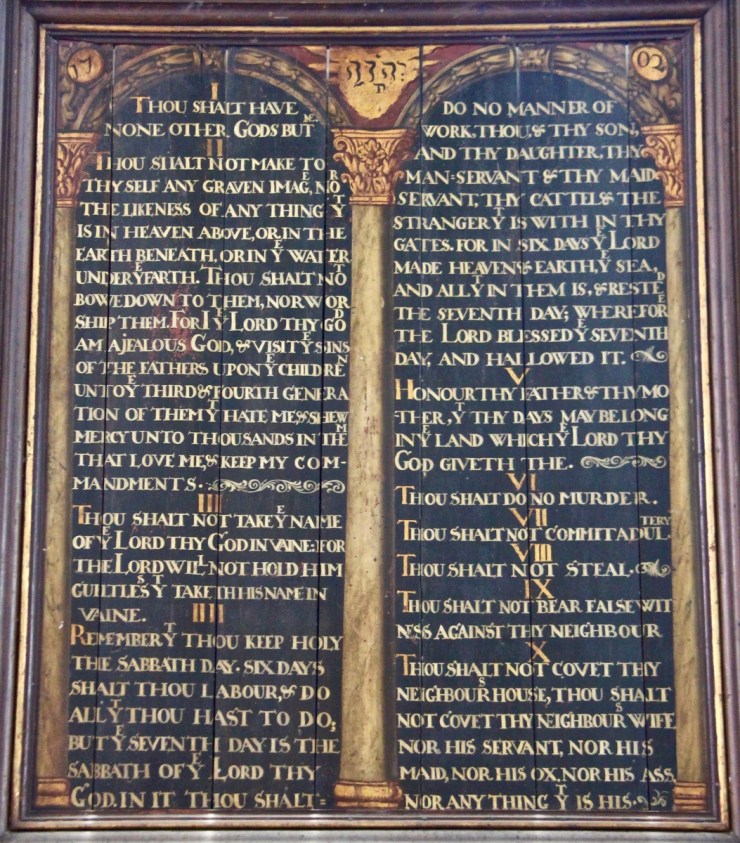
A painting of the Ten Commandments, dated 1702, in Christchurch Priory, Dorset, England.
How may we be right with God?
But, by their constant failure to keep the Law, the Law also brought home to people―at least those who honoured God―that they were slaves of sin. J.B. Phillips writes (in his paraphrase of Romans 3:20): “. . . it is the straight-edge of the Law that shows us how crooked we are”.
And so the Law leads us to Jesus Christ. Paul writes, “now apart from the law the righteousness of God has been made known, to which the Law and the Prophets testify. This righteousness is given through faith in Jesus Christ to all who believe.” (Romans 3:21-22 NIV). God declares us to be in right relationship with Him, not through the Law, but by faith in Jesus Christ.
And God gives us His Spirit so we can obey Him and live in a way that pleases Him. Through Ezekiel, God said to His people, “I will put my Spirit in you and move you to follow my decrees and be careful to keep my laws” (Ezekiel 36:27). We’ll explore this later in our series.
God’s holiness, and ours
God’s holiness is everything about Him that causes us to revere Him with godly fear, to worship and adore and praise Him. It is His absolute and infinite perfection, purity, and glory. See what happened when people saw God’s glory! Moses “quickly bowed his head towards the earth and worshipped” (Exodus 34:8). Overcome, Isaiah cried out “Woe is me! . . . I am a man of unclean lips, and I dwell in the midst of a people of unclean lips; . . . .” (Isaiah 6:5). Ezekiel fell on his face (Ezekiel 1:28). God’s holiness has two aspects. Firstly, God’s holiness means He is transcendent―in other words, He’s above and beyond us, and all His creation. The Psalmist says, “you, O Lord, are most high over all the earth; you are exalted far above all gods” (Psalm 97:9). And secondly, He’s spotlessly pure and morally perfect.
And God wants us to be holy. In fact, we’re already holy, in the sense that we belong to God. But He calls us―as He called His Old Testament people―to devote ourselves completely and unconditionally to Him, and to live as people who belong to God. God made us “in his own image” (Genesis 1:27), and we’re to reflect His character in all we think and say and do. We’re to live holy lives. Paul writes, “let us purify ourselves from everything that contaminates body and spirit, perfecting holiness out of reverence for God” (2 Corinthians 7:1 NIV).
Next time . . .
As we said earlier, God tells us about various sacrifices in His Law. Many of these were animals. We enter a world of butchery and blood and burning carcases. Why all the death? Why all the blood? And how do these sacrifices point us to Jesus our Saviour? We’ll see next time.
Bible reading and question
You may like to read the Ten Commandments, recorded in Exodus 20:1-17 (and also in Deuteronomy 5:6-21). Here’s something to think about:
?The third of the Ten Commandments is “You shall not misuse the name of the Lord your God, . . . .” (Exodus 20:7). This command can be translated more literally as, “You shall not bear the name of the Lord your God in vain, . . . .”[5] As God’s adopted sons, we bear God’s name. How should this awesome truth impact the way we live?
Video
Here’s a short video, entitled The Way to Stay Free. It’s designed for children ages 6 to 12. But youth and adults may find it helpful. This video is number 15 of a series published by Crossway. They’re based on the book called The Biggest Story Bible Storybook. All the videos can be viewed at The Biggest Story videos website. You can also create a free account to enable you to download them.
Book
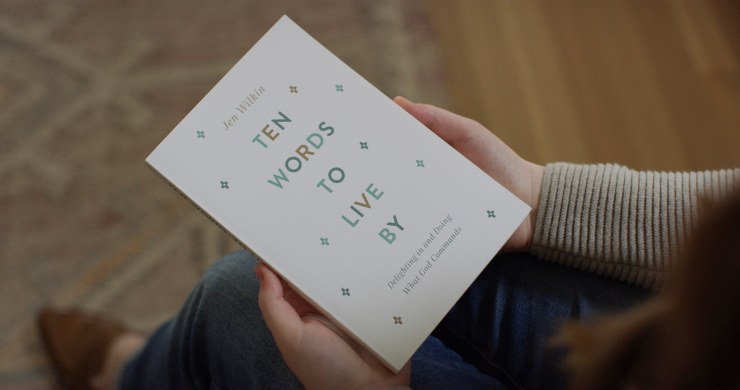
Ten Words to Live By: Delighting in and Doing What God Commands by Jen Wilkin is a readable, engaging introduction to the Ten Commandments, and how they apply to us today. The author begins “This is a book about the law of God in all its life-giving beauty”. An introduction like that invites you to carry on reading, and you won’t be disappointed! One reviewer writes, “What I appreciate most about Jen Wilkin is that as she teaches the Bible, she also teaches us how to read the Bible for ourselves. That’s exactly what she does in this book with one of the most important and yet misunderstood parts of Scripture—the Ten Commandments. Far from being cringe-worthy rules from a grumpy God, we learn that God’s commands are beautiful and lifegiving, revealing the pattern of Christlikeness that we can experience by God’s grace. Reading this book will help you not only to know the Ten Commandments but also to love them, delight in them, and ultimately live by them.” See the publisher’s information HERE. You can read Chapter 1 HERE.
Ten Words to Live By is published by Crossway. They have a great membership scheme called Crossway+. This is free to join. Among the benefits it offers are:
●You receive 50% off all ebooks (PDF, epub and mobi) and audiobooks (MP3). For the great majority of Crossway books, if you buy the ebook, you get the book in all three formats―PDF, epub and mobi. And if you want a printed copy, you can print the PDF―this format doesn’t have printing disabled.
●You will occasionally receive access to special offers on select Crossway resources via email.
You can read the details of the Crossway+ scheme, and sign upHERE.
REFERENCES [1] See The Epic of Eden by Sandra L. Richter, page 181. Published by Intervarsity Press, Downers Grove, Illinois, in 2008. [2] Quoted from Leviticus (Tyndale Old Testament Commentaries) by Jay Sklar, page 27-28. Published by InterVarsity Press, Downers Grove, Illinois, and Inter-Varsity Press, Nottingham, U.K., in 2013. [3] Quoted from God’s Design: a Focus on Old Testament Theology, Third Edition, by Elmer A. Martens, page 82. Published by BIBAL Press, N. Richland Hills, Texas, in 1998. Martens writes, “It will not do, therefore, to assess the law as a set of arbitrary restrictions intended to inhibit people and make them miserable and guilty”. [4] Quoted from Leviticus (Tyndale Old Testament Commentaries) by Jay Sklar, page 42. Published by InterVarsity Press, Downers Grove, Illinois, and Inter-Varsity Press, Nottingham, U.K., in 2013. [5] See Bearing God’s Name: Why Sinai Still Matters by Carmen Joy Imes, pages 48-49. Published by Intervarsity Press Downers Grove, Illinois, in 2019.
CREDITS ► Text copyright © 2024 Robert Gordon Betts ► Unless otherwise indicated, all Scripture is taken from the ESV® Bible (The Holy Bible, English Standard Version®), copyright © 2001 by Crossway, a publishing ministry of Good News Publishers. Anglicized English Standard Version copyright © 2002 by Crossway. Used by permission. All rights reserved. The ESV text may not be quoted in any publication made available to the public by a Creative Commons license. The ESV may not be translated in whole or in part into any other language. ► Scripture quotations marked ‘NIV’ are taken from The Holy Bible, New International Version (Anglicised edition). Copyright © 1979, 1984, 2011 by Biblica (formerly International Bible Society). Used by permission of Hodder & Stoughton Publishers, an Hachette UK company. All rights reserved. ‘NIV’ is a registered trademark of Biblica (formerly International Bible Society). UK trademark number 1448790.
 52 Steps