Part 16: God’s Holy Dwelling Place
Click the icon below to download a 4-page PDF version of this page.

A home for our holy God
Last time, we saw how God led His people to Mount Sinai and made a covenant with them there. It was like a wedding―God became the Husband of His people.
After the covenant ceremony, God makes plans to live with His people. But God is holy. How can He possibly live here in this sinful world? His answer is a special tent, the Tabernacle. He says to Moses, “let them make me a sanctuary, that I may dwell in their midst” (Exodus 25:8).
God gives Moses the plans for this tent (Exodus 25:10-27:19; 30:1-10,17-38). The people supply the materials―mostly plundered from the Egyptians. God fills a man called Bezalel “with the Spirit of God, with ability and intelligence, with knowledge and all craftsmanship” (Exodus 31:3). God appoints Oholiab to help him. These two men, helped by others, will make the Tabernacle and all its furniture, the clothes for the priests, a special anointing oil, and incense.
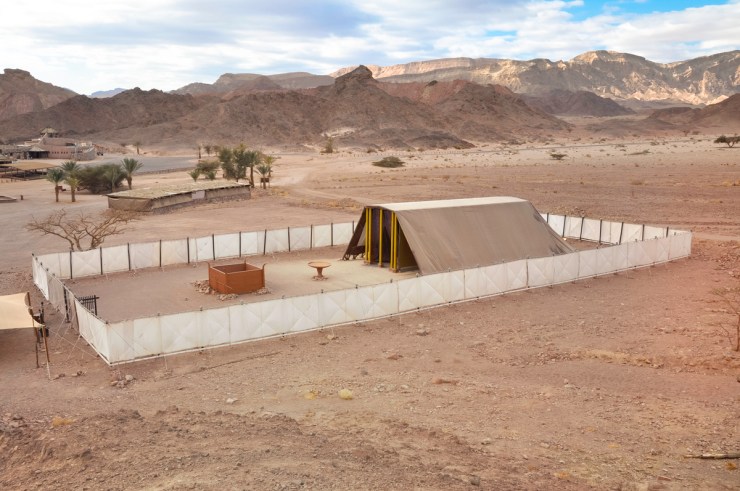
The full-scale replica of the Tabernacle, Timna Park, Israel.
When all is ready, the Tabernacle is erected. God moves into His new home. “Then the cloud covered the tent of meeting, and the glory of the LORD filled the tabernacle” (Exodus 40:34). God, of course, lives in Heaven. In fact, He’s present everywhere. But now He’s also present on Earth in a special way.
“. . . the cloud covered the tent of meeting, and the glory of the LORD filled the tabernacle.”
The outer court
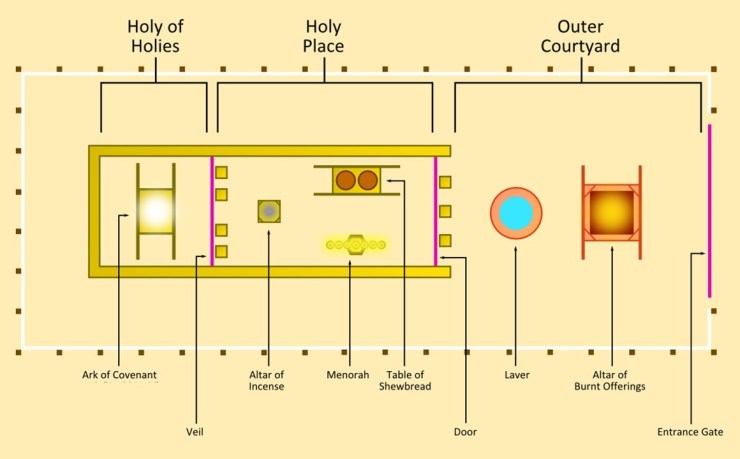
Image © Adik86 at Wikimedia Commons ( CC BY-SA 3.0)
A plan of the Tabernacle.
What is the Tabernacle like? Imagine you’re there in the camp of Israel. You’ll find the Tabernacle right in the centre of the camp. There’s a high linen screen around it, enclosing a courtyard about 45 by 23 metres (150 by 75 feet).
On the eastern side of the courtyard is an opening in the screen, in front of which is a multicoloured curtain. Moving past this curtain, you find yourself in the courtyard. There you’ll see an altar, behind which is a basin. You’ll probably see animal sacrifices burning on the altar. You may see priests washing at the basin.
The tent
Continuing past the basin, you arrive at the entrance of the Tabernacle tent itself. It’s quite a large tent―about 4½ metres high and wide, and 13½ metres long (15 by 15 by 45 feet). It doesn’t look much from outside―its outer covering is made of animal skins. But there’s a beautiful embroidered curtain at the entrance, made of blue and purple and scarlet yarn and fine linen. Only the priests can enter the tent. So you’ll need to imagine that you’re one of the priests.
The Holy Place
Pushing through the embroidered curtain, you find yourself in the tent’s front room, called the Holy Place. It’s like stepping into a different world―a world of stunning beauty and fragrance, a meticulously crafted world of holiness and glory. The sides of the tent are supported by wooden frames overlaid with gold, and set in silver bases. Over these frames is draped a beautiful covering, made of fine linen, blue, purple and scarlet yarns, and decorated with cherubim. Over this covering are a number of outer protective coverings―but you can’t see these, of course, from inside.
Stepping into the Tabernacle is like stepping into a different world―a world of stunning beauty and fragrance, a meticulously crafted world of holiness and glory.
To your left, you’ll see a golden seven-branched candlestick (the menorah). The light from this illuminates the gorgeous multicoloured curtains, and reflects off the gold and silver all around the Holy Place. This beautiful room would have taken your breath away.
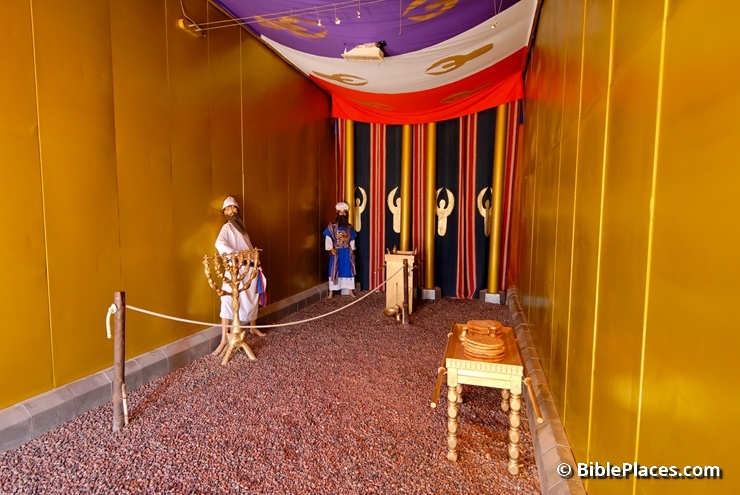
Image © www.BiblePlaces.com
The Interior of the full-scale replica of the Tabernacle, Timna Park, Israel. Note the candlestick, table of showbread and the altar of incense. A model of a priest stands to the left; behind him is a model of the High Priest.
On your right is a table, overlaid with gold. On it, there are twelve loaves of bread called “the bread of the Presence”―in other words, bread laid out in God’s presence (Exodus 25:30). Also on the table are plates, dishes for incense, and jugs and bowls “with which to pour drink offerings” (25:29)―the drink offerings presumably being of wine.
The table in the Tabernacle
Remember how Moses and those with him ate and drank in God’s presence on Mount Sinai (Exodus 24:9-11). That meal confirmed and celebrated Israel’s covenant relationship with God. The bread and (presumably) the wine on this table are also a meal. Each sabbath, a new batch of bread was placed on the table; the priests (representing the whole nation) ate the old batch. They may also have drunk the wine. Like the meal on Mount Sinai, this meal was consumed in God’s presence. It celebrated Israel’s covenant relationship with God. And it points forward to the meal we ourselves eat together in God’s presence―the Lord’s Supper.
In front of you in the Holy Place is an altar, overlaid with gold. Incense is burning on it; a wonderful fragrance fills the room. Beyond this altar there’s another curtain made of fine linen, blue, purple and scarlet yarns, and decorated with cherubim.
The Most Holy Place
Beyond this curtain is the Most Holy Place. An ordinary priest dare not enter this holiest of rooms. Only the High Priest may enter, and then only on one day each year. In this room is just one piece of furniture―the Ark of the Covenant. It’s a wooden box overlaid with gold. On it is a slab of pure gold, with a golden cherub on each end. This golden slab is the “mercy seat” (ESV) or “atonement cover” (NIV).
The Most Holy Place is where God Himself is present in a special way. It is His throne room; the mercy seat is His footstool. From this room, God reigns over His people, and over the whole Earth.
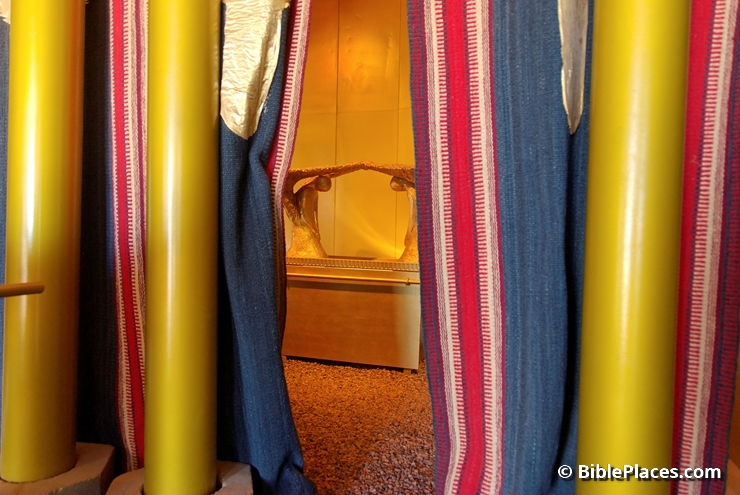
Image © www.BiblePlaces.com
The Interior of the full-scale replica of the Tabernacle, Timna Park, Israel. Here, the curtain at the far end of the Holy Place is pulled aside to reveal the Ark of the Covenant in the Most Holy Place.
The Tabernacle in the wilderness is an earthly “copy and shadow of the heavenly things” (Hebrews 8:5). The Tabernacle is a picture of entering God’s presence in Heaven. It teaches us what Heaven is like.[1]
The camp
Moses and Aaron and his sons are pitched on the eastern side in front of the Tabernacle’s entrance, guarding the doorway. The Levites are pitched on the other three sides. Beyond them range the tents of the other twelve tribes of Israel. The Tabernacle is in the very centre of the camp. God doesn’t want His people to make a pilgrimage to reach Him. He wants to live as close to them as possible.
God doesn’t want His people to make a pilgrimage to reach Him. He wants to live as close to them as possible.
Another Garden of Eden
The Tabernacle isn’t God’s first home on Earth. He first walked on Earth in the garden of Eden. The Tabernacle is like a new garden of Eden. One writer explains, “In the tabernacle the Presence [of God] lives on earth for the first time since Eden”. [2] And so, as you might expect, there are links between the Tabernacle and the garden.
► At “the east of the garden of Eden” God “placed the cherubim and a flaming sword that turned every way to guard the way to the tree of life” (Genesis 3:24). The way back into God’s garden was from the east. The way into the Tabernacle is from the east.
►Guarding the garden’s entrance were “the cherubim”, along with a sword. Cherubim are heavenly beings associated with God’s presence (see, for example, Ezekiel 10:1-22). The Tabernacle’s innermost covering is decorated with cherubim. And two golden cherubim watch over the mercy seat in the Most Holy Place.
►The Tree of Life was in the garden. There’s a symbolic ‘tree of life’ in the Tabernacle, too. The candlestick in the Holy Place is like a tree with branches, and “cups shaped like almond flowers with buds and blossoms” (Exodus 25:33 NIV).
The priests represent God’s people. When priests enter the Tabernacle, they symbolise God’s people returning to the garden of Eden!
A foretaste of the new creation
But the Tabernacle doesn’t just look back to the garden of Eden. It looks forward, too. When the Tabernacle is complete, God’s glory fills it (40:34). One day, God’s glory will fill the whole creation―the wonderful world that God shows us in the Bible’s final chapters (see especially Revelation 21:11,23).
There’s another link. The Most Holy Place is a cube, about 4½ metres high, wide and long. God’s holy city New Jerusalem is a cube, too―its height, length and breadth are equal (Revelation 21:16). New Jerusalem is God’s eternal Most Holy Place! Only the High Priest can enter the Most Holy Place in the Tabernacle―and only on one day each year. But in the renewed creation, all God’s people will live in God’s Most Holy Place all the time. All God’s people will live in His presence for ever!
One day, in the renewed creation, all God’s people will live in God’s Most Holy Place all the time. All God’s people will live in His presence for ever!
The tent of meeting
God often calls His Tabernacle “the tent of meeting” (for example, Exodus 27:21). It’s where He’ll meet with Moses; it’s where He’ll meet with His people (Exodus 29:42-43). God says to Israel, “I will make my dwelling among you, . . . . And I will walk among you and will be your God, and you shall be my people.” (Leviticus 26:11–12.) That points us to what we read at the end of the Bible: “Behold, the dwelling place of God is with man. He will dwell with them, and they will be his people, and God himself will be with them as their God.” (Revelation 21:3).
“The Word . . . tabernacled among us”
The apostle John wrote, “the Word became flesh and dwelt among us” (John 1:14). That Greek word translated “dwelt” is literally “tented”, or “tabernacled”. Jesus was God’s ‘tabernacle’ in the flesh. God once lived among His people in the Old Testament Tabernacle; now He lived among people in the Person of His Son.
Next time . . .
Israel has vowed to love, serve and obey God. God shows them how to do this by giving them His Law. His Law is His love-gift to His people, His blueprint for blessing, His guide to the ‘good life’, life to the full. We’ll look at the Law in the next part of our journey.
Bible reading and question
You may like to read Exodus 40:1-38. Here’s something to think about:
?Imagine you’re one of the Israelites camped around the Tabernacle. You’d see, with your own eyes, “the cloud of the LORD . . . on the tabernacle by day, and fire . . . in it by night”―a visible sign of God’s presence (Exodus 40:38). How might this impact how you and your family live?
Video
Here’s a very short video that takes you on a tour of the Tabernacle.
REFERENCES [1] Quoted from The Tabernacle: Sacred Space (Exodus 25-27, 30, 35-38, 40), by Matt Olliffe. Available online at https://sites.google.com/site/mattolliffe/exodus-series/exodus-25-27-30-35-38-40-the-tabernacle-sacred-space, accessed 16 July 2024. [2] Quoted from The Epic of Eden, by Sandra L. Richter, page 181. Published by Intervarsity Press, Downers Grove, Illinois, in 2008.
CREDITS ► Text copyright © 2024 Robert Gordon Betts ► Unless otherwise indicated, all Scripture is taken from the ESV® Bible (The Holy Bible, English Standard Version®), copyright © 2001 by Crossway, a publishing ministry of Good News Publishers. Anglicized English Standard Version copyright © 2002 by Crossway. Used by permission. All rights reserved. The ESV text may not be quoted in any publication made available to the public by a Creative Commons license. The ESV may not be translated in whole or in part into any other language. ► Scripture quotations marked ‘NIV’ are taken from The Holy Bible, New International Version (Anglicised edition). Copyright © 1979, 1984, 2011 by Biblica (formerly International Bible Society). Used by permission of Hodder & Stoughton Publishers, an Hachette UK company. All rights reserved. ‘NIV’ is a registered trademark of Biblica (formerly International Bible Society). UK trademark number 1448790.
 52 Steps
