Part 15: A Wedding In The Wilderness
Click the icon below to download a 4-page PDF version of this page.

Meeting with God
Last time, we saw how God rescued His people from slavery in Egypt and brought them through the Red Sea. But He doesn’t lead them straight into the Promised Land by the shortest route―the coast road―even though that’s only a week or two’s journey. That route would take them straight into the land of the Philistines, with their fierce warriors. God knows they aren’t yet ready for battle. He says, “If they face war, they might change their minds and return to Egypt” (Exodus 13:17).
But God also wants to prepare His people for their life ahead. He’s going to give them guidelines to live by. He’s going to make a covenant with them, and make His home among them. And He’s going to prepare them to conquer the Promised Land. All this is going to take time―a lot of time!
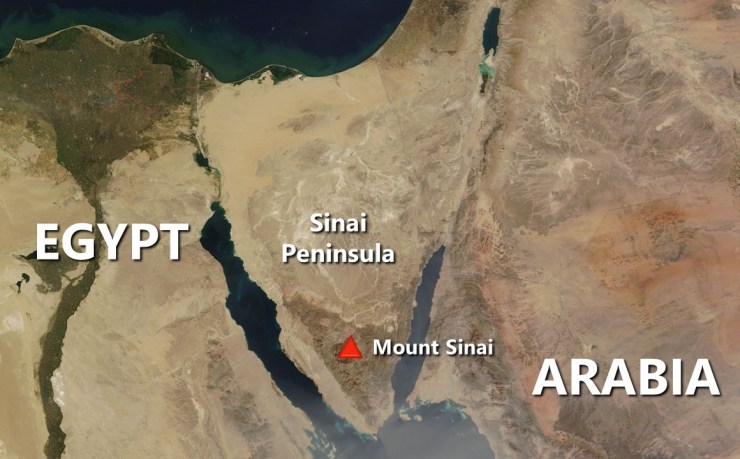
Image of Middle East courtesy of NASA/MODIS via Wikimedia Commons
A satellite image of the Sinai Peninsula and surrounding lands. The red triangle marks the traditional location of Mount Sinai, a mountain now called Jebel Musa (Arabic for ‘Mountain of Moses’).
So God’s people travel through the wilderness to meet with Him (Exodus 19:4). After a few weeks, they’re camped at the foot of Mount Sinai. There, God makes a covenant with them. As we’ve seen before, a covenant is a binding agreement between two parties. This covenant at Mount Sinai, in fact, is like a marriage. Through it, God becomes the Husband of His people (see, for example Isaiah 54:5). Moses “is the minister officiating at the wedding” [1].
God makes a covenant with Israel. It’s like a marriage. Through it, God becomes the Husband of His people.
Remember what we learned in the very first part of this series―the Bible story is at its heart a love story. The goal of history is a marriage―God’s people will be married to the Lamb, Jesus Christ (see Revelation 19:6-9). That marriage relationship begins back here at Mount Sinai.
► The vows. At their wedding, a man and a woman make vows to each other. God makes vows to His people, and they make vows to Him.
►The wedding feast. After the ceremony, there’s a wedding feast. Moses and 73 other men (who together represent the whole nation) eat and drink in God’s presence on Mount Sinai.
►The new home. After their wedding, a married couple set up home together. God makes plans to set up home among His people. He commands Moses “let them make me a sanctuary, that I may dwell in their midst” (Exodus 25:8). That sanctuary is to be a beautiful tent called the Tabernacle.

Image © www.BiblePlaces.com
The plain of er-Raha near Mount Sinai. This plain is traditionally believed to be the area where the Israelites camped when God gave them the Law, and where the tabernacle was constructed.
Exchanging vows
God and His people make vows to each other:
●God vows to bless His people. God tells Moses to say to them, “Now therefore, if you will indeed obey my voice and keep my covenant, you shall be my treasured possession among all peoples, for all the earth is mine; and you shall be to me a kingdom of priests and a holy nation” (Exodus 19:5-6). If Israel obeys God, they’ll be His “treasured possession”―His own precious people.
●Israel vows to love, serve and obey God. God’s Law showed them how to do this. The basis of the Law was the 10 commandments (Exodus 20:1-17). They’re supplemented and expanded by what we read in Exodus 20:22-23:33, and by various other passages in Exodus, Leviticus, Numbers and Deuteronomy.
Israel is God’s ‘new humanity’. The first humans―Adam and Eve―rebelled against God. Israel now promises to do what Adam and Eve failed to do: to obey God. When Moses “told the people all the LORD’s words and laws, they responded with one voice, ‘Everything the LORD has said we will do’” (Exodus 24:3).
Israel promises to do what Adam and Eve failed to do: to love and obey God.
Then a solemn ceremony follows. Animals are sacrificed and Moses throws the blood from the sacrifices against the altar (24:6). Then he reads “the Book of the Covenant” to the people (24:7). This book presumably includes most of Exodus chapters 20 to 23. The people again vow to obey God, and Moses splashes blood over the book and over the people (Exodus 24:8, Hebrews 9:19-20).
►The blood is splashed on the altar and the people, as well as on the book. The altar seems to represent God. Splashing blood on both people and altar seems to show that the people are now linked to God. They’re now God’s special people, consecrated to Him.
►God and His people may also be saying, in effect: “If I should ever break this covenant, may I die, like these sacrificial animals have done”. God, of course, will never break the covenant. But Israel―and every individual Israelite―does break it. They should suffer the penalty of death. But, as we’ll see later, God graciously accepts animals’ death instead of His people’s death.
The wedding feast
After this wedding in the wilderness, there’s a wedding feast. Moses climbs Mount Sinai, accompanied by Aaron and two of his sons, together with 70 elders. These men represent the whole nation. On the mountain, they “saw the God of Israel. Under his feet was something like a pavement made of lapis lazuli, as bright blue as the sky” (Exodus 24:10 NIV). They “saw God, and they ate and drank” (24:11).
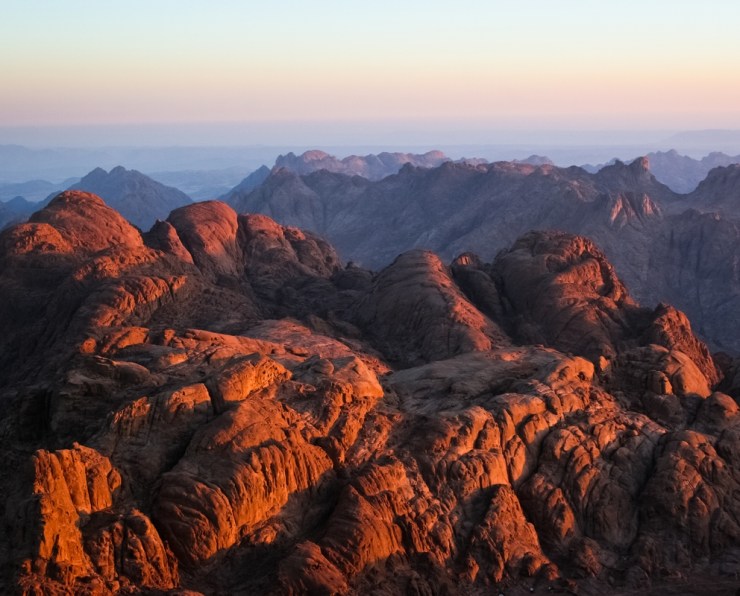
Mountains near Mount Sinai glow terracotta red in the sunrise.
A few chapters earlier, we read: “Mount Sinai was wrapped in smoke because the LORD had descended on it in fire. The smoke of it went up like the smoke of a kiln, and the whole mountain trembled greatly.” (Exodus 19:18). Such was the impact of God’s presence on the mountain. It was awesome beyond words. Now these men were on that very same mountain in God’s presence!
As we’ve seen, in the ancient Middle East, when people made a covenant, they’d typically eat a meal together to confirm and celebrate their covenant relationship. And that’s what happens here. These representatives of Israel eat a covenant meal in God’s presence. It was a day that would be etched into their memories for the rest of their lives.
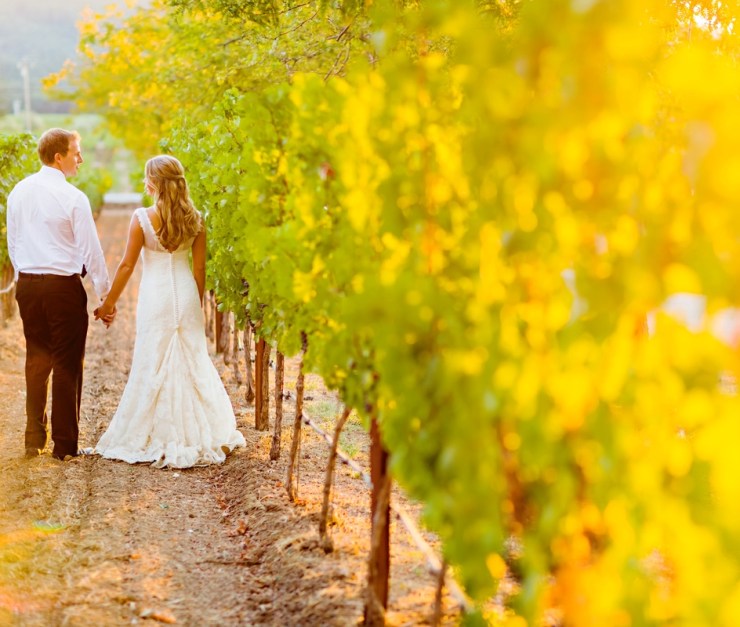
At Mount Sinai, God made a covenant with Israel. It was like a wedding―God became the Husband of His people.
The new home
After the wedding, a married couple set up home together. God is Israel’s Husband; Israel is His bride. So God makes plans to come and live among His people.
God tells Moses to make a special tent, called the Tabernacle. God gives him the plans, detailed in the later chapters of Exodus. God is going to live in a tent, just like His people are doing. And He’s going to pitch His tent in the centre of their camp, as close to His people as He can get.
In the beginning, the first humans lived in God’s presence. Now God makes arrangements for His new people, Israel, to live in His presence.
God makes plans to come and live among His people―as close to them as He can get.
“A kingdom of priests and a holy nation”
God says that, if His people obey Him, they’ll be to Him “a kingdom of priests and a holy nation” (Exodus 19:6).
●Israel was to be a priestly people. What is a priest? Later in Exodus, we see God choose Aaron and his sons as His priests (Exodus 28:1). He chose them to come near to Him to worship and serve Him on behalf of the whole nation. And they were to serve the people on God’s behalf―teaching them, praying for them, and pronouncing God’s blessing on them. But God also called the whole nation to be “a kingdom of priests” (Exodus 19:6). The whole nation was near God―He lived among them in the Tabernacle. The whole nation was to worship and serve God. And the whole nation was to serve the nations around. They were to show them what God was like, and how blessed it was to be in covenant relationship with Him. And the greatest blessing was this: people from the nations around could even become part of God’s people (compare Exodus 12:48)!
●And Israel was to be a royal people. God was their King. They were a royal people―they were, so to speak, God’s royal family. They shared in God’s rule―not because of any merit of their own, but purely through God’s grace. Through Israel, God was going to bring His rule to an unruly world. He was going to extend His Kingdom to the whole Earth.
● Through this “kingdom of priests” and “holy nation”, God was going to fulfil what He’d promised to Abraham centuries before: that through him “all peoples on earth will be blessed” (Genesis 12:3). Through Israel, His “kingdom of priests” and “holy nation”, God was going to fulfil what He’d promised to Abraham: that through him “all peoples on earth will be blessed”. In the beginning, God gave mankind dominion over every living thing (Genesis 1:28). Adam and Eve were to rule this world on His behalf. They were His royal people. Now Israel is His royal people. God put Adam in the garden “to work it and take care of it” (Genesis 2:15 NIV). The two Hebrew words for “to work” and “to take care of” also occur together in the Book of Numbers to describe the Levites’ priestly work (Numbers 3:7-8, 8:26, 18:5-6). Adam was to have a priestly ministry. Now God’s new humanity, Israel, has a priestly ministry. And now we believers are “a chosen race, a royal priesthood, a holy nation, a people for his own possession” (1 Peter 2:9). What God said to His Old Testament people, He now says to us, His New Testament people! We’ll explore this later in our series. In the next part . . . God says to Moses, “let them make me a sanctuary, that I may dwell in their midst” (Exodus 25:8). This sanctuary is the Tabernacle. In the next part, we’ll explore this wonderful tent. Bible Readings and Question You may like to read Exodus 24:1-11 and 25:8. Here’s something to think about: ? Book recommendation I wonder if you struggle to get into the Old Testament. If you do, this little book may well be the answer for you. A Christian’s Pocket Guide to Loving the Old Testament is by Alec Motyer, a respected Old Testament scholar, teacher, author and pastor. Clear and simple, it’s written by someone who himself loves the Old Testament―and you can tell! Tim Keller wrote the foreword. J.I. Packer writes, “Now ninety, Alec Motyer retails all his old clarity, warmth and charm as he shares his infectious affection for, and insight into, Jesus’s Bible. This is a first-rate get-you-started book.” See the publisher’s information HERE. You can get it direct from the publisher, or from any Christian bookseller. 10 of Those is a good Christian book ministry, and they currently have it on sale for only £3.24. REFERENCES [1] Quoted from A House for My Name: a Survey of the Old Testament by Peter J. Leithart, page 78. Published by Canon Press, Moscow, Idaho, in 2000. CREDITS ► Text copyright © 2024 Robert Gordon Betts ► Unless otherwise indicated, all Scripture is taken from the ESV® Bible (The Holy Bible, English Standard Version®), copyright © 2001 by Crossway, a publishing ministry of Good News Publishers. Anglicized English Standard Version copyright © 2002 by Crossway. Used by permission. All rights reserved. The ESV text may not be quoted in any publication made available to the public by a Creative Commons license. The ESV may not be translated in whole or in part into any other language. ► Scripture quotations marked ‘NIV’ are taken from The Holy Bible, New International Version (Anglicised edition). Copyright © 1979, 1984, 2011 by Biblica (formerly International Bible Society). Used by permission of Hodder & Stoughton Publishers, an Hachette UK company. All rights reserved. ‘NIV’ is a registered trademark of Biblica (formerly International Bible Society). UK trademark number 1448790.They were to be holy. The nation was to be consecrated to God, and to serve and worship Him alone.
God became the Husband of His people. Think about what this symbolism tells us about God’s attitude to us, and our relationship with Him.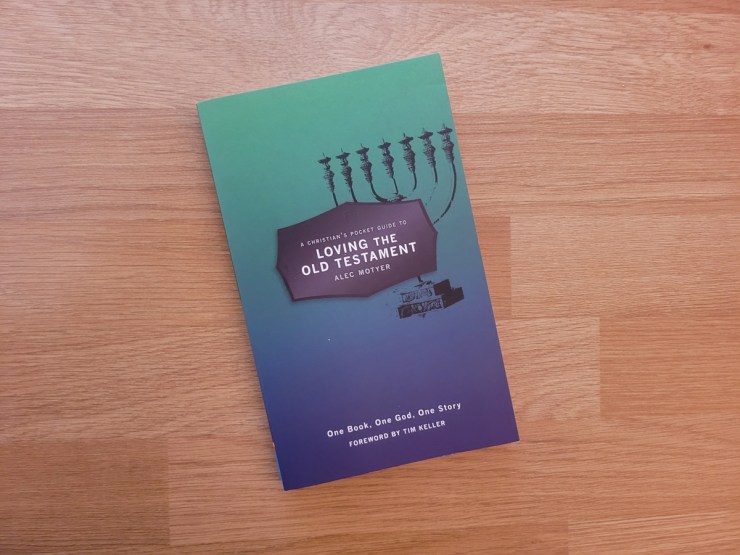
 52 Steps
