
Part 14: Set Free!
Click the icon below to download a 4-page PDF version of this page.

The final plague
Last time we saw God sending nine plagues on the Egyptian nation. He’s showing that He alone is Lord over Egypt. And He’s showing Israel that He is their Lord and God; He alone can rescue them from slavery in Egypt and bring them into the Promised Land.
But Pharaoh is resolutely obstinate. So God unleashes the final, most terrible plague. Every firstborn male in Egypt will die. Every family will suffer this terrible loss―Pharaoh’s royal family included.
The Passover
Before this final plague, God tells Moses that His people must eat a special sacrificial meal. It’s called the Passover. God says, “on the tenth day of this month each man is to take a lamb for his family, one for each household. If any household is too small for a whole lamb, they must share one with their nearest neighbour, . . . . The animals you choose must be year-old males without defect, . . . from the sheep or the goats. Take care of them until the fourteenth day of the month, when all the members of the community of Israel must slaughter them at twilight.” (Exodus 12:3-6.) The sacrificial animal had to be roasted, and eaten with unleavened bread and bitter herbs. Each family was to eat it hastily, dressed ready to depart at a moment’s notice.
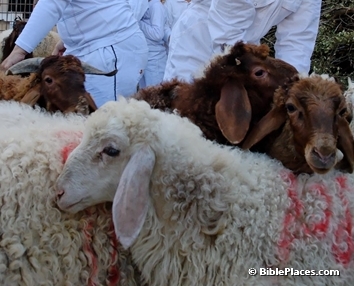
Image © www.BiblePlaces.com
The Samaritans (who today number no more than 600 people) still celebrate Passover, which includes sacrificing lambs. The lambs in this photo are being readied for sacrifice. Samaritans are mentioned several times in the Gospels and Acts.
In those days, people would only eat together if they were in relationship with each other―as family members, or as allies.[1] So when people made a covenant―a binding agreement―with each other, they typically shared a meal together. This showed they were now in relationship with each other―they were now covenant partners.
The Passover meal is a covenant meal. Everyone eating this meal is showing they’re in covenant with God―they’re consecrated to Him; He is their covenant Lord.
This Passover meal is a covenant meal.[2] Only people in covenant relationship with God could eat it―for males, that meant being circumcised (see Genesis 17:9-14). Everyone eating this meal is showing they’re in covenant with God[3]―they’re consecrated to Him; He is their covenant Lord. And so their firstborn son is under His protection!
Centuries before, God made a covenant with their forefather Abraham and his descendants. In that covenant, God made promises. One of them was this: He would give them the Promised Land. Now He’s going to fulfil that promise. He’s going to rescue them from Egypt and lead them into that land.
God tells Moses that His people must smear the Passover animal’s blood on their doorposts and lintels. God says, “The blood shall be a sign for you, on the houses where you are. And when I see the blood, I will pass over you, and no plague will befall you to destroy you, when I strike the land of Egypt.” (12:13). The blood is a visible sign that a Passover animal has been sacrificed. Inside the house, everyone is safe. Outside, there is death.
Then God strikes Egypt. “At midnight the LORD struck down all the firstborn in the land of Egypt, from the firstborn of Pharaoh who sat on his throne to the firstborn of the captive who was in the dungeon, and all the firstborn of the livestock. . . . . And there was a great cry in Egypt, for there was not a house where someone was not dead.” (12:29-30).
But why kill the firstborn? Because they were special. Firstborn sons were “the heir of the family, the one in whom the hopes of the house were centered”.[4] Each firstborn son represented his whole family. So the firstborn sons in Egypt collectively represented the whole nation. God strikes at the heart of the Egyptian nation.
But God spares the firstborn son of every family that ate the Passover. Israel’s firstborn collectively represented God’s whole nation. And so the firstborns’ escape from death represented the whole nation’s escape from death. And the nation escaped because the Passover lambs died in their place.
Jesus, our Passover Lamb
The sacrifice of the Passover lambs points forward to Jesus. He’s “our Passover lamb” (1 Corinthians 5:7), sacrificed for us at the festival of Passover. The Passover lambs died instead of God’s people; Jesus died instead of us. We’ll explore this more later in our journey.
Exodus
In panic, Pharaoh commands Moses and Aaron to get God’s people out of his land. A large and ethnically varied crowd go with them. The Lord Himself guides the people in a pillar of cloud and fire―visible signs of His presence. He leads them to a place beside the Red Sea.
Then God hardens Pharaoh’s heart for the last and crushing blow. Pharaoh―obstinate to the very last―musters his army and pursues God’s people. They find themselves hemmed in with no visible way of escape. Immediately, they complain to Moses―a foretaste of what we’ll meet during their journeying through the wilderness.
But God presences Himself between them and the Egyptians. We read, “the angel of God who was going before the host of Israel moved and went behind them, and the pillar of cloud moved from before them and stood behind them, coming between the host of Egypt and the host of Israel. And there was the cloud and the darkness. And it lit up the night . . . .” Then Moses “stretched out his hand over the sea, and the LORD drove the sea back by a strong east wind all night and made the sea dry land, and the waters were divided. And the people of Israel went into the midst of the sea on dry ground, the waters being a wall to them on their right hand and on their left.” (14:19-22). God’s people walk over the dry sea-bed to the Sinai peninsula and safety. The waters of the sea sweep back over the sea-bed and drown the pursuing Egyptians. God leads His precious people out of Egypt, carrying them “on eagles’ wings” (Exodus 19:4). He lovingly takes them “by the hand to bring them out of the land of Egypt” (Jeremiah 31:32). They’re free at last, and they sing for joy (Exodus 15:1-18).
God leads His precious people out of Egypt, carrying them “on eagles’ wings” (Exodus 19:4).
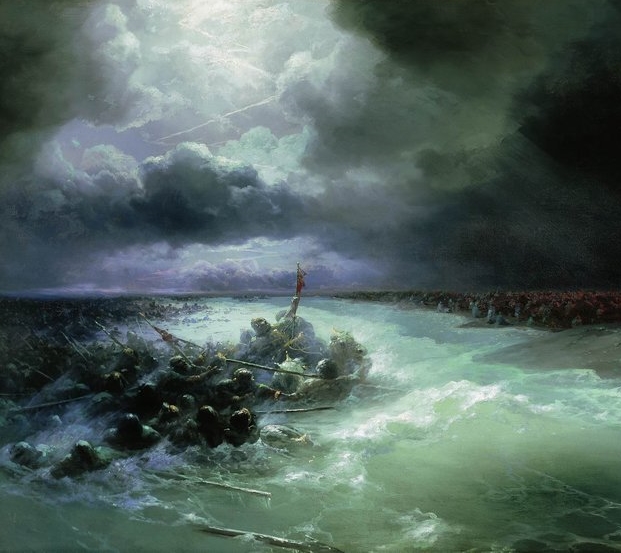
Passage of the Jews Through the Red Sea from Wikimedia Commons
Detail from Passage of the Jews through the Red Sea painted by Ivan Aivazovsky. This scene depicts the Egyptians floundering and drowning in the Red Sea, whilst God’s people, safe on dry land, look on.
Plundering the Egyptians
God had said to Moses that His people wouldn’t leave Egypt empty-handed. He said, “each woman shall ask of her neighbour, and any woman who lives in her house, for silver and gold jewellery, and for clothing. You shall put them on your sons and on your daughters. So you shall plunder the Egyptians” (3:22). In ancient times, victorious armies plundered their defeated foes. God fought for Israel and gave them victory over Egypt. His people plundered the Egyptians. [5] And He Himself drowned the Egyptian army in the sea.
A new beginning
The Exodus echoes two key events we’ve already seen―the creation of the world, and the great flood.
► All three events involve the same Hebrew word rûach. Genesis 1:2 tells us that “the Spirit of God” was hovering over the Earth. After the flood, God sends a “wind” over the land (Genesis 8:1). At the Exodus, the Lord drives back the sea by a strong east “wind” (Exodus 14:21). In all three places, the Hebrew word for “Spirit” or “wind” is rûach.
►All three events involve dry land emerging from the water. On the third creation day, dry land appears (Genesis 1:9-10). After the flood, the ground dries out (Genesis 8:12-14). At the Exodus, the Lord divides the waters, and His people cross over “on dry ground” (Exodus 14:22).
These links aren’t accidental. God is telling us something. They’re all beginnings. The creation of the Earth is a beginning. The great flood was a new beginning for mankind. The Exodus, too, is a new beginning. Through it, God brings a new people into being―His people Israel.
The prophet Isaiah confirms this. He tells us that God “created”, “formed” and “made” His people (Isaiah 43:1,7). He uses the same three words that God uses in Genesis to describe how He first made humanity―God said “Let us make man . . . .” (1:26); in 1:27 we read “So God created man . . . .”; and in Genesis 2:7 we read, “the Lord God formed the man . . . .”.
Israel was a ‘new humanity’, whom God brought into being to be His image-bearers, created to live in fellowship with Him. The first humans, Adam and Eve, originally lived in the Garden of Eden. Now God will lead His new humanity into a new Garden of Eden―the Promised Land, “a land of brooks of water, of fountains and springs, . . . a land of wheat and barley, of vines and fig trees and pomegranates, a land of olive trees and honey” (Deuteronomy 8:7–8).
Israel was a ‘new humanity’, whom God brought into being to be His image-bearers, created to live in fellowship with Him.
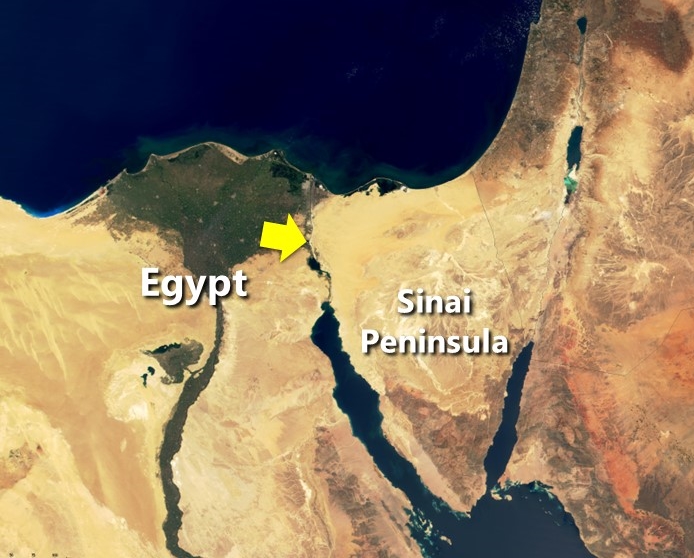
Image of Middle East courtesy of NASA Visible Earth
A satellite image of the Middle East. The yellow arrow shows the location where the Israelites may have crossed the Red Sea (at the position of present-day Lake Timsah).
Israel’s birthday celebration
God’s people Israel came into being as a nation through the Passover and the Exodus. It’s here we first read of “the congregation of Israel” (12:3,6,19,47). This was when Israel was, so to speak, born. So God appointed the month in which the Passover occurred as the first month of their calendar year (12:2).
Every year we celebrate our birthdays; every year God’s people were to celebrate their national birthday at the festivals of Passover and Unleavened Bread. Each year, they would kill a lamb and eat a Passover meal to celebrate their rescue from Egypt (Exodus 12:14,24-27,43-49). And the following week was the festival of Unleavened Bread, when they weren’t to eat anything made with yeast. We’ll see why God commanded this later in our series.
In the next part . . .
So God rescues His people from slavery in Egypt and launches them on their journey to a new life with Him in the Promised Land. But first, God leads them to Mount Sinai. There He makes a covenant with them and makes His home among them. What happens there is like a wedding―a wedding in the wilderness!
Bible Readings and Question
You may like to read Exodus 12:14-20, and 13:3-16. Here’s a question to think about:
?Why did God tell Israel to commemorate the Exodus every year?
Video
Here’s a short video, entitled Free at Last. It’s designed for children ages 6 to 12. But youth and adults may well enjoy it, too. These videos are in a series published by Crossway. They’re based on the book called The Biggest Story Bible Storybook. All the videos can be viewed at The Biggest Story videos website. You can also create a free account to enable you to download them.
REFERENCES ► [1] See Exodus (The New American Commentary) by Douglas K. Stuart, page 555. Published by B&H Publishing Group, Nashville, Tennessee, in 2006. [2] See An Argument for Close Communion in Baptist Life: a Dissertation Presented to the Faculty of the Southern Baptist Theological Seminary in Partial Fulfilment of the Requirements for the Degree Doctor of Philosophy by Dallas Wayne Vandiver, May 2020, pages 122,126-128. Available online at https://repository.sbts.edu/handle/10392/6078. [3] See Sacrifice in the Bible edited by Roger T. Beckwith and Martin J. Selman, page 18. Published by Paternoster Press, Carlisle, UK., and Baker Book House, Grand Rapids, Michigan, in 1995. [4] Quoted from Principles of Biblical Hermeneutics by Edwin Hartill, page 58. Published by Zondervan Academic, an imprint of Zondervan Publishing House, Grand Rapids, Michigan, in 2007. [5] See Exodus: A 12-Week Study by Matthew Newkirk, Week 3. Published by Crossway, Wheaton, Illinois, in 2015.
CREDITS ► Text copyright © 2024 Robert Gordon Betts ► Unless otherwise indicated, all Scripture is taken from the ESV® Bible (The Holy Bible, English Standard Version®), copyright © 2001 by Crossway, a publishing ministry of Good News Publishers. Anglicized English Standard Version copyright © 2002 by Crossway. Used by permission. All rights reserved. The ESV text may not be quoted in any publication made available to the public by a Creative Commons license. The ESV may not be translated in whole or in part into any other language. ► Scripture quotations marked ‘NIV’ are taken from The Holy Bible, New International Version (Anglicised edition). Copyright © 1979, 1984, 2011 by Biblica (formerly International Bible Society). Used by permission of Hodder & Stoughton Publishers, an Hachette UK company. All rights reserved. ‘NIV’ is a registered trademark of Biblica (formerly International Bible Society). UK trademark number 1448790.
 52 Steps
