
Part 13: From Prosperity to Slavery
Click the icon below to download a 4-page PDF version of this page.

God’s fruitful people
The fledgling nation of Israel flourishes in Egypt. They “were fruitful and increased greatly; they multiplied and grew exceedingly strong” (Exodus 1:7). God is beginning to make Abraham’s offspring into a great nation, just as He has promised.
Many years pass; all Joseph’s generation dies out. Another Pharaoh is now on the throne―a Pharaoh “to whom Joseph meant nothing” (Exodus 1:8 NIV). That’s ominous. This Pharaoh says, “Behold, the people of Israel are too many and too mighty for us” (Exodus 1:9). He’s afraid that―if war breaks out―they might join forces with Egypt’s enemies. So the Egyptians “set taskmasters over them to afflict them with heavy burdens” (1:11). That doesn’t work. So “they ruthlessly made the people of Israel work as slaves and made their lives bitter with hard service, in mortar and brick, and in all kinds of work in the field” (1:13-14).
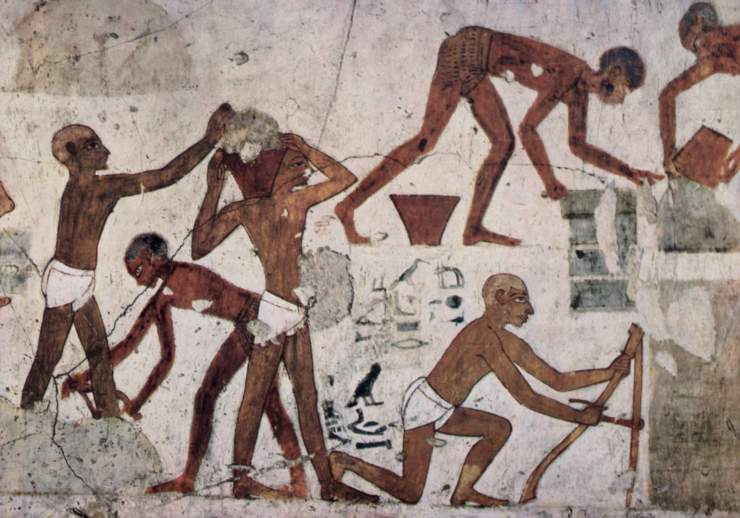
Image from Wikimedia
Burial chamber of Rechmirê, chief and vizier, scene: production of bricks. Rechmirê was an ancient Egyptian noble and official, and this tomb painting is dated around 1500-1450BC, a period when God’s people were in Egypt. In Exodus we read the Egyptians “ruthlessly made the people of Israel work as slaves . . . in mortar and brick, and in all kinds of work in the field” (Exodus 1.13–14)
As a last desperate measure, Pharaoh commands that every Israelite baby boy is killed at birth. But the Israelite midwives refuse to murder them. So Pharaoh commands that the babies are thrown into the River Nile instead.
Moses―training for God’s service
Now God sets in motion His plan to deliver His people from Egypt. To lead His people out of Egypt, God chooses and prepares a man―a man called Moses.
A couple from the tribe of Levi―Amram and Jochabed―have a baby son. Instead of drowning him in the Nile, they hide him. But after three months, they can’t hide the baby any longer. So they place him in the Nile―but safely inside a waterproof basket. They float this basket, with their precious son inside, among the reeds along the riverbank (Exodus 2:1-3). Miriam, the baby’s sister, keeps watch at a distance.
To lead His people out of Egypt, God chooses and prepares a man―a man called Moses.
The baby is found by none other than Pharaoh’s daughter. She sends Miriam to get a nurse for the baby. Miriam, of course, gets her mother. And so it turns out that Jochabed is paid by Pharoah’s daughter to nurse her own baby son! After he’s weaned, Pharaoh’s daughter adopts him, and names him Moses. As Pharaoh’s adopted grandson, Moses is educated in all the wisdom of Egypt’s sophisticated culture. In the Book of Acts, we read that Moses becomes “powerful in speech and action” (Acts 7:22 NIV).
But God has another―and quite different―season of training for Moses. Moses kills an Egyptian who is beating an Israelite. But Pharoah hears about it; now he’s after Moses’ blood. So Moses flees from Egypt, eastwards into the land of Midian. He marries a Midianite woman. For 40 years, he tends his father-in-law’s flocks in the wilderness.
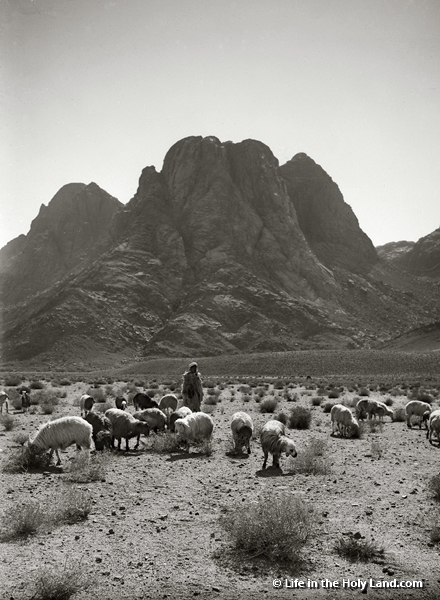
Image © Life in the Holy Land.com
A shepherd and his flock near the mountain range that includes a peak known as Jebel Musa, which may be the biblical Mount Sinai. (Jebel Musa itself seems to be hidden from view).
The discipline of the ordinary
Moses probably never knew that this 40-year period in the wilderness was a time of preparation. He probably thought he’d never return to Egypt and would die as a shepherd in the wilderness.
Our lives, too, may seem very ordinary; at times, perhaps, even dreary. But if we’re obedient, we serve God as much in the routine of ordinary life as we do in any seemingly more significant ways. And all the while, God is shaping us for future service for Him not only here on Earth, but in the glorious new creation!
Our lives may seem very ordinary; at times, perhaps, even dreary. But if we’re obedient, we serve God as much in the routine of ordinary life as we do in any seemingly more significant ways.
So Moses is first trained “in all the wisdom of the Egyptians” (Acts 7:22). Then God gives him 40 years of training in the wilderness. After those 40 years, Moses’ self-confidence has been knocked out of him. When God calls him to lead His people out of Egypt, the man who was “powerful in speech and action” says, “I am not eloquent” (Exodus 4:10). He implores God to send someone else. Now God can use this man!
And notice that Moses works as a shepherd during those 40 years―in the same kind of wilderness where he’ll one day lead God’s flock, His people Israel. Sheep depend on their shepherd for everything. They need constant care and attention. God’s people will be no different!
‘I Am He Who is here for you’
When Moses is 80 years old, he leads his flock to the western side of the wilderness and comes to Mount Horeb (Exodus 3:1-4:17). This is another name for Mount Sinai, the very place where God will later make a covenant with His people. There, “the angel of the LORD appeared to him in a flame of fire out of the midst of a bush” (Exodus 3:2). But although the bush is burning, the flames don’t consume it.
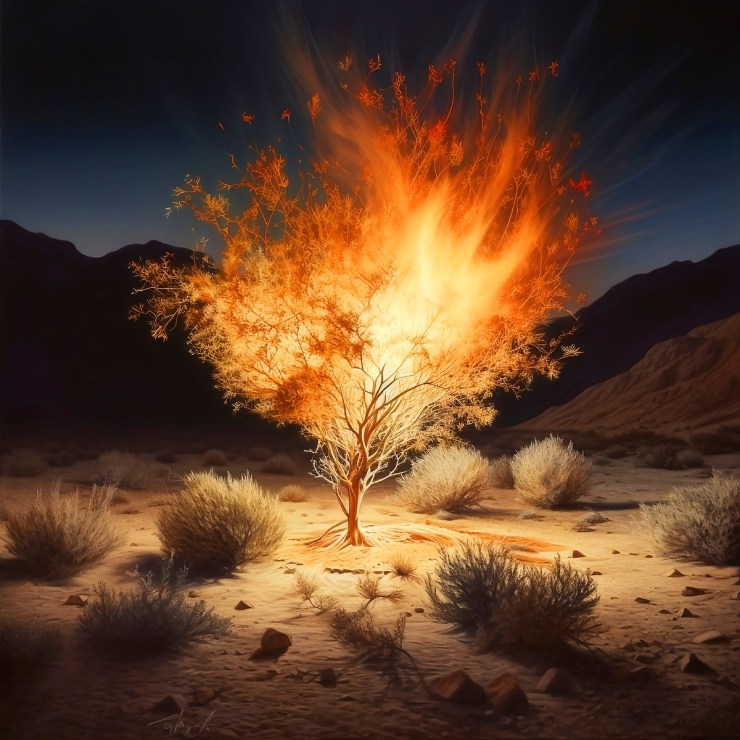
At Mount Horeb, the angel of the LORD appeared to Moses “in a flame of fire out of the midst of a bush” (Exodus 3:2). Though the bush is burning, the flames don’t consume it.
God calls to Moses out of the bush and commissions him to lead His people out of Egypt. Moses asks God, “If I come to the people of Israel and say to them, ‘The God of your fathers has sent me to you,’ and they ask me, ‘What is his name?’ what shall I say to them?” (3:13). God replies: “I AM WHO I AM. . . . . Say this to the people of Israel, ‘I AM has sent me to you. . . . . The LORD, the God of your fathers, the God of Abraham, the God of Isaac, and the God of Jacob, has sent me to you.'” (3:14-15.)
This name “I AM WHO I AM” can be explained in more than one way. The best option may well be “’I will be who I am/I am who I will be’ . . . in essence, ‘I will be God for you’”.[1] Through this name, God is revealing Himself as the living, personal God who is present with His people and actively working to save and bless them. [2,3] Moses and all God’s people could rely on Him―and so can we!
So God identifies Himself as “I AM”. The Hebrew word for “I AM” sounds similar to His personal name ‘Yahweh’. ‘Yahweh’ is the most frequently used name of God in the Old Testament.
God’s name Yahweh reveals Him as the living, personal God, who is present with His people, at work to save and bless them.
The ancient Hebrew text didn’t include vowels. So ‘Yahweh’ was simply written with four consonants ‘YHWH’. Devout Jews consider this name unspeakably holy. Even today, when reading the Scriptures, they do not pronounce it, and instead say ’Adônāy, which means ‘Lord’. That’s why most Bible translations use the name ‘LORD’ (which is usually written in capitals) instead of ‘Yahweh’.
A few chapters on, we read that God says to Moses: “I am the LORD. I appeared to Abraham, to Isaac, and to Jacob, as God Almighty, but by my name the LORD I did not make myself known to them.” (Exodus 6:2-3). Again, the word “LORD” here is ‘Yahweh’ in the Hebrew text.
But the name Yahweh was known to people before this time. For example, Eve knew it. When Cain was born, Eve said, “I have produced a man with the help of the LORD” (Genesis 4:1). So why does God say to Moses: “by my name the LORD I did not make myself known to them”? As we’ve seen, Yahweh reveals God as living, personal, present with His people, and at work to save and bless them. Now God is going to demonstrate all this in a wonderful new way. At this moment of their greatest need, God is going to be there for His people. He’s going to rescue them from slavery in Egypt. He’s going to make a covenant with them, dwell among them, and lead them into the Promised Land![4]
The Name of God
God reveals His ‘name’―His character―to Moses. That’s very significant. In part 5, we saw Satan tempting Adam and Eve to think wrongly about God―to think that He wasn’t trustworthy, that He didn’t love them, that He was selfish, and that He didn’t want the best for them. Throughout the Old Testament, God is setting the record straight. Step by step, He reveals His character to us. He’s refuting Satan’s lies, and exposing him as “the father of lies” (John 8:44).
Plagues upon Egypt
Moses and his brother Aaron (whom God had chosen as Moses’ spokesman) meet Israel’s leaders. They tell them what God is going to do; “the people believed; and . . . they bowed their heads and worshipped” (4:31).
Moses and Aaron appear before Pharaoh, and say, “Thus says the LORD, the God of Israel, ‘Let my people go, that they may hold a feast to me in the wilderness’” (5:1). Pharaoh refuses. He makes the Israelites’ slavery even harsher! But God assures Moses that He will indeed deliver His people.
So God sends plagues to bring the Egyptians to obey Him. He changes water into blood; He sends plagues of frogs and gnats and flies; He inflicts a deadly plague on livestock; He unleashes plagues of boils and hail and locusts; He sends a black and terrifying darkness upon the Egyptians. But why is God doing all this? He’s demonstrating to the Egyptians that He, and not Pharaoh nor their many gods, is Lord over Egypt. The forces of nature―and life and death itself―are under His control, no-one else’s. And God is showing Israel that He is their Lord and God, and that He alone can rescue them from slavery in Egypt and bring them into the Promised Land.
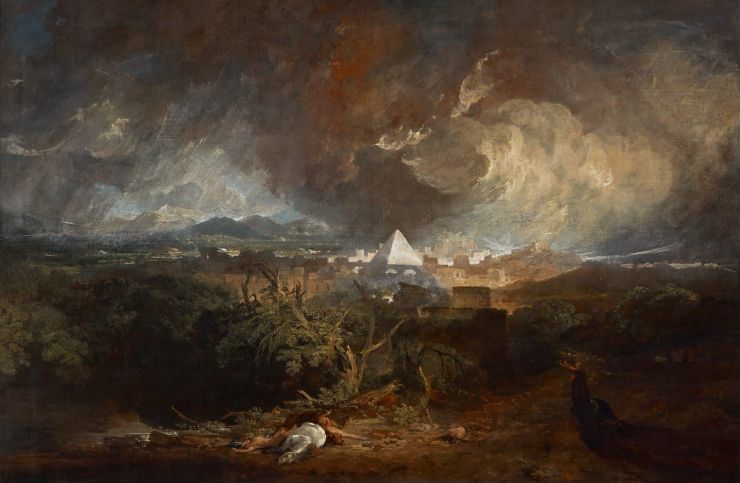
Image courtesy of Indianapolis Museum of Art at Newfields
The Fifth Plague of Egypt by J.M.W. Turner. The artist seems to have mistitled his painting, as it actually depicts the seventh plague of Egypt, the plague of hail (Exodus 9:13-35).
God tells Moses to say to His people, “I am the LORD, . . . and I will redeem you . . . with great acts of judgment. I will take you to be my people, and I will be your God, . . . . I will bring you into the land that I swore to give to Abraham, to Isaac, and to Jacob. I will give it to you for a possession. I am the LORD.” (Exodus 6:6-8). This sets the scene for the rest of Exodus, and on to the Book of Joshua. As we journey through these books, we’ll see how God fulfils all these wonderful promises.
God tells Moses to say to Israel, “I am the Lord, . . . I will redeem you . . . with great acts of judgment. I will take you to be my people, and I will be your God, . . . .”
In the next part . . .
Pharaoh still resolutely refuses to let God’s people go. So God unleashes the last and most terrible plague upon him and the Egyptians. But what will happen to God’s people? And how will God rescue them from Egypt? We’ll see next time.
Bible Reading and Questions
You may like to read Exodus 3:1-22. Here are two questions to think about:
? What are all the things this scene shows us about God?
?God says that He will bring His people out of Egypt (3:8). But He also tells Moses, “I will send you to Pharaoh that you may bring my people . . . out of Egypt” (3:10). What does this tell us about how God so often chooses to work?[5]
Resource―Knowing the Bible study guides
Crossway’s Knowing the Bible is a superb series of Bible study guides―the video above introduces them. You can access them free of charge. The series covers all 66 books of the Bible, and there are additional guides covering the Ten Commandments, the Sermon on the Mount, and Jesus’s parables. The guides are great for both individual and group study. They include brief discussion of each Bible passage, and questions to think about or discuss. There are also brief sections that highlight the way the passage displays the gospel, links to the wider Bible story, and key teachings.
Read the publisher’s description of the series HERE. You can download a free, complete PDF of one of the studies (on the Gospel of Mark) HERE.
You can access all the guides free of charge HERE!
Finally, if you have a subscription to the ESV Study Bible, this series is included as one of the resources available. (Click HERE for more information about the ESV Study Bible subscription.)
Video
Here’s a short video, entitled God Raises Up a Deliverer. It’s designed for children ages 6 to 12. But youth and adults may well enjoy it, too. These videos are in a series published by Crossway. They’re based on the book called The Biggest Story Bible Storybook. All the videos can be viewed at The Biggest Story videos website. You can also create a free account to enable you to download them.
REFERENCES [1]Quoted from New International Dictionary of Old Testament Theology and Exegesis, volume 4; general editor, Willem A. VanGemeren, page 1296. Published by Paternoster Press, an imprint of Paternoster Publishing, Carlisle, UK, in 1996. [2] See The Message of Exodus: the Days of our Pilgrimage (The Bible Speaks Today), by J.A. Motyer, page 69. Published by InterVarsity Press, Downers Grove, Illinois and Inter-Varsity Press, Nottingham, U.K., in 2005. [3] See Far as the Curse is Found: the Covenant Story of Redemption by Michael D. Williams, page 30. Published by P&R Publishing, Phillipsburg, New Jersey, in 2005. [4] See Exodus for You by Tim Chester, page 60. Published by The Good Book Company, Epsom, Surrey, U.K., in 2016. [5] This question is adapted from Genesis: A 12-Week Study by Mitchell M. Kim, Week 3. Published by Crossway, Wheaton, Illinois, in 2013.
CREDITS ► Text copyright © 2024 Robert Gordon Betts ► Unless otherwise indicated, all Scripture is taken from the ESV® Bible (The Holy Bible, English Standard Version®), copyright © 2001 by Crossway, a publishing ministry of Good News Publishers. Anglicized English Standard Version copyright © 2002 by Crossway. Used by permission. All rights reserved. The ESV text may not be quoted in any publication made available to the public by a Creative Commons license. The ESV may not be translated in whole or in part into any other language. ► Scripture quotations marked ‘NIV’ are taken from The Holy Bible, New International Version (Anglicised edition). Copyright © 1979, 1984, 2011 by Biblica (formerly International Bible Society). Used by permission of Hodder & Stoughton Publishers, an Hachette UK company. All rights reserved. ‘NIV’ is a registered trademark of Biblica (formerly International Bible Society). UK trademark number 1448790.
 52 Steps
