
Part 12: From Canaan to Egypt
Click the icon below to download a 4-page PDF version of this page.

A wife for Isaac
We ended part 10 in Genesis 22 with Abraham offering his beloved son Isaac to God. Abraham now makes sure that Isaac marries the right girl―a girl from among his own relatives back in Mesopotamia. This beautiful story is told in Genesis 24. This story foreshadows how God the Father, through the agency of the Spirit, finds a bride for His Son, Jesus. As we saw last week, woven through the entire Old Testament are pointers to Jesus. The most important character in the Old Testament, in fact, is Jesus.
The most important character in the Old Testament, in fact, is Jesus.
God confirms to Isaac the promises that He made to Abraham. Isaac’s wife, Rebekah, is barren, just as his mother Sarah had been; but God heals her, and she bears twins, Esau and Jacob. Both Sarah’s son Isaac, and Rebekah’s son Jacob are ancestors of Jesus, the promised “offspring” of Genesis 3:15. Both are born through God’s miraculous power. Eve’s promised offspring will come only through God’s intervention!
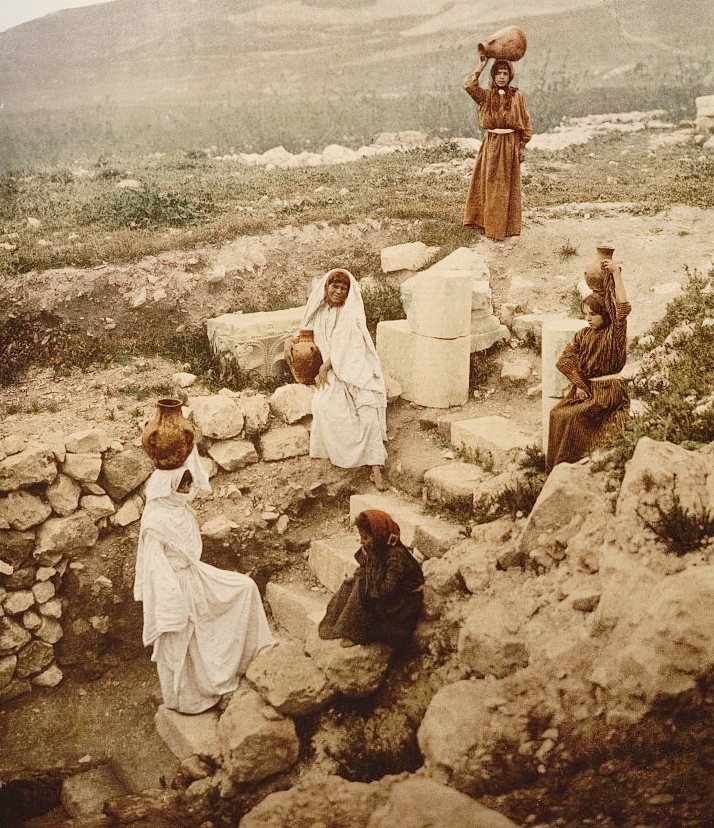
The well of the Samaritan (Shechem), Nablus, West Bank courtesy of The Library of Congress
Women gathered around the well of the Samaritan (Shechem), Nablus, West Bank. A photograph taken around 1890-1900. Abraham’s servant Eliezer first met Rebekah, who would become Isaac’s wife, at a well (Genesis 24:10-28). Jacob first met his wife Rachel by a well, too (Genesis 29:1-12).
Jacob―from wheeler-dealer to God’s man of faith
Esau was the firstborn of Rebekah’s twins. As the firstborn, he was due to succeed Isaac as head of the family. And he would have continued Abraham’s family line down to Jesus Himself. But Esau doesn’t care about the privilege and responsibility of being the firstborn. In a moment of hunger, Esau sells his birthright to Jacob for a meal (Genesis 25:29-34).
The day comes when aged, blind Isaac arranges to bless his firstborn son before he dies. Trickster Jacob deceives his father―he pretends to be Esau! Isaac pronounces the firstborn’s blessing over him, not Esau. So Jacob gets hold of both Esau’s birthright and his blessing (27:36).
Esau resolves to kill Jacob. So Isaac sends Jacob off to Uncle Laban in Haran, in Mesopotamia, to give Esau time to cool off. On the way, Jacob has a dream (Genesis 28:10-22). He sees a ladder linking Heaven and Earth, with angels going up and down it. In this dream, God confirms to Jacob the promises He made to Abraham: ◆ he and his offspring will inherit the land of Canaan; ◆ he’ll have multitudes of descendants, and ◆ all the families of the Earth will be blessed through him and his offspring. And God declares, “I am with you and will keep you wherever you go, and will bring you back to this land” (28:15). How that must have cheered Jacob’s heart!
Jacob worships God and makes a vow to Him. But God still has work to do in this enterprising, self-reliant man. Years of trial for Jacob follow as he works for Laban. One writer comments, “In Laban Jacob met his match and his means of discipline. Twenty years . . . of drudgery and friction were to weather his character; . . . .”[1]
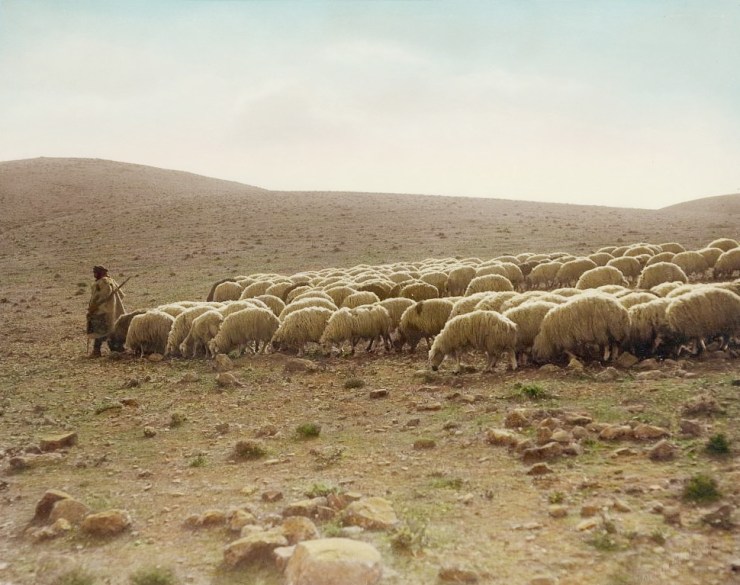
Image courtesy of The Library of Congress
For twenty years, Jacob tended his uncle Laban’s flock (Genesis 31:38). A photograph of a shepherd and his flock in the Holy Land, taken in or before 1919.
On his return home to Canaan, God meets with Jacob again. God appears as “a man”―who is, in fact, an angel (Hosea 12:4)―and wrestles with him (Genesis 32:24-32). At length, the angel dislocates Jacob’s hip. Disabled, he clings to the angel, saying “I will not let you go unless you bless me” (32:26). And God does bless him. God renames him ‘Israel’, saying “for you have striven with God and with men, and have prevailed” (32:28). Jacob is no longer the self-reliant wheeler-dealer. He’s wrestled with God and obtained God’s blessing. But he’s obtained it by asking God for it, not through his own human resourcefulness.
Jacob is no longer the self-reliant wheeler-dealer. He’s obtained God’s blessing by asking God for it, not through his own human resourcefulness.
Joseph―from spoiled child to saviour of Egypt
Jacob has twelve sons. They’re ancestors of the twelve tribes of Israel. Jacob’s favourite is his 11th son, Joseph. This doesn’t go down well with his brothers! Joseph adds fuel to the fire by bringing a “bad report” (37:2) of his brothers to Isaac. Then he tells them about two dreams he’s had. These dreams picture his brothers―and, in the second dream, his parents, too!―bowing down to him. But, in fact, these dreams are prophecies.
Out of hatred for “this dreamer” (37:19), Joseph’s brothers sell him to some passing Midianite traders. They take him to Egypt and sell him to Potiphar―captain of the Egyptian king’s guard. So Joseph finds himself serving in Potiphar’s house. Joseph resists seduction by Potiphar’s wife; she retaliates by falsely accusing him of attempted rape. Potiphar puts him in prison, and there Joseph remains for some years. But Joseph serves both Potiphar and the chief jailor faithfully. Whatever Joseph did, “the LORD made it succeed” (39:23).
One day, the Egyptian king (the Pharaoh) sends for Joseph to interpret two dreams he’s had. Joseph tells him that these dreams predict seven years of plenty and then seven years of famine in Egypt. But Joseph doesn’t only explain the dreams. He also offers wise advice about how to feed the nation during the famine. So Pharaoh says to him, “Since God has shown you all this, there is none so discerning and wise as you are” (41:39). Pharaoh sets Joseph “over all the land of Egypt” (41:41). Joseph arrives in Pharaoh’s palace a prisoner; he departs as Pharaoh’s chief minister! In this exalted position, Joseph saves the nation of Egypt―and his family in Canaan―from starvation during the famine.
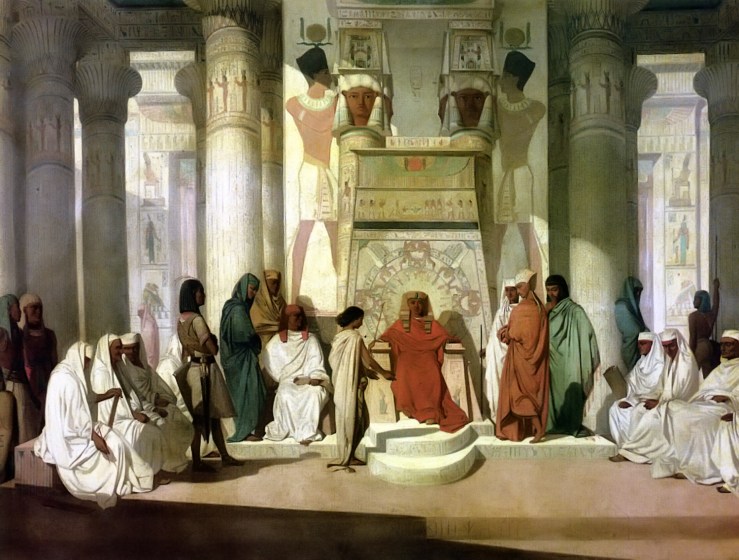
Joseph Explaining Pharoah’s dreams from Wikimedia Commons
Joseph Explaining Pharaoh’s Dreams painted by Jean-Adrien Guignet. The artist depicts the scene recorded in Genesis 41:14-36.
We read that “all the world came to Egypt to buy grain from Joseph, because the famine was severe everywhere” (41:57 NIV). Among those who come are Joseph’s own brothers! They present themselves to Joseph and bow down to him! In his dreams, young Joseph had foreseen this. Those dreams, that so angered his family, have come true!
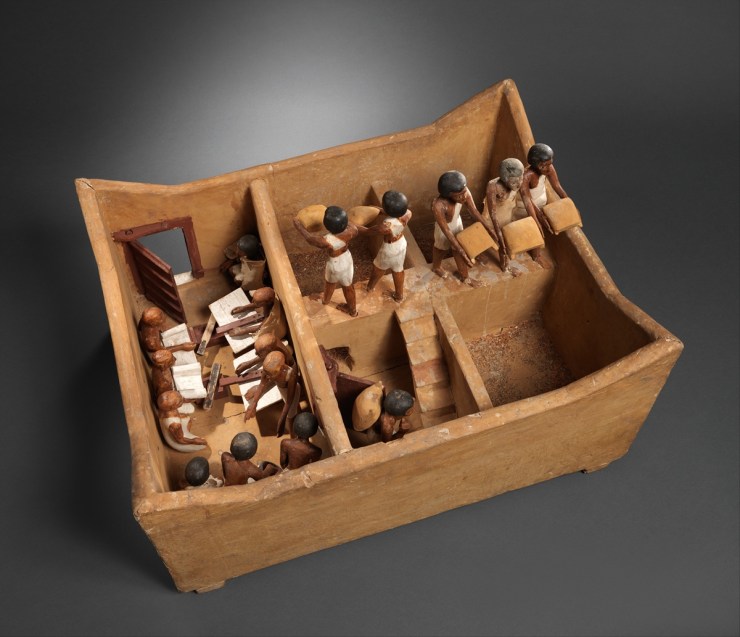
Model of a Granary with Scribes courtesy of The Met (The Metropolitan Museum of Art)
An ancient Egyptian model of a granary with manual workers and scribes made about 1981–1975 BC, over 250 years before Jacob’s family settled in Egypt. This reminds us of the granaries that would have been used to store grain during the seven years of good harvests for use during the seven years of bad harvests (Genesis 41:33-36,46-49,53-57).
At first, Joseph doesn’t let his brothers know that he’s their brother―not difficult, as he now dresses and speaks like an Egyptian! But, in the end, Joseph does reveal his identity and there’s a heart-warming family reunion. Joseph forgives his brothers and tells them, “you meant evil against me, but God meant it for good, to bring it about that many people should be kept alive, . . . So do not fear; I will provide for you and your little ones.” (Genesis 50:20-21). God was behind the scenes, working His purposes out. He’s sovereign over the lives of Joseph and his family for good. He’s sovereign over our lives for good, too. What a wonderful comfort and encouragement!
God was behind the events of Joseph’s life, working His purposes out.
Pharaoh gives Joseph’s father Jacob and his family “the best of the land of Egypt” (45:18) to settle in. And so Abraham’s descendants come to live in Egypt, safe from famine, and with someone from their own family as governor of the land! Could you ever have predicted such a marvellous ending to a story that begins with family favouritism and sibling rivalry?
Joseph is a wonderful picture of Jesus. Like Joseph, Jesus is rejected by his own people, suffers humiliation, but then saves God’s people.
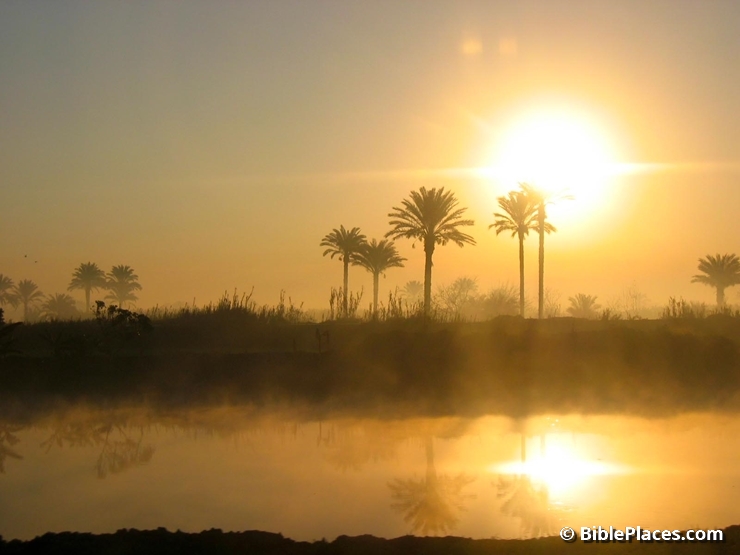
Image © www.BiblePlaces.com
Sunrise in the eastern Nile delta. The land of Goshen, where Jacob and his family settled (Genesis 45:10, 26:28-34) was probably in the eastern delta area of the Nile.
So Jacob and his family move to Egypt. They flourish there. But why did they have to go to Egypt? Couldn’t they have remained in Canaan? Couldn’t God have provided food there? We can suggest two reasons:
► God is giving the Canaanites plenty of time to change their sinful ways, before destroying them. And during that time, God gives Abraham’s expanding family―the nation He’ll one day use to conquer the Canaanites―a home elsewhere. God is shielding them from the Canaanites’ wicked ways.
►Secondly, before His people enter the Promised Land, God will make another covenant with them and set up home among them. He’s going to teach them about Himself. He’ll give them His law, teach them how to live as His holy people, and discipline them. He’s going to prepare His people for their mission in the Promised Land.
In the tribe of Judah, a dynasty of kings would arise. This dynasty’s final king will rule over the nations. That king is Jesus.
At the end of his life, Jacob prophesies over his twelve sons. Over Judah, he says: “The sceptre will not depart from Judah, nor the ruler’s staff . . . until he to whom it belongs shall come and the obedience of the nations shall be his” (49:10 NIV). The tribe of Judah would be the leading tribe in Israel. A dynasty of kings would arise in that tribe. And, one day, this dynasty’s final king would command the obedience of the nations. He would rule over them. That king is Jesus.
Jesus the Messiah
This final king, Jesus, is called the ‘Messiah’―a Hebrew word meaning ‘anointed one’. The picture of Messiah begins right back in Genesis 3:15. We learn more and more about Him as we journey through the Old Testament. We’ll discover that He’ll save God’s people, defeat their enemies, and rule the world in righteousness and justice.
Here in Genesis 49, we learn that Messiah will belong to the tribe of Judah and will rule the nations. And in 49:11 we learn something of what life under Messiah’s rule will be like. The imagery here depicts overflowing abundance. So plentiful are the grape harvests, that vines are used as donkeys’ hitching posts, and wine is used to wash clothes! That’s the kind of world Messiah will bring into being!
The fledgling nation of Israel flourished in Egypt. They “multiplied and grew exceedingly strong” (Exodus 1:7). Abraham’s offspring were becoming a great nation, just as God promised.
In the next part . . .
We read, “Now there arose a new king over Egypt, who did not know Joseph” (Exodus 1:8). That’s ominous. God’s fledgling nation enters a time of trouble. Blessing gives way to bondage. We’ll see what happens next time.
Bible reading and question
You may like to read Genesis 50:15-26. Here’s a question to think about:
?In what ways do these verses, and, in fact, the whole story of Joseph, encourage us about (1) God’s faithfulness to us as individuals and together as His people and (2) His sovereignty over history?
Videos
Here’s two short videos, entitled God’s Tricky, Hairy, Blessed People and Joseph’s Mean Brothers and What God Meant to Do. They’re designed for children ages 6 to 12. But they’re so good, I think that youth and adults may well enjoy them, too. These videos are in a series published by Crossway. They’re based on the book called The Biggest Story Bible Storybook. All the videos can be viewed at The Biggest Story videos website. You can also create a free account to enable you to download them.
REFERENCES [1] Quoted from Genesis: An Introduction and Commentary (Tyndale Old Testament Commentaries) by Derek Kidner, page 159. Published by Inter-Varsity Press, Leicester, U.K. and Downers Grove, Illinois, in 1967.
CREDITS ► Text copyright © 2024 Robert Gordon Betts ► Unless otherwise indicated, all Scripture is taken from the ESV® Bible (The Holy Bible, English Standard Version®), copyright © 2001 by Crossway, a publishing ministry of Good News Publishers. Anglicized English Standard Version copyright © 2002 by Crossway. Used by permission. All rights reserved. The ESV text may not be quoted in any publication made available to the public by a Creative Commons license. The ESV may not be translated in whole or in part into any other language. ► Scripture quotations marked ‘NIV’ are taken from The Holy Bible, New International Version (Anglicised edition). Copyright © 1979, 1984, 2011 by Biblica (formerly International Bible Society). Used by permission of Hodder & Stoughton Publishers, an Hachette UK company. All rights reserved. ‘NIV’ is a registered trademark of Biblica (formerly International Bible Society). UK trademark number 1448790.
 52 Steps
