
Part 11: ‘Help! How Can I Understand the Old Testament?
Click the icon below to download a 4-page PDF version of this page.

As we’ve seen, through the Bible runs a single story. That story begins, not in Matthew chapter 1, but in Genesis chapter 1. Reading the New Testament on its own is like starting to watch a TV drama series halfway through. You’d be puzzled by a lot of things! Who are all the characters? What’s the story so far?
And so we can’t fully understand the New Testament without knowing the Old Testament. But reading the Old Testament can be a real challenge, can’t it? So how can we understand it?
We can’t fully understand the New Testament without knowing the Old Testament.
Another age, another place . . .
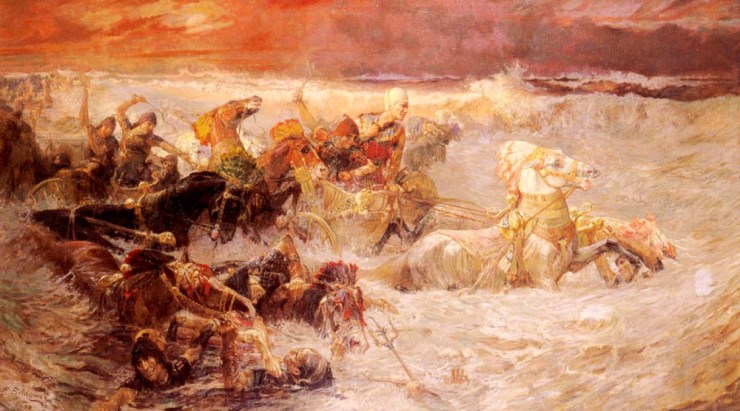
Image from Wikimedia Commons
Pharaoh’s army engulfed by the Red Sea, painted by Frederick Arthur Bridgman (1847-1928). The Exodus from Egypt was the key event in the history of God’s people. And it points forward to the salvation Jesus has provided for us.
Many of us know some of the characters and stories of the Old Testament: Noah and the great flood, Moses and the Exodus from Egypt through the Red Sea, David’s victory over Goliath.
But then we find page after page of text that’s―to be honest―often rather dry, sometimes really obscure, and occasionally even shocking.
● For example, when we read about the Old Testament sacrifices, we enter a gory world of blood and butchery and burning carcases. And what about all the complicated rules for the sacrifices?
●How can we understand the prophetic books―Isaiah and Jeremiah and Ezekiel―especially Ezekiel with its strange visions? These prophets lived in an ancient Near Eastern culture very different from ours. They refer to events, places and people in a long-vanished world. They use poetry and imagery that are unfamiliar to us.
●There are battles and slaughter and even beheadings! Why are these in the Old Testament?
●Then there are the long lists of names―just read the first nine chapters of 1 Chronicles!
Yet what we now call the Old Testament was the complete Bible as Jesus knew it. The Old Testament shaped His thinking and guided His life. Both the Old and the New Testaments together comprise the Scripture that’s “breathed out by God and profitable for teaching, for reproof, for correction, and for training in righteousness” (2 Timothy 3:16). So what are we to make of all its unfamiliar and perplexing parts?

What are we to make of all the Old Testament’s unfamiliar and perplexing parts?
Our national history
Our own nation’s history is important to us. It’s shaped our language, our values, and our way of life. And it plays a key role in shaping our own individual lives.
But as Christians, we’re also citizens of another nation―God’s nation. We’re “grafted in” to God’s ancient people Israel (Romans 11:17-24). We are members of Abraham’s family (see Galatians 3:29). And so Israel’s history as we read it in the Old Testament is our history, too. It’s our own national history.
The Exodus, the conquest of the Promised Land, the Tabernacle and Temple, the Israelite kings and battles, the good times and bad times that God’s people went through, what God’s prophets spoke to His people―all this is part of our own national history.
As Christians, we’re citizens of God’s nation. And so Israel’s history as we read it in the Old Testament is our national history.
Paul gives us one example. After reminding us of the story of the Exodus, he tells us, “these things happened to them as an example, but they were written down for our instruction, . . . .” (1 Corinthians 10:11).
As Alec Motyer writes, “The Old Testament is our book, and the things that happened in the Old Testament are our prehistory, yours and mine because we belong to Jesus.”[1]
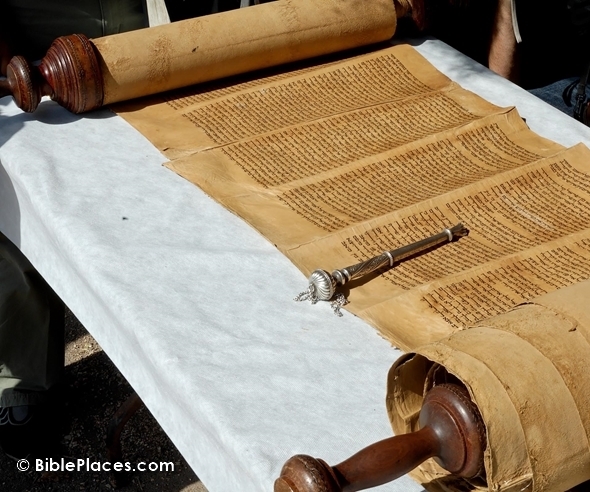
Image © www.BiblePlaces.com
A scroll of the ‘Torah’ (the Hebrew name for the first five books of the Old Testament).
Character studies
The Old Testament contains many amazing characters. God brings us ‘up close and personal’ to men and women such as Abraham, Moses, and Esther and Jeremiah and Daniel―the list could go on and on! Through these characters, God teaches us about ourselves, and about Himself, too.
God’s revelation of Himself
In fact, God reveals Himself throughout the Old Testament. In its pages, we learn of God’s omnipotence and wisdom, of His love and faithfulness, of His holiness and righteousness.
The power of a picture
The Old Testament contains many types. What are types? They’re pictures. They’re people, events and things that picture what we read later in the Bible.
►For example, Moses is one of the people who foreshadow Jesus.
►The Exodus points forward to what Jesus would one day do for us―to lead us out of bondage to sin into a new life in God’s presence.
►The sacrifices are God’s ‘scale-models’ of what Jesus did for us on the Cross, where He fulfilled the entire Old Testament sacrificial system! So if we really want to know what the Cross achieved, then we need to read about these Old Testament sacrifices.

A full-scale replica of the Tabernacle, Timna Park, Israel. In front of the Tabernacle tent is the altar of burnt offering; and you can also just see the laver (washing basin) behind the altar. Various sacrifices were offered in the Tabernacle – sacrifices that point forward to Jesus’s final sacrifice of Himself on the Cross. We’ll be looking at the Tabernacle in part 16.
Foreshadowings
There are many prophecies about Jesus in the Old Testament. For example, right after the Fall, God said to Satan “I will put enmity between you and the woman, and between your offspring and hers; he will crush your head, and you will strike his heel” (Genesis 3:15 NIV). An “offspring” or descendant of Eve would defeat Satan. In one writer’s words, “The rest of the Bible can be seen as a ‘search for the serpent-crusher’.”[2] That Serpent-Crusher, of course, is Jesus Christ.
We’ve already met a number of events or people that foreshadow Jesus:
●In part 6, we saw how God clothed Adam and Eve with animal skins (Genesis 3:21)―which, we assume, required God to kill animals. And so it foreshadows Jesus’s sacrificial death on the Cross.
●In part 9, we met Melchizedek, “priest of God Most High” (Genesis 14:18). He foreshadows King Jesus, who is our High Priest “after the order of Melchizedek” (Hebrews 7:17, quoting Psalm 110:4).
●In part 10, we saw God confirming His promises to Abraham by making a covenant with him (Genesis 15:7-21), a covenant confirmed by a sacrificial ceremony. This again points to Jesus’s sacrificial death.
●In part 10, we also saw how God told Abraham to sacrifice his beloved son Isaac―another pointer to Jesus’s sacrifical death.
●Later in our series, we’ll look at the sacrifices that the Old Testament priests offered―again, pointers to Jesus’s death on the Cross.
●There are many prophecies about Jesus’s life and work, too. For example, the prophet Micah foretold exactly where Jesus would be born! He wrote, “you, Bethlehem Ephrathah, . . . out of you will come for me one who will be ruler over Israel, whose origins are from of old, from ancient times” (Micah 5:2, quoted in Matthew 2:6).
Alec Motyer comments that the Old Testament “is, in many ways, a book standing on tiptoe, straining forward into the future.”[3] Through the Old Testament, God progressively and cumulatively reveals His plans for the human race.
In one writer’s words, “The rest of the Bible can be seen as a ‘search for the serpent-crusher’.” That Serpent-Crusher is Jesus Christ.
Names, names and more names
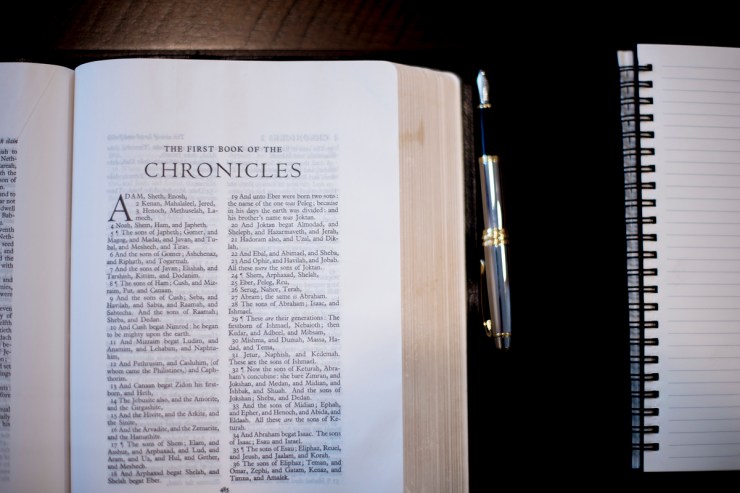
The first nine chapters of 1 Chronicles largely consists of lists of names. But God speaks to us through these chapters. They have an important place in the Bible story.
The Old Testament contains many lists of names. They may not strike us as very significant. In fact, they’re an important part of the Old Testament. Some are lists of descendants―in other words, genealogies.
In part 6, we learned that one of Eve’s descendants would “crush” the serpent’s “head” (Genesis 3:15 NIV)―that is, defeat Satan. From then on, as we read through the Old Testament, we’re on the lookout for that descendant. Some of the genealogies give us a clue to who this descendant is. For example, there’s a genealogy in 1 Chronicles 1:1–5, 24-27. This takes us all the way from the first man Adam to Abraham. The Gospel writer Matthew picks up this genealogy from Abraham and takes it all the way to Jesus (Matthew 1:1-17). He is that promised descendant of Eve who’ll conquer Satan.
There’s another reason why these genealogies and all the other lists of names are important. They show that the Bible is rooted in history. It’s God’s history book. It’s a history of the world from God’s perspective. In particular, it’s the history of God’s people, Israel.
Pointing to the Saviour
After His resurrection, Jesus walked with two fellow-travellers on the road to a village called Emmaus. As they talked together, Jesus spoke to them about Himself. Starting “with Moses and all the Prophets,” Jesus “interpreted to them in all the Scriptures the things concerning himself” (Luke 24:27). The Old Testament points us to Jesus. As we’ve seen, it points us to Him through types―people, events and things that foreshadow Him and His work of salvation. It points us to Him through prophecies. It leads us to Him through genealogies. And so, as we continue our journey through the Old Testament, we’ll see God filling out the details of the Man Jesus Christ, the one who would defeat Satan and rescue and restore mankind and the whole creation.
In the next part . . .
We follow the story of Abraham’s family―son Isaac, grandson Jacob and great-grandson Joseph. Abraham’s family, now seventy people, end up, not in the Promised Land, but in Egypt. Why? That’s what we’ll see next time.
Bible reading and question
You may like to read Luke 24:13-27, 36-49 and think about this question:
?We see Jesus explaining “what was said in all the Scriptures concerning himself” (Luke 24:27 NIV). Do these passages in Luke and what you’ve read in this part of the 52 Steps help you to see the Old Testament in a new light?
Resource – the ESV Study Bible
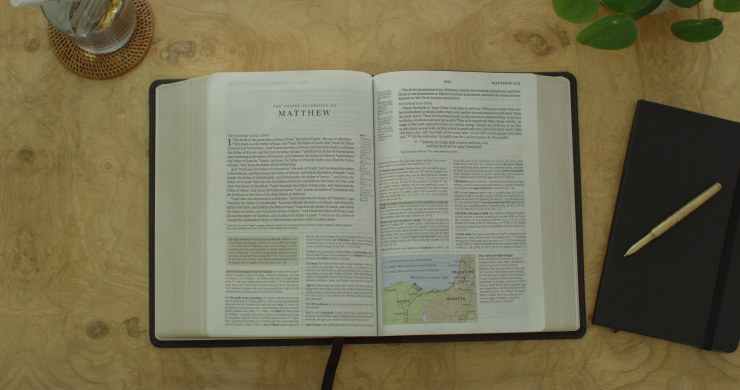
Alongside your Bible reading, you’ll find that a good study Bible is an invaluable help. One of the best available today is the ESV Study Bible. It’s based on the English Standard Version of the Bible―an excellent Bible translation that combines accuracy and readability. Click HERE to find out more.
The ESV Study Bible includes a wealth of resources―20,000 study notes, more than 200 charts and timelines,more than 240 full colour maps and illustrations, together with introductions to the books of the Bible, articles on different theological topics, and so on. Here’s a short video introducing this study Bible:
There’s also an ESV Study Bible subscription. This gives you online access to the following:
►The ESV Study Bible and seven other study Bibles.
►Two Bible commentary series (The ESV Expository Commentary series and the Preaching the Word commentary series). These are both excellent resources.
►A series of Bible study guides, called Knowing the Bible, which includes questions, and are great for personal or group use.
►Four devotional resources.
►Greek and Hebrew language tools.
This subscription-based resource is a brilliant aid for personal Bible study. And it’s a great resource for preparing group Bible studies, sermons, and Bible talks, too. There’s a week’s free trial, then either a monthly or annual subscription. Click HERE to find out more.
REFERENCES [1] A Christian’s Pocket Guide to Loving the Old Testament by Alec Motyer, page 44. Published by Christian Focus Publications, Fearn, Ross-shire, Scotland, in 2015. [2] God’s Big Picture: Tracing the Storyline of the Bible by Vaughan Roberts, page 78. Published by Inter-Varsity Press, Leicester, England, in 2003. [3] A Christian’s Pocket Guide to Loving the Old Testament by Alec Motyer, page 42. Published by Christian Focus Publications, Fearn, Ross-shire, Scotland, in 2015.
CREDITS ► Text copyright © 2024 Robert Gordon Betts ► Unless otherwise indicated, all Scripture is taken from the ESV® Bible (The Holy Bible, English Standard Version®), copyright © 2001 by Crossway, a publishing ministry of Good News Publishers. Anglicized English Standard Version copyright © 2002 by Crossway. Used by permission. All rights reserved. The ESV text may not be quoted in any publication made available to the public by a Creative Commons license. The ESV may not be translated in whole or in part into any other language. ► Scripture quotations marked ‘NIV’ are taken from The Holy Bible, New International Version (Anglicised edition). Copyright © 1979, 1984, 2011 by Biblica (formerly International Bible Society). Used by permission of Hodder & Stoughton Publishers, an Hachette UK company. All rights reserved. ‘NIV’ is a registered trademark of Biblica (formerly International Bible Society). UK trademark number 1448790.
 52 Steps
