
Part 49: The Clash of the Kingdoms
Click the icon below to download a 4-page PDF version of this page.

The “ruler of this world”
As we’ve already seen, we’re in a spiritual war―a war between Satan’s kingdom and God’s Kingdom. But why is Satan fighting? What’s he trying to achieve?
Satan seems to have originally been a very powerful angel who lived in God’s presence in Heaven―we saw this in Part 5. But he became proud. He wanted to be like God, and to be worshipped like He is. God threw him out of Heaven, along with the angels who’d joined his rebellion.
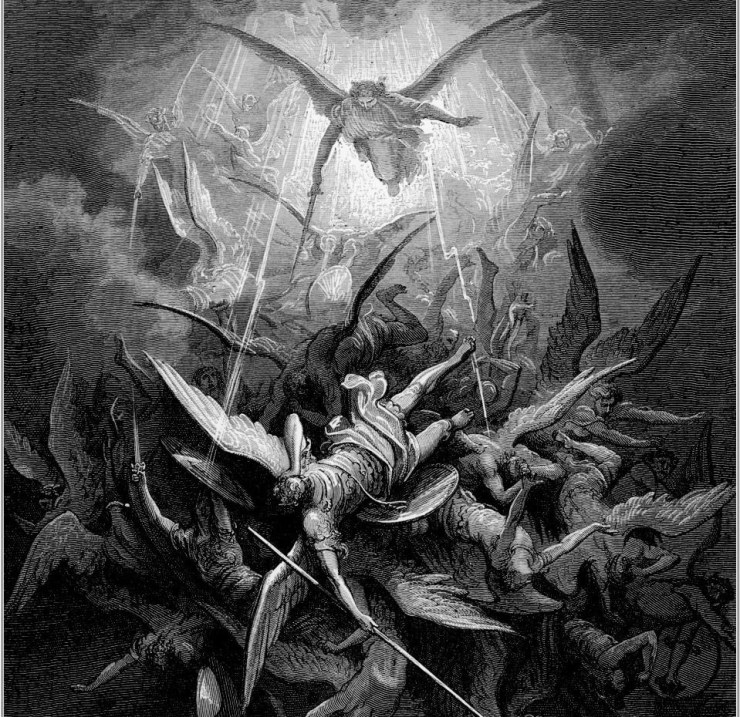
Image from Wikimedia Commons
An illustration by Gustave Doré for John Milton’s Paradise Lost. It illustrates Satan’s original fall after he tried to be like God in Heaven. In this image, Satan and his angels are being thrown down from Heaven by one of God’s holy angels.
Then, it seems, Satan saw another chance to realise his dream―here on Earth. He saw his chance to be worshipped and served here on Earth. He tempted Eve and, through her, Adam. The rest is history: they gave in to Satan’s temptation and so they came under Satan’s power. He became “the ruler of this world” (John 12:31, 14:30, 16:11).
Satan continues to labour tirelessly to bring people under his rule and make them rebels against God. History is littered with attempts to create a ‘brave new world’[1] in rebellion against God. The city and tower of Babel was an early venture. In Old Testament times, kings strove for glory through magnificent cities and vast empires. King Nebuchadnezzar boasted, “Is not this great Babylon, which I have built by my mighty power . . . for the glory of my majesty?” (Daniel 4:29-30). Instantly, God humbled him (4:31-33). And over recent centuries, philosophers and revolutionaries of all kinds have reached out for a godless utopia―a false ‘paradise’ without God. The kingdoms of this world do indeed have a kind of glory, as Satan himself pointed out to our Lord (Matthew 4:8). But when we look more closely, we find that they’re kept going only through fear, corruption, and human misery. All the while, Satan and his evil forces are working in the background, propelling people along the path to godlessness.[2]
History is littered with attempts to create a ‘brave new world’ in rebellion against God.

Image from Wikimedia Commons
Detail from The Course of Empire: The Consummation of Empire by Thomas Cole. This painting, the third of a series of five paintings illustrating the rise and fall of a civilisation, depicts it at its height. A great crowd throngs the balconies and terraces of the magnificent city as a scarlet-robed king or victorious general crosses a bridge connecting the two sides of the river in a triumphal procession. The scene suggests the height of ancient Rome and is a vivid depiction of godless civilisation.
God’s judgments on this world
But God is always in control. And He’s at work in this godless world. In the Book of Revelation, we see three series of judgments that God sends―heralded by the opening of seven seals (6:1-17, 8:1,3-5), the blowing of seven trumpets (8:2, 8:6-9:21), and the emptying of seven bowls (15:1, 15:5-16:21). They’re described in symbolic language; we don’t know exactly how they work out in history. What we do know is that God is ravaging every means by which people can live securely and comfortably without Him. He’s showing divine mercy, bringing people to their senses, driving home the fact that He has first claim on their lives, that they cannot live apart from Him. He wants them to repent from sin, and cry out to Him for salvation. As Peter writes: “The Lord is not slow to fulfill his promise . . . , but is patient toward you, not wishing that any should perish, but that all should reach repentance” (2 Peter 3:9). And through these judgments, God speaks to His churches. Remember how He called some of His churches to repent (2:16, 21-22, 3:3,19)? The world they were consorting with is under God’s judgment. It’s facing eternal ruin. Will they share its fate?
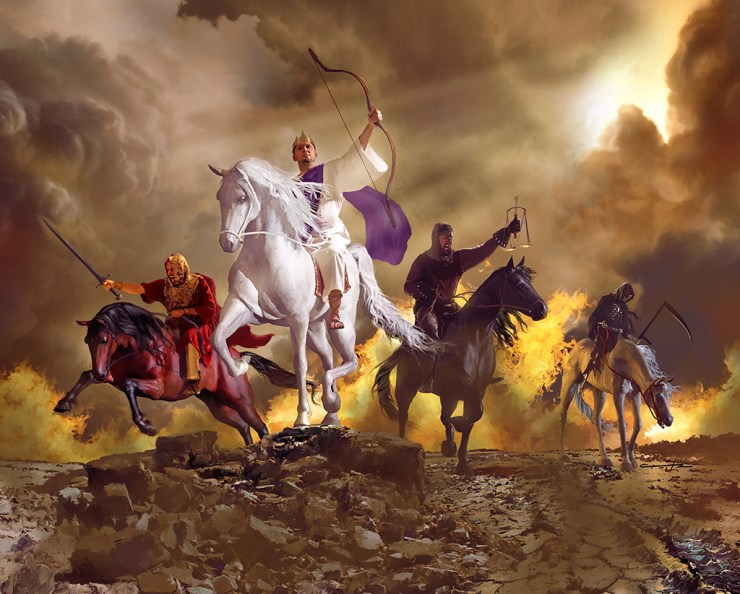
Image © Steve Creitz at ProphecyArt.com
An artist’s depiction of the four horsemen who bring the judgments unleashed by the opening of the first four seals of the scroll (Revelation 5:1-8)―the ‘four horsemen of the apocalypse’.
The suffering and witness of God’s people
In the midst of all these judgments, Satan attacks God’s people. In Revelation 12:3, we see “an enormous red dragon with seven heads and ten horns and seven crowns on its heads” (NIV). This is none other than “that ancient serpent, who is called the devil and Satan” (12:9). He pursues “the woman” (12:13)―here a picture of the Church. He spews out a torrent of “water”―a stream of slander, lies, oppression and persecution―“to sweep her away with a flood” (12:15). But in the midst of suffering, God protects and provides for His people. Enraged with the woman, the dragon goes off ”to make war on the rest of her offspring, on those who keep the commandments of God and hold to the testimony of Jesus” (12:17). Who are these ‘offspring’? They’re probably individual believers. They include us. As Jesus’s return draws near, and the spiritual war we’re in approaches its climax, so we may expect the Church’s suffering to rise to a crescendo, too.
And as they suffer, what are God’s people doing? In 11:3, we see “two witnesses”―that’s a symbol for God’s people. They’re warning the nations of God’s judgment, and proclaiming the gospel of Jesus Christ, making “disciples of all nations” (Matthew 28:19). And they’re praying: “O Sovereign Lord . . . how long before you will judge and avenge our blood on those who dwell on the earth?” (6:10, and see 8:3-4). They’re calling for God to bring justice, to put this world to rights. And they’re praying what our Lord taught us to pray: “Our Father in heaven, . . . . Your kingdom come, your will be done, on earth as it is in heaven” (Matthew 6:9–10).
First Kuman Bible out © Kahunapule Michael Johnson on Flickr.com
(CC BY-NC-SA 2.0)
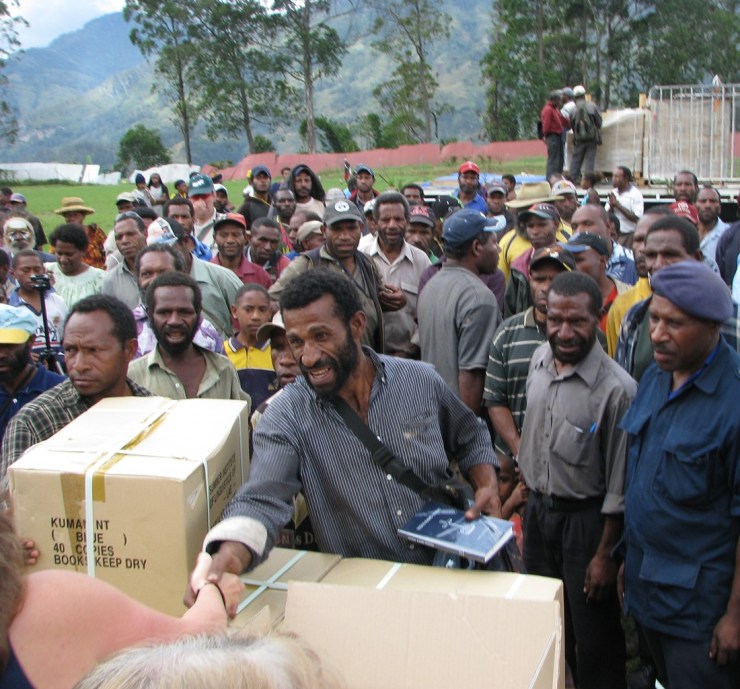
During these last days, God’s Kingdom work goes on. A scene from the distribution of the Kuman New Testament, in Kundiawa, Simbu Province, Papua New Guinea, on 27th June 2008. This was the first day these people could get a whole New Testament in their own language.
The Antichrist and the rebellion
Satan’s last-ditch attempt to rule the world will climax with the Antichrist. The word ‘antichrist’ can mean ‘against Christ’ or ‘in place of Christ’. The Antichrist opposes Christ by trying to take His place. In the apostle John’s day, “the spirit of the antichrist” (1 John 4:3) drew people into heresy about Jesus, denying that He’s both fully divine and fully human. John also refers to “many antichrists” (1 John 2:18)―many heretics. But shortly before Jesus’s return, the final Antichrist will emerge. He’ll be a man inspired and controlled by Satan.
Satan’s last-ditch attempt to rule the world will climax with the Antichrist.

Shortly before Jesus’s Second Coming, the final Antichrist will emerge. Through this world leader, Satan will make his final bid to rule humanity united in rebellion against God.
In 2 Thessalonians, Paul tells us about “. . . the coming of our Lord Jesus Christ and our being gathered together to him”. That day “will not come, unless the rebellion comes first, and the man of lawlessness is revealed, . . . .” (2 Thessalonians 2:1,3). This “rebellion”―a great revolt against God―will crystallise around the leadership of “the man of lawlessness”, who’s undoubtedly the Antichrist. Just as God is fulfilling His purposes on Earth through a Man―the Man Christ Jesus, so Satan, it seems, will try to fulfil his purposes on Earth through a man. Christ is God who became a Man. But Satan is only an angel. He can’t become a man. The best he can do is to control a man completely. That’s what he does with the Antichrist.
Antichrist will imitate Christ. He’ll “be revealed”, mimicking Christ’s “appearance”; his coming will be “by the activity of Satan with all power and false signs and wonders, and with all wicked deception for those who are perishing, because they refused to love the truth and so be saved. Therefore God sends them a strong delusion, so that they may believe what is false, . . . .” (2 Thessalonians 2:8-11). He’ll mimic Christ’s own miracles, and the “signs and wonders” that God performs (for example, Acts 15:12).
Antichrist “opposes and exalts himself against every so-called god or object of worship, so that he takes his seat in the temple of God, proclaiming himself to be God” (2 Thessalonians 2:4). He’ll claim the honour and worship that belong to God alone. He’ll have astonishing charisma because of his satanic power. We can imagine him promising to solve the world’s political, social, economic and environmental problems. As the world slithers helplessly towards disaster, people will willingly allow him to wield the power he demands.
Satan’s false ‘trinity’
The Book of Revelation tells us more about Satan’s attempt to rule planet Earth. He’s working through two henchmen―a beast that emerges from the sea (13:1-10, 17:1-18), and a beast that rises out of the earth (13:11-18), also called “the false prophet” (16:13). Satan wants to be like God. God is a Trinity; Satan has his false ‘trinity’: Satan, the “dragon” (12:9) mimics the Father; the “beast” from the sea mimics Christ; and the “beast” from the land mimics the Holy Spirit.
The sea beast – a false ‘christ’
The dragon (Satan) calls a terrifying monster out of the sea. It has “ten horns and seven heads, with ten crowns on its horns, and on each head a blasphemous name” (13:1 NIV). It’s a blend of the four beasts Daniel saw, which represented the Babylonian, Persian, Greek and Roman empires (see Part 31). Now we see them merged into one horrific monster. It seems to picture every regime that’s opposed God and His people since the Day of Pentecost. It blasphemes God, and is worshipped by “all who dwell on earth” whose names are not “written . . . in the book of life of the Lamb who was slain” (13:8).
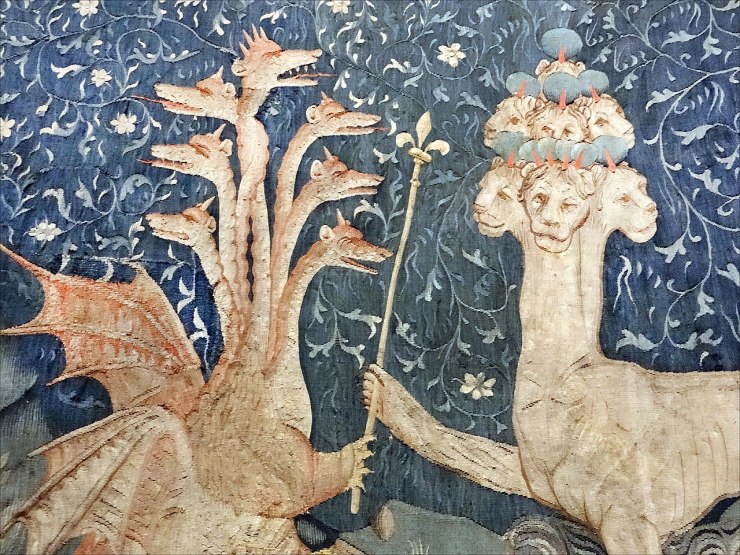
Image from Wikimedia Commons
Detail from a medieval French tapestry that illustrates the Book of Revelation. This image depicts Revelation 13:1-2, in which the dragon Satan (on the left) gives the sea beast (on the right) a sceptre, representing “his power and his throne and great authority”.
This beast acts as Satan’s ‘christ’. It’s a blasphemous imitation of the true Christ:
● The Father gave Jesus “All authority in heaven and on earth” (Matthew 28:18); Satan gives this beast “his power and his throne and great authority” (Revelation 13:2).
●Jesus was resurrected; one of the beast’s heads recovers from what seemed a fatal wound, which astonishes the whole world (13:3). This may well refer to the fact that evil governments throughout history all collapse, yet keep arising in new forms to continue Satan’s opposition to God.
●Christ is the exact image of the Father (Colossians 1:15, Hebrews 1:3). The beast is like the dragon, which pictures Satan; they both have seven heads, ten horns, and are crowned.
●The beast’s crowns mimic Christ’s crowns (Revelation 19:12).
The sea beast mimics Christ; as we’ve seen, so does the Antichrist. This suggests they’re connected. It seems that the final manifestation of this beast will be a powerful anti-Christian regime headed up by the Antichrist. He’ll be “the supreme persecutor of Christ’s church”, who’ll “exercise his reign of terror through state-sponsored heresy”.[3]
The land beast―a false ‘holy spirit’
Another beast appears, rising “out of the earth” (Revelation 13:11-18). It has “two horns like a lamb”. But this is no lamb―it speaks ”like a dragon”. The sea beast delegates all its authority to this land beast. It’s a counterfeit of the Holy Spirit: ● The Holy Spirit glorifies Christ (John 16:14); this beast “makes the earth and its inhabitants worship the first beast”―Satan’s false ‘christ’. ● The Holy Spirit guides us into all truth (John 16:13); this beast is “the false prophet” (16:13). It seems to represent false religion and godless ideology; it performs “great signs” to deceive people.
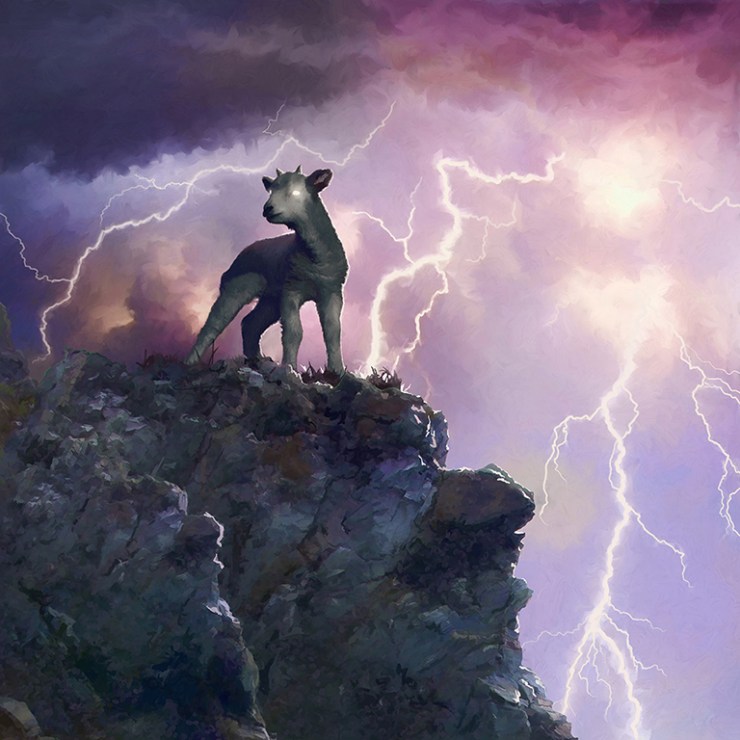
Image © Steve Creitz at ProphecyArt.com
An artist’s depiction of the land beast. “It had two horns like a lamb and it spoke like a dragon. It exercises all the authority of the first beast . . . and makes the earth and its inhabitants worship the first beast, . . . .” (Revelation 13:11-12).
This beast causes everyone “to be marked on the right hand or the forehead” with ”the name of the beast or the number of its name”. This is the famous ‘mark of the beast’. What’s “the number of its name”? We’re given a clue: “it is the number of a man, and his number is 666”. The number six repeated three times seems to symbolise people aspiring to take God’s place (three being the number of the Triune God). The mark is symbolic. Those bearing this symbolic mark belong to the beast―in other words, they belong to the godless world system, and ultimately, of course, to Satan.
Armageddon
In Revelation 16, Jesus shows us more about the spiritual war we’re involved in. John sees, coming out of the mouths of the dragon, the sea beast, and the land beast (here called “the false prophet”) “three unclean spirits like frogs” (16:13). These frog-like spirits are “demonic spirits, performing signs, who go abroad to the kings of the whole world, to assemble them for battle on the great day of God the Almighty” (16:13-14). The “kings” assemble in a place called “Armageddon” (16:16)―a name that’s passed into language and legend as the apocalyptic end-time battle. This is not a military battle fought with tanks and planes and bombs. It’s a spiritual battle between God with His people, and Satan with his forces of evil. As we’ve said, Satan’s kingdom is already at war with God’s Kingdom. The battle of Armageddon is its climactic, decisive battle, fought when our Lord returns. We get more details later in Revelation, as we’ll see in our next part.
The battle of Armageddon is the climactic, decisive spiritual battle, fought when our Lord returns.
Babylon the Great
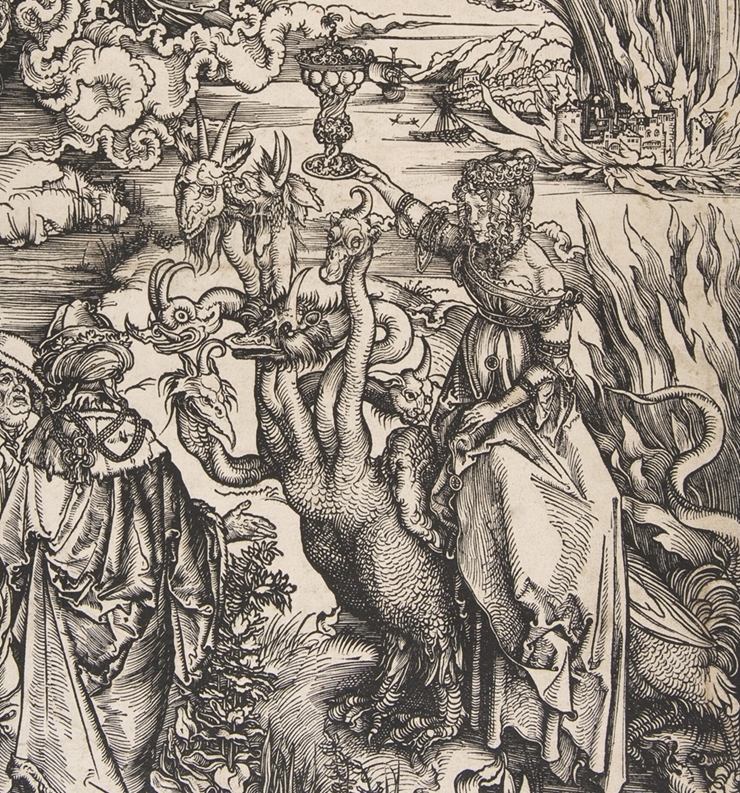
John tells us, “I saw a woman sitting on a scarlet beast . . . . holding in her hand a golden cup full of abominations and the impurities of her sexual immorality. And on her forehead was written a name . . . ‘Babylon the great, mother of prostitutes and of earth’s abominations.’” (Revelation 17:3-5). This filthy woman is Satan’s counterpart to God’s pure Bride, New Jerusalem (which we’ll meet in Revelation 21). She sits on “a scarlet beast that was full of blasphemous names, and it had seven heads and ten horns”―this is the sea beast of 13:1-10. Babylon ‘sits’ on this beast; she’s connected to it. Like the prostitute she is, she’s seductive. She seduces the nations to join with the beast in building a false paradise without God. The beast seems to represent the godless state―godless political and military regimes. The woman seems to represent godless civilisation that’s birthed, nourished and protected by political and military power. The woman and the beast collaborate to persecute God’s people: the beast is “allowed to make war on the saints and to conquer them” (13:7); Babylon is drunk with their blood (17:6).
The Whore of Babylon, from The Apocalypse courtesy of The Met (The Metropolitan Museum of Art)
Detail from The Whore of Babylon from The Apocalypse. A print from a woodcut by Albrecht Durer. She’s described in Revelation 17:1-6.
As we saw in Part 9, the Bible is, among other things, ‘a tale of two cities’―humanity’s city Babylon (“Babel” in Genesis 11:9), and God’s city Jerusalem. Babylon is “this present world” (2 Timothy 4:10)―godless humanity under Satan’s control. New Jerusalem is God’s world[4]―God’s people in God’s presence in God’s paradise. It’s “the city that has foundations, whose designer and builder is God” (Hebrews 11:10). We’ll explore this city in Part 51. The contrast between these cities began in Genesis; it climaxes here in Revelation.
The restrainer removed
Until now, Satan has been restrained from raising up the final Antichrist and bringing world rebellion to a climax. Paul tells us in 2 Thessalonians 2:6-7: “you know what is restraining him now . . . . For the mystery of lawlessness is already at work. Only he who now restrains it will do so until he is out of the way.” The restrainer is both a force (which is why Paul uses “what”) and a person (which is why Paul uses “he”). The Bible doesn’t clearly identify them.
Who is restraining?
Ultimately, of course, it is God who rules over human affairs. But God may be restraining “the mystery of lawlessness” through an angel. If so, then we must assume that God will one day withdraw this angel. The stage is then set for Antichrist’s dominion.
What is restraining?
Whether the restrainer is God or an angel, the question remains, what is this restraint?
►Antichrist may be being restrained by the thing he rebels against, which is basic moral law. Such law preserves a minimum level of justice that prevents total social lawlessness. Of course, basic moral law has been swept aside in certain countries for a season many times―for example, Stalin’s brutal regime in Russia and the unspeakable horror of the Holocaust during World War II. But Antichrist’s rule may bring a moral breakdown far worse even than these.
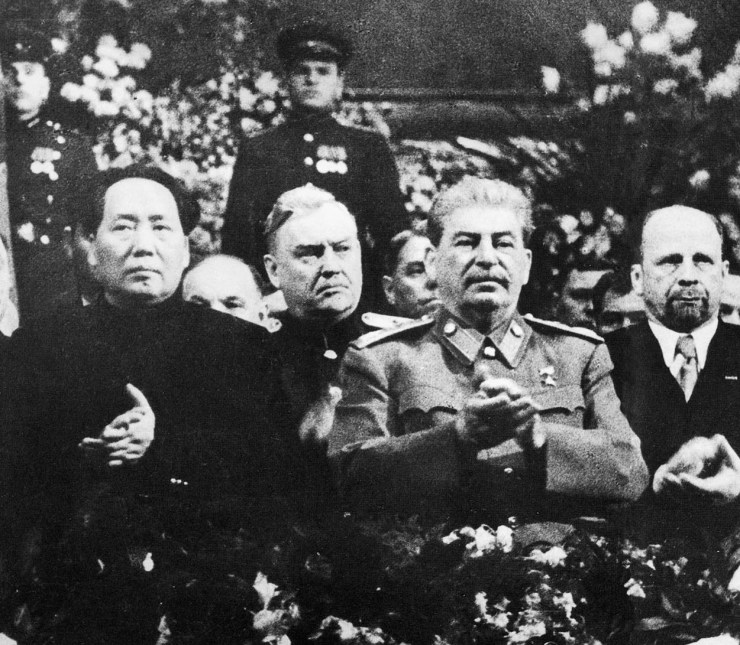
Image from Wikimedia Commons
Mao Tse-tung (1893–1976) (on the far left) and Joseph Stalin (1878–1953) (the second from the right) together at a ceremony arranged for Stalin’s 71st birthday in Moscow in December 1949. One estimate calculates that, between them, Mao and Stalin’s respective regimes in the People’s Republic of China and the USSR were responsible, directly or indirectly, for 60 million deaths.[5]
►It may be the restraint that God put in place at Babel, when He “confused the language of all the earth” and “dispersed them” all over the Earth (Genesis 11:9). People can’t readily exchange ideas and technical skills when they can’t communicate easily, and when they’re distant from each other. This, in turn, hindered the development of a global civilisation under Satan’s control. But our modern world’s ever-increasing technological know-how and interconnectivity is now reversing that. For example, people’s personal data can now be monitored and controlled centrally. That, coupled with the appalling power of modern weaponry, could now provide a platform on which a few―or just one person―could control the lives of everyone in the world. Domination by one man is now possible like it’s never been before.
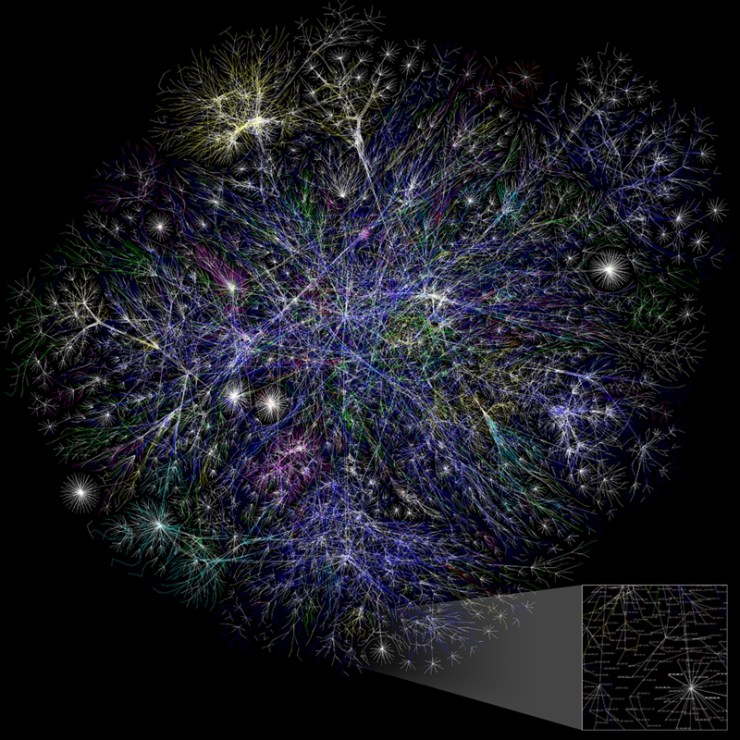
Chora of Patmos © Matt Britt at Wikimedia Commons (CC BY 2.5)
A partial ‘map’ of the Internet as it was in 2005―a stunning demonstration of the interconnectivity of our modern world.
Next time . . .
Jesus’s return is “our blessed hope” (Titus 2:13). We’ll look at Jesus’s Second Coming next time.
Bible Reading and Questions
You may like to read Colossians 2:13-15, Revelation 1:5, 5:9-10, and 12:7-12. Here are questions to think about:
?God’s people “have conquered” Satan “by the blood of the Lamb” (12:11). How do they conquer him by the Lamb’s (Jesus’s) blood?
?They also conquer Satan “by the word of their testimony, for they loved not their lives even unto death” (12:11). What’s “the word of their testimony”, and how does it defeat Satan?
Book Recommendations
Daring Devotion, Daring Dependence, and Daring Decision by M.R. Conrad each contain 31 brief sketches of ordinary Christians through history who followed God with daring faith. These three books combine missionary biography and devotional reflection that encourage faith and obedience. Be inspired by the stories of David Livingstone, Hudson Taylor, Jim Elliot, William Carey, Mary Slessor, George Muller, Amy Carmichael and many more. None were superheroes. All looked to God for direction and strength as they dared to extend the gospel into the dark places of this world. Explore the full three-book series from Church Works Media for a rich, encouraging, three-month journey through centuries of missionary history. For more information click HERE.
REFERENCES [1] This is the title of a novel by Aldous Huxley, published in 1932. [2] See Powers of Darkness: Principalities and Powers in Paul’s Letters by Clinton E. Arnold, page 204. Published by InterVarsity Press, Downers Grove, Illinois, in 1992. [3] Quoted from The Man of Sin: Uncovering the Truth about the Antichrist, by Kim Riddlebarger, page 168. Published by Baker Books, a division of Baker Publishing Group, Grand Rapids, Michigan, in 2006. [4] See From Eden to the New Jerusalem: Exploring God’s Plan for Life on Earth by T. Desmond Alexander, page 175. Published by Inter-Varsity Press, Nottingham, United Kingdom, in 2008. [5] See Source List and Detailed Death Tolls for the Primary Megadeaths of the Twentieth Century by Matthew White. Available online at https://necrometrics.com/20c5m.htm (accessed 6 June 2025).
CREDITS ► Text copyright © 2025 Robert Gordon Betts ► Unless otherwise indicated, all Scripture is taken from the ESV® Bible (The Holy Bible, English Standard Version®), copyright © 2001 by Crossway, a publishing ministry of Good News Publishers. Anglicized English Standard Version copyright © 2002 by Crossway. Used by permission. All rights reserved. The ESV text may not be quoted in any publication made available to the public by a Creative Commons license. The ESV may not be translated in whole or in part into any other language. ► Scripture quotations marked ‘NIV’ are taken from The Holy Bible, New International Version (Anglicised edition). Copyright © 1979, 1984, 2011 by Biblica (formerly International Bible Society). Used by permission of Hodder & Stoughton Publishers, an Hachette UK company. All rights reserved. ‘NIV’ is a registered trademark of Biblica (formerly International Bible Society). UK trademark number 1448790.
 52 Steps


_(2).jpg)

