
A short guided tour of the Bible
The Bible. It’s the world’s number one best seller of all time. It’s estimated that more than 5 billion copies of the Bible have been printed. The complete Bible has been translated into over 700 languages―far, far more than any other book.
The Bible isn’t just one book. It’s a whole library of books. It contains 66 different books, written by around 40 different people over a period of around 1,500 years.
But although ordinary people wrote these books, God inspired these people in a unique way as they were writing them. The Bible is actually God’s book. It is the written word of God. When God speaks, things happen. God spoke the whole Universe into being. Through the Bible, God speaks powerfully to us.
The 66 books in the Bible contain all kinds of writing. There’s history and biography. There are genealogies and commands and practical guidelines on how to live. There are songs and poems, prophecies and letters.
But through these 66 books runs a single story. It’s the greatest story ever told, the greatest story that ever could be told. It’s an epic, breathtaking drama with more twists and turns in the plot than any human writer could dream up. The Bibe tells the story of the world from the moment God spoke it into being, till the day when He renews and transforms this world at the end of this age.
In particular, the Bible is the history of God’s people―from Adam and Eve in the garden of Eden to the countless multitudes in the garden-city that we read about at the end of the Bible.
The Bible is divided into two main sections―the Old and the New Testaments. These two testaments appear very different. But they’re simply two halves of a single story. Reading the New Testament on its own is like starting to watch a TV drama halfway through. You’d be puzzled by a lot of things―for example, you’d wonder how all the characters are related, and what the story is so far. You’d need to know the backstory. And the backstory to the New Testament is the Old Testament. So we can’t fully understand the New Testament without reading the Old Testament.
In particular, the Old Testament prepares us for the story of Jesus Christ. The Old Testament contains many, many passages that show us about Jesus Christ. Jesus tells us that Himself. Luke’s Gospel tells us that, after His Resurrection, Jesus was walking with two men. “And beginning with Moses and all the Prophets,” Jesus “explained to them what was said in all the Scriptures concerning himself” (Luke 24.27 NIV). Those Scriptures were the books of the Old Testament.
We said earlier that the Bible is a whole library of books. We’ll now take a short guided tour of these books.
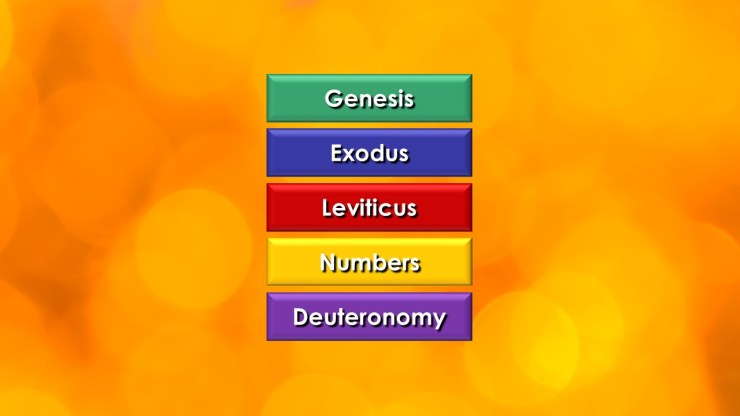
The first five books of the Bible―Genesis, Exodus, Leviticus, Numbers and Deuteronomy―are a foundation for the rest of the Bible. In these books, we learn about how God created this Universe, and how sin and evil spoiled our world. And we see how God begins His plan of salvation for us and for our world.
A key moment is recorded in Genesis chapter 12. There we read how God called a man to leave his home and go to a land that He would show him. That man was called Abraham. God promised him that he’d have many, many descendants. And through this man, the whole world would be blessed. The rest of the Bible tells us how God fulfils these promises.
The land God led Abraham to was the Promised Land, the land of Israel.
The rest of Genesis through to Deuteronomy tells us how Abraham’s family grew in number and became a great nation, Israel. In the course of time, this nation found itself in slavery in Egypt. We read how God rescued them from Egypt, and led them to freedom through the Red Sea―an event called the Exodus (by one estimate, around 1446BC, by another estimate, around 1250BC). He made a covenant―a binding agreement―with them, and came to live among them in a wonderful tent called the Tabernacle. And He led them through the wilderness towards the Promised Land.
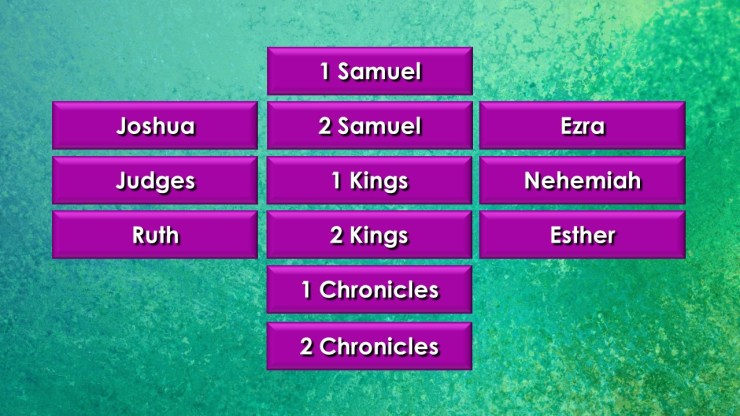
The next twelve books of the Bible―Joshua to Esther―are the history of Israel. It starts from their conquest of the Promised Land. It ends with the Jews’ return from exile in Babylonia, the rebuilding of Jerusalem, and, finally, the events recorded in the book of Esther. Through these books we see how God’s people repeatedly rebelled against Him. But God never gave up on them.
Israel’s greatest moment was when King David defeated all of Israel’s enemies, and his son King Solomon (who reigned around 970BC to 930BC) built a magnificent Temple in Jerusalem for God to dwell in.
But Solomon worshipped idols of false gods. So God caused the nation to divide into two in 930BC―the Northern Kingdom kept the name Israel, and the southern kingdom was called Judah. Because of their idolatry, God allowed the Assyrian empire to take control of Israel; the Assyian conquest was completed in around 722BC. Later, also because of their idolatry, God allowed the Babylonians to conquer Judah and take many people into exile, a long drawn-out process occurring around 605BC to 582BC.
But all was not lost. Decades later, many of God’s people returned from exile and rebuilt the Temple (completed in around 516BC), and then the city of Jerusalem, whose walls were rebuilt around 445BC.
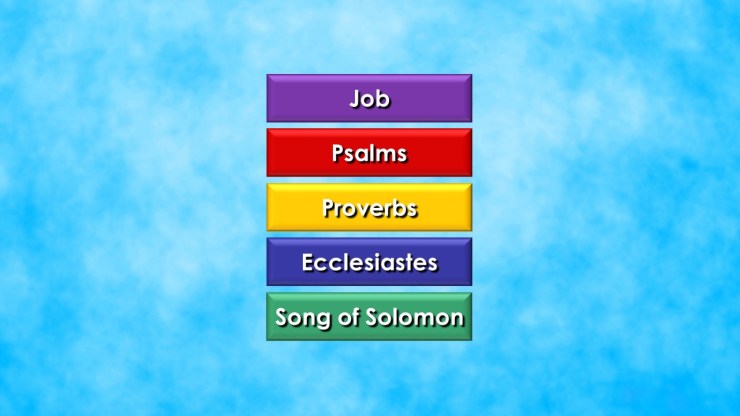
The next five books are what we call ‘Wisdom Books’. The Book of Job is the story of a man who was allowed to suffer greatly, but kept trusting in God. The Book of Psalms is the Bible’s song-book. Proverbs shows us how to live wisely. Ecclesiastes explores the meaning of our brief lives on Earth. And the Song of Songs is a love song that ultimately pictures the love between Jesus and His people.
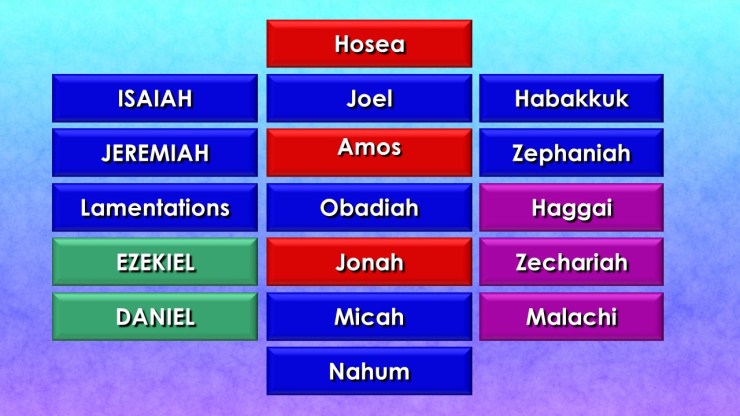
The four books displayed in capitals are called the ‘major prophets’, because they wrote longer books. The other books are shorter; they’re called ‘minor prophets’. But the ‘minor’ prophets’ weren’t less inspired by God―all these books are equally inspired. The books displayed in red boxes were written by prophets in the northern kingdom of Israel; those in blue boxes were written by prophets in Judah. Ezekiel and Daniel, displayed in green boxes, prophesied in Babylonia, among the people of Judah in exile. Finally, the three books displayed in purple boxes prophesied after Judah’s return from exile (Joel may also be in this group, but it’s not certain).
The Old Testament concludes with 17 prophetic books, Isaiah to Malachi. Through these prophets, God warned and reprimanded His people. But God also gave His people a breathtaking vision of future glory. There would be a new Exodus, a new Promised Land―in fact, a new Earth. There would be a new Jerusalem, a new Temple and a new King over God’s people.
And God told His people how He would deal with sin―the thing that caused all their troubles, the thing that causes all the troubles in this world. God shows us how He was going to provide forgiveness and cleansing from sin. He would do this through Jesus Christ, His Son.

And so the day came when Jesus was born. The New Testament begins with four biographies of Jesus, written by Matthew, Mark, Luke and John. Each biography, called a Gospel, gives us a unique view of Jesus’s life and character.

The book of Acts tells how the gospel travelled outwards from Judea as far as Rome. It’s still travelling outwards to the remotest regions of the globe!
The book of Acts tells the story of how Jesus’s disciples began to follow Jesus’s command to go and make disciples of all nations. These disciples―who became known as Christians―grew in number and began to spread throughout the world. The book of Acts ends with the apostle Paul in Rome. The book seems to be unfinished. That’s because it is unfinished! The story we read in Acts won’t be finished until Jesus comes again!

The 13 books displayed in purple boxes were written by the apostle Paul. James was written by the Lord’s half-brother, James. 1 Peter and 2 Peter were written by the apostle Peter. 1, 2 and 3 John seem pretty certain to have been penned by the apostle John, who also very likely penned the book of Revelation. Jude was written by another of Jesus’s half-brothers, Jude. We don’t know who wrote the letter to the Hebrews, though there have been quite a few suggestions!
The books of Romans through to Jude are letters written by leaders of the early church―such as Paul, Peter, and John. Through these writers, Jesus teaches and encourages and corrects His people.
Finally, the book of Revelation gathers up all the themes and stories of the Bible, and weaves them into the final grand climax of the Bible story. In the final two chapters of Revelation we see a new Heaven and Earth. God’s people live in God’s presence in God’s paradise for ever. The Bible begins with two people living in a paradise. It ends with a countless multitude of God’s people living in a new paradise for ever. That’s the Bible story―the greatest story ever told.
CREDITS ► Text copyright © 2024 Robert Gordon Betts ► Scripture quotations are taken from The Holy Bible, New International Version (Anglicised edition). Copyright © 1979, 1984, 2011 by Biblica (formerly International Bible Society). Used by permission of Hodder & Stoughton Publishers, an Hachette UK company. All rights reserved. ‘NIV’ is a registered trademark of Biblica (formerly International Bible Society). UK trademark number 1448790.
 52 Steps